Hey, Pension Community – We Have Liftoff!

By: Russ Kamp, CEO, Ryan ALM, Inc.

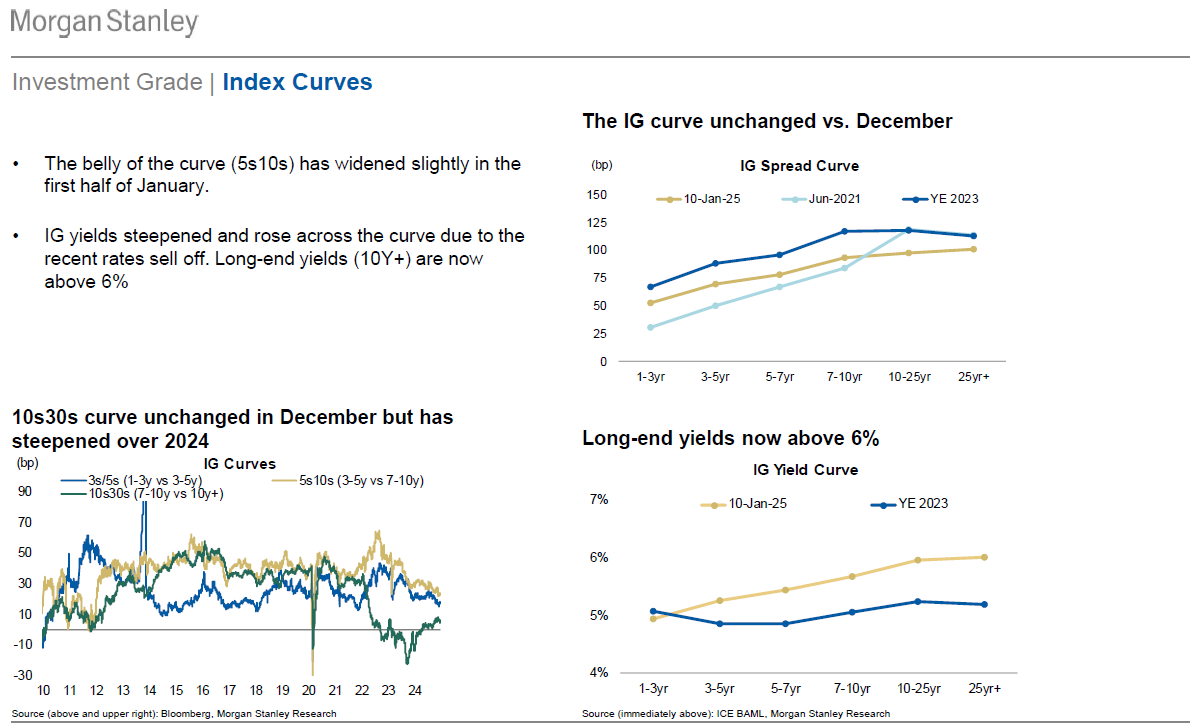
Not since October of 2023 have we seen long-dated Treasury yields at these levels. Currently, the 30-year Treasury bond yield is 5% (12:47 pm EST) and the 10-year Treasury Note’s yield has eclipsed 4.8%. Despite tight credit spreads, long-dated (25+ years) IG corporate bond yields are above 6% today (chart in the lower right corner).

Securing pension liabilities, whether your DB plan is private, public, or a multiemployer plan, should be the primary objective. All the better if that securing (defeasement strategy) can be accomplished at a reasonable cost and with prudent risk. The good news: the current rate environment is providing plan sponsors with a wonderful opportunity to accomplish all of those goals, whether you engage in a cash flow matching (CFM) for a relatively short period (5-years), intermediate, (10ish-years) or longer-term (15- or more years) your portfolio of IG corporate bonds will produce a YTM of > 5.5%. This represents a significant percentage of the target ROA.

Furthermore, as we’ve explained, pension liabilities are future values (FVs), and FVs are not interest rate sensitive. Your portfolio will lock in the cost savings on day one, and barring any defaults (about 2/1,000 in IG bonds), the YTM is what your portfolio will earn throughout the relationship. That is exciting given the fact that traditional fixed income core mandates bleed performance during rising rate regimes. In fact, the IG index is already off 1.2% YTD (<10 trading days).

Who knows when the high equity valuations will finally lead to a repricing. Furthermore, who knows if US inflation will continue to be sticky, the Fed will raise or lower rates, geopolitical risks will escalate, and on and on. With CFM one doesn’t need a crystal ball. You can SECURE the promised benefits for a portion of your portfolio and in the process you’d be stabilizing the funded status and contribution expenses associated with those assets. Don’t let this incredibly attractive rate environment come and go without doing anything. We saw inertia keep plans from issuing POBs when rates were historically low. It is time to act.

ARPA Update as of January 10, 2025

By: Russ Kamp, CEO, Ryan ALM, Inc.

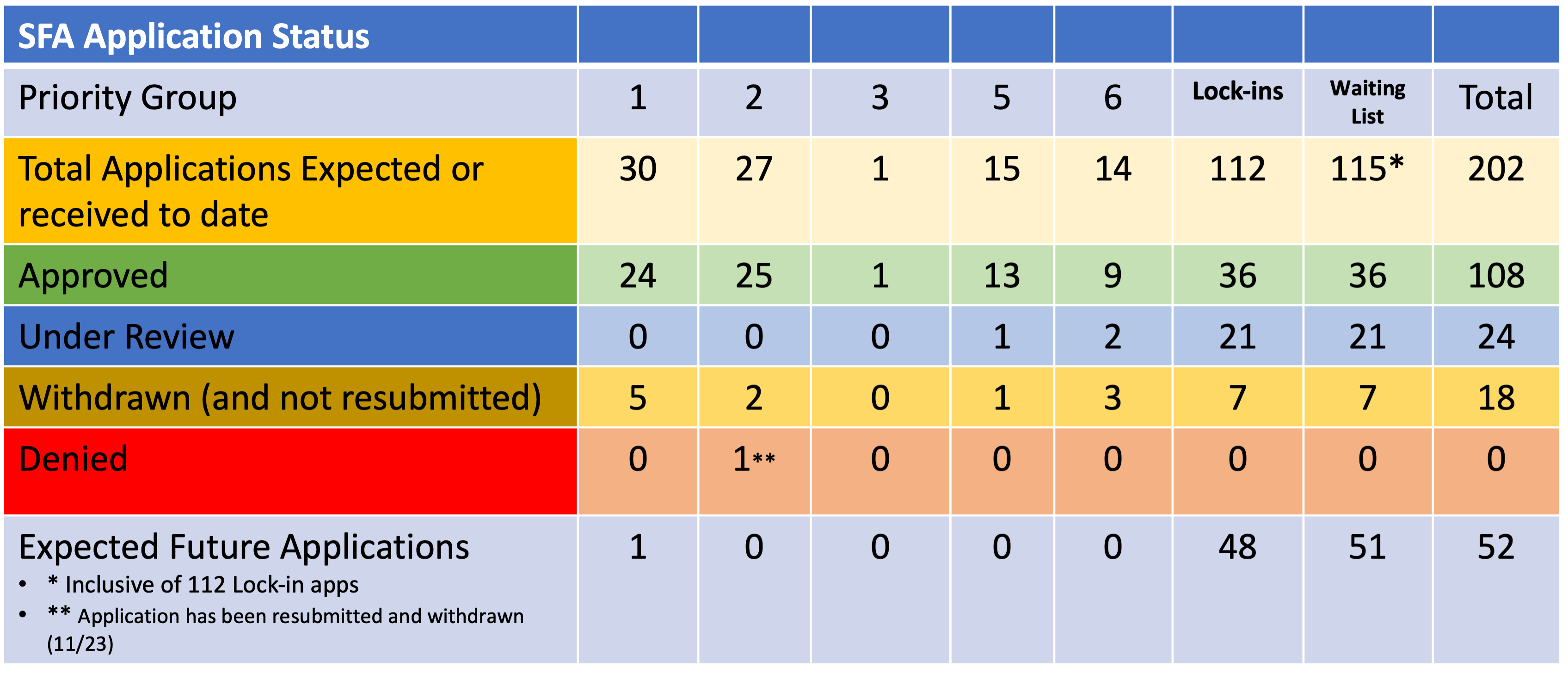
Welcome to the second full week of January. Although the PBGC’s efiling portal remains temporarily closed, there was still some good activity last week, including the approval of another three applications seeking Special Financial Assistance (SFA). Pleased to report that Laborers’ Local No. 265 Pension Plan, Local 734 Pension Plan, and Upstate New York Engineers Pension Fund each a non-priority group member received approval for their revised applications. In total, they will receive $244.6 million in SFA for the 11,374 plan participants. What an exciting way to begin 2025.

In other news, there was one application withdrawn, Warehouse Employees Union Local 169 and Employers Joint Pension Plan, from Elkins Park, PA, withdrew its initial application seeking nearly $90 million in SFA for just over 3,600 members of the plan.

The 108 funds receiving SFA to date have been awarded grants exceeding $70 billion benefiting the quality of life for more than 1.4 million American workers. There is still much more to do (possibly another 94 funds will get SFA), but the program has already been an incredible success. Finally, US Treasury yields continue to rise, providing pension plans with the wonderful opportunity to further de-risk the SFA assets received and those to come. IG corporate bond yields exceeding 6% are not rare. Let us know how we can help you.

5.6% 10-year forecast for US All-Cap

By: Russ Kamp, Managing Director, Ryan ALM, Inc.

Fiducient Advisors has published its 2025 Outlook. Given the strong performance in US equity markets, future returns have been adjusted downward – rightfully so. Here are some of the highlights:

Full valuations, concentrated U.S. large-cap indexes and the risk of reigniting inflation are shaping the key themes we believe will drive markets and portfolio positioning in 2025.

-Recent market successes have pushed our 2025 10-year forecasts lower across most major asset classes. Long-term return premium for equities over fixed income is now at its narrowest since 2007, sparking important conversations about portfolio posture and risk allocation.

Rising reinflation risk leads us to increase our allocation to more flexible fixed income strategies (dynamic bonds) and TIPS while eliminating our global bond allocation.

US stock market performance has been heavily influenced by the “Magnificent Seven”, creating concentration risk not seen in decades, if ever. The outperformance of US markets vis-a-vis international markets is unprecedented. As stated above, valuations are stretched. Most metrics used to measure “value” in our markets are at extreme levels, if not historical. How much more can one squeeze from this market? As a result, Fiducient is forecasting that US All-Cap (Russell 3000?) will appreciate an annualized 5.6% for the next 10-years.

Nearly as weak are the forecasts for private equity, which Fiducient believes will produce only an annualized 8.6% return through the next 10-years. What happened to the significant “premium” that investing privately would provide? Are the massive flows into these products finally catching up with this asset class? Sure seems like it.

With regard to the comment about fixed income, I’m not sure that I know what “flexible fixed income strategies” are and the reference to dynamic escapes me, too. I do know that bonds benefit from lower interest rates and get harmed when rates rise. We have been very consistent in our messaging that we don’t forecast interest rates as a firm, but we have also written extensively that the inflation fight was far from over and that US growth was more likely to surprise on the upside than reflect a recessionary environment. Today, the third and final installment of the Q3’24 GDP forecast was revised up to 3.1% annual growth. The Q4’24 estimate produced by the Atlanta Fed through its GDPNow model is forecasting 3.2% annual growth. What recession?

Given that US growth is likely to be stronger, employment and wage growth still robust, and sticky inflation just that, bonds SHOULDN’T be used as a performance instrument. Bonds should be used for their cash flows of interest and principal. BTW, one can buy an Athene Holding Ltd (ATH) bond maturing 1/15/34 with a YTW of 5.62% today. Why invest in US All-Caps with a projected 5.6% return with all of that annual standard deviation when you can buy a bond, barring a default and held to maturity, will absolutely provide you with a 5.62% return? This is the beauty in bonds! Those contractual cash flows can be used, and have been for decades, to defease liabilities (pension benefits, grants, etc.) and to SECURE the promises made to your participants.

It is time to rethink the approach to pension management and asset allocation. Use a cash flow matching strategy to secure your benefits for the next 10-years that buys time for the growth assets to GROW, as they are no longer a source of liquidity. Equity markets may not provide the same level of appreciation as they have during the last decade (+13.4% annualized for the S&P 500 for 10-years through 11/30/24), but a defeased bond portfolio will certainly provide you with the necessary liquidity, an extended investing horizon, and the security (peace of mind) of knowing that your benefits will be paid as promised and when due! Who needs “flexible and dynamic” bonds when you have the security of a defeased cash flow matching strategy?

P&I: Asset Owner CIOs See Uncertainty in 2025

By: Russ Kamp, Managing Director, Ryan ALM, Inc.

P&I is out with a story today about asset owner CIOs “forecasting” uncertainty for 2025. The capital markets are always uncertain. It only takes a “surprise” to disrupt even the most obvious trend. Given a new regime in Washington, stubborn inflation, geopolitical risks throughout the globe, and equity valuations that are stretched (that’s putting it mildly), CIOs have reason to be uncertain, especially over a short timeframe, such as a calendar year or two.

The lack of certainty can be destabilizing to individuals and investment strategies. I covered the psychology of uncertainty in a post earlier this year. Here were a few highlights:

  • When facing ongoing uncertainty, our bodies stay at a high level of physiological arousal, exerting considerable wear and tear.
  • Uncertainty exerts a strong pull on our thoughts and inhibits our ability to act, leaving us in a suspended waiting game.
  • We can manage uncertainty by figuring out what we can control, distracting ourselves from negative thoughts, and reaching out to others.

The last point is particularly important. We can manage “uncertainty” by figuring out what we can control. As a plan sponsor, we can utilize an investment strategy (cash flow matching or CFM) that creates certainty for the portion of the portfolio that uses CFM. In the following post, I question the significant use of equity and equity-like product in public pension systems that are accompanied by tremendous annual volatility. Again, this produces great uncertainty.

Adopting the use of greater fixed income exposure also doesn’t ensure less uncertainty, as changes in US interest rates can play havoc on fixed income strategies. ONLY with a CFM strategy do you bring certainty of cash flows (absent any defaults) to the management of pension plans. Traditional fixed income strategies benefited from a nearly 4-decade move down in rates, but there is currently great uncertainty as to the future direction of inflation and as a result, rates. With CFM one knows what the performance will look like a decade from now. With a fixed income strategy focused on a generic index, such as the BB Aggregate, one has no idea how that portfolio will perform 10 or more years from now.

Lastly, there is no reason to live with the uncertainty that many CIOs currently foresee. I wrote a piece just recently on achieving “peace of mind“. Uncertainty won’t help you in your quest for a good night’s sleep, but achieving peace of mind is very much achievable once you adopt a CFM strategy and secure the promised benefits (or grants) for some period of time. Call us. We want to remove as much uncertainty from your professional life as possible.

“Peace of Mind” – How Beneficial Would That Be?

By: Russ Kamp, Managing Director, Ryan ALM, Inc.

As a member of the investment community do you often feel stressed, worried, insecure, uneasy, or are you just simply too busy to be at peace? In the chaotic world of pension management, finding peace of mind can sometimes be hard, if not impossible. How much would it mean to you if you could identify an investment strategy that provides you with just that state of being?

At Ryan ALM, Inc. our mission is to protect and preserve DB pension plans through a cash flow matching (CFM) strategy that ensures, barring any defaults, that the liabilities (benefits and expenses) that YOU choose to cover are absolutely secured chronologically. You’ll have the liquidity to meet those obligations in the amounts and at the time that they are to be used. There is no longer the worry and frustration about finding the necessary “cash” to meet those promises. CFM provides you with that liquidity and certainty of cash flows.

Furthermore, you are buying time for the growth (alpha or non-bond) assets to now grow unencumbered, as they are no longer a source of liquidity. You don’t have to worry about drawdowns, as the CFM portfolio creates a bridge over the challenging markets with no fear of locking in losses due to cash flow needs. Don’t you just feel yourself nodding off with the knowledge that there is a way to get a better night’s sleep?

How much would you “spend” to achieve such peace of mind? Most pension systems cobble together disparate asset classes and products, many which come with hefty price tags, in the HOPE of achieving the desired outcome. With CFM, YOU choose the coverage period to be defeased, which could be as short as 3-5 years or as long as it takes to cover the last liability. The longer the time horizon the greater the potential cost reduction. As an FYI, most of our clients have chosen a coverage period of roughly 10-years. Knowing that you have SECURED your plan’s obligations for the next 10-years, and locked in the cost reduction, which can be substantial (2% per year = 20% for 1-10 years), on the very first day in which the portfolio is constructed, has to be just an incredible feeling compared to living in an environment in which traditional pension asset allocations can have significant annual volatility and no certainty of providing either the desired return or cash flow when needed.

Remember, the amount of peace of mind is driven by your decisions. If you desire abundant restful nights, use CFM for longer timeframes. If you believe that you only need “peace of mind” in the near-term, engage a CFM strategy for a shorter 3-5 years. In any case, I guarantee that the pension plan’s exposure to CFM won’t be the reason why you are restless when you put your head on the pillow. Oh, and by the way, we offer the CFM strategy at fee rates that are substantially below traditional fixed income strategies, let alone, non-bond capabilities. Call us. We want to be your sleep doctor!

ARPA Update as of October 4, 2024

By: Russ Kamp, Managing Director, Ryan ALM, Inc.

Welcome to October. It is always a beautiful time of year in New Jersey.

With regard to the PBGC’s implementation of the ARPA legislation, there was some activity last week. After a short pause in accepting applications, the PBGC accepted two initial applications from two non-Priority Group members. Cement Masons Local No. 524 Pension Plan and the Roofers Local No. 75 Pension Plan, both Ohio-based, filed applications seeking $11.3 million combined in SFA for 486 plan participants. As a reminder, the PBGC has 120 days to act on those applications.

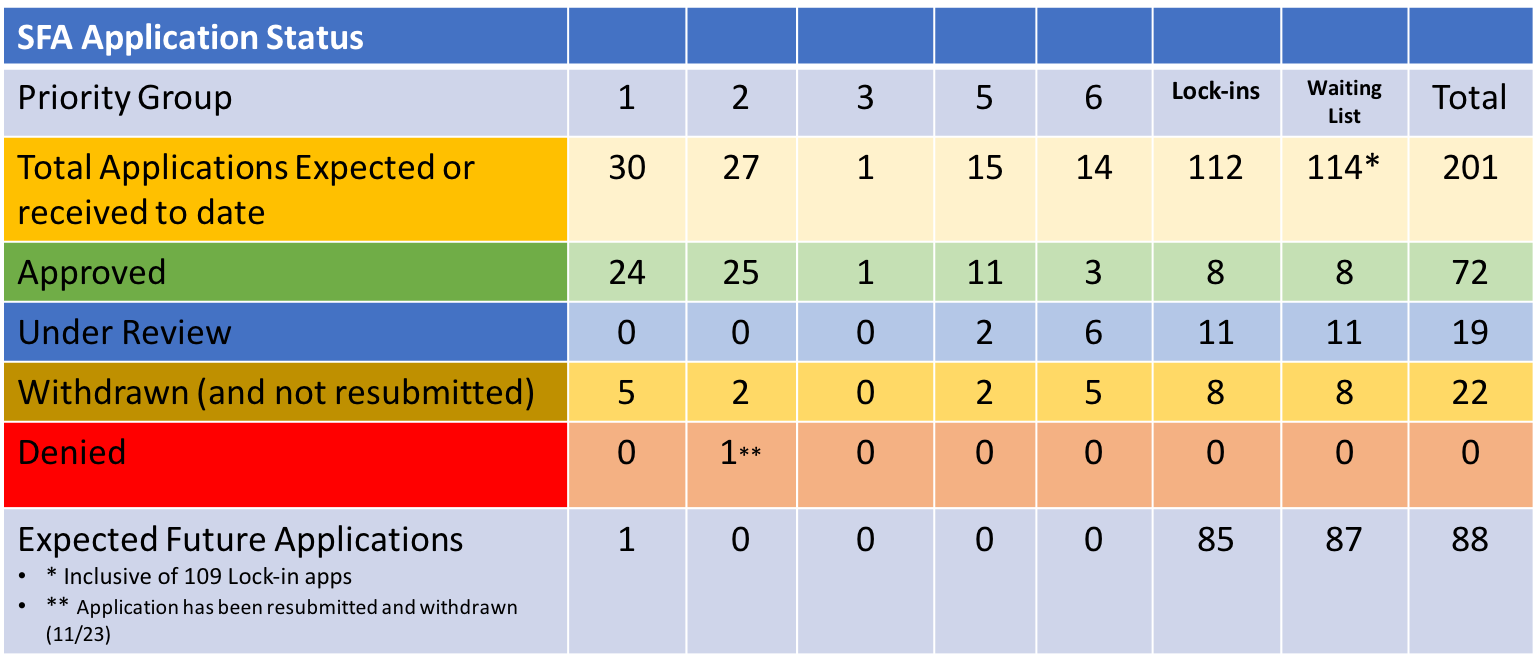
In addition to the 2 new applications, the PBGC recouped another $1.2 million in SFA overpayments due to census errors. This brings the repayment to of excess SFA to $144.1 million for 19 plans. The recovery of SFA amounts to 0.37% of the grant monies awarded. In other news, there were no applications approved, denied or withdrawn during the last week. There also were no funds seeking to be added to the waitlist.

As the chart above highlights, there are 110 funds yet to have applications approved. US Treasury yields are once again on the rise after a dramatic retreat as bond investors plowed into bonds anticipating very aggressive rate cuts by the Federal Reserve. Higher rates reduce the PV cost of those FV payments of benefits and expenses. A defeasement strategy significantly reduces interest rate risk as FVs are not interest sensitive. As we’ve discussed on many occasions, using a cash flow matching strategy to meet those benefits and expenses reduces the uncertainty associated with a traditional benchmark relative fixed income product. We are happy to discuss this subject in far greater detail.

Cash Flow Matching Done Right!

By: Russ Kamp, Managing Director, Ryan ALM, Inc.

Most of us seek to climb the “ladder to success”. We also use ladders for important everyday activities. I’ll soon be back on a ladder myself, as year-end approaches and the Christmas lights are placed on my home. Despite the usefulness of ladders, there is one place where they aren’t necessarily beneficial. I’m specifically addressing the use of ladders for bond management as a replacement for a defeasement strategy.

There are still so many misconceptions regarding Cash Flow Matching (CFM). Importantly, CFM is NOT a “laddered bond portfolio”, which would be quite inefficient and costly. It IS a highly sophisticated cost optimization process that maximizes cost savings by emphasizing longer maturity bonds (within the program’s parameters capped at the maximum year to be defeased) and higher yielding corporate bonds, such as A and BBB+.

Furthermore, it is not just a viable strategy for private pension plans, as it has been deployed successfully in public and multiemployer plans for decades, as well as E&Fs. It is also NOT an all or nothing strategy. The exposure to CFM is a function of several factors, including the plan’s funded status, current allocation to core fixed income, and the Retired Lives Liability, etc. Many of our clients have chosen to defease their pension liabilities from 5-30 years or beyond. When asked, we recommend a minimum of 10 years, but again that will be a function of each plan’s unique funding situation.

CFM strategies are NOT “buy and hold” programs. CFM implementations must be dynamic and responsive to changes in the actuary’s forecasts of benefits, expenses, and contributions. There are also continuous changes in the fixed income environment (I.e. yields, spreads, credits) that might provide additional cost savings that need to be monitored and managed. Plan sponsors may seek to extend the initial length (years) of the program as it matures which will often necessitate a restructuring or rebalancing of the original portfolio to maximize potential funding coverage and cost reductions.

CFM programs CANNOT be managed against a generic index, as no pension plan’s liabilities will look like the BB Aggregate or any other generic index. Importantly, no pension plan’s liabilities will look like another pension plan given the unique characteristics of that plan’s workforce and plan provisions. The appropriate management of CFM requires the construction of a Custom Liability Index (CLI) that maps the plan’s liabilities in multiple dimensions and creates the path forward for the successful implementation of the asset/liability match.

Importantly, CFM programs are NOT going to negatively impact the plan’s ability to achieve its desired ROA. In fact, a successful CFM program, such as the one we produce, will actually enhance the probability of achieving the return target. How? Your plan likely has an allocation to core fixed income. Our implementation will likely outyield that portfolio over time creating alpha as well as SECURING the promised benefits. Given the higher corporate bond interest rates, an allocation to this asset class can generate a significant percentage of the ROA target with risks substantially below those of other asset classes.

When done right, a successful CFM implementation achieves the following:

Provides liquidity to meet benefits and expenses

Secures benefits for the time horizon the CFM portfolio is funding (1-10 years +)

Buys time for the alpha assets to grow unencumbered

Out yields active bond management… enhances ROA

Reduces Volatility of Funded Ratio/Status

Reduces Volatility of Contribution costs

Reduces Funding costs (roughly 2% per year in this rate environment)

Mitigates Interest Rate Risk for that portion of the portfolio using CFM as benefits are future values that are not interest rate sensitive.

No laddered bond portfolio can provide the benefits listed above. Whether you are responsible for a DB pension, an endowment or foundation, a HNW individual, or any other pool of assets, you likely have liquidity needs regularly. CFM done right will greatly enhance this process. Call on us. We’ll gladly provide an initial analysis on what can be achieved, and we will do it for FREE.

ARPA Update as of May 10, 2024

By: Russ Kamp, Managing Director, Ryan ALM, Inc.

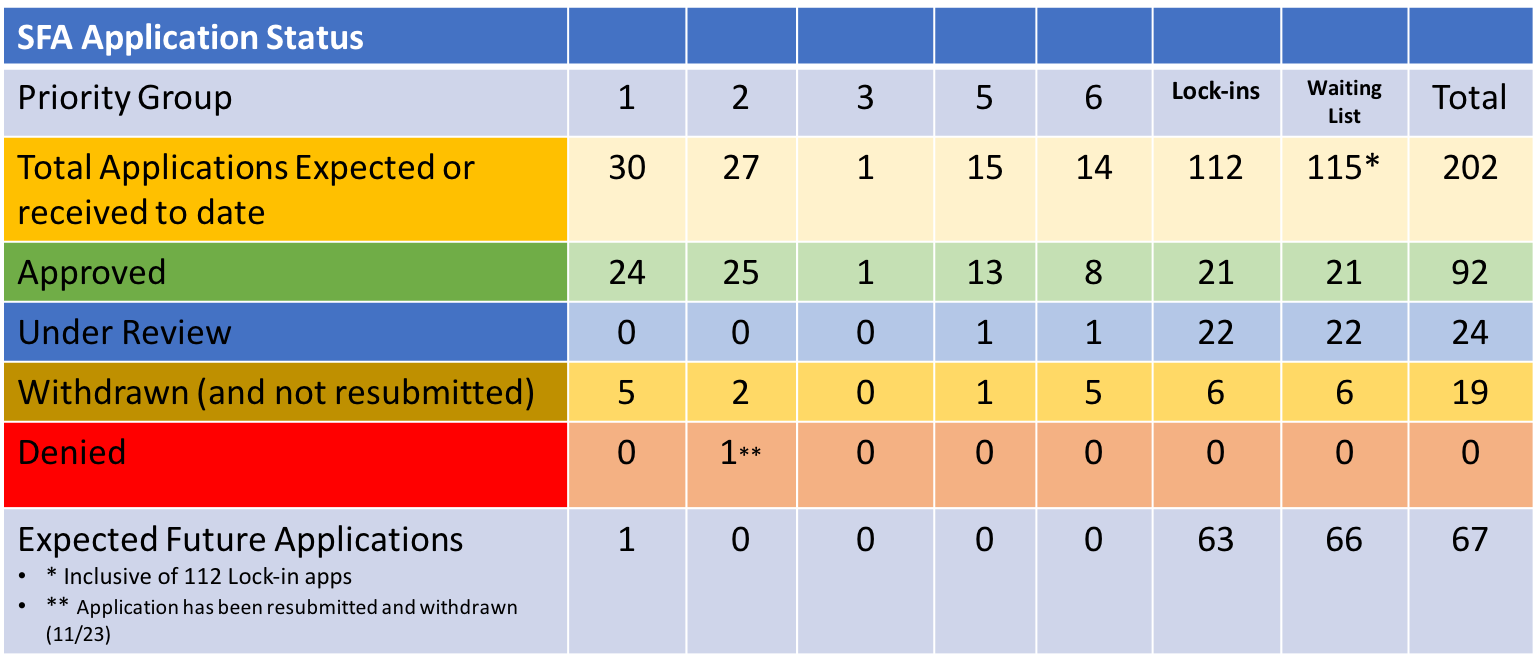
Another Monday brings the weekly update on the PBGC’s effort to implement the pension rescue under ARPA. As noted previously, activity has definitely slowed in recent weeks, and the week ending May 10, 2024 is no exception. I can report that the only activity on the PBGC’s ARPA spreadsheet is a withdrawal of a previously revised application. Employers’ – Warehousemen’s Pension Plan, a non-priority plan out of Los Angeles, was seeking $40 million in Special Financial Assistance (SFA) for just over 1,800 plan participants. The latest version of the application had been filed on March 4, 2024.

Unfortunately, there were no additional applications submitted or approved. At the same time, there were no additional applications withdrawn or denied. Lastly, no plans that might have received excess SFA have returned those excess assets at this tie outside of Central States. There remain 129 plans to still have their applications for SFA reviewed and approved.

Glen Eagle Trading reported the following in a recent email, that In 2023, a survey found that 78% of Americans live paycheck-to-paycheck, up six percentage points from the previous year. Unfortunately, in yet another survey 29% of Americans don’t earn enough to cover basic living costs. The ability to fund a retirement is getting to be more challenging than ever, which is why DB pension systems need to be be protected and preserved. The ARPA pension legislation is going a long way to securing pensions for millions of American workers who were on the verge of losing most, if not everything, that they had earned and counted on for their “golden years”.

Another Challenging Month for US Fixed Income

By: Russ Kamp, Managing Director, Ryan ALM, Inc.

S&P Dow Jones is out with its monthly “Dash Board” on a variety of benchmarks, both domestic and foreign. April proved challenging for both US equities and bonds. With regard to stocks, the S&P 500 was down -4.1% bringing the YTD performance to +6.04%. It was a tougher environment for both mid cap (-6.0%) and small cap (-5.6%). Small caps (S&P 600) continue to be pressured and the index is now down -3.3% YTD. As US interest rates continue on a course higher, US equities will continue to be challenged.

The higher US rates are also continuing to pressure US fixed income. The Aggregate Index produced a -1.8% April, and the index is now down -2.4% since the start of 2024 despite the rather robust YTM of 5.3%. As we’ve discussed on many occasions, bonds are the only asset class with a known cash flow of a terminal value and contractual coupon payments. As a result, bonds should be used for the certainty of those cash flows and specifically to defease pension liabilities. As a reminder, pension liabilities are bond-like in nature and they will move with changes in interest rates. Don’t use bonds as a total return strategy, as they will not perform in a rising rate environment. Sure, the nearly 40-year decline in rates made bonds and their historical performance look wonderful, but that secular trend is over.

Use the fixed income allocation to match asset cash flows of interest and principal to the liability cash flows of benefits and expenses. As a result, that portion of the total assets portfolio will have mitigated interest rate risk, while SECURING the promised benefits. Having ample liquidity is essential. Using bonds to defease pension liabilities ensures that the necessary liquidity will be available as needed. The current US interest rate environment may be pressuring total return-seeking fixed income managers, but it is proving cash flow matching programs with a very healthy YTM that dramatically reduces the cost of those future value payments. Don’t waste this golden opportunity.

What’s the Motivation?

By: Russ Kamp, Managing Director, Ryan ALM, Inc.

There appears in the WSJ today an article stating that pension plans were pulling “hundreds of billions from stocks”. According to a Goldman analyst, “pensions will unload $325 billion in stocks this year, up from $191 billion in 2023″. We are told that proceeds from these sales will flow to both bonds and alternatives. First question: What is this estimate based on? Are average allocations now above policy normal levels necessitating a rebalancing? Are bonds more attractive given recent movements in yields?

Yes, equities have continued to rally through 2024’s first quarter, and the S&P 500 established new highs before recently pulling back. Valuations seem stretched, but the same argument could have been made at the end of 2023. Furthermore, US interest rates were higher heading into 2023’s fourth quarter. If bond yields were an attractive alternative to owning equities, that would have seemed the time to rotate out of equities.

The combination of higher interest rates and equity valuations have helped Corporate America’s pensions achieve a higher funded status, and according to Milliman, the largest plans are now more than 105% funded. It makes sense that the sponsors of these plans would be rotating from equities into bonds to secure that funded status and the benefit promises. Hopefully, they have chosen to use a cash flow matching (CFM) strategy to accomplish the objective. Not surprisingly, public pension plans are taking a different approach. Instead of securing the benefits and stabilizing the plan’s funded status and contribution expenses by rotating into bonds, they are migrating both equities and bonds into more alternatives, which have been the recipients of a major asset rotation during the last 1-2 decades, as the focus there remains one of return. Is this wise?

I don’t know how much of that estimated $325 billion is being pulled from corporate versus public plans, but I would suggest that much of the alternative environment has already been overwhelmed by asset flows. I’ve witnessed this phenomenon many times in my more than 40 years in the business. We, as an industry, have the tendency to arbitrage away our own insights by capturing more assets than an asset class can naturally absorb. Furthermore, the migration of assets to alternatives impacts the liquidity available for plans to meet ongoing benefits and expenses. Should a market correction occur, and they often do, liquidity becomes hard to find. Forced sales in order to meet cash flow needs only serve to exacerbate price declines.

Pension plans should remember that they only exist to meet a promise that has been made to the participant. The objective should be to SECURE those promises at a reasonable cost and with prudent risk. It is not a return game. Asset allocation decisions should absolutely be driven by the plan’s funded status and ability to contribute. They shouldn’t be driven by the ROA. Remember that alternative investments are being made in the same investing environment as public equities and bonds. If market conditions aren’t supportive of the latter investments, why does it make sense to invest in alternatives? Is it the lack of transparency? Or the fact that the evaluation period is now 10 or more years? It surely isn’t because of the fees being paid to the managers of “alternative” products are so attractive.

Don’t continue to ride the asset allocation rollercoaster that only ensures volatility, not success! The 1990’s were a great decade that was followed by the ’00s, in which the S&P 500 produced a roughly 2% annualized return. The ’10s were terrific, but mainly because stocks were rebounding from the horrors of the previous decade. I don’t know what the 2020s will provide, but rarely do we have back-to-back above average performing decades. Yes, the ’90s followed a strong ’80s, but that was primarily fueled by rapidly declining interest rates. We don’t have that scenario at this time. Why assume the risk?