“More Needs To Be Done!” – Do You Think?

By: Russ Kamp, Managing Director, Ryan ALM, Inc.

This post is the 1,500th on this blog! I hope that you’ve found our insights useful. We’ve certainly appreciated the feedback – comments, questions, and likes – throughout the years. A lot of good debate has flowed from the ideas that we have expressed and we hope that it continues. The purpose of this blog is to provide education to those engaged in the pension/retirement industry. We have an incredible responsibility to millions of American workers who are counting on us to help provide a dignified retirement. A goal that is becoming more challenging every day.

As stated numerous times, doing the same-old-same-old is not working. How do we know? Just look at the surveys that regularly appear in our industry’s media outlets. Here is one from MissionSquare Research Institute done in collaboration with Greenwald Research. The survey reached a nationally representative sample of 1,009 state and local government workers between September 12 and October 4. What they found is upsetting, if not surprising. According to the research, “81% are concerned they won’t have enough money to last throughout retirement, and 78% doubt they’ll have enough to live comfortably during their golden years.”

Some of the other findings in the survey also tell a sad story. In fact, 73% of respondents are concerned they won’t be able to retire on time, while the same number are unsure whether they’ll have sufficient emergency savings. How terrible. The part about being able to retire “on time” is not often in the workers control wether because of health and the ability to continue to do the required task or as a result of other plans by their employer. Amazingly, public sector workers believe that their current retirement situation is better than those in the private sector. Wow, if that isn’t telling of the crisis unfolding in this country.

Given these results, it shouldn’t be shocking that unions are seeking a return of DB plans as the primary retirement vehicle. We know that asking untrained individuals to fund, manage, and then disburse a “benefit” through a defined contribution plan is poor policy. We’ve seen the results and they are horrid, with median balances for all age groups being significantly below the level needed to have any kind of retirement. Currently, the International Association of Machinists and Aerospace Workers are on strike at Boeing, and a major sticking point is the union’s desire to see a reopening of Boeing’s frozen DB plan.

We’ve also recently seen the UAW and ILA memberships seek access to DB plans. It shouldn’t be a shock given the ineffectiveness of DC plans that were once considered supplemental to pensions. Again, asking the American worker to fund a DC offering with little to no disposable income, investment acumen, or a crystal ball to help with longevity concerns is just foolish. Yes, there is more to do, much more! It is time to realize that DB plans are the only true retirement vehicle and one that helps retain and attract talented workers who aren’t easily replaced. Wake up before the crisis deepens and everyone suffers.

3% Return for the Decade? It Isn’t Far-fetched!

By: Russ Kamp, Managing Director, Ryan ALM, Inc.

This blog is a follow up to a post that I published last week. In that post I cited a recent analysis by Goldman Sach’s forecasting a 3% 10-year return. I concluded the blog with the following: “I wouldn’t worry about the 5% fixed income yield-to-worst (YTW) securing my pension liabilities. Instead, I’d worry about all the “growth” assets not used to secure the promises, as they will likely be struggling to even match the YTW on a CFM corporate bond portfolio.”

How likely is it that Goldman and other financial institutions are “right” in forecasting such a meager return for the next decade? I’m sure that plan sponsors and their advisors are pondering the same question. Well, here is more insight into how one forecasts long-term equity returns (not necessarily Goldman’s forecasting technique) and how one might arrive at such a low equity return (S&P 500 as the proxy) that, if realized, would likely crush pension funding.

Inputs necessary to forecast the future return for the S&P 500 are the current S&P EPS ($255), future expected EPS growth (5.5%) and an assumed P/E multiple in 10 years. Finally, add in the dividend yield (1.3%) and you have your expected annualized return.

Charles DuBois, my former Invesco research colleague, provided me with his thoughts on the following inputs. He believes that nominal earnings growth will be roughly 5.5% during the next decade, reflecting 4% nominal GDP growth coupled with a small boost from increasing federal deficits as a share of GDP and a boost for net share buybacks (1.5% in total). 

Right now, earnings per share for the S&P 500 are forecasted to be about $255 in 2024. If earnings grow by the 5.5%/per annum described above, in 10 years earnings for the S&P 500 will be $428 per share.

The S&P is currently trading at 5,834, which is 22.9X (high by any measure) the current EPS. Let’s assume a more normal, but still historically high, multiple of 18X in 10 years. That gets you to an S&P 500 level of 7,704 or a 2.8% annual rate of gain over the next 10 years.  Add in a 1.3% dividend yield gets you to 4.1%. Not Goldman’s 3%, but close. It is still much lower than the long-term average for the market or the average ROA for most public and multiemployer pension plans.

If one were to assume a 15X P/E multiple in 10 years, the return to the S&P 500 is 0.64%/annum and the “total” return is slightly less than 2.0%. UGLY! Obviously, the end of the 10-year period multiple is the key to the return calculation. But all in all, the low returns that most investment firms (including Goldman) are forecasting seem to be in the right neighborhood given these expectations.

Given the potential challenges for Pension America to achieve the desired return (ROA objective) outcome, a cash flow matching (CFM) strategy will help a pension plan bridge this potentially difficult period. Importantly, by having the necessary liquidity to meet monthly benefits and expenses, assets won’t have to be sold to meet those obligations thus eliminating the potential to lock in losses. Lastly, the roughly 5% yield-to-worse (YTW) on the CFM portfolio looks to be superior to future equity returns – a win/win!

It just might be time to rethink your plan’s asset allocation. Don’t place all of your assets into one return bucket. Explore the many benefits of dividing pension assets into liquidity and growth buckets. Want more info? Ryan ALM, Inc. has a ton of research on this idea. Please go to RyanALM.com/research.

ARPA Update as of October 25, 2024

By: Russ Kamp, Managing Director, Ryan ALM, Inc.

Welcome to the last week of October. Like many of us, I can’t wait to see my children’s and grandchildren’s costumes on Thursday. The weather in NJ will be more like June than the end of October. Enjoy!

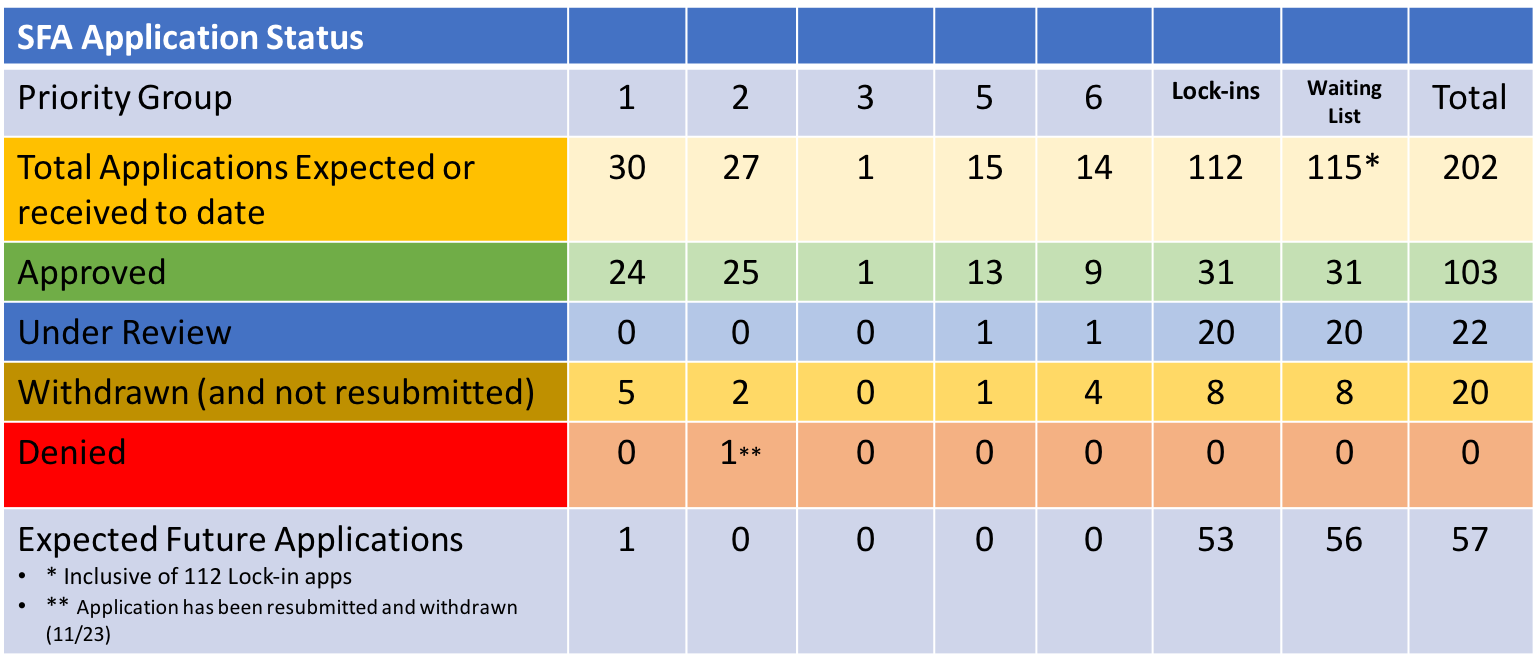
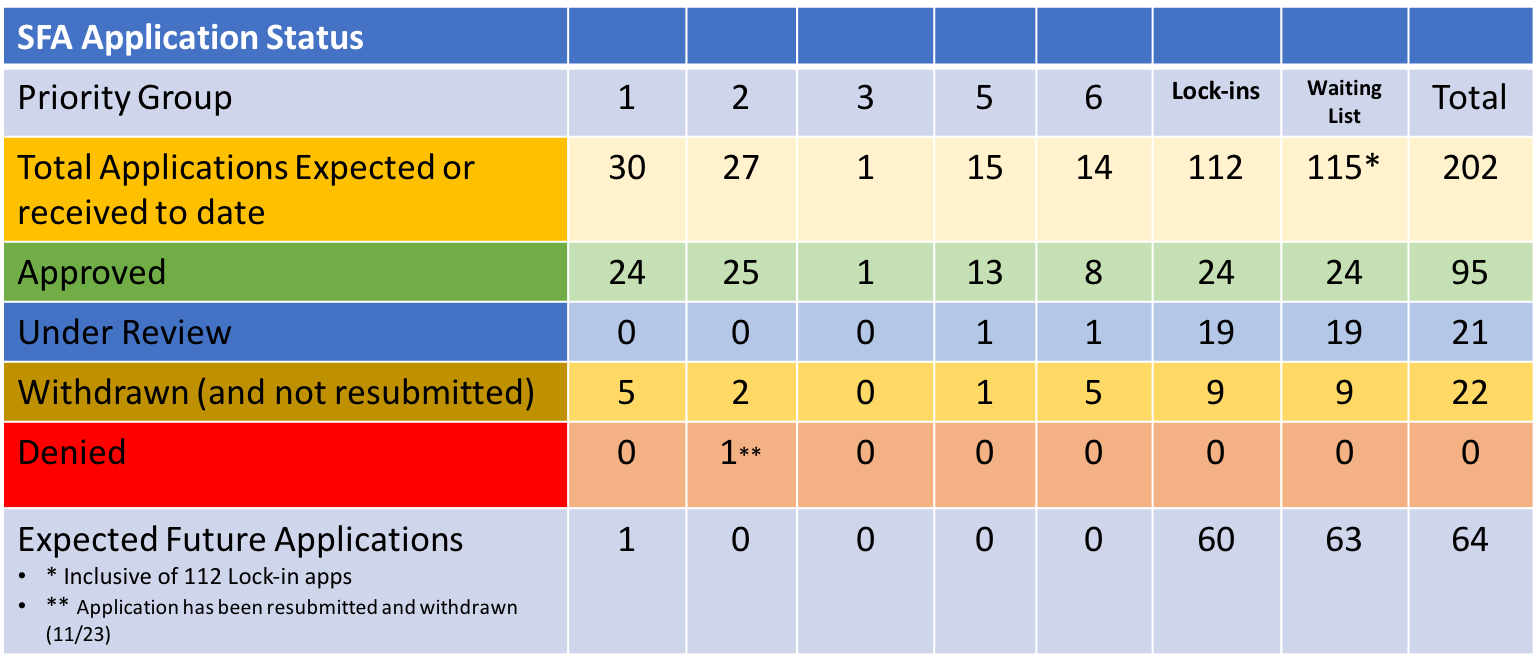
With regard to the PBGC’s effort to implement the ARPA pension legislation, last week’s activity was rather muted. I’m happy to report that we had one plan’s application approved, as I.B.E.W. Pacific Coast Pension Fund will receive $75.5 million in SFA and interest for 3,318 plan participants. This brings the number of approved applications to 95 and the total award of SFA to $68.8 billion. There are still 107 applications that are in the queue to eventually (hopefully) receive special financial assistance, with 64 yet to file an initial application.

Also, during the past week, we had the Laborers’ Local No. 265 Pension Plan withdraw its application. That plan is seeking $55.6 million for 1,460 members of its plan. This was the initial application for this fund which had been filed on July 11, 2024. There has been a total of 117 applications filed and withdrawn throughout the ARPA implementation. Some funds have seen multiple applications withdrawn and resubmitted.

Given the limited activity last week, it isn’t surprising to learn that the eFiling Portal remains temporarily closed. There is still much to accomplish with this legislation and time, although not currently an issue, will become one should this process linger beyond 2025.

Lastly, the recent move up in US Treasury rates bodes well for those plans receiving SFA and wanting to use cash flow matching to secure the promised benefits. Ryan ALM is always willing to produce an initial analysis on what can be achieved through CFM in terms of a coverage period. Don’t hesitate to reach out to us.

That’s Not Right!

By: Russ Kamp, Managing Director, Ryan ALM, Inc.

I’ve recently had a series of terrific meetings with consultants, actuaries, and asset owners (mostly pension plans) about cash flow matching (CFM). I believe that most folks see the merit in using CFM for liquidity purposes, but often fail to see the benefit of bringing certainty to a portfolio for that segment that is defeasing asset cash flows relative to liability cash flows (benefits and expenses). I’m not entirely sure why that is the case, but one question comes up regularly. Question: If I use 30% of my assets on lower yielding fixed income, how am I supposed to meet my ROA objective? I guess that they believe that the current 4.75% to 5% yielding investment grade corporate portfolio will be an anchor on the portfolio’s return.

What these folks fail to understand is the fact that the segment of the portfolio that is defeasing liability cash flows is matched as precisely as possible. The pension game has been won! If the defeased bond portfolio represents 30% of the total plan, the ROA objective is now only needed to be achieved for the 70% of assets not used to SECURE your plan’s liabilities. The capital markets are highly uncertain. Using CFM for a portion of the plan brings greater certainty to the management of these programs. Furthermore, we know that time (investing horizon) is one of the most important investment tenets. The greater the investing horizon the higher the probability of achieving the desired outcome, as those assets can now grow unencumbered as they are no longer a source of liquidity.  It bears repeating… a major benefit of CFM is that it buys time for the growth assets to grow unencumbered.

Plan sponsors should be looking to secure as much of the liability cash flows (through a CFM portfolio) as possible eliminating the rollercoaster return pattern that ultimately leads to higher contribution expenses. As mentioned above, capital markets are highly uncertain. The volatility associated with a traditional asset allocation framework has recently been calculated by Callan as +/-33.6% (2 standard deviations or 95% of observations). Why live with that uncertainty? In addition, Goldman Sachs equity strategy team “citing today’s high concentration in just a few stocks and a lofty starting valuation” forecasts that the S&P 500 “will produce an annualized nominal total return of just 3% the next 10 years, according to the team led by David Kostin, which would rank in just the 7th percentile of 10-year returns since 1930.” (CNBC)

Given that forecast, I wouldn’t worry about the 5% fixed income YTW securing my pension liabilities. Instead, I’d worry about all the “growth” assets not used to secure the promises, as they will likely be struggling to even match the YTW on a CFM corporate bond portfolio.

What Will Their Performance be? Continued

By: Russ Kamp, Managing Director, Ryan ALM, Inc.

I recently published a post titled, “What Will Their Performance be in About 11 Years?” I compared the Ryan ALM, Inc. cash flow matching (CFM) strategy to a relative return fixed income manager, and I raised the question about future performance. Barring any defaults within the investment grade universe, which historically average about 2/1,000 bonds, we can tell you on day one of the portfolio’s construction what the performance will be for the entire period of a CFM mandate.

In my previous post, I stated, “now, let me ask you, do you think that a core fixed income manager running a relative return portfolio can lay claim to the same facts? Absolutely, not! They may have benefitted in the most recent short run due to falling interest rates, but that future performance would clearly depend on multiple decisions/factors, including the duration of the portfolio, changes in credit spreads, the shape of the yield curve, the allocation among corporates, Treasuries, agencies, and other bonds, etc. Let’s not discount the direction of future interest rate movements and the impact those changes may have on a bond strategy. In reality, the core fixed income manager has no idea how that portfolio will perform between now and March 31, 2035.

Whatever benefit the active relative-return fixed income manager might have gotten from those declining rates earlier this year has now been erased, as Treasury yields have risen rapidly across all maturities since the Fed announced its first cut in the FFR. Including today’s trading, the US 10-year Treasury note yield has backed up 67 bps since the yield bottomed out at 3.5% in mid-September (currently 4.17% at 11:40 am). The duration of the 10-year note is 8.18 years, as of this morning. That equates to a loss of principal of -5.48% in roughly 1 month. Wow!

Again, wouldn’t you want the certainty of a CFM portfolio instead of the very uncertain performance of the relative return fixed income manager? Especially when one realizes that the active fixed income manager’s portfolio won’t likely cover the liquidity needed to meet benefits and expenses. Having to “sell” bonds in a rising rate environment locks in losses for the active manager, while the CFM portfolio is designed to meet ALL of the liquidity through maturing principal and income – no selling. This seems like a no-brainer!

ARPA Update as of October 18, 2024

By: Russ Kamp, Managing Director, Ryan ALM, Inc.

Major League baseball finally has the last two competitors for this year’s World Series. As a Mets’ fan, I would have appreciated a different outcome, but it was a surprisingly good season for the team from Flushing! Good luck to the Yankees and Dodgers.

With regard to ARPA and the PBGC’s effort to implement this important pension legislation, last week provided just a couple of updates for us to digest. There were no new applications submitted, approved or denied. The PBGC’s eFiling Portal remains temporarily closed at this time. There were also no new systems seeking to be added to the waitlist at this time.

There was one application withdrawn. PA Local 47 Bricklayers and Allied Craftsmen Pension Plan, a non-priority group plan, withdrew its initial application last week that was seeking $8.3 million for the 296 participants in the plan.

The last bit of activity to discuss relates to the repayment of excess SFA as a result of census corrections. Teamsters Local Union No. 52 Pension Fund became the 22nd plan to repay a portion of their SFA received. In the case of Local No. 52, they repaid $1.1 million, which represented 1.15% of their grant. The largest repayment to date has been the $126 million repaid by Central States (0.35% of grant). In terms of percentages, the Milk Industry Office Employees Pension Trust Fund returned 2.36% of their grant marking the high watermark, while Local Union No. 466 Painters, Decorators and Paperhangers Pension Plan, was asked to return only 0.11% of their reward.

Finally, US interest rates have risen significantly since the Fed’s first rate cut on September 18th, as highlighted in the graph below. The higher rates reduce the present value of those future benefit payments and helps to stretch the coverage period provided by the SFA.

We Suggested That It Might Just Be Overbought

By: Russ Kamp, Managing Director, Ryan ALM, Inc.

Regular readers of this blog might recall that on September 5th we produced a post titled, “Overbought?” that suggested that bond investors had gotten ahead of themselves in anticipation of the Fed’s likely next move in rates. At that time, we highlighted that rates had moved rather dramatically already without any action by the Fed. Since May 31, 2024, US Treasury yields for both 2-year and 3-year maturities had fallen by >0.9% to 9/5. By almost any measure, US rates were not high based on long-term averages or restrictive.

Sure, relative to the historically low rates during Covid, US interest rates appeared inflated, but as I’ve pointed out in previous posts, in the decade of the 1990s, the average 10-year Treasury note yield was 6.52% ranging from a peak of 8.06% at the end of 1990 to a low of 4.65% in 1998. I mention the 1990s because it also produced one of the greatest equity market environments. Given that the current yield for the US 10-year Treasury note was only 3.74% at that point, I suggested that the present environment wasn’t too constraining. In fact, I suggested that the environment was fairly loose.

Well, as we all know, the US Federal Reserve slashed the Fed Funds Rate by 0.5% on September 18th (4.75%-5.0%). Did this action lead bond investors to plow additional assets into the market driving rates further down? NO! In fact, since the Fed’s initial rate cut, Treasury yields have risen across the yield curve with the exceptions being ultra-short Treasury bills. Furthermore, the yield curve is positively sloping from 5s to 20s.

Again, managing cash flow matching portfolios means that we don’t have to be in the interest rate guessing game, but we are all students of the markets. It was out thinking in early September that markets had gotten too far ahead of the Fed given that the US economy remained on steady footing, the labor market continued to be resilient, and inflation, at least sticky inflation, remained stubbornly high relative to the Fed’s target of 2%. Nothing has changed since then except that the US labor market seems to be gaining momentum, as jobs growth is at a nearly 6-month high and the unemployment rate has retreated to 4.1%.

There will be more gyrations in the movement of US interest rates. But anyone believing that the Fed and market participants were going to drive rates back to ridiculously low levels should probably reconsider that stance at this time.

ARPA Update as of October 4, 2024

By: Russ Kamp, Managing Director, Ryan ALM, Inc.

Welcome to October. It is always a beautiful time of year in New Jersey.

With regard to the PBGC’s implementation of the ARPA legislation, there was some activity last week. After a short pause in accepting applications, the PBGC accepted two initial applications from two non-Priority Group members. Cement Masons Local No. 524 Pension Plan and the Roofers Local No. 75 Pension Plan, both Ohio-based, filed applications seeking $11.3 million combined in SFA for 486 plan participants. As a reminder, the PBGC has 120 days to act on those applications.

In addition to the 2 new applications, the PBGC recouped another $1.2 million in SFA overpayments due to census errors. This brings the repayment to of excess SFA to $144.1 million for 19 plans. The recovery of SFA amounts to 0.37% of the grant monies awarded. In other news, there were no applications approved, denied or withdrawn during the last week. There also were no funds seeking to be added to the waitlist.

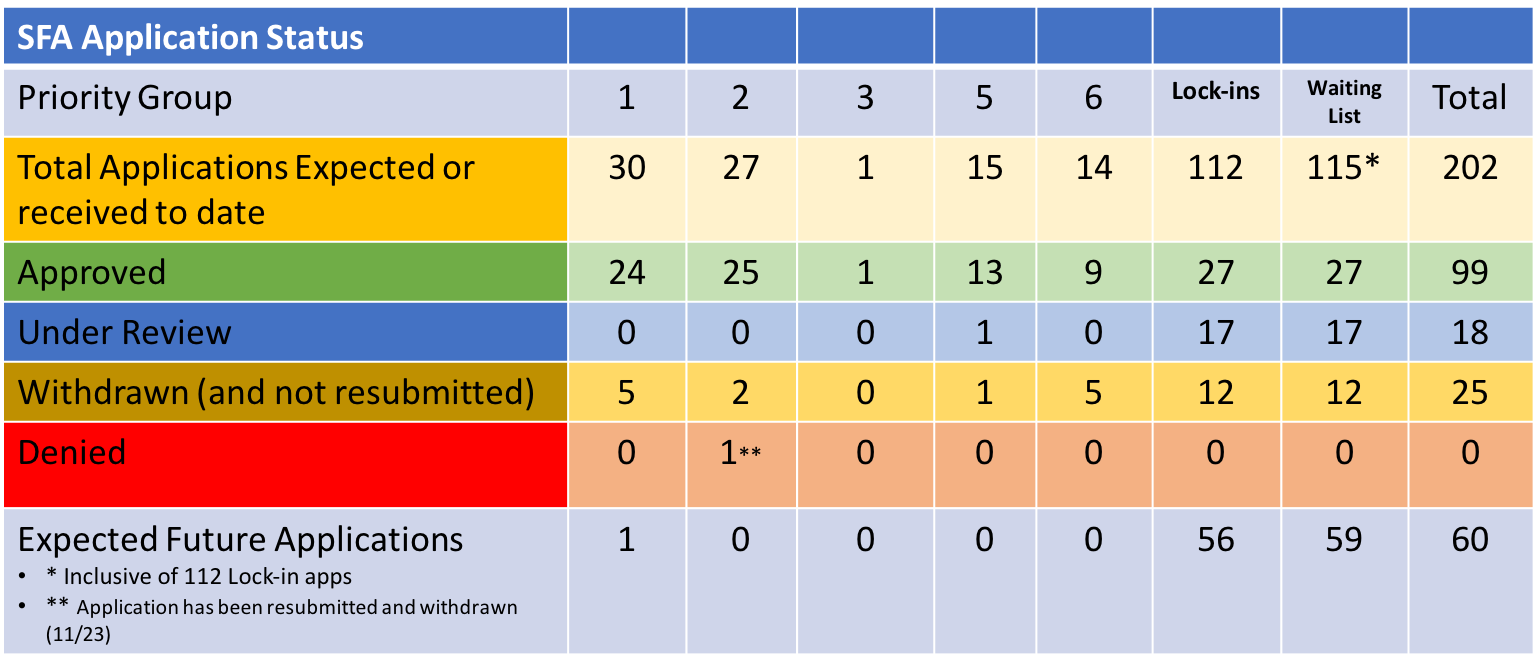
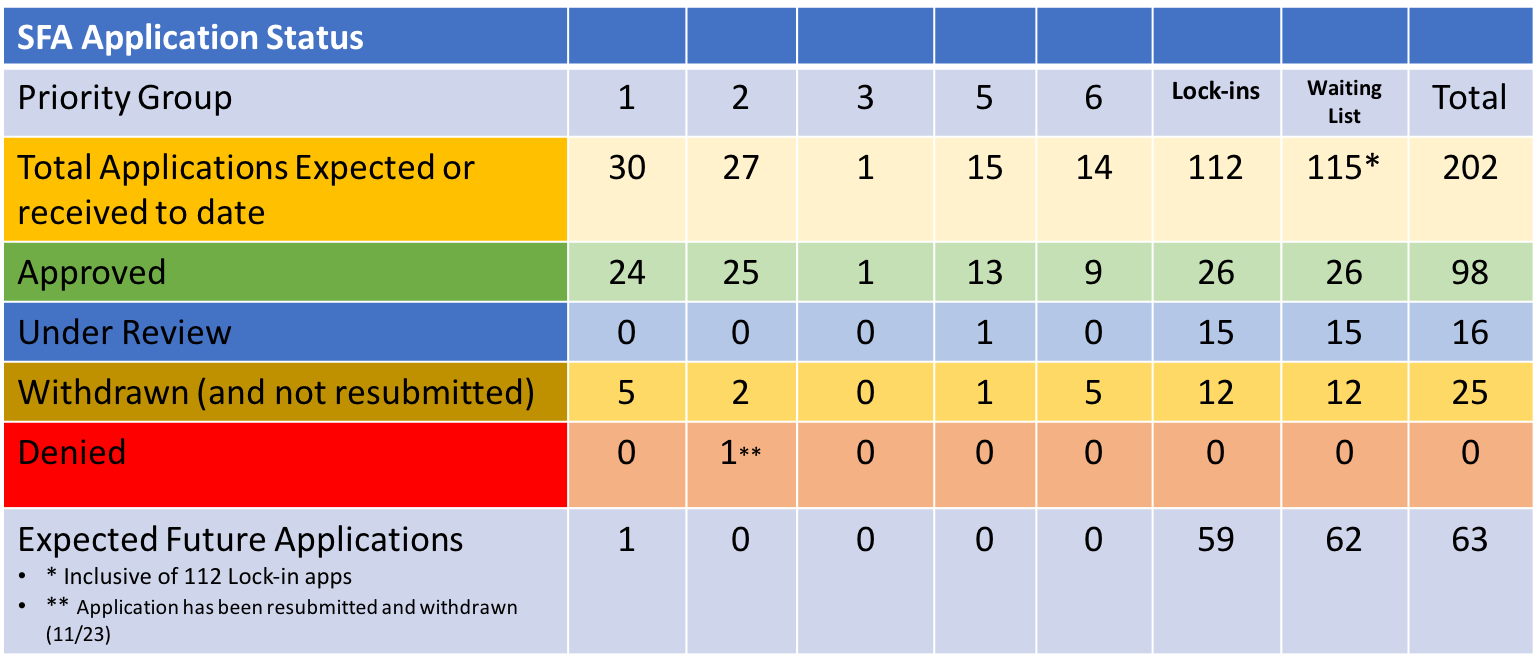
As the chart above highlights, there are 110 funds yet to have applications approved. US Treasury yields are once again on the rise after a dramatic retreat as bond investors plowed into bonds anticipating very aggressive rate cuts by the Federal Reserve. Higher rates reduce the PV cost of those FV payments of benefits and expenses. A defeasement strategy significantly reduces interest rate risk as FVs are not interest sensitive. As we’ve discussed on many occasions, using a cash flow matching strategy to meet those benefits and expenses reduces the uncertainty associated with a traditional benchmark relative fixed income product. We are happy to discuss this subject in far greater detail.

What Will Their Performance Be In About 11 years?

By: Russ Kamp, Managing Director, Ryan ALM, Inc.

How comforting would it be for both plan sponsors and their advisors to know how a particular strategy is going to perform over some defined period of time? I would think that having that knowledge would be quite comforting, at least as a “core” holding. Do you think that a core fixed income manager running a relative return strategy versus the Bloomberg Barclays Aggregate Index could tell you how that portfolio will perform in the next 10 1/2 years? No. Ryan ALM can with a very high degree of certainty. How’s that? Well, cash flow matching (CFM) of asset cash flows to liability cash flows locks in that relationship on the day that the portfolio is constructed. Ryan ALM views risk as the uncertainty of achieving the objective. If the true pension objective is to fund benefits and expenses in a cost-efficient manner with prudent risk, then our CFM model will be the lowest risk portfolio.

We were awarded a CFM assignment earlier this year. Our task was/is to defease the future grant payments for this foundation. On the day the portfolio was built, we were able to defease $165.1 million in FV grant payments for only $118.8 million, locking in savings (difference between FV and PV of the liability cash flows) of $46.3 million equal to 28.0% of those future grant payments. That’s fairly substantial. The YTM on that day was 5.19% and the duration was 5.92 years.

Earlier this week, we provided an update for the client through our monthly reporting. The current Liability Beta Portfolio (the name that we’ve given to our CFM optimization process) has the same FV of grant payments. On a market value basis, the portfolio is now worth $129 million, and the PV of those future grant payments is $126 million. But despite the change in market value due to falling interest rates, the cost savings are still -$46.3 million. The YTM has fallen to 4.31%, but that doesn’t change the initial relationship of asset cash flows to liability cash flows. That is the beauty of CFM.

Now, let me ask you, do you think that a core fixed income manager running a relative return portfolio can lay claim to the same facts? Absolutely, not! They may have benefitted in the most recent short run due to falling interest rates, but that would clearly depend on multiple decisions/factors, including the duration of the portfolio, changes in credit spreads, the shape of the yield curve, the allocation among corporates, Treasuries, agencies, and other bonds, etc. Let’s not discount the direction of future interest rate movements and the impact those changes may have on a bond strategy. In reality, the core fixed income manager has no idea how that portfolio will perform between now and March 31, 2035.

Furthermore, will they provide the necessary liquidity to meet those grant payments or benefits and expenses, if it were a DB pension? Not likely. With a yield to maturity of 4.31% and a market value of assets of $129.3 million, they will produce income of roughly $5.57 million/year. The first year’s grant payments are forecast to be $9.7 million. Our portfolio is designed to meet every $ of that grant payment. The relative return manager will be forced to liquidate a portion of their portfolio in order to meet all of the payments. What if rates have risen at that point. Forcing liquidity in that environment will result in locking in a loss. That’s not comforting.

CFM portfolios provide the client with the certainty of cash flows when they are needed. There is no forced selling, unlike the relative return manager that might be forced to sell in a market that isn’t conducive to trading. Furthermore, a CFM mandate locks in the cost savings on day 1. The assets not used to meet those FV payments, can now be managed more aggressively since they benefit from more time and aren’t going to be used to meet liability cash flows.

Asset allocation strategies should be adapted from a single basket approach to one that uses two baskets – liquidity and growth. The liquidity bucket will house a defeased bond portfolio to meet all the cash flow requirements and the remainder of the assets will migrate into the growth bucket where they can now grow unencumbered. You’ll know on day 1 how the CFM portfolio is going to perform. Now all you have to worry about are those growth assets, but you’ll have plenty of time to deal with any challenges presented.

ARPA Update as of September 27, 2024

By: Russ Kamp, Managing Director, Ryan ALM, Inc.

Welcome to the last update for September 2024. Let’s hope that today brings at least one Mets’ win in Atlanta. It would mark quite the turnaround from where this team was on June 1st.

With regard to the PBGC’s implementation of the ARPA legislation, the efiling portal still remains temporarily closed. As a result, new applications have not been forthcoming. There are presently 22 applications with the PBGC. Sixteen of those must be acted on by November 30th.

Activity was fairly limited during the past week. There were no applications approved or denied. There was one application withdrawn. Bricklayers Pension Fund of West Virginia withdrew the initial application seeking $1.2 million for the 170 plan participants. In addition, 3 funds repaid a portion of the SFA grant received. Mid-Jersey Trucking Industry and Teamsters Local 701 Pension and Annuity Fund, the Pension Plan of the Bakery Drivers and Salesmen Local 194 and Industry Pension Fund, and the Building Material Drivers Local 436 Pension Plan each returned a portion of the overfunding due to incorrect census data. In total, the three plans returned $2.7 million from the $348.3 million received in SFA or 0.78%. To date, 17 plans have returned $142.3 million or 0.36% of the grant monies received. Lastly, there were no additional plans seeking to be added to the waitlist, which remains at 68.

Please don’t hesitate to reach out to us with any questions that you might have regarding investment strategies for the SFA assets. We are always willing to model your plan’s forecasted cash flows so that various implementations can be reviewed.