Good Ideas Are Often Overwhelmed!

By: Russ Kamp, Managing Director, Ryan ALM, Inc.

We have a tendency in our industry to overwhelm good ideas with much too much money. Asset flows can be evil as they drive valuations up as too much money pursues to few good ideas. The “winner” in the bidding competition frequently (eventually) becomes the loser in the long run. I recently wrote about this phenomenon as it related to private credit. Well, we have a similar, if not more egregious example as it pertains to private equity. With more than $3.2 trillion tied up in aging, closely held companies at the end of 2023, according to Preqin data. 

I recently read a refreshingly honest post on LinkedIn.com about the current state of private equity. The comments referred to a discussion given by a “leading” voice within the industry who mentioned that the “types of PE returns it (our industry) enjoyed for many years, you know, up to 2022, you’re not going to see that until the pig moves through the python. And that is just the reality of where we are.” That is quite the image. It speaks to my point about too much money chasing too few good ideas. Pension America has pursued a return objective in lieu of one that stresses the securing of the pension promise. Striving for return has forced most participants to load up on gimmicky alternatives, including real estate, private credit, private equity and worst of all, hedge funds.

For the early adopters, returns above those produced by the public markets were achievable, but again, once someone has a decent idea we tend to jump on that bandwagon until the horse can’t pull the cart any longer. What happens next is usually not pretty. This leading voice also mentioned that “fewer realizations and lower returns” were on the horizon until the proverbial pig was digested. Unfortunately, PE firms are holding onto these aging companies and they will need to be refinanced at much higher interest rates which will further reduce expected returns.

In other news, Heather Gillers, WSJ, reported that the honeymoon may be over between pension America and private equity managers. The promise of high returns may not be realized after all. According to Ms. Gillers, payouts from these expensive offerings have all but dried up. As a result, many pension funds are unloading their investments at significant discounts through secondary markets. According to this article, large public pension systems have migrated roughly 14% of the plan’s AUM into PE. What once looked like an investment that could produce a premium return is struggling to match returns of the S&P 500.

Worse, about 50% of the private equity investors have assets tied up in “Zombie funds”, which hadn’t paid out on the expected timeframe. Needing liquidity (should have invested in a cash flow matching strategy), these pension funds are getting an average of about 85% of the value of assets that were assigned just three to six months prior. According to Jefferies Financial Group about $60 billion was transacted in secondhand sales by PE investors last year.

Despite the lack of liquidity and the idea that too much money has been chasing too few good ideas, the “honest’ assessment by our industry “leading voice” stopped at their doorstep. You see, his firm believes that by 2026 (beginning or end of year???) their alternative assets under management will rocket from $651 billion to $1 trillion. Wow! Now how will that pig pass through the python? Are we to believe that growth of that magnitude will not negatively impact that firm or our industry? I guess that the news to date hasn’t been sufficiently ugly to stop this rampage into PE. I’ve seen this movie before. Spoiler alert – the train barrels forward until it goes over a cliff where the tracks used to be. I’d suggest getting off the next stop.

ARPA Update as of June 14, 2024

By: Russ Kamp, Managing Director, Ryan ALM, Inc.

We hope that you enjoyed a wonderful Father’s Day. I’m blessed to still have my Dad with us (95 years young). In addition, I have two sons and two sons-in-law who are wonderful fathers. It was a terrific day!

Regarding ARPA and the PBGC’s implementation of that critical pension legislation, there was some activity during the previous week. However, the filing portal remains temporarily closed for those plans still seeking relief through the SFA grants. That said, there are still 17 applications that are currently being reviewed with 6 of those nearing the 120 deadline for action. Those six plans are seeking nearly $5.5 billion in SFA. As a result, the rest of June is going to be busy for the PBGC.

The Pension Plan for the Arizona Bricklayers’ Pension Trust Fund received approval for its application. They will receive $10.7 million to protect the pensions for the 666 members of the plan. This non-priority plan received approval on their initial application. In other news, there were no applications either denied or withdrawn. However, the Graphic Communications Conference of the International Brotherhood of Teamsters National Pension Fund joined Central States as the only other plan to repay excess SFA as a result of a death audit. In this case, they are repaying just over $8 million.

Have a great week. Don’t hesitate to reach out to us if you like to learn more about cash flow matching and how it can be used to extend and protect the SFA grant assets so vital to ensuring that the pension promises are met for your participants.

ARPA Update as of June 7, 2024

By: Russ Kamp, Managing Director, Ryan ALM, Inc.

We are pleased to provide you with another ARPA update. The PBGC approved the applications for two New Jersey funds seeking Special Financial Assistance (SFA). CWA/ITU Negotiated Pension Plan and the Pension Plan of Local 102, both non-priority funds, will receive $545.6 million and $12.5 million, respectively, in order to ensure that their 24,796 participants will receive the promised benefits.

Unfortunately, there isn’t much else to report, as there were no new applications submitted, and the queue remains at 18. There were no applications rejected or withdrawn and no pension systems were added to the waitlist, with 32 of 114 having had some activity (submissions, withdrawals, and approvals) to date. Central States remains the only plan to pay back excess SFA proceeds.

The 18 plans that are currently under review carry some heft, as they are collectively seeking >$13 billion in SFA for nearly 370K participants. Seven of those plans have application “deadlines” in June. As a reminder, the PBGC has 120 days to act on an application once it has been submitted. Fortunately, US interest rates remain elevated providing plan sponsors with the opportunity to use cash flow matching to secure the SFA assets and significantly reduce the risk associated with a traditional asset allocation. Sponsors would be wise to use the legacy assets to assume a more traditional asset allocation since those assets now have the benefit of an extended investing horizon.

We hope that you have a wonderful week.

Money Managers Recaptured 1/2 the 2022 losses – Should We Be Pleased?

By: Russ Kamp, Managing Director, Ryan ALM, Inc.

P&I has produced an article highlighting the fact that money managers recaptured nearly half of the institutional assets lost (-$9 trillion) in 2022’s market correction. They mention that this was accomplished despite “lingering economic and political uncertainties that kept a lot of money sidelined, including a record $6 trillion parked in money market funds alone.”

According to Pensions & Investments’ 2023 survey of the largest money managers, institutional assets for 411 managers around the globe rose 9.7%, or $4.89 trillion, to $55.23 trillion as of Dec. 31, 2023 for a recovery rate of 52.5%. This recapture of assets was primarily driven by equities, both US (+26%) and global X US (+18%), while bonds were up 5.6% domestically and abroad.

Obviously, it was great to see the “rally” despite wide-spread uncertainty related to the economy, inflation, interest rates, and the labor market. Issues that are still impacting perceptions today. But the real question one should ask has to do with the cyclical nature of markets and what plan sponsors and their advisors can do to mitigate the peaks and valleys. As I reported earlier this week, since 2000, public pension plans have seen a tripling (or more) in contribution expenses as a % of pay, while the funded status of Piscataqua research’s universe of 127 state and local plans has fallen by 25%.

Isn’t it time to get off the asset allocation rollercoaster? The nearly singular focus on return (ROA) by pension plan sponsors has placed pension funding on a ride that does little to guarantee success, but has certainly exacerbated volatility. In the process, contributions into these critically important retirement systems have skyrocketed. Let’s stop thinking that the only way to fund pensions is through outsized market returns. Today’s interest rate environment is providing plan sponsors with a wonderful opportunity to SECURE a portion of their future promises by carefully constructing a defeased bond portfolio that matches and funds asset cash flows of principal and interest with liability cash flows of benefits and expenses.

By doing so, you eliminate the impact of drawdowns, as the assets and liabilities will now move in tandem. How refreshing! Because you are defeasing a future benefit, you are also eliminating interest rate risk, as future values are not interest rate sensitive. Furthermore, you have now created a liquidity profile that is enhanced, as the bond portfolio now pays all of the benefits and expenses chronologically as far into the future as the allocation to the cash flow matching program lasts. Lastly, the growth or alpha assets can now grow unencumbered, as they are no longer a source of funding. The need for a cash sweep has been replaced by cash flow matching with bonds.

Let’s stop having to celebrate recovery rates of roughly 50%, when we can institute investment programs that eliminate these massive and harmful drawdowns. They aren’t helpful to the sustainability of DB pension plans, which we so desperately need if we are to provide a dignified retirement to the American worker. Let’s get back to the fundamentals, as the true objective of a pension is to fund benefits in a cost-efficient manner with prudent risk. It isn’t a performance arms race!

What A Ride!

By: Russ Kamp, Managing Director, Ryan ALM, Inc.

In 1971, Bread produced the song If. The song starts off with David Gates singing the lyrics, “if a picture paints a thousand words”. Looking at the graph below, I think that Bread and David could have used a number far greater than 1,000 to describe the impact that this picture might produce.

It never ceases to amaze me how momentum builds for an idea driving perceptions to depths or altitudes not supported by the underlying fundamentals. We see it so often in our markets whether discussing bonds, equities, or alternatives. In the case above, the “Street” became convinced that the US Federal Reserve was going to have to drive US interest rates down as our economy was about to collapse. A “please do something” cry could almost be heard from market participants who thrived on nearly four decades of Fed support. They were so accustomed to the Fed stepping in anytime that there was a wobble in the markets that it became part of the investment strategy.

It got so silly, that fixed income managers drove rates down substantially from the end of October to the end of 2023. In the process, they created an environment that was once again very “easy” and supportive of economic growth. But, that wasn’t the end of the story. I can recall a near unanimous expectation that there was going to be anywhere from 4-6 cuts in the Fed Funds Rate and perhaps more during 2024. We had analysts predicting 250 – 300 bps of rate cuts. Was the world ending?

I’ve produced more than 40 blog posts since March of 2022 that used the phrase “higher for longer” in describing an economic and inflationary environment that I felt was to robust for the Fed to reduce rates. Of course, there were many more posts in which I questioned the wisdom of the deflationary and lower rates crowd where I didn’t precisely utter those three words. Well, fortunately for pension America and the American worker, the US economy has held up in far greater fashion than predicted. The labor market remains fairly robust keeping Americans working and spending.

While inflation remains sticky and elevated, US rates have remained at decade highs providing defined benefit sponsors the opportunity to take substantial risk from the plan’s asset allocation framework through asset/liability strategies (read Cash Flow Matching) that secure the promises at substantially lower cost. As the chart above highlights, expectations for rate cuts have fallen from 4-6 or more to fewer than 2 at this point, as only a -31 bps decline is currently priced in. We’ve seen quite a repricing in 2024, and I suspect that we might need to see more, as “higher for longer” seems to be the approach being taken by the Fed.

While this is the case, plan sponsors would be wise to secure as many years of promised benefits as possible. Plan sponsors and their advisors let 2000 come and go without securing the benefits only to see two major market declines sabotage the opportunity and your plan’s funded status. Riding the asset allocation rollercoaster hasn’t worked. Is the car that you are riding in nearing the peak at this time?

He Said What?

By: Russ Kamp, Managing Director, Ryan ALM, Inc.

I’d like to thank Bill Gross for his honest assessment that he just provided on the likely failure of “Total Return” bond products going forward. Here are his thoughts that were summarized in a Bloomberg Business email:

Bill Gross says his “total return” strategy—the one that revolutionized the bond market— “is dead”! Instead of just picking up steady interest payments like his peers did at the time, the co-founder of Pacific Investment Management created the firm’s Total Return Fund in 1987 to take active positions in duration, credit risk and volatility. The idea is that, more than just clipping coupons, bond investors can also benefit from capital appreciation as bond prices rise and yields fall. But in an outlook published Thursday, Gross noted what’s different now is that yields are much lower than when he first coined the concept, leaving investors with less room for price appreciation. 

We’ve been stressing this point for a long time now. Bonds should be used for the certainty of cash flows that they produce of interest and principal. Those cash flows are known and can be modeled with certainty (barring no defaults) to meet the liability cash flows of a pension plan (benefits) or foundation (grants). As Gross rightly points out, given the current level of US interest rates and inflation, just how much appreciation can be achieved, if an investor is on the correct side of a duration bet.

Capital market participants benefited tremendously during the nearly four decades decline in rates from 1981 to 2021. That move down in rates was certainly great for “total return” bond programs, but it also acted as rocket fuel for risk assets. What most market participants have either forgotten or don’t know is the fact that US interest rates trended higher for 28 years prior to the peak achieved in 1981. They are used to the Fed stepping into the fray every time there was a wiggle or wobble in the markets. Well, those days might be behind us.

Yes, US employment came in light this morning with 175k jobs being created in April when the forecast was for 240k, but that is one data point. We certainly witnessed an aggressive move down in rates during 2023’s fourth quarter only to see most of that move reversed to start 2024. Was your bond program able to get both directions correct or did your portfolio get whipsawed? Wouldn’t it be more comforting to know that you can install a cash flow matching portfolio that will SECURE the promises that have been made to the plan participants without having to guess the direction of rates? Even if one were to guess correctly, just how far will rates fall given that inflation remains sticky? Are you likely to see negative real yields?

The US economy remains robust. Fiscal policy remains easy with excessive Government spending and in direct competition with monetary policy. The labor market continues to be strong, as is wage growth. The stock market’s performance continues to support the economy. Given these realities, why should US rates plummet, which is what it would take to create an investing horizon that would be supportive of “total return” fixed income products.

CFM: Buy Time and Reduce Risk

By: Russ Kamp, Managing Director, Ryan ALM, Inc.

A traditional DB plan’s asset allocation comes with a lot of annual volatility (see the graph below). That volatility gets reduced as one extends the investing horizon, but it is still quite uncertain until you extend sufficiently, such as 10 or more years. However, as plan sponsors and investment managers, we have been living in a quarter-to-quarter measurement cycle for decades. In that environment, a 1 standard deviation (1 SD) measurement for a 1-year time frame (Ryan ALM asset allocation model since 1999) is +/- 10.5%. In the example below, 68% of the observations (1 SD) will fall between 16.5% and -4.5%. A 2 SD measurement would have the range for 95% of the observations between 27% and -15%. That gap, or should I say canyon, is a 1-year observation. Extend the measurement period to 5-years and the range of results is still wide but less so at +/- 9.8% for 2 SDs. It isn’t until you get beyond 10 years that the volatility associated with a fairly traditional asset allocation gets to a reasonable level.

Is there a way to bring more certainty to the asset allocation process that would allow for longer observation periods and less volatility? Absolutely! A plan sponsor and their advisors can adopt a bifurcated asset allocation in which a liquidity bucket is created that will fund and match the plan’s liability cash flows of benefits and expenses chronologically from the next month as far out as the allocation will cover (10+ years) allowing for the remainder of the alpha assets (all non-bond assets) to now grow unencumbered. The task for those assets is to meet future liabilities.

As the graph below highlights, a carefully constructed cash flow matching (CFM) portfolio can help plan sponsors wade through the volatility associated with shorter timeframes. The CFM portfolio will consist of investment grade bonds whose cash flows of interest and principal will be matched to the liability cash flows. This process now ensures (absent defaults) that the necessary liquidity is available when needed as those future promises have been SECURED. The remaining assets can now be managed as aggressively as the plan’s funded status dictates.

With this process, short-term market dislocations will no longer impact the plan’s ability to meet its obligations. There will be no forced selling to meet benefit payments. The alpha assets can now grow without fear of being sold at an unreasonable level. The CFM program takes care of your needs while establishing a buffer (longer investing horizon) from market corrections that happen on a fairly regular basis. This structure should also lead to less volatility related to contributions and the plan’s funded status.

Given the elevated US interest rate environment, now is the time to engage in this process. CFM will provide a level of certainty that doesn’t exist in a traditional asset allocation. This is a “sleep well at night” strategy that should become the core holding for DB pensions. As I mentioned in an earlier blog post today, bonds should only be used for the cash flows they produce. They should not be used as total return-seeking instruments. Leave that task to the alpha assets that will benefit from a longer investing period.

Another Challenging Month for US Fixed Income

By: Russ Kamp, Managing Director, Ryan ALM, Inc.

S&P Dow Jones is out with its monthly “Dash Board” on a variety of benchmarks, both domestic and foreign. April proved challenging for both US equities and bonds. With regard to stocks, the S&P 500 was down -4.1% bringing the YTD performance to +6.04%. It was a tougher environment for both mid cap (-6.0%) and small cap (-5.6%). Small caps (S&P 600) continue to be pressured and the index is now down -3.3% YTD. As US interest rates continue on a course higher, US equities will continue to be challenged.

The higher US rates are also continuing to pressure US fixed income. The Aggregate Index produced a -1.8% April, and the index is now down -2.4% since the start of 2024 despite the rather robust YTM of 5.3%. As we’ve discussed on many occasions, bonds are the only asset class with a known cash flow of a terminal value and contractual coupon payments. As a result, bonds should be used for the certainty of those cash flows and specifically to defease pension liabilities. As a reminder, pension liabilities are bond-like in nature and they will move with changes in interest rates. Don’t use bonds as a total return strategy, as they will not perform in a rising rate environment. Sure, the nearly 40-year decline in rates made bonds and their historical performance look wonderful, but that secular trend is over.

Use the fixed income allocation to match asset cash flows of interest and principal to the liability cash flows of benefits and expenses. As a result, that portion of the total assets portfolio will have mitigated interest rate risk, while SECURING the promised benefits. Having ample liquidity is essential. Using bonds to defease pension liabilities ensures that the necessary liquidity will be available as needed. The current US interest rate environment may be pressuring total return-seeking fixed income managers, but it is proving cash flow matching programs with a very healthy YTM that dramatically reduces the cost of those future value payments. Don’t waste this golden opportunity.

ARPA Update as of April 26, 2024

By: Russ Kamp, Managing Director, Ryan ALM, Inc.

Can you believe that a 1/3 of 2024 will soon be behind us? It is finally feeling like Spring in NJ today.

There is not much to discuss regarding the PBGC’s implementation of the ARPA pension legislation. According to the latest update, there were no new applications filed, approved, denied, or withdrawn. However, there was one fund that received the SFA. United Food and Commercial Workers Union Local 152 Retail Meat Pension Plan, a Mount Laurel, NJ, plan received SFA and interest in the amount of $279.3 million for the more than 10k plan participants.

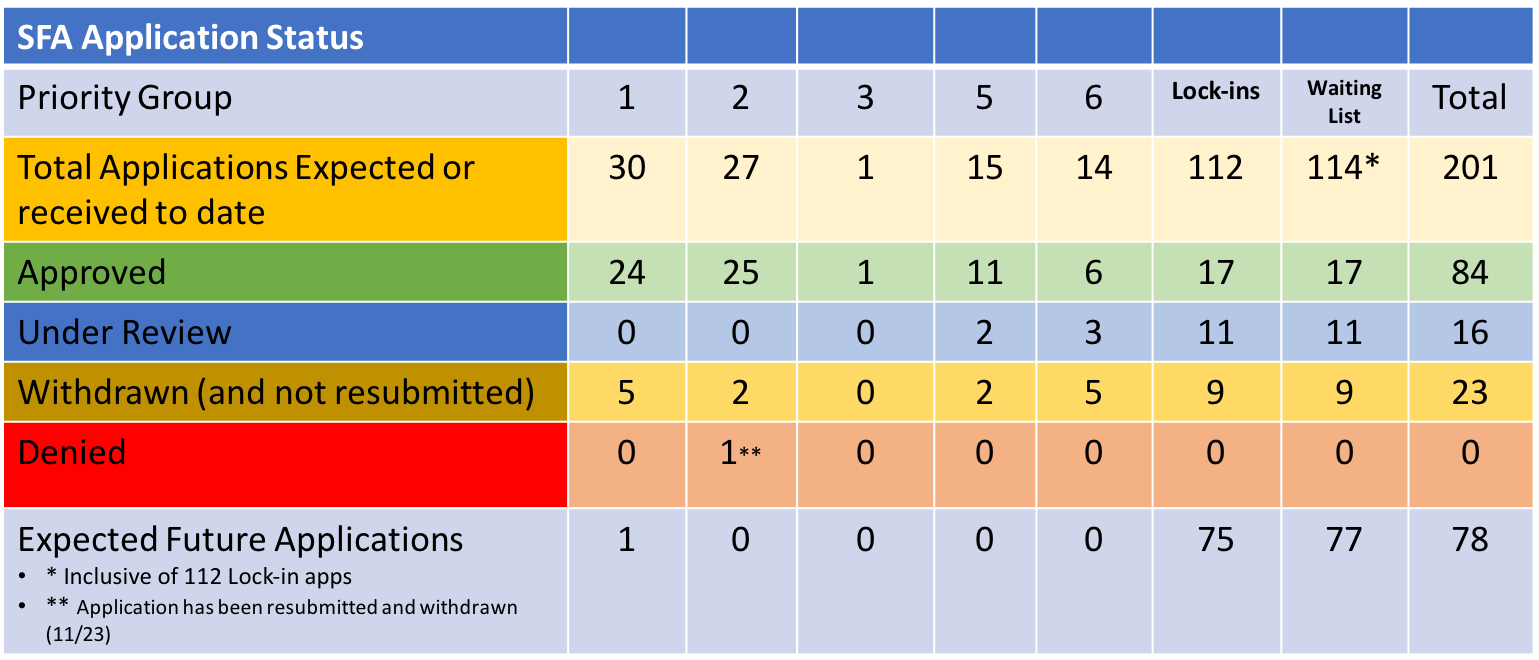
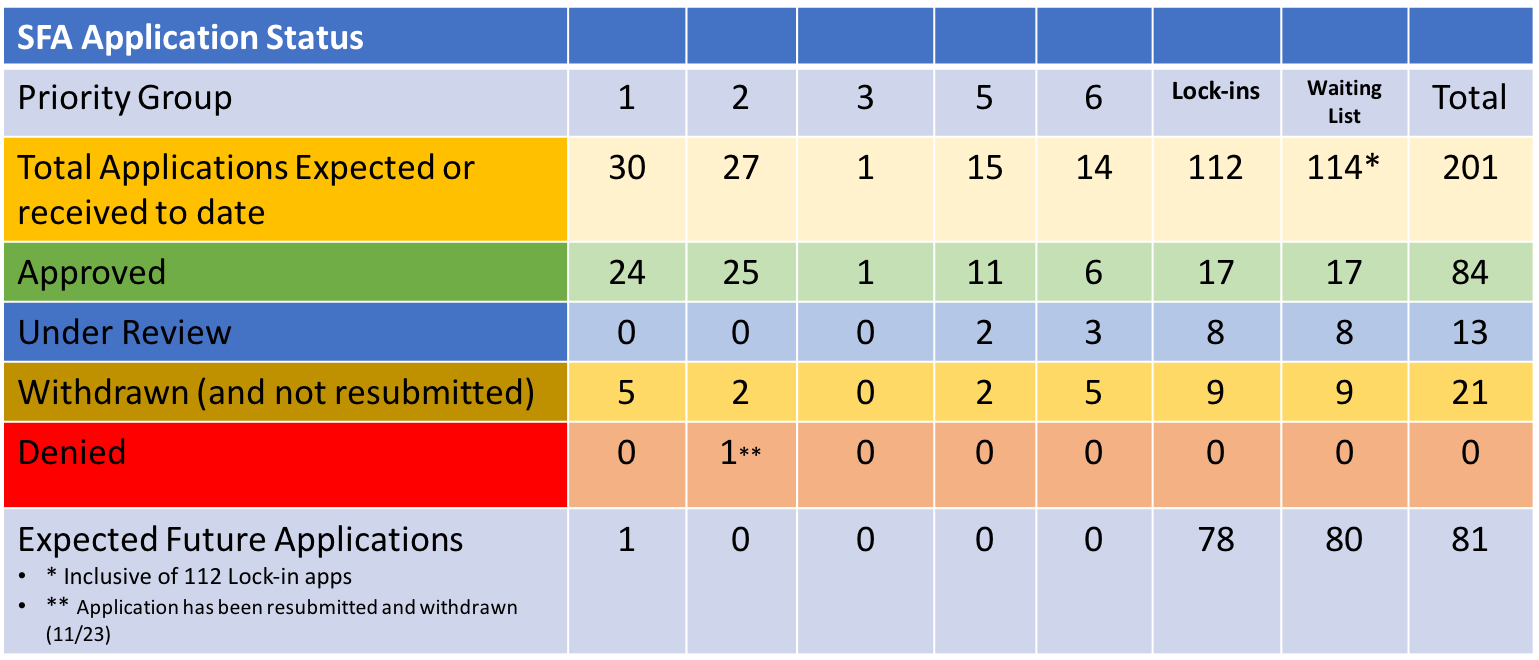
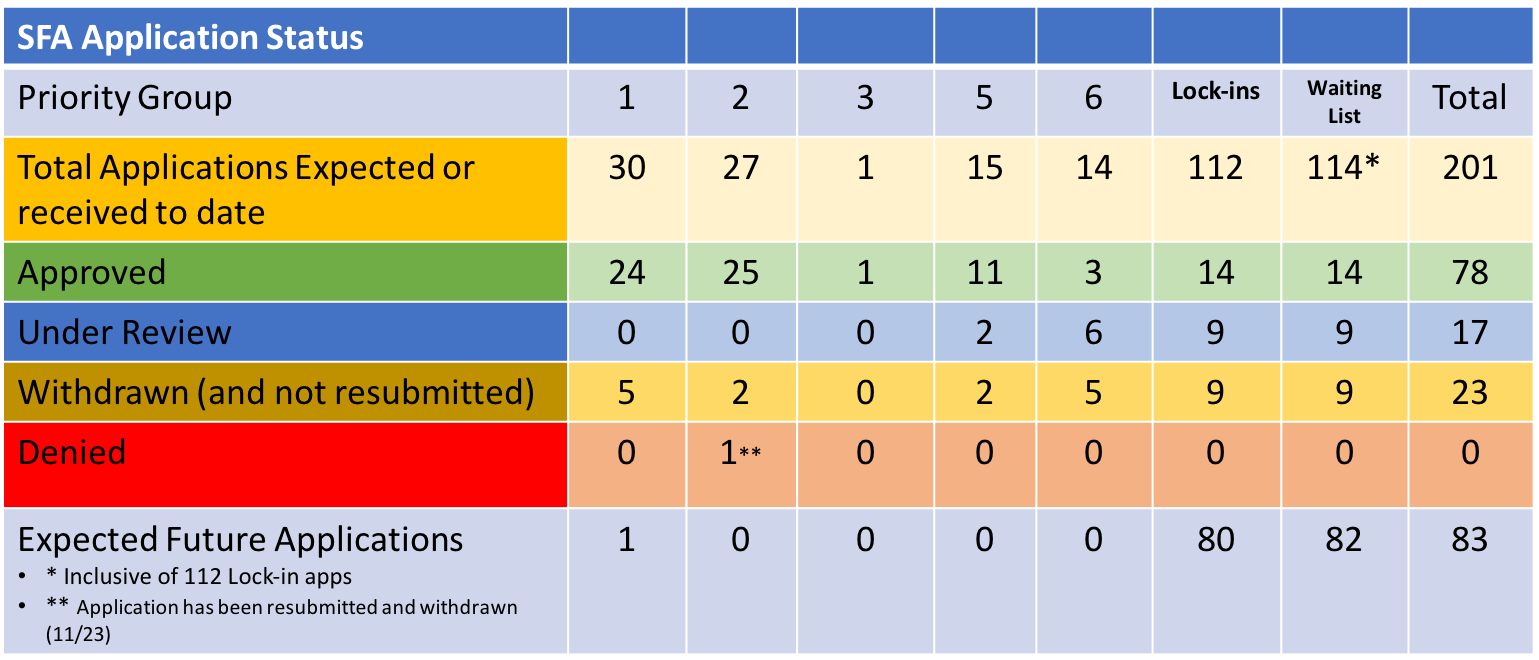
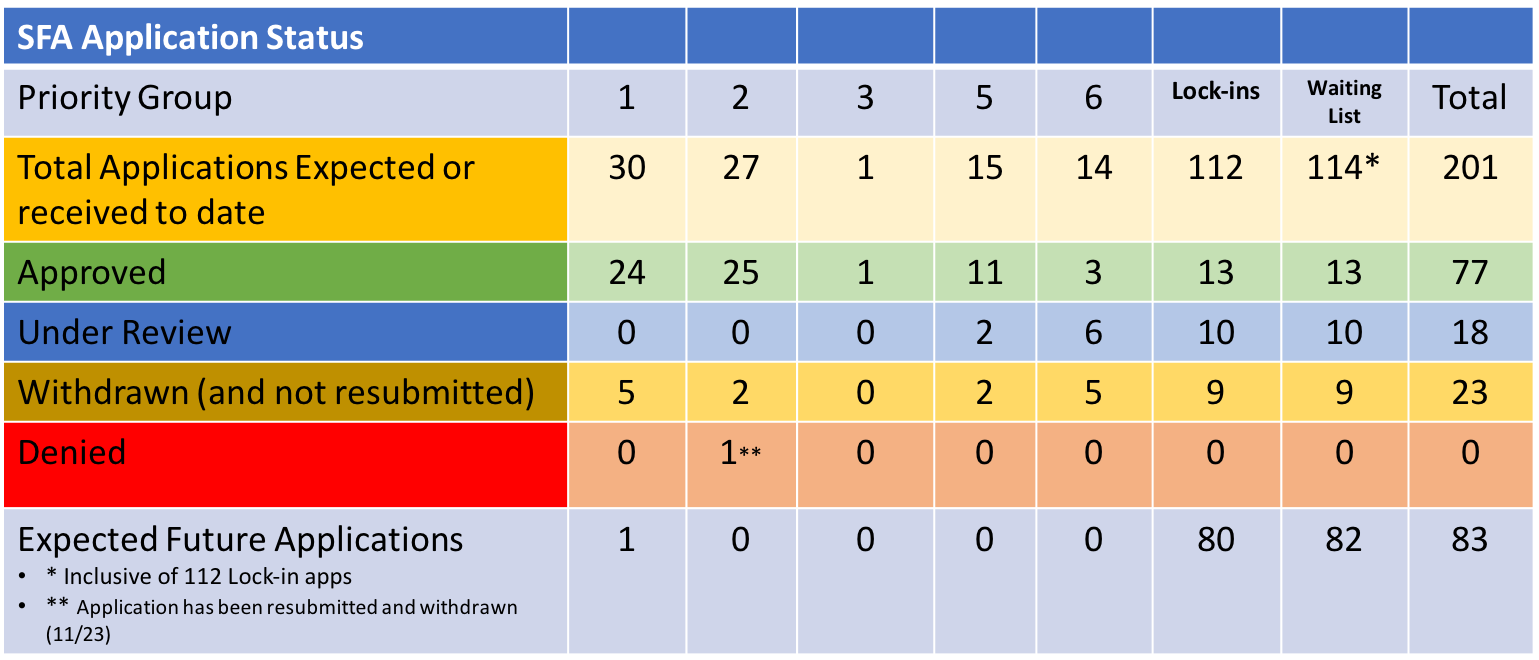
There currently are 114 names on the waitlist. Of those, 27 have been invited to submit applications. As the data above reflects, 8 of those applications have been approved, 12 are currently under review, while another 7 have been withdrawn presumably to have the submission corrected and resubmitted. In addition to that activity, 112 of the 114 funds have locked-in a valuation date for SFA measurement (discount rate). Ninety-two percent of those chose 12/31/22, while 2 have no lock-up and the other 9 have chosen dates between December 31, 2022 and November 30, 2023. As a reminder, the SFA is based on a series of discount rates. The lower the rate, the greater the potential SFA. Using the 10-year Treasury yield as a proxy for the discount rate, those plans locking in an evaluation date as of year-end 2022 have done alright, as the yield at the end of 2022 was 3.88%, while it currently stands at 4.63% (4/29 at 3:39 pm).

We’ll have to see if the others have faired as well. In the meantime, the higher US interest rates have certainly helped from an investment standpoint, as the current environment is providing 5%+ YTM investment grade bond portfolios. The higher rates reduce the cost of those future promises while extending the coverage period to secure benefits through a cash flow matching investment strategy.

Tricky? Not Sure Why!

By: Russ Kamp, Managing Director, Ryan ALM, Inc.

The WSJ produced an article on April 22, 2024 titled, “Path for 10-Year U.S. Treasury Yield to 5% Is Possible but Tricky” At the time of publication, the 10-year Treasury note yield was just under 4.7%. It is currently at 4.66%. Those providing commentary talked about the need to further reduce expectations for potential rate cuts of another 25 to 40 basis points. As you may recall, there were significantly greater forecasts of rate cuts at the beginning of 2024, but those have been scaled back in dramatic fashion.

Given the current inflationary landscape in which the Consumer Price Index for All Urban Consumers (CPI-U) increased 0.4 percent in March and 3.5% annually, a move toward 5% for the US 10-year Treasury note’s yield shouldn’t be surprising or tricky. According to the graph below, the US 10-year yield has averaged a “real” yield of nearly 2% (1.934%) since 1984. A 2% inflation premium would place today’s 10-year Treasury note yield at roughly 5.6%.

Given the current economic conditions (2.9% GDP growth for Q1’24) and labor market strength (3.8% unemployment rate), it certainly doesn’t seem like the Fed’s “aggressive” action elevating the Fed Funds Rate from 0 to 5.5% today has had the impact that was anticipated. Inflation in 2024 has been sticky and may in fact be increasing. Should geopolitical issues grow in magnitude, inflation may get worse. These current conditions don’t say to me that a move to a 5% 10-year Treasury note yield should be tricky at all. As a reminder, the yield on this note hit 4.99% in late October 2023. Financial conditions have not gotten more restrictive since then.

Should the Treasury yield curve ratchet higher, with the 10-year eventually eclipsing 5%, plan sponsors would have a wonderful opportunity to secure the future promised benefits at significantly reduced cost in present value terms, especially if the cash flow matching portfolio used investment grade corporate bonds with premium yields. Although US corporate bond spreads are tight relative to average spreads, they still provide a healthy premium. Don’t let this rate environment pass without taking some risk from your plan’s asset allocation. We’ve seen that scenario unfold before and the outcome is scary.