The Status Quo Isn’t Working

By: Russ Kamp, Managing Director, Ryan ALM, Inc.

Anyone who has read just a handful of the >1,400 blog posts that I’ve produced knows that I am a huge fan of defined benefit (DB) plans. That I’ve come to loathe the fact that DB plans were/are viewed as dinosaurs, and as a result have been mostly replaced by ineffective defined contribution plans. As a result, the American worker is less well-off given the greater uncertainty of their funding outcome. A dignified retirement is getting further out of reach for a majority of today’s workers.

That said, just because I desire to see DB plans maintained as the primary retirement vehicle, doesn’t mean that I appreciate how many of them have been managed. The pension plan asset allocations remain focused on the wrong objective, which continues to be the ROA and NOT the plan’s liabilities. It is this mismatch in the primary objective that has exacerbated the volatility of the funded ratio/status and contribution expenses. As I’ve stated many times, it is time to get off the asset allocation rollercoaster. We need to bring an element of certainty to the investment structure despite the fact that outcomes within the capital markets are highly uncertain.

How bad have things been? According to a recently produced analysis by Piscataqua Research, Inc., which regularly reviews the performance of both assets and liabilities for 127 state and local retirement systems, since 2000 contributions as a % of pay have tripled, while funded status has declined by more than 25%. Again, I’m not here to bash public funds. On the contrary, I am here to offer a potential solution to the volatility exhibited. I wrote a piece many years (1/17) ago titled, “Perpetual Doesn’t Mean Sustainable” in which I discussed the need to bring stability to these critically important retirement plans because at some point there might just be a revolt from the taxpayers that are lacking defined benefit participation themselves. We can’t afford to have tens of millions of American public fund workers added to the federal social safety net God forbid their retirement plans are terminated and benefits frozen prematurely.

There is only one asset class – bonds – in which the future performance is known on the day that the bond is acquired. You can’t tell me what Amazon or Tesla will be worth in 10 years or the value of a building or private equity portfolio, but I can tell you how much interest and principal you will have earned on the day that the bond matures, whether that be 3-, 5-, 10- or 30-years from now. That information is incredibly valuable and can be used to match and SECURE the pension plan’s liabilities. That portion of the plan’s assets will now provide stability and certainty reducing the ups and downs exhibited through normal market behavior. Why continue to embrace an asset allocation that has NO certainty? An asset allocation that can create the explosion in contribution expenses that we’ve witnessed.

DB plans need to be protected and preserved! Ryan ALM’s focus is solely on achieving that lofty goal. It should be your goal, too. Let us help you get off the asset allocation rollercoaster before markets reach their peak and we once again ride those market down creating a funding deficit that will take years and major contributions to overcome.
CFM: Buy Time and Reduce Risk

By: Russ Kamp, Managing Director, Ryan ALM, Inc.

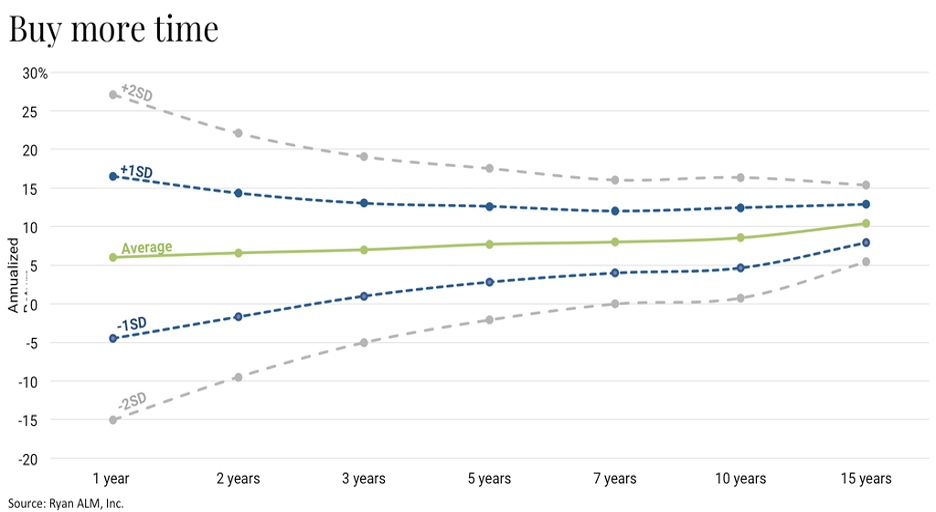
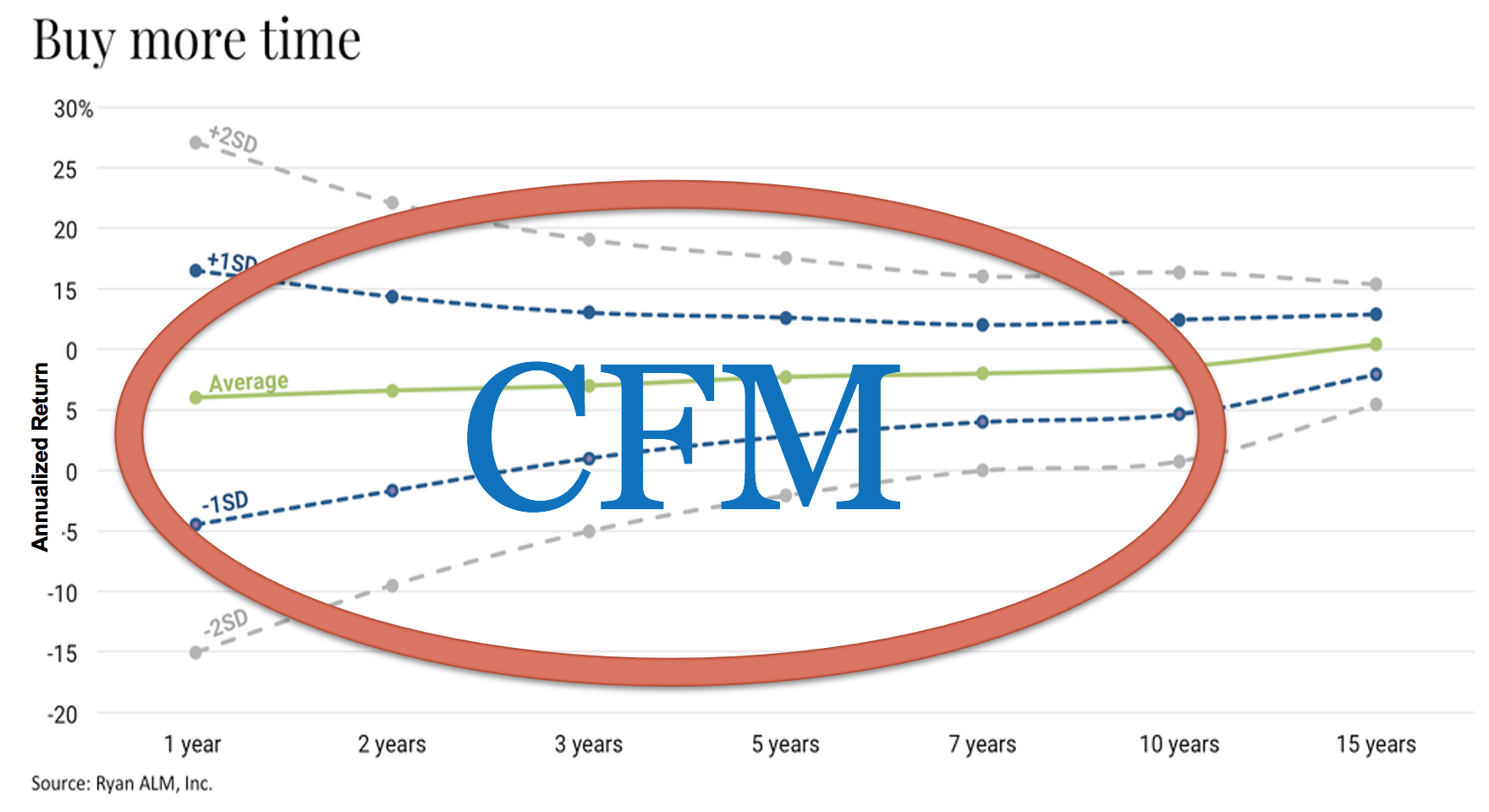
A traditional DB plan’s asset allocation comes with a lot of annual volatility (see the graph below). That volatility gets reduced as one extends the investing horizon, but it is still quite uncertain until you extend sufficiently, such as 10 or more years. However, as plan sponsors and investment managers, we have been living in a quarter-to-quarter measurement cycle for decades. In that environment, a 1 standard deviation (1 SD) measurement for a 1-year time frame (Ryan ALM asset allocation model since 1999) is +/- 10.5%. In the example below, 68% of the observations (1 SD) will fall between 16.5% and -4.5%. A 2 SD measurement would have the range for 95% of the observations between 27% and -15%. That gap, or should I say canyon, is a 1-year observation. Extend the measurement period to 5-years and the range of results is still wide but less so at +/- 9.8% for 2 SDs. It isn’t until you get beyond 10 years that the volatility associated with a fairly traditional asset allocation gets to a reasonable level.

Is there a way to bring more certainty to the asset allocation process that would allow for longer observation periods and less volatility? Absolutely! A plan sponsor and their advisors can adopt a bifurcated asset allocation in which a liquidity bucket is created that will fund and match the plan’s liability cash flows of benefits and expenses chronologically from the next month as far out as the allocation will cover (10+ years) allowing for the remainder of the alpha assets (all non-bond assets) to now grow unencumbered. The task for those assets is to meet future liabilities.

As the graph below highlights, a carefully constructed cash flow matching (CFM) portfolio can help plan sponsors wade through the volatility associated with shorter timeframes. The CFM portfolio will consist of investment grade bonds whose cash flows of interest and principal will be matched to the liability cash flows. This process now ensures (absent defaults) that the necessary liquidity is available when needed as those future promises have been SECURED. The remaining assets can now be managed as aggressively as the plan’s funded status dictates.

With this process, short-term market dislocations will no longer impact the plan’s ability to meet its obligations. There will be no forced selling to meet benefit payments. The alpha assets can now grow without fear of being sold at an unreasonable level. The CFM program takes care of your needs while establishing a buffer (longer investing horizon) from market corrections that happen on a fairly regular basis. This structure should also lead to less volatility related to contributions and the plan’s funded status.

Given the elevated US interest rate environment, now is the time to engage in this process. CFM will provide a level of certainty that doesn’t exist in a traditional asset allocation. This is a “sleep well at night” strategy that should become the core holding for DB pensions. As I mentioned in an earlier blog post today, bonds should only be used for the cash flows they produce. They should not be used as total return-seeking instruments. Leave that task to the alpha assets that will benefit from a longer investing period.

Healthier Than Ever? Nah!

By: Russ Kamp, Managing Director, Ryan ALM, Inc.

P&I produced an article yesterday titled, “Corporate Pension Funds Are Fully Funded, Healthier Than Ever. Now What?” According to Milliman, corporate pension plans are averaging roughly a funded ratio of 106%. This represents a healthy funded status, but it is by no means the healthiest ever. One may recall that corporate plans were funded in excess of 120% as recently as 2000. In what might be more shocking news, public pension plans were too when using a market discount rate (ASC 715 discount rate). Today, those public pension plans have a funded status of roughly 80% according to Milliman’s latest public fund report.

The question, “Now what”? is absolutely the right question to be asking. Many corporate plans have already begun de-risking, as the average exposure to fixed income is >45% according to P&I’s asset allocation survey through November 2023. Unfortunately, public pension systems still sit with only about 18% exposure to US fixed income, preferring a “let it ride” mentality as equities and alternatives account for more than 75% of the average plan’s asset allocation. Is this the right move? No. The move into alternatives has dried up liquidity, increased fees, and reduced transparency. Furthermore, just because a public plan believes that its sponsor is perpetual, does that make the system sustainable? You may want to be reminded about Jacksonville Police and Fire. There are other examples, too.

Whether the pension plan is corporate, multiemployer, or public, the asset allocation should reflect the funded status. There is no reason that a 60% funded plan should have the same asset allocation as one that is 90% or better funded. All plans should have both liquidity and growth buckets. The liquidity bucket will be a bond allocation (investment grade corporates in our case) that matches asset cash flows to liability cash flows of benefits and expenses. That bucket will provide all of the necessary liquidity as far into the future as the pension system can afford. The remaining assets will be focused on outperforming future liability growth. These assets will be non-bonds that now have the benefit of an extended investing horizon to grow unencumbered. Forcing liquidity in environments in which natural liquidity has been compromised only serves to exacerbate the downward spiral.

Pension America has the opportunity to stabilize the funded status and contribution expenses. They also have the chance to SECURE a portion of the promises. How comforting! We saw this movie a little more than 20 years ago. Are we going to treat this opportunity as a Ground Hog Day event and do nothing or are we going to be thoughtful in taking appropriate measures to reduce risk before the markets bludgeon the funded status? The time to act is now. Not after the fact.

What’s the Motivation?

By: Russ Kamp, Managing Director, Ryan ALM, Inc.

There appears in the WSJ today an article stating that pension plans were pulling “hundreds of billions from stocks”. According to a Goldman analyst, “pensions will unload $325 billion in stocks this year, up from $191 billion in 2023″. We are told that proceeds from these sales will flow to both bonds and alternatives. First question: What is this estimate based on? Are average allocations now above policy normal levels necessitating a rebalancing? Are bonds more attractive given recent movements in yields?

Yes, equities have continued to rally through 2024’s first quarter, and the S&P 500 established new highs before recently pulling back. Valuations seem stretched, but the same argument could have been made at the end of 2023. Furthermore, US interest rates were higher heading into 2023’s fourth quarter. If bond yields were an attractive alternative to owning equities, that would have seemed the time to rotate out of equities.

The combination of higher interest rates and equity valuations have helped Corporate America’s pensions achieve a higher funded status, and according to Milliman, the largest plans are now more than 105% funded. It makes sense that the sponsors of these plans would be rotating from equities into bonds to secure that funded status and the benefit promises. Hopefully, they have chosen to use a cash flow matching (CFM) strategy to accomplish the objective. Not surprisingly, public pension plans are taking a different approach. Instead of securing the benefits and stabilizing the plan’s funded status and contribution expenses by rotating into bonds, they are migrating both equities and bonds into more alternatives, which have been the recipients of a major asset rotation during the last 1-2 decades, as the focus there remains one of return. Is this wise?

I don’t know how much of that estimated $325 billion is being pulled from corporate versus public plans, but I would suggest that much of the alternative environment has already been overwhelmed by asset flows. I’ve witnessed this phenomenon many times in my more than 40 years in the business. We, as an industry, have the tendency to arbitrage away our own insights by capturing more assets than an asset class can naturally absorb. Furthermore, the migration of assets to alternatives impacts the liquidity available for plans to meet ongoing benefits and expenses. Should a market correction occur, and they often do, liquidity becomes hard to find. Forced sales in order to meet cash flow needs only serve to exacerbate price declines.

Pension plans should remember that they only exist to meet a promise that has been made to the participant. The objective should be to SECURE those promises at a reasonable cost and with prudent risk. It is not a return game. Asset allocation decisions should absolutely be driven by the plan’s funded status and ability to contribute. They shouldn’t be driven by the ROA. Remember that alternative investments are being made in the same investing environment as public equities and bonds. If market conditions aren’t supportive of the latter investments, why does it make sense to invest in alternatives? Is it the lack of transparency? Or the fact that the evaluation period is now 10 or more years? It surely isn’t because of the fees being paid to the managers of “alternative” products are so attractive.

Don’t continue to ride the asset allocation rollercoaster that only ensures volatility, not success! The 1990’s were a great decade that was followed by the ’00s, in which the S&P 500 produced a roughly 2% annualized return. The ’10s were terrific, but mainly because stocks were rebounding from the horrors of the previous decade. I don’t know what the 2020s will provide, but rarely do we have back-to-back above average performing decades. Yes, the ’90s followed a strong ’80s, but that was primarily fueled by rapidly declining interest rates. We don’t have that scenario at this time. Why assume the risk?

The Truth Will Set You Free!

By: Russ Kamp, Managing Director, Ryan ALM, Inc.

Managing a pension plan should be all about securing the promised benefits at a reasonable cost and with prudent risk. I believe that most plan sponsors would agree, yet that is not how plans are managed, especially public and multiemployer plans that continue to pursue the return on asset assumption (ROA) as if it were the Holy Grail. I’ve written quite a bit on this subject, including discussing asset consulting reports that should have the relationship of plan assets to plan liabilities on page one of the quarterly performance reports.

We know that pension liabilities are like snowflakes, as there are no two pension liability streams that are the same given the unique characteristics of each labor force. Furthermore, most pension actuaries only produce an annual update making more frequent (monthly/quarterly) updates more challenging. Would plan sponsors want a more frequent view of the liabilities if they were available? I think that they would. Again, if securing the promised benefits are the primary objective when it comes to managing a pension plan, then plan sponsors need a more frequent view of the relationship between assets and liabilities.

Why is this important? First and foremost, the capital markets are constantly moving, and the changes impact the value of the plan’s assets all the time. But it isn’t just the asset-side that is being impacted, as liabilities are bond-like in nature and they change as interest rates change. We’ve highlighted this activity in both the Ryan ALM Pension Monitor and the Ryan ALM Quarterly Newsletter. However, accounting rules for both multiemployer and public plans allow a static discount rate equivalent to the plan’s ROA to be used that hides the impact of those changing interest rates on the value of a plan’s liabilities and funded status.

What if a more frequent analysis was available at a modest cost. Would plan sponsors want to see how the funded status was behaving? Would they want that comparison available to help with asset allocation changes, especially if it meant reducing risk as funding improved? I suspect that they would. Well, there is good news. Ryan ALM, Inc. created a Custom Liability Index (CLI) in 1991. The CLI is designed to be the proper benchmark for liability driven objectives. The CLI calculates the present value of liabilities based on numerous discount rates (ASC 715 (FAS 158), PPA – MAP 21, PPA – Spot Rates, GASB 67, Treasury STRIPS and the ROA). The CLI calculates the growth rate, summary statistics, and interest rate sensitivity as a series of monthly or quarterly reports depending on the client’s desired frequency.

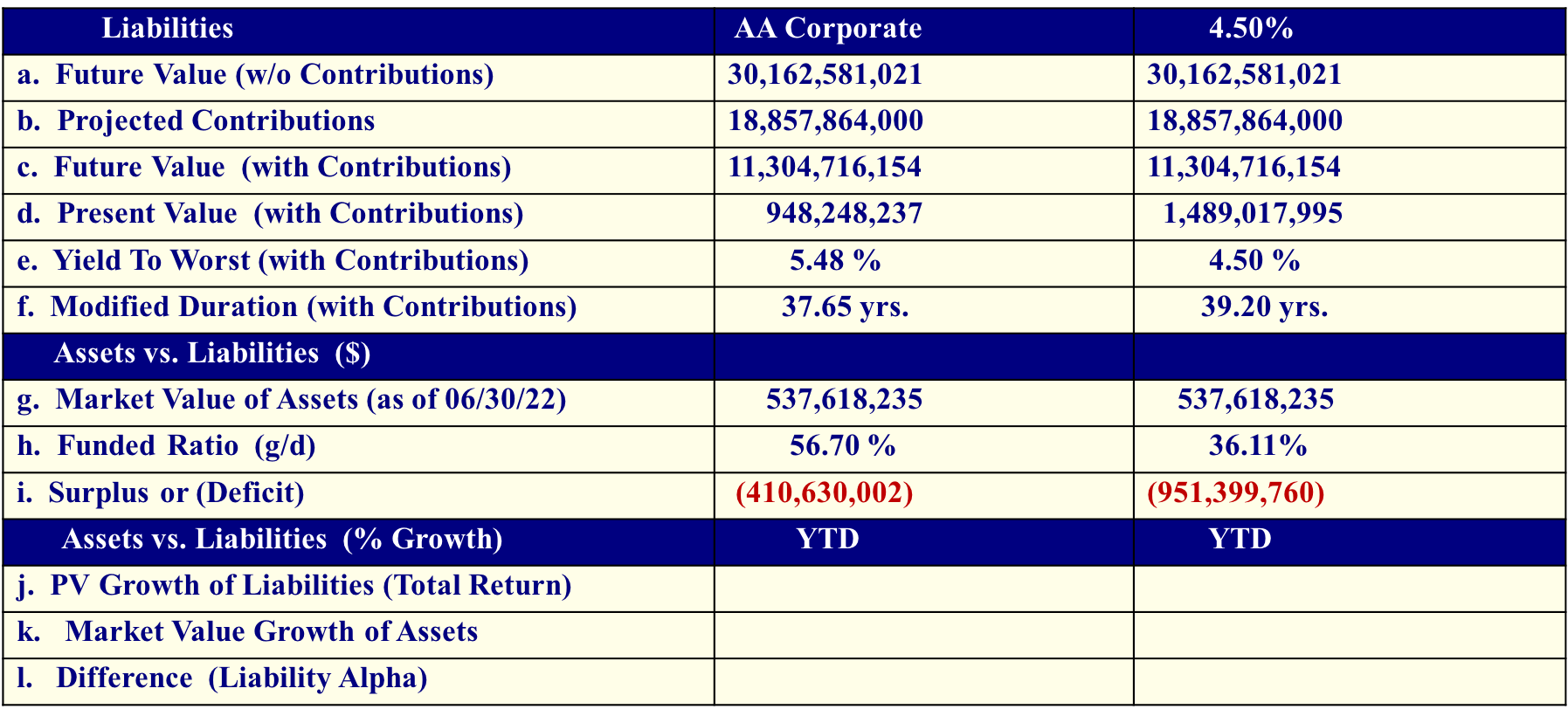
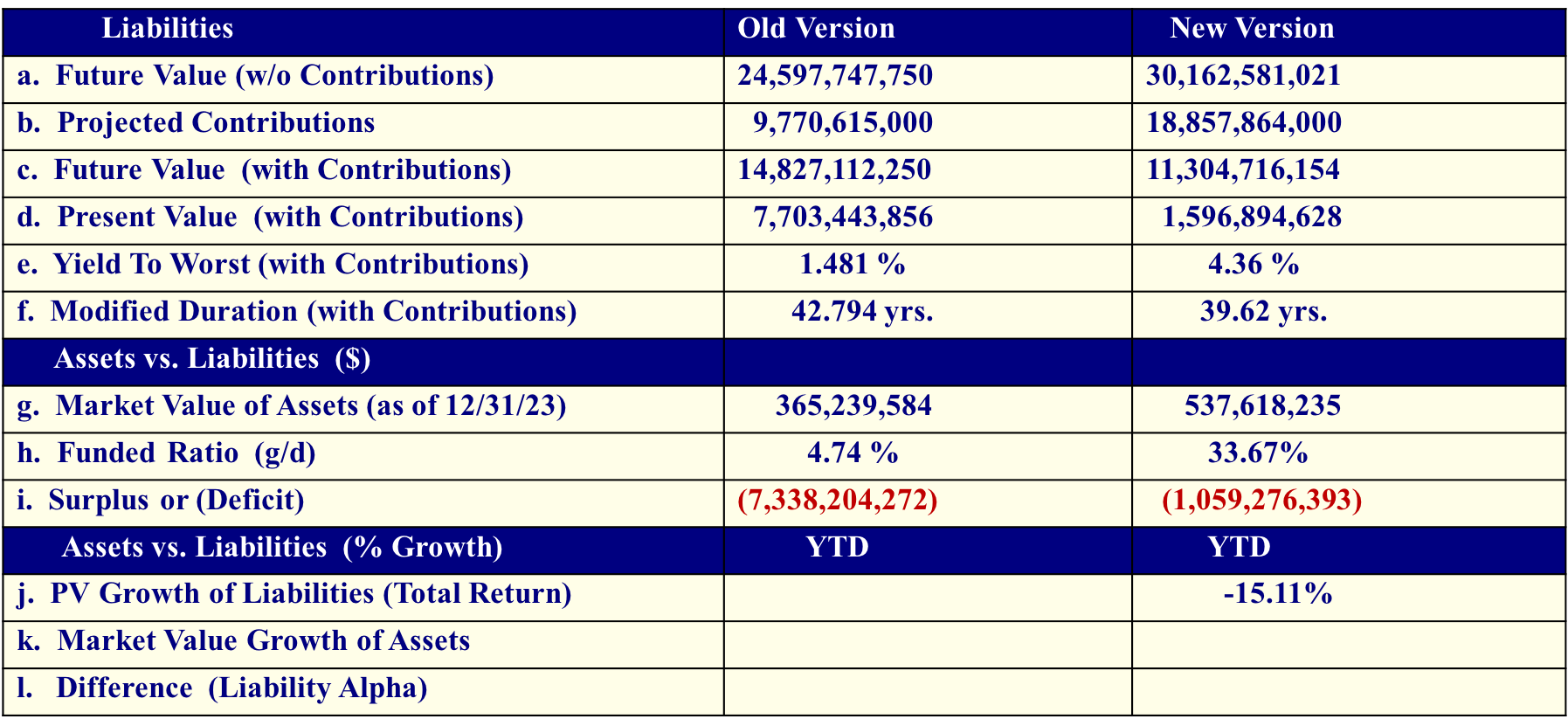
The above information is for an actual client, who we’ve been providing a CLI for 15+ years. This client has elected to receive quarterly reviews. They’ve also chosen to see the impact on liabilities for multiple discount rates, including a constant 4.5% ROA, which could easily be a pension plan’s ROA of say 7%. As you will note, the present value (PV) of those future value (FV) liabilities are different, and they could be dramatic, depending on the interest rate used. In this case, the AA Corporate rate (5.48% YTW) produces a funded ratio of 56.7%, while the flat 4.5% rate increases the PV liabilities thus reducing the funded status by more than 20%.

Using Treasury STRIPS as the discount rate produces the lowest funded ratio of 33.7% or 23% lower than using the AA Corporate discount rate.

With this information, plan sponsors and their advisors (consultants and actuaries) can make informed decisions related to contributions and asset allocation. Most plan sponsors are currently blind to these facts. As a result, decisions may be taken without having all of the necessary facts. Pension plans need to be protected and preserved (Ryan ALM’s mission). Having a complete understanding of what those future promises look like is essential.

You’ve made a promise: measure it – monitor it – manage it – and SECURE it…   

Get off the pension funding rollercoaster – sleep well!

Weakening Jobs Growth To Further Pressure DB Plans

Given the news from this morning regarding US job growth (only 142,000 jobs added and revisions down in the previous two months), it would not surprise us to see US interest rates continue to fall.  If in fact this happens, DB plans’ funded ratios and funded status will continue to weaken. As we’ve reported on numerous occasions, plan liabilities, although discounted at the ROA, do not grow at the same rate as assets.

Liability growth has far outpaced asset growth in the last 15 years, and the asset allocation mismatch that exists between a plan’s assets and liabilities continues to be dramatic.  With most everyone expecting interest rates to rise, fixed income exposures have been reduced and bond durations shortened. A combination that continues to weigh on plan performance.

We continue to believe that weak global growth will keep interest rates low for the foreseeable future, and as such, fixed income exposures should be increased and reconfigured to meet near-term liabilities.  I will be discussing this concept / strategy at the upcoming FPPTA conference on Tuesday in Naples, FL.

Plans continue to focus almost exclusively on their fund’s ROA, but the liability side of the equation needs some attention, too, especially given the prospects for continuing global economic weakness.  In this environment, a plan will not close it’s funding gap through outperformance relative to its ROA.

Market Volatility Giving You The Woollies?

I’ve witnessed many market declines during my more than 33 years in the investment industry, and I would be lying if I told you that I called the beginning, end, and ultimate magnitude of any of the sell-offs.  Market declines are part of the investing game.  But just knowing that isn’t enough, as unfortunately, they can have a profound impact on retirement plans and retirement planning, both institutional and individual, as they impact the psyche of the investors.

It is well documented how individuals tend to buy high and sell low. The market crash of 2007 – 2009 drove many individuals out of equities at or near the bottom, and many of those “investors” have kept their allocations to equities below 2007 levels. It hasn’t been that much better for the average institutional investor either.  We are aware of a number of situations (NJ for one) that plowed into expensive, absolute-return product at the bottom of the equity market only to see that portfolio dramatically underperform very inexpensive beta, as the equity markets have rallied since March 2009.

In some cases, the selling “pressure” was the result of liquidity needs, which lead to the tremendous explosion in the secondary markets for private equity, real estate, etc. in 2009.  The E&F asset allocation model, made so famous by Yale, was the undoing for many retirement plans, as the failure to secure adequate liquidity exacerbated market losses. Who knows whether the turmoil in Greece will lead to their exit (expulsion) from the Euro, but there is certainly heightened fear and volatility in the global markets? Are you currently prepared to meet your liquidity needs?

As we’ve discussed within both the Fireside Chats and on the KCS blog, the development of a hybrid asset allocation model geared specifically to your plan’s liabilities, can begin to de-risk your plan, while dramatically improving liquidity.  The introduction of the beta / alpha concept will provide plan sponsors with an inexpensive cash matching strategy that meets near-term benefit needs, while extending the investing horizon for the less liquid investments in your portfolio. By not being forced to sell into the market correction, your investments have a greater chance of rebounding when the market settles.

Traditional asset allocation models subject the entire portfolio to market movements, while the beta / alpha approach only subjects the alpha assets to volatility.  But, since one doesn’t have to sell alpha assets to meet liquidity needs given that the beta portfolio is used for that purpose, the volatility doesn’t matter. Don’t fret about Greece and its potential implications for the global markets and your plan. Let us help you design an asset allocation that improves liquidity, extends the investment horizon for your alpha assets, and begins to de-risk your plan, as the funded ratio and status improve.

The latest Iteration of the “High School Dance”

It has been a very long time since I was in high school, and as a result, things may be different today.  But, what I remember about my high school days and the dances at Palisades Park, NJ, were that the boys stood on one side of the gym and the girls stood on the other.  Occasionally a couple of girls would dance, but there was little fraternizing among the boys and girls.

Well, I get the same sense about the management of DB pension plans today, as I did at those dances a very long time ago.  It seems to me that we have on one side of the “gym” assets and on the other side is liabilities, and never the twain shall meet.  As a result, DB plans haven’t found their rhythm and there is no dancing!

We get periodic updates from a number of industry sources highlighting how the funded status is improving or deteriorating.  But we don’t seem to get a lot of direction on how we should mitigate the volatility in the funding of these extremely important retirement vehicles.  I can say with certainty that it isn’t striving to achieve the ROA.  That’s been tried, and DB plans continue to see deterioration in their funded ratios.

For too long, the asset side of the pension equation has dominated everyone’s focus, and as a result, a plan’s specific liabilities are usually only discussed when the latest actuarial report is presented, which is on a one or two year cycle.  This isn’t nearly often enough. We suggest that the primary objective for the assets should be the plan’s liabilities, and that every performance review start off with this comparison.  However, in order to get an accurate accounting of the liabilities one needs a custom liability index (CLI).

In order to preserve DB plans we need assets and liabilities dancing as one. Without this, DB plans face a very uncertain future. Are you ready to bring both parties to the dance floor?

Next 10 years Could Really Challenge Your ROA Assumption – Are You Ready?

According to Standard & Poor’s Institutional Market Services, which polled 679 defined benefit plan sponsors, the median return on asset (ROA) assumption is 7.56%, down slightly from 2013.  How realistic is this objective?  According to Rob Arnott, sponsors will have a very difficult time in the near future meeting this objective. Arnott gave investors a gloomy forecast for medium-term returns at the Inside ETFs Europe conference recently, and urged the audience to think of a new way to attack the ROA challenge.

According to Arnott, “10-year forward-looking expected returns are unanimously low.” He is predicting that Core fixed-income stands at 0.5 percent real returns as well as long-dated inflation linked bonds. Long Treasuries will go barely above zero. U.S. equities are 1 percent above inflation, and small-caps also give 1 percent, despite their yield of 1.8 percent.

Furthermore, the “Growth of earnings and dividends over and above inflation is 1.3 percent, not the 5 percent or more that Wall Street wants us to believe,” said Arnott.

Importantly, these real return expectations are before fees, which for many active strategies would “eat” most of the potential gain. Arnott’s research found that the U.S. top-quartile active manager pockets 0.9371% of the “alpha” and only passes on 0.0629% on to the client.

The plan sponsor quest to meet the ROA challenge has also produced exceptional volatility.  In the next 10 years, volatility is likely to remain at these levels or increase, but it seems that the return won’t be there to compensate for that extra volatility.  Importantly, we believe that liability growth is likely to be flat to negative during the next 10 years as interest rates rise, so a more conservative asset allocation may accomplish a sponsor’s funding goal.

We would suggest that a plan sponsor focus more attention on the plan’s liabilities to drive asset allocation decisions.  However, in order to accomplish this objective, the plan needs to have greater transparency on their liabilities.  Receiving an actuarial report every one or two years will not suffice.  In order to gain greater clarity, we would suggest that plans have a custom liability index (CLI) produced. The CLI will use various discount rates, and will provide a view with and without contributions factored in.  The CLI is provided on a monthly basis.

As a reminder, the only reason that a DB plan exists is to fund a benefit that has been promised in the future. Knowing how that benefit is changing on a regular basis should be a goal of every plan. We stand ready to provide you with the tools necessary to gain greater transparency on your plan’s liabilities, since it doesn’t seem that plan’s will win the funding game by generating outsized returns in the next decade.

KCS May 2015 Fireside Chat – Do You Know The Answer?

We are pleased to share with you the latest edition of the KCS Fireside Chat series.

Click to access KCSFCMay2015.pdf

This article is the 34th in our series.  In this piece we explore whether or not the US Federal Reserve is likely to raise interest rates in the near-term – the $64,000 question.

The uncertainty surrounding this action continues to challenge DB plan asset allocation decisions.  Level to falling US rates will continue to harm DB plan funded ratios.

We hope that you find our insights thought provoking.  Please don’t hesitate to reach out to us with any comments and / or questions, or if we can be of any assistance to you.