You Can’t Manage What You Don’t Measure!

By: Russ Kamp, CEO, Ryan ALM, Inc.

Nearly 10 years ago, before joining Ryan ALM, I wrote an article about the idea that plan sponsors need to focus on their fund’s liabilities, as much as, if not more than, their plan’s assets. It shouldn’t be a shocking statement since the only reason that the plan exists is to fund a promise (benefit) that has been granted. Yet I would often get strange looks and frowns every time that concept was mentioned.

Why? Well, for over 50 years, pension sponsors and their consultants have been under the impression that if the return on assets (ROA) objective is achieved or exceeded, then the plan’s funding needs shall be sated. Unfortunately, this is just not true. A plan can achieve the ROA and then some, only to have the Funded Ratio decline and the Funded Status deteriorate, as liability growth exceeds asset growth.

We place liabilities – and the management of plan assets versus those liabilities – at the forefront of our approach to managing DB plans. Pension America has seen a significant demise in the use of DB plans, and we would suggest it has to do, in part, with how they’ve been managed. It will only get worse if we continue to support the notion that only the asset side of the pension equation is relevant. Focusing exclusively on the asset side of the equation with little or no integration with the plan’s liabilities has created an asset allocation that can be completely mismatched versus liabilities. It is time to adopt a new approach before the remaining 23,000 or so DB plans are all gone!

Our Suggestion

As this article’s title suggests, to manage the liability side of the equation, one needs a tool to measure and monitor the growth in liabilities, and it needs to be more frequent than the actuarial report that is an annual document usually available 3-6 months following the end of the calendar or fiscal year.

Such a tool exists – it is readily available, yet under-appreciated and certainly under-utilized! Ryan ALM has provided this tool to DB plan sponsors; namely, a Custom Liability Index (CLI), since 1991. This is a real time (available monthly or quarterly) index based on a plan’s specific projected liabilities. Furthermore, the output from this index should be the primary objective for a DB plan and not asset growth versus some hybrid index. Importantly, the CLI will provide to a plan sponsor (and their consultant) the following summary statistics on the liabilities, including:

  • Term-structure, Duration and Yield to Worst
  • Growth Rate of the Liabilities
  • Interest Rate Sensitivity
  • Present Value based on several discount rates

Different discount rates are used depending on the type of plan. GASB allows the ROA to be used as the discount rate for public pension plans, while FASB has a AA Corporate blended rate (ASC 715) as the primary discount rate for corporate plans. Having the ability (transparency) to see a plan’s liabilities at various discount rates with projected contributions is an incredible tool for both contribution management and asset allocation. Don’t hesitate to reach out to us for more information on how you can get a Custom Liability Index for your pension plan.

Buy on the Rumor…

By: Russ Kamp, CEO, Ryan ALM, Inc.

After 44-years in the investment industry I’ve pretty much heard most of the sayings, including the phrase “buy on the rumor and sell on the news”. I suspect that most of you have probably heard those words uttered, too. However, it isn’t always easy to point out an example. Here is graph that might just do the trick.

There had been significant anticipation that the U.S Federal Reserve would cut the Fed Funds Rate and last week that expectation was finally realized with a 0.25% trimming. However, it appears that for some of the investment community that reduction wasn’t what they were expecting. As the graph above highlights, the green line representing Treasury yields as of this morning, have risen nicely in just the last 6 days for most maturities 3 months and out, with the exception of the 1-year note. In fact, the 10- and 30-year bonds have seen yields rise roughly 10 bps. Now, we’ve seen more significant moves on a daily basis in the last couple of years, but the timing is what has me thinking.

There are still many who believe that this cut is the first of several between now and the end of 2025. However, there is also some trepidation on the part of some in the bond world given the recent rise in inflation after a prolonged period of decline. As a reminder, the Fed does have a dual mandate focused on both employment and inflation, and although the U.S. labor force has shown signs of weakening, is that weakness creating concerns that dwarf the potential negative impact from rising prices? As stated above, there may also have been some that anticipated the Fed surprising the markets by slicing rates by 0.50% instead of the 0.25% announced.

In any case, the interest rate path is not straight and with curves one’s vision can become obstructed. What we might just see is a steepening of the Treasury yield curve with longer dated maturities maintaining current levels, if not rising, while the Fed does their thing with short-term rates. That steepening in the curve is beneficial for cash flow matching assignments that can span 10- or more years, as the longer the maturity and the higher the yield, the greater the cost reduction to defease future liabilities. Please don’t let this attractive yield environment come and go before securing some of the pension promises.

ARPA Update as of 9/19/25

By: Russ Kamp, CEO, Ryan ALM, Inc.

Good morning and welcome to the first full day of Fall. Autumn has always been my favorite season. How about you?

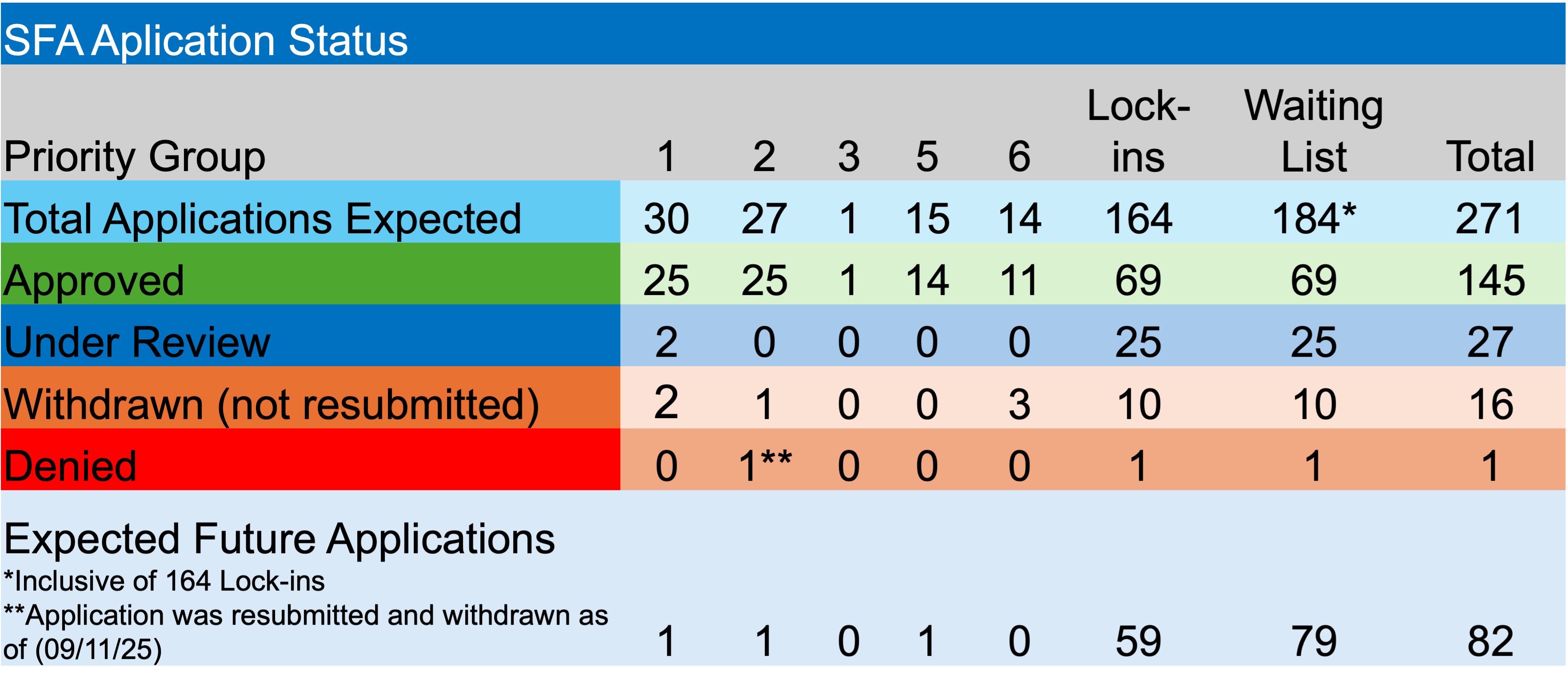
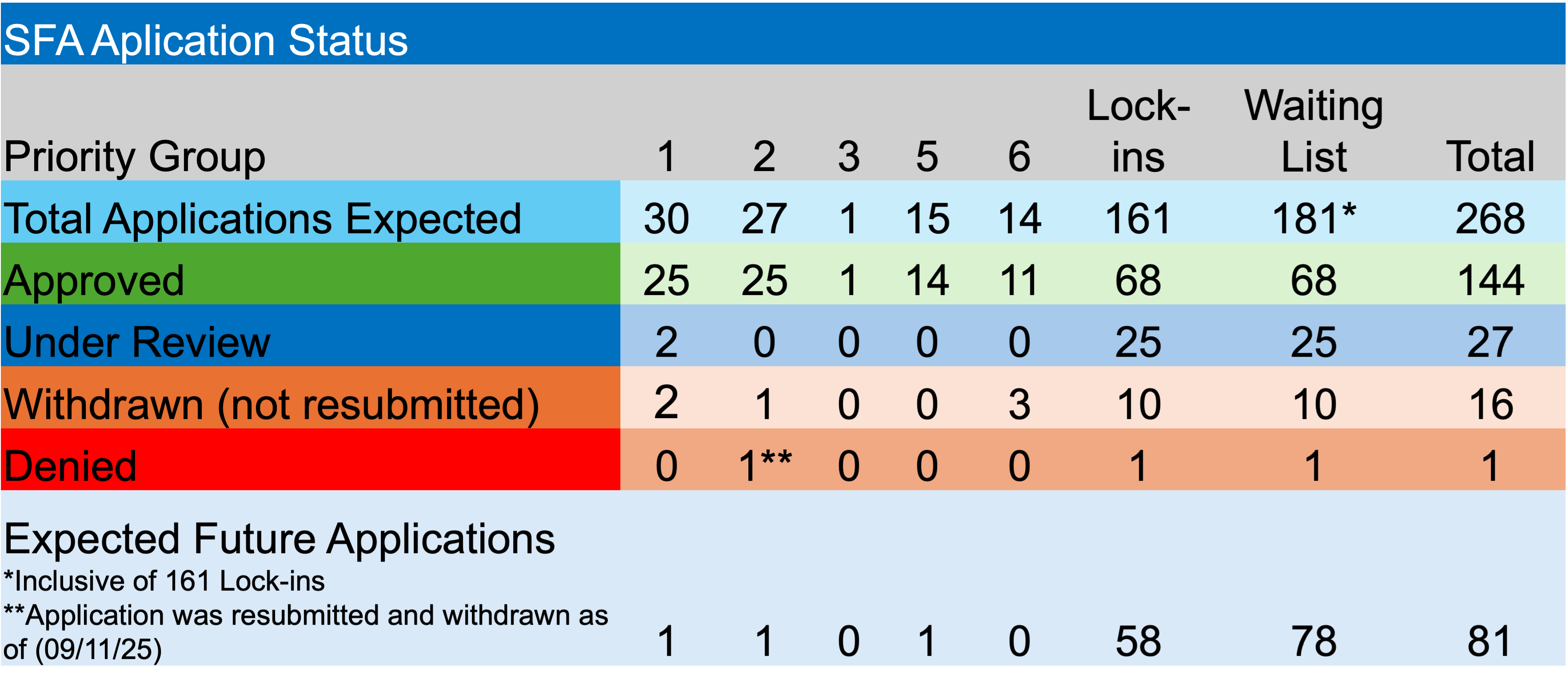
Regarding the implementation of ARPA’s pension legislation by the PBGC, we are now about 3 1/2 months away from the deadline to have all initial applications seeking Special Financial Assistance (SFA) submitted. Unfortunately, there are still dozens of multiemployer pension plans sitting on the PBGC’s waitlist.

Last week witnessed a slower pace of activity, as the PBGC is only reporting the submission of three applications and the repayment of excess SFA by one fund. There were no applications approved, denied, or withdrawn during the previous week. Furthermore, there were no pension funds seeking to be added to the waitlist and none of the plans currently sitting on that list locked-in the valuation date. We may not see any new plans being added to the list given the rapidly approaching deadline for initial application submission. As a reminder, those plans that submit an application before 12/31/25 can submit a revised application until 12/31/26 – the legislation’s deadline.

Pleased to report that Pension Trust Fund Agreement of St. Louis Motion Picture Machine Operators, Teamsters Local 837 Pension Plan, and Iron Workers’ Pension Trust Fund for Colorado each submitted an initial application seeking SFA. These non-Priority Group members are hoping to secure >$30 million for the nearly 3,200 plan participants. As a reminder, the PBGC has 120-days to act on these applications.

Finally, there was one plan asked to rebate a portion of the SFA based on a census error. Western Pennsylvania Teamsters and Employers Pension Fund, a recipient of $994.6 million has agreed to rebate $8.8 million or 0.89% of the grant. To date, 61 multiemployer pension funds have repaid $260.7 million in excess SFA on grants totaling $53.4 billion or 0.49%.

We hope that you have a great week. Check back in next Monday for the next ARPA legislation update.

Houston, We Have A Problem!

By: Russ Kamp, CEO, Ryan ALM, Inc.

That famous phrase from the movie Apollo 13, is actually modified from the original comment spoken by Jack Swigert, the command module pilot, who said, “Okay, Houston…we’ve had a problem here”. In any case, I am not referencing our space program, the City of Houston or for that matter, any other municipality. However, I am acknowledging that we continue to have an issue with how the debt of companies, municipalities, and other government entities get rated and how those rating agencies get compensated.

There was a comment in New Jersey Spotlight News (a daily email newsletter) that stated “New Jersey is facing uncertain economic times, to say the least, but its state government got a vote of confidence from Wall Street this week.” Of course, I was intrigued to understand what this vote of confidence might be especially given my knowledge of the current economic reality facing my lifelong state of residence. It turns out that Moody’s has elevated NJ’s debt rating. Huh?

Moody’s action in raising the rating to Aa3 follows a similar path that S&P took several months ago. Yes, NJ was able to recently close its budget gap by $600 million through tax increases but given that the state has one of the greatest tax burdens of any U.S. state, the ability to further raise taxes is likely significantly curtailed unless they want to witness a mass exodus of residents, including the author of this post!

According to Steve Church, Piscataqua Research, a highly experienced and thoughtful actuary, “New Jersey’s public employees, teachers, police and fire systems are $96B underfunded by reference to their actuaries’ contribution liability calculations and $154B underfunded using their actuaries’ LDROM calculations!” Ouch! Furthermore, they offer an OPEB that is funded at <10%. In addition, New Jersey, like many states, will be negatively impacted by the cuts in Medicaid and other social safety net programs. These cuts are likely to put significant pressure on the state’s budget, which has already risen significantly in just the last 5 years from $38.3 billion in fiscal year 2020 to nearly $60 billion today.

So, how is it possible that NJ could see a ratings increase given the significant burden that it continues to face in meeting future pension and OPEB funding, while also protecting the social safety net that so many Jersey residents are depending on. Well, here’s the rub. Rating agencies are paid under the practice called “issuer-pays”. This process has often been criticized, especially during the GFC when a host of credit ratings were called into question. Unfortunately, few alternatives have been put into practice today. How likely will a municipality or corporate entity pay an agency for a rating that puts the sponsor in a poor light? We’ve been extremely fortunate to have mostly weathered recent economic storms, but as history has shown, there is likely another just around the corner. How will these bonds hold up during the next crisis?

Dear Plan Sponsor: Please ask Yourself the Following Questions

By: Russ Kamp, CEO, Ryan ALM, Inc.

Do you believe that your pension plan exists to meet (secure) a promise (benefit) that was given to the plan’s participants?

Are you factoring in that benefit promise when it comes to asset allocation?

Do you presently have exposure to core fixed income, and do you know where U.S. interest rates will be in the next day, month, year, 5-years?

Has liquidity to meet benefits and expenses become more challenging with the significant movement to alternatives – real estate, private equity, private debt, infrastructure, etc.?

Do you believe that providing investment strategies more time is prudent?

So, if you believe that securing benefits, driving asset allocation through a liability lens, improving liquidity, eliminating interest rate risk, and buying-time are important goals when managing a defined benefit plan, how are you accomplishing those objectives today?

Cash Flow Matching (CFM) achieves every one of those goals! By strategically matching asset cash flows of interest and principal from investment-grade bonds against the liability cash flows of benefits and expenses, the DB pension plan’s asset allocation becomes liability focused, liquidity is improved from next month as far out as the allocation covers, interest rate risk is mitigated for the CFM portfolio, the investing horizon is extended for the remaining assets improving the odds of a successful outcome, and most importantly, the promises made to your participants are SECURED!

How much should I invest into a CFM program? The allocation to CFM should be a function of the plan’s funded ratio/status, the ability to contribute, and the level of negative cash flow (contributions falling short of benefits and expenses being paid out). Since all pension plans need liquidity, every DB pension plan should have some exposure to CFM, which provides the necessary liquidity each month of the assignment. There is no forced liquidation of assets in markets that might not provide natural liquidity.

Again, please review these questions. If they resonate with you, call me. We’ll provide you with a good understanding of how much risk you can remove from your current structure before the next market crash hits us.

Glorified Savings Accounts!

By: Russ Kamp, CEO, Ryan ALM, Inc.

This could happen to any company, so I’m not writing this post to pick on Sherwin-Williams (love their paint), but they just happen to be the latest firm to “temporarily” suspend the matching contribution into the employee 401(k) plan. S-W cited economic conditions, that in many cases are getting worse, for the need to preserve cash at this time. It is also being reported that they did this same thing during the GFC and again in 2020 during Covid. In both cases, they eventually restored full-matching of benefits at 100% on the first 6% contributed by employees.

Again, I’m not picking on Sherwin-WIlliams. But this decision highlights my concerns about 401(k)s in general. It is bad enough that we are asking untrained individuals to fund, manage, and then disburse a “retirement” benefit with little disposable income, investment acumen, or a crystal ball to help forecast longevity, but we also have employers who can suspend, reduce, or eliminate contributions at the drop of a hat.

Few American workers are saving enough to ensure a quality retirement. With general living expenses continuing to rise, the assets needed to enjoy a retirement is getting more significant all the time. When an employer can suspend or amend a contribution level and an employee can suspend contributions, take a loan, switch jobs and cash out a balance, this vehicle is not a retirement account. It is truly a glorified savings account. We need to bring back defined benefit plans as the primary retirement program. DC plans were intended to be supplemental, and given the funding challenges, that’s the lane that they should occupy.

ARPA Update as of September 12, 2025

By: Russ Kamp, CEO, Ryan ALM, Inc.

Welcome to FOMC week. I wouldn’t ordinarily mention the Federal Reserve in the ARPA update, but we could see an interest rate cut, and perhaps one that is larger than currently anticipated. The implications from falling interest rates are potential large, as it raises the costs to defease pension liabilities (benefits and expenses) that would be secured through the SFA grant by reducing the coverage period. This impact could be potentially diminished if the yield curve were to steepen given recent inflationary news.

Enough about rates and the Fed. The PBGC is still plugging away on the plethora of applications before them and those yet to be accepted. Currently, there are 20 applications under review. Teamsters Industrial Employees Pension Plan is the latest fund to submit an application seeking SFA. They are hoping to secure $27.4 million for the 1,888 participants. The PBGC has 6-7 applications that must be finalized in each of the next 3 months.

Happy to report that both Alaska Teamster – Employer Pension Plan and Hollow Metal Pension Plan received approval for their applications. The two non-priority pension funds will receive a combined $240.1 million for >13k members.

In other ARPA news, Bakery Drivers Local 550 and Industry Pension Fund, a Priority Group 2 member, whose initial application was originally denied because they were deemed ineligible, has had their revised application denied because of “completeness”. Will three times be the charm? In their latest application they were seeking $125.8 million to support 1,122 plan participants.

Lastly, Greater Cleveland Moving Picture Projector Operators Pension Fund, became the most recent fund added to the waitlist. They are the 167th fund on the waitlist of non-priority members, with 74 still to submit an application. According to the PBGC’s website, their e-Filing portal is limited at this time.

We’ll keep you updated on the activity of the U.S. Federal Reserve and the potential implications from their interest rate decision. Hopefully, concerns related to inflation will offset the current trends related to employment providing future SFA recipients with an environment conducive to defeasing the promised benefits at higher yields and thus, lower costs.

Actuaries of DB Pension Plans Prefer Higher Interest Rates

By: Russ Kamp, CEO, Ryan ALM, Inc.

I produced a post yesterday, titled “U.S. Rates Likely to Fall – Here’s the Good and Bad”. In that blog post I wrote, “I’d recommend that you not celebrate a potential decline in rates if you are a plan sponsor or asset consultant, unless you are personally looking for a loan.” Falling rates have historically benefited plan assets, and not just bonds, but risk assets, too. But lower rates cause the present value (PV) of liabilities to grow. A 50 bp decline in rates would cause the PV of liabilities to grow by 6% assuming a duration of 12-years. NOT GOOD!

Not being a trained actuary, although I spend a great deal of time communicating with them and working with actuarial output, I was hesitant to make that broad assessment. But subsequent research has provided me with the insights to now make that claim. Yes, unlike plan sponsors and asset consultants that are likely counting down the minutes to a rate cut next week, actuaries do indeed prefer higher interest rates.

Actuaries of DB pension plans, all else being equal, generally prefer higher interest rates when it comes to funding calculations and the plan’s financial position.

Impact of Higher Interest Rates

  • Lower Liabilities: When interest rates (used as the discount rate for future benefit payments) increase, the (PV) of the plan’s obligations may sharply decrease depending on the magnitude of the rate change, making the plan look better funded.
  • Lower Required Contributions: Higher discount rates mean lower calculated required annual contributions for plan sponsors and often lead to lower ongoing pension costs, such as PBGC costs per participant.
  • Potential for Surplus: Sustained periods of higher rates can create or increase pension plan surpluses, improving the financial health of the DB plan and providing flexibility for sponsors.

Why This Preference Exists

  • Discount Rate Role: Actuaries discount future benefit payments using an assumed interest rate tied to high-grade bond yields. The higher this rate, the less money is needed on hand today to meet future obligations.
  • Plan Health: Lower required contributions and lower projected liabilities mean sponsors are less likely to face funding shortfalls or regulatory intervention. Plans become much more sustainable and plan participants can sleep better knowing that the plan is financially healthy.
  • Plan Sponsor Perspective: While actuaries may remain neutral in advising on appropriate economic assumptions (appropriate ROA), almost all calculations and required reports look stronger with higher interest rates. What plan sponsor wouldn’t welcome that reality.

Consequences of Lower Interest Rates

  • Increase in Liabilities: Contrary to the impact of higher rates, lower rates drive up the PV of projected payments, potentially causing underfunded positions and/or the need for larger contributions.
  • Challenge for Plan Continuation: Persistently low interest rates have made DB plans less attractive or sustainable and contributed to a trend of plan terminations, freezes, or conversions to defined contribution or hybrid structures. The sustained U.S. interest rate decline, which spanned nearly four decades (1982-2021), crushed pension funding and led to the dramatic reduction in the use of traditional pension plans.

In summary, actuaries valuing DB pension plans almost always prefer higher interest rates because they result in lower reported liabilities, lower costs, and less financial pressure on employers. Given that 100% of the plan’s liabilities are impacted by movements in rates, everyone associated with DB pensions should be hoping that current interest rate levels are maintained, providing plan sponsors with the opportunity to secure the funded ratio/status through de-risking strategies. A DB pension plan is the gold standard of retirement vehicles and maintaining them is critical in combating the current retirement crisis.

U.S. Rates Likely to Fall – Here’s the Good and Bad

By: Russ Kamp, CEO, Ryan ALM, Inc.

Unfortunately, there exists weakness in the U.S. labor force, as a notable deterioration in job creation, initial jobless claims, and job openings is taking place at this time. This weakness will likely lead the Federal Reserve to lower U.S. interest rates at the next FOMC, which takes place next week with an announcement on the 18th. The current consensus is for a 0.25% reduction in the Fed Fund’s Rate to 4.0%-4.25%. There is also a rising expectation that the “cut” could be larger. That might be more hope than reality at this time, given the CPI’s 0.4% posting today.

So, if rates were to be lowered, who benefits and who gets hurt? Well, individuals seeking loans – mortgages, cars, student loans – certainly benefit. But individuals hoping to generate some income from savings and retirement assets get hurt, especially since these rates tend to be shorter maturity instruments. Who else is impacted? Fixed income asset managers will benefit if they are holding coupon bonds, as falling rates drive bond prices upward. However, those holding bonds with adjustable yields won’t benefit as much.

How about DB pension funds? Yes, those pension funds invested in U.S. fixed income will likely see asset appreciation. However, both public and multiemployer plans have dramatically reduced their average exposure to this asset class. According to P&I’s annual survey, multiemployer plans have 18.2% in U.S. domestic fixed income, while public plans have roughly 18.7% of plan assets dedicated to U.S. fixed income. As a point of reference, corporate plans have nearly half of the plan’s assets dedicate to fixed income (45.4%). As rates fall, these plans will see some appreciation providing a boost in their quest to achieve the desired ROA. Great!

However, let us not forget that pension liabilities will be negatively impacted by falling rates, as they are bond-like in nature and the present value of those liabilities will grow. This is what crushed DB pensions during the massive decline in interest rates from 1982 until 2021. A move down in rates will directly benefit less than 50% of the assets, if we are talking about a corporate plan, and <20% of the assets for multiemployer and public funds. However, 100% of the liabilities will be impacted! Doesn’t seem like a good trade-off. As a result, funded ratios will decline and funded status shortfalls will grow, leading to greater contributions.

Given the mismatch identified above, I’d recommend that you not celebrate a potential decline in rates if you are a plan sponsor or asset consultant, unless you are personally looking for a loan. I would also recommend that you align your plan’s asset cash flows (principal and income from bonds) with your liability cash flows (benefits and expenses) while rates remain moderately high. As I’ve stated many times in this blog, Pension America had a great opportunity to de-risk DB pensions in 1999 but failed to act. Please don’t let this opportunity slip by without appropriate action.

Corporate Pension Funding Up, Again!

By: Russ Kamp, CEO, Ryan ALM, Inc.

Milliman released its monthly Milliman 100 Pension Funding Index (PFI), which analyzes the 100 largest U.S. corporate pension plans. Again, the news was positive.

For August, strong investment performance overcame a decline in discount rates to power the PFI funded ratio from 105.5% at the end of July to 106.2%, as of August 31. As previously mentioned, discount rates slipped during the period from 5.55% to 5.53%, as U.S. interest rates ticked lower, while the index participants enjoyed gains of 1.25%. The collective market value of plan assets rose by $10 billion during August, to $1.290 trillion. Importantly, the index participants experienced a funded status improvement of $8 billion, marking the fifth consecutive monthly rise in funding levels.  

““After strong investment performance, corporate pension plans moved further into surplus territory during August,” said Zorast Wadia, author of the PFI. “However, with the expectation of rate cuts on the horizon, plan sponsors should take steps now to preserve funded status gains and institute prudent asset-liability management strategies.”” (bolding is my addition to the text)

We, Ryan ALM, couldn’t agree more with Zorast’s recommendation. Managing a DB pension plan’s primary objective is to SECURE the promised benefits at a reasonable cost and with prudent risk. It is NOT a performance game. With the great uncertainty surrounding the current economic environment with cross-currents such as job losses and inflation, why wait to remove risk from the plan’s current asset allocation. By doing so, you are minimizing the chance of a significant market decline impacting the pension plan’s funded status/ratio and contributions both taking a hit.

You can read the complete Milliman report in the link below. It’s a good read!

View this Month’s complete Pension Funding Index.