Buy on the Rumor…

By: Russ Kamp, CEO, Ryan ALM, Inc.

After 44-years in the investment industry I’ve pretty much heard most of the sayings, including the phrase “buy on the rumor and sell on the news”. I suspect that most of you have probably heard those words uttered, too. However, it isn’t always easy to point out an example. Here is graph that might just do the trick.
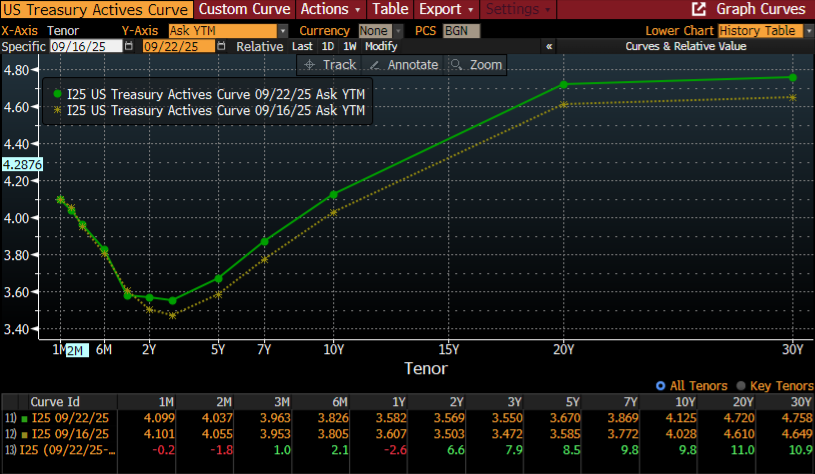
There had been significant anticipation that the U.S Federal Reserve would cut the Fed Funds Rate and last week that expectation was finally realized with a 0.25% trimming. However, it appears that for some of the investment community that reduction wasn’t what they were expecting. As the graph above highlights, the green line representing Treasury yields as of this morning, have risen nicely in just the last 6 days for most maturities 3 months and out, with the exception of the 1-year note. In fact, the 10- and 30-year bonds have seen yields rise roughly 10 bps. Now, we’ve seen more significant moves on a daily basis in the last couple of years, but the timing is what has me thinking.

There are still many who believe that this cut is the first of several between now and the end of 2025. However, there is also some trepidation on the part of some in the bond world given the recent rise in inflation after a prolonged period of decline. As a reminder, the Fed does have a dual mandate focused on both employment and inflation, and although the U.S. labor force has shown signs of weakening, is that weakness creating concerns that dwarf the potential negative impact from rising prices? As stated above, there may also have been some that anticipated the Fed surprising the markets by slicing rates by 0.50% instead of the 0.25% announced.

In any case, the interest rate path is not straight and with curves one’s vision can become obstructed. What we might just see is a steepening of the Treasury yield curve with longer dated maturities maintaining current levels, if not rising, while the Fed does their thing with short-term rates. That steepening in the curve is beneficial for cash flow matching assignments that can span 10- or more years, as the longer the maturity and the higher the yield, the greater the cost reduction to defease future liabilities. Please don’t let this attractive yield environment come and go before securing some of the pension promises.
U.S. Rates Likely to Fall – Here’s the Good and Bad

By: Russ Kamp, CEO, Ryan ALM, Inc.

Unfortunately, there exists weakness in the U.S. labor force, as a notable deterioration in job creation, initial jobless claims, and job openings is taking place at this time. This weakness will likely lead the Federal Reserve to lower U.S. interest rates at the next FOMC, which takes place next week with an announcement on the 18th. The current consensus is for a 0.25% reduction in the Fed Fund’s Rate to 4.0%-4.25%. There is also a rising expectation that the “cut” could be larger. That might be more hope than reality at this time, given the CPI’s 0.4% posting today.

So, if rates were to be lowered, who benefits and who gets hurt? Well, individuals seeking loans – mortgages, cars, student loans – certainly benefit. But individuals hoping to generate some income from savings and retirement assets get hurt, especially since these rates tend to be shorter maturity instruments. Who else is impacted? Fixed income asset managers will benefit if they are holding coupon bonds, as falling rates drive bond prices upward. However, those holding bonds with adjustable yields won’t benefit as much.

How about DB pension funds? Yes, those pension funds invested in U.S. fixed income will likely see asset appreciation. However, both public and multiemployer plans have dramatically reduced their average exposure to this asset class. According to P&I’s annual survey, multiemployer plans have 18.2% in U.S. domestic fixed income, while public plans have roughly 18.7% of plan assets dedicated to U.S. fixed income. As a point of reference, corporate plans have nearly half of the plan’s assets dedicate to fixed income (45.4%). As rates fall, these plans will see some appreciation providing a boost in their quest to achieve the desired ROA. Great!

However, let us not forget that pension liabilities will be negatively impacted by falling rates, as they are bond-like in nature and the present value of those liabilities will grow. This is what crushed DB pensions during the massive decline in interest rates from 1982 until 2021. A move down in rates will directly benefit less than 50% of the assets, if we are talking about a corporate plan, and <20% of the assets for multiemployer and public funds. However, 100% of the liabilities will be impacted! Doesn’t seem like a good trade-off. As a result, funded ratios will decline and funded status shortfalls will grow, leading to greater contributions.

Given the mismatch identified above, I’d recommend that you not celebrate a potential decline in rates if you are a plan sponsor or asset consultant, unless you are personally looking for a loan. I would also recommend that you align your plan’s asset cash flows (principal and income from bonds) with your liability cash flows (benefits and expenses) while rates remain moderately high. As I’ve stated many times in this blog, Pension America had a great opportunity to de-risk DB pensions in 1999 but failed to act. Please don’t let this opportunity slip by without appropriate action.

Corporate Pension Funding Improves Once Again – Milliman

By: Russ Kamp, CEO, Ryan ALM, Inc.

Milliman has provided its monthly update on the health of corporate America’s largest 100 pension plans with the release of the Milliman 100 Pension Funding Index (PFI). The good news continues, as the funded ratio for the PFI plans advanced last month from December’s 104.8% to 105.8% as of January 31, 2025. The improved funded ratio reflected both asset growth of $9 billion as a result of a 1.19% return for the index, while a minimal increase of 1 basis point in the discount rate (now 5.6%) reduced plan liabilities to $1.237 trillion. According to the Zorast Wadia, author of the Milliman PFI, the improved funded ratio marks a 27-month high.

Zorast went on to say, “With Fed rate cuts still a possibility this year, prudent asset-liability management remains a key directive for plan sponsors to preserve the funded status gains achieved thus far.” We don’t make interest rate forecasts at Ryan ALM, but we wholeheartedly agree with Zorast regarding the prudence of preserving the impressive funding gains realized during the last couple of years. Given the stretched equity valuations, taking risk of the table and securing the promised benefits through a cash flow matching strategy makes great sense.

Hey, Pension Community – We Have Liftoff!

By: Russ Kamp, CEO, Ryan ALM, Inc.

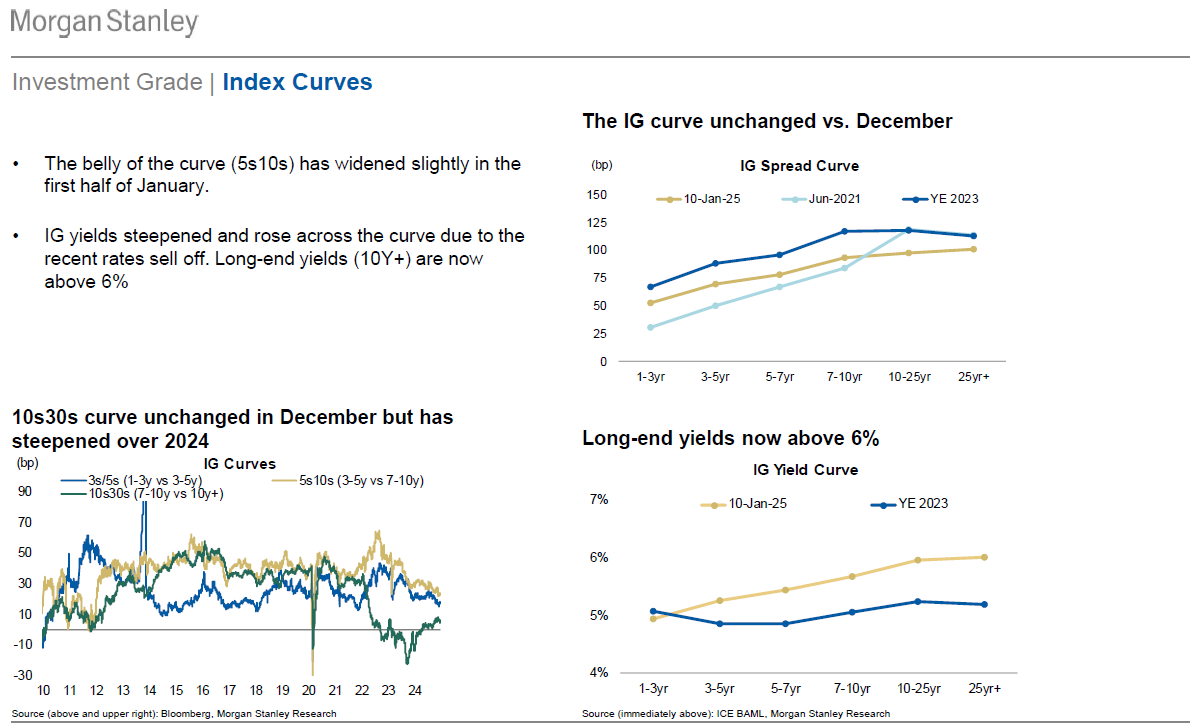
Not since October of 2023 have we seen long-dated Treasury yields at these levels. Currently, the 30-year Treasury bond yield is 5% (12:47 pm EST) and the 10-year Treasury Note’s yield has eclipsed 4.8%. Despite tight credit spreads, long-dated (25+ years) IG corporate bond yields are above 6% today (chart in the lower right corner).

Securing pension liabilities, whether your DB plan is private, public, or a multiemployer plan, should be the primary objective. All the better if that securing (defeasement strategy) can be accomplished at a reasonable cost and with prudent risk. The good news: the current rate environment is providing plan sponsors with a wonderful opportunity to accomplish all of those goals, whether you engage in a cash flow matching (CFM) for a relatively short period (5-years), intermediate, (10ish-years) or longer-term (15- or more years) your portfolio of IG corporate bonds will produce a YTM of > 5.5%. This represents a significant percentage of the target ROA.

Furthermore, as we’ve explained, pension liabilities are future values (FVs), and FVs are not interest rate sensitive. Your portfolio will lock in the cost savings on day one, and barring any defaults (about 2/1,000 in IG bonds), the YTM is what your portfolio will earn throughout the relationship. That is exciting given the fact that traditional fixed income core mandates bleed performance during rising rate regimes. In fact, the IG index is already off 1.2% YTD (<10 trading days).

Who knows when the high equity valuations will finally lead to a repricing. Furthermore, who knows if US inflation will continue to be sticky, the Fed will raise or lower rates, geopolitical risks will escalate, and on and on. With CFM one doesn’t need a crystal ball. You can SECURE the promised benefits for a portion of your portfolio and in the process you’d be stabilizing the funded status and contribution expenses associated with those assets. Don’t let this incredibly attractive rate environment come and go without doing anything. We saw inertia keep plans from issuing POBs when rates were historically low. It is time to act.

Cash Flow Matching Done Right!

By: Russ Kamp, Managing Director, Ryan ALM, Inc.

Most of us seek to climb the “ladder to success”. We also use ladders for important everyday activities. I’ll soon be back on a ladder myself, as year-end approaches and the Christmas lights are placed on my home. Despite the usefulness of ladders, there is one place where they aren’t necessarily beneficial. I’m specifically addressing the use of ladders for bond management as a replacement for a defeasement strategy.

There are still so many misconceptions regarding Cash Flow Matching (CFM). Importantly, CFM is NOT a “laddered bond portfolio”, which would be quite inefficient and costly. It IS a highly sophisticated cost optimization process that maximizes cost savings by emphasizing longer maturity bonds (within the program’s parameters capped at the maximum year to be defeased) and higher yielding corporate bonds, such as A and BBB+.

Furthermore, it is not just a viable strategy for private pension plans, as it has been deployed successfully in public and multiemployer plans for decades, as well as E&Fs. It is also NOT an all or nothing strategy. The exposure to CFM is a function of several factors, including the plan’s funded status, current allocation to core fixed income, and the Retired Lives Liability, etc. Many of our clients have chosen to defease their pension liabilities from 5-30 years or beyond. When asked, we recommend a minimum of 10 years, but again that will be a function of each plan’s unique funding situation.

CFM strategies are NOT “buy and hold” programs. CFM implementations must be dynamic and responsive to changes in the actuary’s forecasts of benefits, expenses, and contributions. There are also continuous changes in the fixed income environment (I.e. yields, spreads, credits) that might provide additional cost savings that need to be monitored and managed. Plan sponsors may seek to extend the initial length (years) of the program as it matures which will often necessitate a restructuring or rebalancing of the original portfolio to maximize potential funding coverage and cost reductions.

CFM programs CANNOT be managed against a generic index, as no pension plan’s liabilities will look like the BB Aggregate or any other generic index. Importantly, no pension plan’s liabilities will look like another pension plan given the unique characteristics of that plan’s workforce and plan provisions. The appropriate management of CFM requires the construction of a Custom Liability Index (CLI) that maps the plan’s liabilities in multiple dimensions and creates the path forward for the successful implementation of the asset/liability match.

Importantly, CFM programs are NOT going to negatively impact the plan’s ability to achieve its desired ROA. In fact, a successful CFM program, such as the one we produce, will actually enhance the probability of achieving the return target. How? Your plan likely has an allocation to core fixed income. Our implementation will likely outyield that portfolio over time creating alpha as well as SECURING the promised benefits. Given the higher corporate bond interest rates, an allocation to this asset class can generate a significant percentage of the ROA target with risks substantially below those of other asset classes.

When done right, a successful CFM implementation achieves the following:

Provides liquidity to meet benefits and expenses

Secures benefits for the time horizon the CFM portfolio is funding (1-10 years +)

Buys time for the alpha assets to grow unencumbered

Out yields active bond management… enhances ROA

Reduces Volatility of Funded Ratio/Status

Reduces Volatility of Contribution costs

Reduces Funding costs (roughly 2% per year in this rate environment)

Mitigates Interest Rate Risk for that portion of the portfolio using CFM as benefits are future values that are not interest rate sensitive.

No laddered bond portfolio can provide the benefits listed above. Whether you are responsible for a DB pension, an endowment or foundation, a HNW individual, or any other pool of assets, you likely have liquidity needs regularly. CFM done right will greatly enhance this process. Call on us. We’ll gladly provide an initial analysis on what can be achieved, and we will do it for FREE.