When Should I Use CFM?

By: Russ Kamp, CEO, Ryan ALM, Inc.

Good morning. I’m currently in Chicago in the midst of several meetings. Yesterday’s meetings were outstanding. As you’d expect, the conversations were centered on DB pension plans and the opportunity to de-risk through a Cash Flow Matching strategy (CFM) in today’s economic environment. The line of questioning that I received from each of my meeting hosts was great. However, there does seem to be a misconception on when and how to use CFM as a de-risking tool. Most believe that you engage CFM for only the front-end of the yield curve, while others think that CFM is only useful when a plan is at or near full funding. Yes, both of those implementations are useful, but that represents a small sampling of when and how to implement CFM. For instance:

As a plan sponsor you need to make sure that you have the liquidity necessary to meet you monthly benefits (and expenses). Do you have a liquidity policy established that clearly defines the source(s) of liquidity or are you scurrying around each month sweeping dividends, interest, and if lucky, capital distributions from your alternative portfolio? Unfortunately, most plan sponsors do not have a formal liquidity policy as part of their Investment Policy Statement (IPS). CFM ensures that the necessary liquidity is available every month of the assignment. There is not forced selling!

Do you currently have a core fixed income allocation? According to a P&I asset allocation survey, public pension plans have an average 18.9% in public fixed income. How are you managing that interest rate risk, which remains the greatest risk for an actively managed fixed income portfolio? As an industry, we enjoyed the benefits of a nearly four decades decline in U.S. interest rates beginning in 1982. However, the prior 28-years witnessed rising rates. Who knows if the current rise in rates is a blip or the start of another extended upward trend? CFM defeases future benefit payments which are not interest rate sensitive. A $2,000 payment next month or 10-years from now is $2,000 whether rates rise or fall. As a result, CFM mitigates interest rate risk.

As you have sought potentially greater returns from a move into alternatives and private investments, not only has the available liquidity dried up, but you need a longer time horizon for those investments to mature and produce the expected outcome. Have you created a bridge within your plan’s asset allocation that will mitigate normal market gyrations? A 10-year CFM allocation will not only provide your plan with the necessary monthly liquidity, but it is essentially a bridge over volatile periods as it is the sole source of liquidity allowing the “alpha” assets to just grow and grow. That 10-year program coincides nicely with many of the lock-ins for alternative strategies.

There has been improvement in the funded status of public pension plans. According to Milliman, as of June 30, 2025, the average funded ratio for the constituents in their top 100 public pension index is now 82.9%, which is the highest level since December 2021. That’s terrific to see. Don’t you want to preserve that level of funding and the contribution expenses that coincide with that level? Riding the rollercoaster of performance can’t be comforting. Given what appears to be excessive valuations within equity markets and great uncertainty as it relates to the economic environment, are you willing to let your current exposures just ride? By allocating to a CFM program, you stabilize a portion of your plan’s funded status and the contributions associated with those Retired Lives Liability. Bringing a level of certainty to a very uncertain process should be a desirable goal for all plan sponsors and their advisors.

If I engage a CFM mandate, don’t I negatively impact my plan’s ability to meet the return objective (ROA) that we have established? NO! The Ryan ALM CFM portfolio will be heavily skewed to investment-grade corporate bonds (most portfolios are 100% corporates) that enjoy a significant premium yield relative to Treasuries and agencies. As mentioned previously, public pension plans already have an exposure to fixed income. That exposure is already included in the ROA calculation. By substituting a higher yielding CFM portfolio for a lower yielding core fixed income program benchmarked to the Aggregate index, you are enhancing the plan’s ability to achieve the ROA while also eliminating interest rate risk. A win-win in my book!

So, given these facts, how much should I allocate to a CFM mandate? The answer is predicated on many factors, including the plan’s current funded status, the ability to contribute, whether or not the plan is in a negative cash flow situation, the Board’s risk appetite, the current ROA, and others. Given that all pension systems’ liabilities are unique, there is no one correct answer. At Ryan ALM, we are happy to provide a detailed analysis on what could be done and at what cost to the plan. We do this analysis for free. When can we do yours?
Risk On or Risk Off?

By: Russ Kamp, CEO, Ryan ALM, Inc.

I have the pleasure of speaking at the Opal/LATEC conference on Thursday. My panel has been given the topic of Risk On or Risk Off: How Are You Adjusting Your Portfolio, and Which Investment Risks Concern You Most? I think it is an incredibly timely discussion given the many cross-currents in the markets today.

Generally speaking, what is risk? At Ryan ALM, Inc. we would say that risk is the failure to achieve the objective. What is the objective in managing a defined benefit pension plan? We believe that the primary objective is to secure the promised benefits at a reasonable cost and with prudent risk. We don’t believe that it is a return objective.

However, most DB pension systems are NOT focused on securing the promised benefits, but they are engaged in developing an asset allocation framework that cobbles together diversified (overly perhaps) asset classes and investment strategies designed to achieve an annual return (ROA) target that has been established through the contributions of the asset consultant, actuary, board of trustees, and perhaps internal staff, if the plan is of sufficient size to warrant (afford) an internal management capability.

Once that objective has been defined, the goal(s) will be carefully addressed in the plan’s investment policy statement (IPS), which is a road map for the trustees and their advisors to follow. It should be reviewed often to ensure that those goals still reflect the trustees’ wishes. The review should also incorporate an assessment of the current market environment to make sure that the exposures to the various asset classes reflect today’s best thinking.

There are numerous potential risks that must be assessed from an investment standpoint. Some of those include market (beta), credit, liquidity, interest rates, and inflation. For your international managers, currency and geopolitical risk must be addressed. From the pension management standpoint, one must deal with both operational and regulatory risk. Some of these risks carry greater weight, such as market risk, but each can have an impact on the performance of your pension plan.

However, there are going to be times when a risk such as inflation will dominate the investing landscape (see 2022). Understanding where inflation MAY be headed and its potential impact on interest rates and corporate earnings is a critical input into how both bonds and stocks will likely perform in the near-term. Being able to assess these potential risks as a tool to adjust your funds asset allocation could reduce risk and help mitigate the negative impact of significant drawdowns that will impact the plan’s funded status and contribution expenses. Of course, the ability to reduce or increase exposures will depend on the ranges that have been established around asset class exposures (refer to your IPS).

So, where are we today? Is it risk on or risk off as far as the investing community is concerned? It certainly appears to me that most investors continue to take on risk despite extreme equity valuations, sticky, and perhaps worsening inflation, leading to an uncertain path for U.S. interest rates, and geopolitical risk that can be observed in multiple locations from the Middle East, to Ukraine/Russia, and China/Taiwan. The recent change in the administration and policy changes related to the use of tariffs has created uncertainty, if not anxiety, among the investment community.

So, how are you adjusting your portfolio? If your plan is managed similarly to most where all the assets are focused on the ROA, the ability to adjust allocations based on the current environment is likely limited to those ranges that I described above. Also, who can market time? I would suggest that the best way to adjust your portfolio given today’s uncertainty is to adopt an entirely different asset allocation framework. Instead of having all of the assets focused on that ROA objective, bifurcate your asset allocation into liquidity and growth buckets.

By adopting this strategy, liquidity is guaranteed to be available when needed to make those pesky monthly benefit payments. In addition, you’ve just bought time, an extremely important investment tenet, for the remainder of the assets (growth/alpha) to now grow unencumbered. The liquidity bucket will provide a bridge over choppy waters churned up by underperforming markets. Yes, there appears to be significant uncertainty in today’s investment environment. Instead of throwing up your hands and accepting the risks because you have limited means to act, adopt the new asset allocation structure before it is too late to protect your plan’s funded status.

Interesting Insights From Ortec Finance

By: Russ Kamp, CEO, Ryan ALM, Inc.

PensionAge’s, Paige Perrin, has produced an article that referenced recent research from Ortec Finance. The research, which surveyed senior pension fund executives in the UK, US, the Netherlands, Canada, and the Nordics, found that 77% believe that risk will be elevated, either dramatically or slightly, in 2025. That’s quite the stat. It also follows on reporting from P&I that referenced heightened uncertainty by U.S. plan sponsors. As regular readers of this blog know, I’ve been suggesting to (pleading with) sponsors that they don’t need to live with uncertainty, which is truly uncomfortable.

Among several risks cited were interest rates, inflation, and market volatility. I can’t say that I blame them for their concerns. Who among us are able to adequately forecast rates and inflation? Seems like most fixed income professionals and bond market participants have been forecasting an aggressive move down in rates. Some of these prognosticators were forecasting as many as 7 rate reductions in 2024 and several others in 2025. We didn’t get 2024’s tally. Who knows about 2025 given that inflation has remained fairly sticky.

There is an easy fix for those of you who are concerned about interest rates and inflation. Adopt a cash flow matching (CFM) strategy that will carefully match asset cash flows of interest and principal with liability cash flows (benefits and expenses). Because benefit payments are future values (FVs), they are not interest rate sensitive. Problem solved! Furthermore, the use of CFM extends the investing horizon for the remainder of the fund’s growth assets, so they now have the appropriate time to grow to meet future liabilities.

One other startling stat caught my attention, as “77 per cent of senior pension fund executives believe the increasing number of retirees relative to the number of new hires in defined benefit (DB) plans pose a “significant” or “slight” risk to the DB pensions industry.” That concern is misplaced. I just wrote a post earlier this week on that subject. DB Pension plans are not Ponzi Schemes. They don’t need more depositors than those receiving payments. It is truly frightening that a significant percentage of our senior plan sponsors don’t understand how these plans are actuarial determined and subsequently funded.

Lastly, I nearly jumped out of my chair with excitement when I read the following quotes from Marnix Engels, Ortec Finance’s managing director for global pension risk, who stated the following:

“We believe assessing the risks of both (the bolding is my emphasis) assets and liabilities in combination is crucial to get the full picture on the health of a pension fund,” he said.

“If the impacts of risk drivers are only understood for one side of the funding health equation, then it is possible to misrepresent the overall effect.”

“If a fund is not assessing both assets and liabilities, then it is difficult to conclude the overall impact of interest rate hikes on the plan’s funding ratio.”

YES!!

ARPA Update as of December 27, 2024

By: Russ Kamp, Managing Director, Ryan ALM, Inc.

We, at Ryan ALM, Inc., wish for you a happy, healthy, and prosperous New Year in 2025. May the markets continue to treat you well. However, nothing grows to the heavens, so it may be wise to alter one’s asset allocation and reduce risk as the year begins given inflated valuations, particularly for large cap US equities.

Regarding ARPA and the PBGC’s on-going effort implementing this critical legislation, there was a pause in activity during the last week. Good for them, as 2024 has been an incredibly busy and successful year. Regarding last week, the PBGC’s eFiling portal remains temporarily closed, so there were no new applications filed. There also weren’t any applications denied, withdrawn, or approved. Finally, there were no repayments made by funds that had received excess SFA.

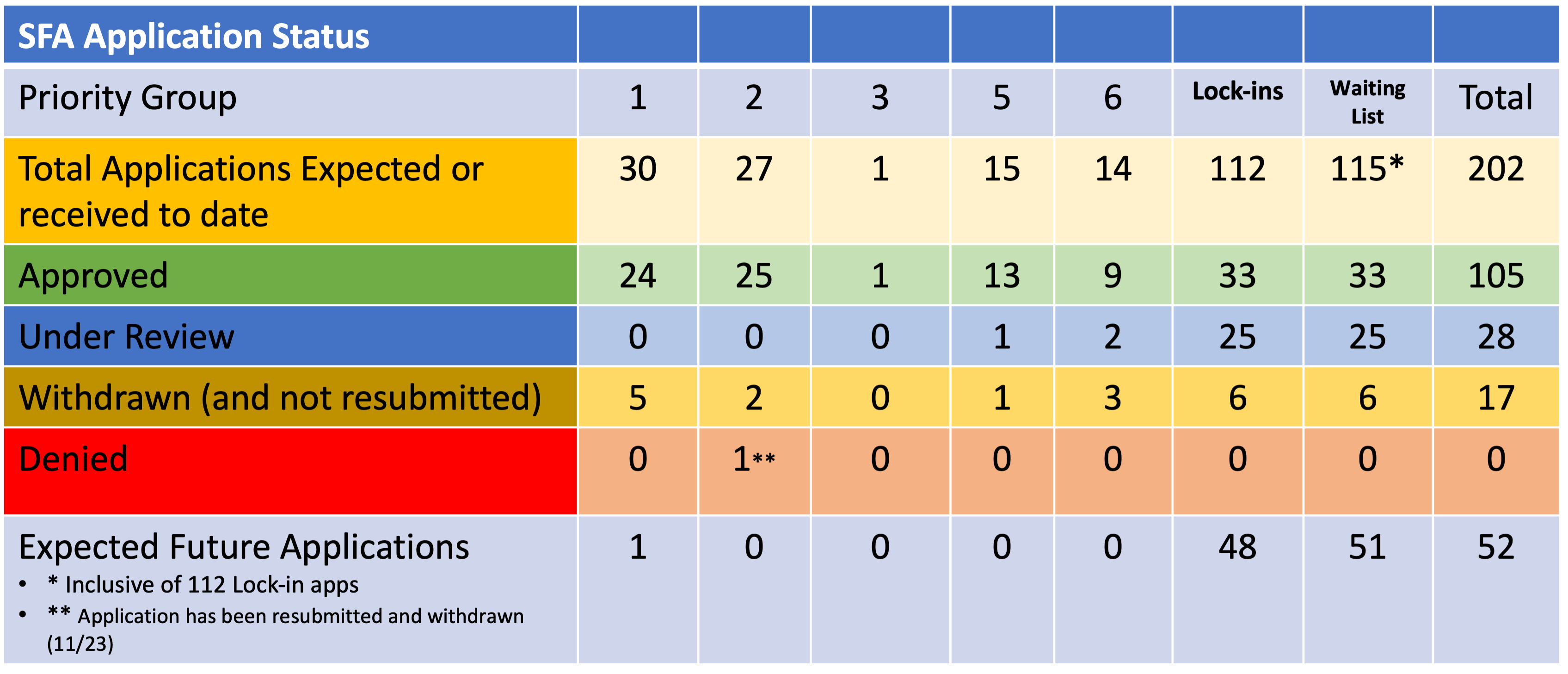
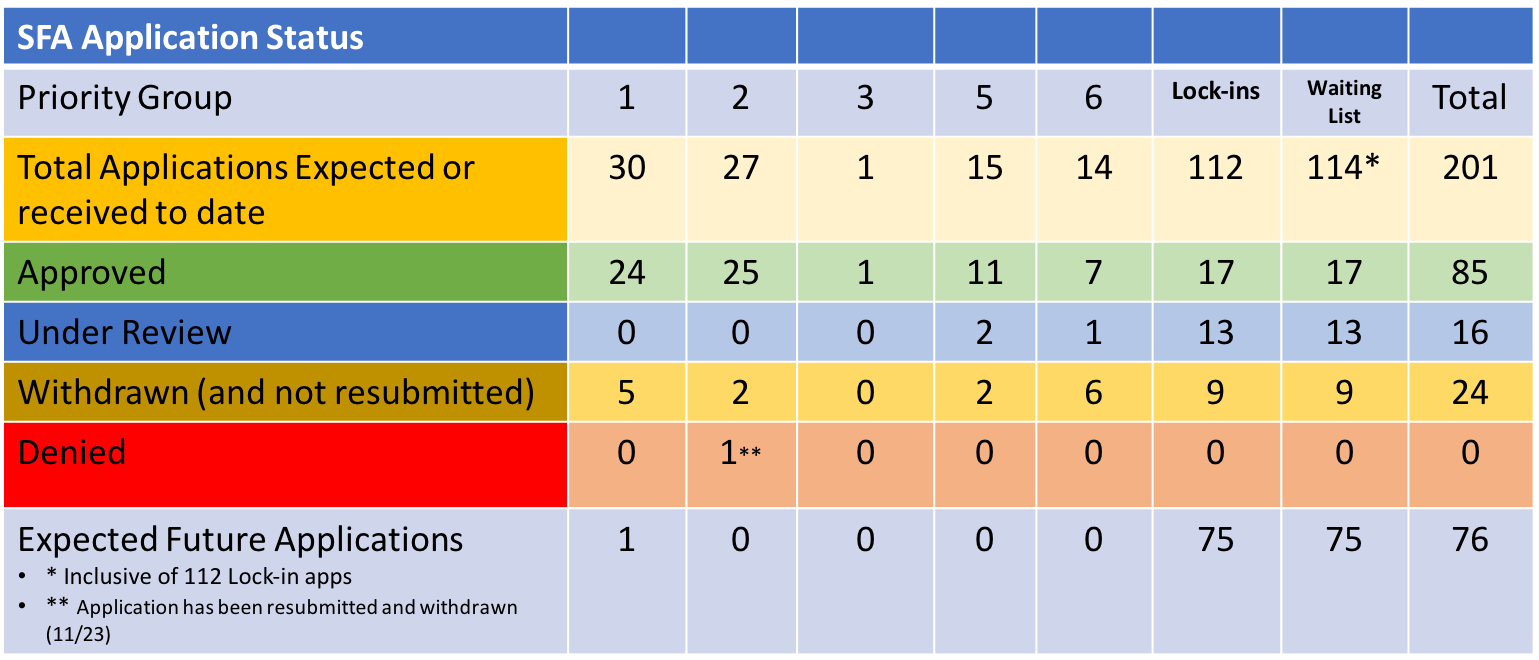
To recap 2024, the PBGC approved 36 applications, awarding more than $16.2 billion in SFA grants that went to support the promised benefits for 458,446 plan participants. WOW! As the chart below highlights, only 15 of the 87 Priority Group members have yet to have the applications for SFA approved. Three of those applications are currently under review. Of the 115 funds seeking support that weren’t initially identified as a Priority Group member, 64 pension plans have participated to some extent in this program with 33 of those applications approved.

US Treasury note and bond yields (longer maturities) have risen sharply in the last few months. They are at levels not witnessed since early this year. As a result, they are providing plan sponsors with a wonderful opportunity to reduce risk without giving up potentially higher returns. We’d be happy to provide a free analysis on what could be achieved within your plan. Don’t hesitate to reach out to us.

Again, Happy New Year!

Different Levels of Certainty

By: Russ Kamp, Managing Director, Ryan ALM, Inc.

A friend of mine in the industry emailed me a copy of Howard Marks’ latest memo titled, “The Folly of Certainty”. As they normally are, this piece is excellent. As regular readers of this blog know, I’ve encouraged plan sponsors and their advisors to bring more certainty to defined benefit plans through a defeasement strategy known as cash flow matching. I paused when I read the title, thinking, “oh, boy”, I’m at odds with Mr. Marks and his thoughts. But I’m glad to say after reading the piece that I’m not.

What Howard is referring to are the forecasts, predictions, and/or estimates made with little to no doubt concerning the outcome. He cited a few examples of predictions that were given with 100% certainty. How silly. Forecasts always come with some degree of uncertainty (standard deviation around the observation), and it is the humble individual who should doubt, to some degree, those predictions. I’ve often said that hope isn’t an effective investment strategy, but that thought doesn’t seem to have resonated with a majority of the investment community.

Ryan ALM’s pursuit of greater certainty is brought about through our ability to create investment grade bond portfolios whose cash flows match with certainty (barring a default) the liability cash flows of benefits and expenses. We accomplish this objective through our highly sophisticated and trade-marked optimization model. We are not building our portfolios with interest rate forecasts, based on economic variables that come with a very high degree of uncertainty. No, we build our portfolios based on the client’s specific liability cash flows and implement them in chronological order. Importantly, once those portfolios are created, we’ve locked in a significant cost reduction that is a function of the rate environment and the length of the mandate.

As stated previously, I have a great appreciation for Howard Marks and what he’s accomplished. He is absolutely correct when he questions any forecast that has little expectation for being wrong. In most cases, the forecaster is not in control of the outcome, which should lend itself to being more cautious. In the case of the Ryan ALM cash flow matching strategy, we are in control. Having the ability to bring some certainty in our pursuit of securing the promised benefits should be greatly appreciated by the plan sponsor community. Because of the uncertain economic environment that we are currently living in, bringing some certainty should be an immediate goal. Care to learn more?

ARPA Update as of July 12, 2024

By: Russ Kamp, Managing Director, Ryan ALM, Inc.

Not only has the weather heated up, but so has the activity at the PBGC as it relates to the implementation of the ARPA pension legislation. During the past week two non-priority group plans submitted applications. In the case of the Carpenters Pension Trust Fund – Detroit & Vicinity, it was a revised application seeking nearly $600 million in Special Financial Assistance (SFA), while the Laborers’ Local No. 265 Pension Plan put forward its initial filing seeking $55.6 million. In total, more than 24,000 plan participants would enjoy a more secure retirement with the approval of these applications.

In other ARPA news, the American Federation of Musicians and Employers’ Pension Plan finally received approval. This fund had multiple filings throughout the process, which began on March 10, 2023 with the initial filing followed by two other applications. The wait was certainly worth it, as they will receive >$1.5 billion to reinforce the pensions of nearly 50,000 eligible participants.

There were no applications denied during the past week, but one fund, the United Food and Commercial Workers Union and Participating Food Industry Employers Tri-State Pension Plan, withdrew its application that had been seeking $638.3 million in SFA for 29+k members. There were no plans that were forced to repay excess SFA assets and no new plans added to the waitlist.

We’ve all heard the phrase with uncertainty comes opportunity, and that may very well be true, but the uncertainty comes with a certain level of risk, too. Given all of the uncertainty in the economic and political spheres at this time, is the opportunity greater than the risk? We would encourage plan sponsors of all plan types to look to reduce some of the risk in their funds, especially given the elevated multiples on which the equity markets are currently trading. The higher US interest rates are providing a unique opportunity not available to us in the past two decades. Secure some of the promises (benefits) by defeasing your liabilities through a cash flow matching strategy. We are happy to discuss this suggestion in far greater detail or you can go to RyanALM.com to read myriad research articles and blog posts on the subject.

Willingness and Ability to Customize

By: Russ Kamp, Managing Director, Ryan ALM, Inc.

Coalition Greenwich, a division of CRISIL, has released a report on the top trends in asset management for 2024. Among the categories discussed was the establishment of “Strategic Partnerships” among one’s clients. There were four categories in which 499 respondents to the survey were asked to rate from most influential when hiring an investment management organization to least influential. The categories included willingness to provide customization, fees, commitment to knowledge transfer, and finally brand recognition.

Not surprising, the willingness to provide customization achieved the top ranking in importance, with 72% indicating that it was either the most or very influential in the decision to bring on a manager and that product. We often read about a manager’s willingness to customize a solution, but what does that mean in reality? Ironically, Ron Ryan produced, just today, an article on the importance of creating custom liability indexes for LDI assignments. This was written primarily in response to a series of LDI-related research pieces that discussed “custom benchmarks” but used generic indexes.

In order to successfully implement an LDI strategy, especially one using Cash Flow Matching (CFM), the benchmark needs to be a custom solution that uses the client’s specific liabilities, as each pension plan has a unique set of liabilities, like snowflakes. The liabilities are future values that need to be priced at some discount rate(s) into present values (market values) similar to the plan’s assets. It is only then that an appropriate LDI strategy can be implemented.

Every client of Ryan ALM, Inc. gets a custom solution. There are no “off the shelf” products. Fees, which received the second highest ranking in importance, had 68% of the respondents rating this category as most or very influential. Despite the highly customized products, we at Ryan ALM, Inc. provide our services at low fees. We believe that the primary objective in managing a defined benefit plan is to SECURE the promised benefits at a reasonable cost and with prudent risk. Everything that we do as an investment firm is focused on that belief. Custom solutions and low fees – that doesn’t seem like the norm in our industry. We are proud to be different!