And Now Utility Bills!

By: Russ Kamp, CEO, Ryan ALM, Inc.

Electric payment company Payless Power released a report showing how Americans are being forced to choose between keeping the lights on, buying groceries, or paying for medicine. They conducted a survey of 1,069 people, including nearly half of whom came from low-income households, and regrettably 39% said they’d fallen behind on electricity payments in the past year.

Incredibly, more than 30% received at least one shutoff notice, while 11% had their power cut off due to missed payments. “Beyond the financial stress, high electricity prices are creating real safety risks,” Payless Power said. “More than half of low-income households said they went without heat or air conditioning for several days in the past year because they couldn’t afford it.”

The impact of having one’s electricity shut off has led roughly 30% of the respondents to feel physically unsafe at home during extreme temperatures. Not unlike the challenging economic times found during the Great Depression, nearly one in four sent children or pets away from their home to escape dangerous indoor conditions.

More than half (52%) of low-income households cut back on groceries to pay utility bills, while 16% skipped medication or medical care. Another 19% reduced transportation or internet spending, and 5% missed rent or mortgage payments. As you can imagine, larger families are hit hardest, as households with five or more people were nearly twice as likely to fall behind as those homes with two or fewer individuals at home.

Rising utility costs come as households are already stretched thin by higher housing costs and food prices compounded by a deteriorating labor market. Research from Goldman Sachs shows consumers are absorbing >50% of the cost of President Trump’s widespread tariffs. In a Harris/Axios poll, 47% of Americans said groceries are more difficult to afford than they were in September 2024.

Lastly, as of Q2’25, Moody’s and the Federal Reserve estimate that the top 10% of income earners in the U.S. account for 49.2% of the consumption. This is the highest percentage on record dating back to when data collection began in 1989. A level of concentration such as this is NOT good for the long-term viability of the U.S. economy.

Taking From Peter to Pay Paul

By: Russ Kamp, CEO, Ryan ALM, Inc.

Do you, or would you, consider yourself a “high earner” with a salary of $145k/year?

Try asking a family of four in NYC that question, when you consider the expenses from taxes (federal, state, city, sales, and property), the housing costs associated with an apartment, childcare, healthcare, food, clothing, etc. Yet, those at the IRS certainly do. In case you didn’t realize it, SECURE 2.0 is eliminating the tax deductibility of “make up” contributions for those 50 and up after they have maxed out their $23,500 annual contribution beginning in 2027. As a reminder, for those that 50-years old and up one can contribute another $7,500. For those between the ages of 60-and 63-years-old there is a super catch up contribution of $11,500. Why a 64- or 65-year-old can’t contribute more is beyond me. Perhaps it will blow out the U.S. federal budget deficit!

Unfortunately, if you are so lucky to earn a whopping $145k from a single employer in a calendar year, you will be forced to use a Roth 401(k) for those make up contributions. As stated previously, you lose the tax deductibility for those additional contributions. So, if you earn $200k and you contribute the additional $7,500 or the $11,500, instead of seeing your gross income fall by those figures, you will be taxed at the $200k level, increasing your tax burden for that year. Yes, the earnings within the account grow tax free, but the growth in the account balance is subject to a lot of risk factors.

We should be incentivizing all American workers to save as much as possible. Let’s stop with all these different gimmicks. Do we really want a significant percentage of our older population no longer participating in our economy? Those 65-years and older represent about 17% of today’s population, but they are expected to be 23% by 2050. Do we really want them depending on the U.S government for social services? No, and they don’t want that either. We want folks to be able to retire with dignity and remain active members of our economic community.

The demise of the traditional DB pensions has placed a significant burden on most American workers who are now tasked with funding, managing, and then disbursing a “retirement” benefit with little disposable income, no investment acumen, and a crystal ball to determine longevity as foggy as many San Francisco summer days. Again, with the burdens associated with all of the expenses mentioned above and more, it really is a moot point for many Americans to even consider catch up contributions, but for those lucky few, why penalize them?

I’m Concerned! Are You?

By: Russ Kamp, CEO, Ryan ALM, Inc.

I’ve been concerned about the U.S. retirement industry for many years, with a particular focus on traditional pensions. The demise of DB pensions is a major social and economic issue for a significant majority of American workers, who fear that their golden years will be greatly tarnished without the support of a traditional DB pension plan coupled with their inability to fund a supplemental retirement vehicle, such as a defined contribution plan.

I recently had hope that the rising U.S. interest rate environment would bring about a sea change in the use of DB pensions, but I haven’t seen the tidal wave yet. That said, the higher rate environment did (could still) provide plan sponsors with the ability to take some risk off the table, but outside of private pensions, I’ve witnessed little movement away from a traditional asset allocation framework. You see, the higher rate environment reduces the present value cost of those future benefit payments improving both the funded ratio and funded status of DB pensions, while possibly reducing ongoing contributions. Securing those benefits, even for just 10-years dramatically reduces risk.

But, again, I’ve witnessed too few plans engaging in alternative asset allocation strategies. That’s not the same as engaging in alternative strategies, which unfortunately continues to be all the rage despite the significant flows into these products, which will likely diminish future returns, and the lack of distributions from them, too. An alternative asset allocation strategy that Ryan ALM supports and recommends is the bifurcation of assets into two buckets – liquidity and growth – as opposed to having all of the plan’s assets focused on the return on asset (ROA) assumption.

By dividing the assets into two buckets, one can achieve multiple goals simultaneously. The liquidity bucket, constituting investment grade bonds, will be used to defease the liability cash flows of benefits and expenses, while the growth or alpha assets can grow unencumbered with the goal of being used to defease future liabilities (current active lives). One of the most important investment tenets is time. As mentioned above, defeasing pension liabilities for even 10-years dramatically enhances the probability of the alpha assets achieving the desired outcome.

So why am I concerned? The lack of risk mitigation is of great concern. I’m tired of watching pensions ride the rollercoaster of returns up and down until something breaks, which usually means contributions go up and benefits go down! Given the great uncertainty related to both the economy and the labor force, why would anyone embrace the status quo resulting in many sleepless nights? Do something, and not just for the sake of doing something. Really do something! Embrace the asset allocation framework that we espouse. Migrate your current core bond allocation to a defeased bond allocation known as cash flow matching (CFM) to bring an element of certainty to the management of your plan.

Listen, if rates fall as a result of a deteriorating labor force and economy, the present value of pension liabilities will rise. Given that scenario, it is highly likely that asset prices will fall, too. That is a lethal combination, and not unique given how many times I’ve seen that play out during my 44-year career. Reach out to us if you aren’t sure how to start the process. We’d be pleased to take you through a series of scenarios so that you can determine what is possible. Perhaps you’ll sleep like a baby after we talk.

Today is National 401(k) Day. Where is National DB Pension Plan Day?

By: Russ Kamp, CEO, Ryan ALM, Inc.

I suspect that most of us have no idea that today, September 5, 2025, is National 401(k) Day. This day is recognized every year on the Friday following Labor Day. The day is supposed to be an opportunity for retirement savings education and for companies to inform their employees about their ability to invest in company sponsored 401(k)s. Did you get your update today? Unfortunately, like many small company employees, I don’t have access to one or a DB plan.

For the uninformed, 401(k) plans are defined contribution plans (DC). This plan type was created in the late 1970s (Revenue Act of 1978) as a “supplemental” benefit. Corporate America liked the idea of a DC offering because it helped them recruit middle and senior management types who wouldn’t accrue enough time in the company’s traditional pension plan. Again, the benefit was supplemental to the traditional monthly pension payment and not in lieu of it!

I think that defined contribution plans are fine as long as they remain supplemental to a DB plan. Asking untrained individuals to fund, manage, and then disburse a retirement benefit is a ridiculous exercise, especially given their lack of disposable income, investment acumen, and NO crystal ball to help with longevity issues. In fact, why do we think that 99.9% of Americans have this ability? Regrettably, we have a significant percentage (estimated at 28%) of our population living within 200% of the poverty line. Do you think that they have any discretionary income that would permit them to fund a retirement benefit when housing, health insurance, food, education, childcare, and transportation costs eat up most, if not all, of an individual’s take home pay? Remember, these plans are only “successful” based on what is contributed. Sure, there may be a company match of some kind, but we witnessed what can happen during difficult economic times, when the employer contribution suddenly vanishes.

Defined benefit plans are the gold standard of retirement vehicles. They once covered more than 40% of the private sector workforce, most union employees, and roughly 85% of public sector workers. What happened? Did we lose focus on the primary objective in managing a DB plan which is to SECURE the promised benefits in a cost-effective manner with prudent risk? Did our industry’s focus on the return on asset assumption (ROA) create an untenable environment? Yes, we got more volatility and less liquidity! Did we did we get the commensurate return? Not consistently. It was this volatility of the funded ratio/status that impacted the financial statements and led to the decision to freeze and terminate a significant percentage of private DB plans. It is a tragic outcome!

What we have today is a growing economic divide among the haves and haves-not. This schism continues to grow, and the lack of retirement security is only making matters worse. DB plans can be managed effectively where excess volatility is not tolerated, where the focus is on the promised benefit and not some made up ROA, and where decisions that are made relative to investment structure and asset allocation are predicated on the financial health of the plan: mainly the funded status. We need DB plans more than ever and ONLY a return to pension basics will help us in this quest. Forget about all the newfangled investment products being sold. Replacing one strategy for another is no better than shifting deck chairs on the Titanic. We need improved governance and a renewed focus on why pensions were provided in the first place.

Where’s The Beef?

By: Russ Kamp, CEO, Ryan ALM, Inc.

In case this little ditty got by you, today is National Hamburger Day. According to the history books, the beef patty that most of us love originated in Hamburg, Germany. It has nothing to do with the meat, which as far as I know was never pork/ham. I bring you this info not only because I am looking forward to my burger later this evening, but because of a lack of “beef” in today’s retirement industry.

Despite adoption of financial wellness programs, millions of workers in their 50s and early 60s remain critically unprepared to fund their retirement, “according to a new report from the Institutional Retirement Income Council”. How bad are the stats? Nearly 50% of Americans aged 55 to 64 have NO retirement savings – zilch, nada, zippo! That info comes courtesy of the Federal Reserve Board’s 2023 Survey of Consumer Finances, which was cited in the IRIC report. Furthermore, for those that have accumulated retirement savings, the median account balance is only $202,000, and totally insufficient for a retirement that could last more than 20 years. Applying the 4% rule to annual withdrawals provides this median participant an annual spending budget of $8,080. That certainly won’t get you much.

It gets worse. According to a bank of America study, “only 38% understand how to properly claim Social Security”. Compounding these issues is the fact that most underestimate how much they might need for health care, estimated at up to $315,000 in medical expenses, per Fidelity Investments.  

IRIC Executive Director Kevin Crain, the report’s author, wrote that the lack of preparedness is already leading to a troubling trend of “delayed retirements, workplace disruption, and heightened financial stress among older employees and their employers.”  

This dire situation needs to be rectified immediately, and the only way to ensure a sound retirement for our American workforce is to once again institute defined benefit (DB) pension plans. Asking untrained individuals to fund, manage, and then disburse a “benefit” through a DC plan without disposable income, investment acumen, or a crystal ball to help with longevity is just silly. There’s just no beef in today’s retirement offerings!

Where’s Clara Peller when we need her the most?

DC Participants: “Just Say No”

By: Russ Kamp, CEO, Ryan ALM, Inc.

Most everyone who lived through the ’80s will remember the slogan “Just Say No”. The slogan was created and championed by Nancy Reagan during her husband’s presidency. As you’ll recall, the slogan was part of the U.S.-led war on drugs.

I’d like to reuse the slogan of JUST SAY NO as it relates to using alternatives, especially private equity and credit in defined contribution (DC) plans. DC plans are proving to be a failed model for the vast majority of participants given the anemic median balances, as asking untrained individuals to fund, manage, and then disburse a “retirement” benefit with little to no disposable income, investment acumen, or a crystal ball to help with longevity is just silly policy. Trying to push alternatives onto these folks is maddening! They don’t need more offerings providing complicated structures, little transparency, high fees, and poor liquidity.

Importantly, what happened to being a “qualified or accredited” investor? As you may recall, private investments are restricted in most cases to individuals who meet certain financial thresholds that have been established by regulatory authorities. These considerations included minimum income levels (>$200k for some period of time and sustainable), net worth considerations at >$1 million not including your primary residence, and finally, investment knowledge, in which individuals need to demonstrate sufficient knowledge and experience in financial and business matters to evaluate the risks and merits of a prospective investment. Do you honestly think that the average 401(k) participant qualifies under any of these considerations?

The alternative suite of product offerings is proving to be challenging for many institutional investors/boards, often requiring the retention of a specialist consultant to support the plan’s generalist advisor. Given that reality, does it really make sense that an untrained individual will truly understand the potential risk and reward characteristics? Furthermore, these investments are NOT the magic elixir that they are made out to be. Performance results range far and wide and liquidity (capital distributions) is proving illusive. Do providers of these products really believe that more assets are needed at this time given how difficult it is to invest the current dry powder?

I put a similar comment to this post on LinkedIn.com earlier today. Somebody commented that a simple NO without exploration perhaps would violate my fiduciary responsibility. My answer: Someone needs to be the grown up in the room trying to keep our industry’s greedy hands off DC plans. I believe that I am acting very much in a fiduciary capacity.

I could apply the “Just Say No” slogan to so many practices within our pension industry, but for now I’ll restrict it to this one area of concern. This one rant!

A Retirement is Out of the Question for Many – Unfortunately!

By: Russ Kamp, CEO, Ryan ALM, Inc.

Is there such a thing as a retirement anymore? According to Fidelity’s Q4 2024 Retirement Analysis, 41% of “retirees” are working, have worked, or are currently seeking work. I would guess that the need to work is strongly correlated to the demise of the DB pension plan.

In other Fidelity news, a big deal was made out of the fact that 527k participants had account balances >$1 million (2.2% of their account holders), but despite those attractive balances, the “average” balance was still only 131k at year-end following two incredible years of growth for the S&P 500 specifically, and equities generally, especially if you rode the tech sector.

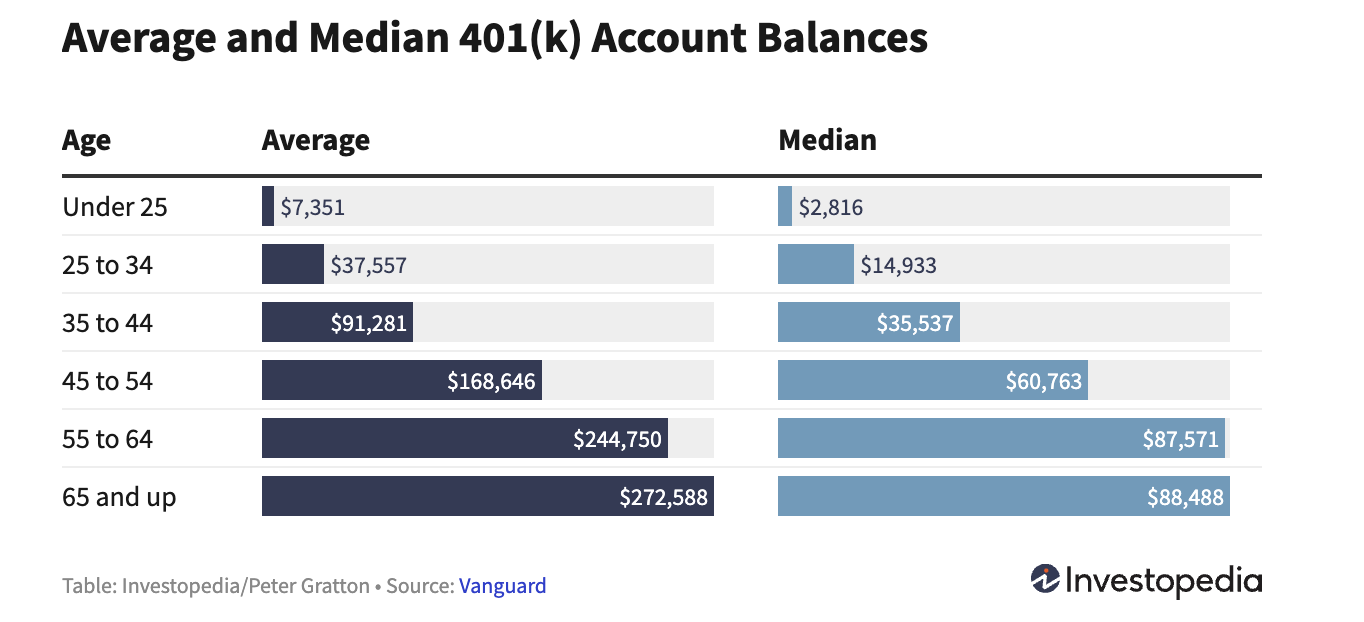
Regrettably, there was once again NO mention of the median account balance, which we know is rather anemic. Can the providers of 401(k)s, IRAs, and 403(b)s, please stop highlighting average accounts which are clearly skewed by the much larger balances of a few participants? According to an analysis provided earlier this year by Investopedia, median account balances at Vanguard were dramatically lower than average accounts. As the chart below highlights, there was not a median balance within 40% of the average balance. In fact, those 65-years-old and up had an account balance at 32% of the average balance. I can’t imagine that this ratio would be much different at Fidelity or any other provider of defined contribution accounts.

It is truly unfortunate that a significant percentage of the American workforce will never enjoy the rewards of a dignified retirement. My Dad, who just recently passed at age 95, enjoyed a 34-year retirement as a result of receiving a modest DB pension benefit. That monthly payment coupled with my parents Social Security enabled them to enjoy their golden years. Providing this opportunity for everyone needs to be the goal of our retirement industry.


Note: Fidelity’s 401(k) analysis covers 26,700 corporate DC plans and 24.5 million participants.

How Comforting is $1,305.54/year?

By: Russ Kamp, Managing Director, Ryan ALM, Inc.

One doesn’t have to spend much time on LinkedIn.com these days without seeing a discussion about the pros and cons of Defined Benefit (DB) vs. Defined Contribution (DC) aka 401(k) plans. Anyone who has read just a few of the >1,500+ posts on this blog know that I and Ryan ALM, Inc. are huge supporters of DB plans. Based on the following, it becomes apparent why that is the case.

One topic frequently mentioned among our peers is financial literacy. As a former member of two boards of education (11 years in total), I have witnessed first-hand how little financial literacy is shared with our high school students, especially as it relates to saving and investing. That said, as important as education is, the greatest issue for me is the lack of disposable income for the average American worker.

Frequently we read about the spending habits of younger generations, including being the “avocado toast” crowd. Examples often used include the daily purchase of a Starbucks drink or two, the use of Uber Eats, and similar examples of perceived wasteful spending. They fail to mention that even “well-paid” workers (>$100k) are burdened by a mortgage or rent payment, they likely have student loan debt, they have to buy insurance in order to use their car, which is also a very expensive purchase, they are required to have health insurance, homeowners or rental insurance, and God forbid that they have a spouse and a couple of kids. Childcare expenses have gotten to be insane. Is there any wonder that funding one’s own retirement has proven to be incredibly challenging?

So how are we doing? Unfortunately, most of the literature on the subject uses average balances to represent 401(k) savings. This practice needs to stop. According to Vanguard the average balance in 2024 is $134,128, but the median balance is $35,285. In addition, Morningstar has just published an article stating that retirees should use only a 3.7% withdrawal rate (no longer 4%) to safely use a 401(k) retirement balance given the recent performance of equity markets and the current interest rate environment. Let’s see: 3.7% * $35,285 = $1,305.54. That is an annual withdrawal, although it looks like it should be a monthly payout! What kind of retirement will that level of annual withdrawals provide? For comparison purposes, the average DB payout in the private sector is $11k and nearly $25k in public pensions.

As a reminder, DC plans were intended to be supplemental to DB plans. It is highly regrettable that they have morphed into most everyone’s primary means of “accumulating” retirement resources. This migration in proving to be an unmitigated failure and the consequences will be untenable. The American worker needs access to a DB plan. Let’s work together to protect and preserve those that remain, while encouraging former sponsors of these plans to rethink the decision to freeze or terminate. There are also state sponsored entities that afford employees in smaller companies access to a DB-like plan. That said, please manage them with a focus on the pension promise (securing benefits). Don’t rely on markets and all the volatility that comes with that exposure to “fund” these essential programs. That strategy hasn’t worked!

The Joke’s On Us!

By: Russ Kamp, Managing Director, Ryan ALM, Inc.

According to a P&I article, the ECB has undertaken an “exploratory review of bank exposures to private equity and private credit funds in order to better understand these channels and to assess banks’ risk management approaches.” According to P&I, the overarching message was that “complex exposures to private equity and credit funds require sophisticated risk management.”

Yesterday, there was a FundFire article that questioned the effectiveness of the “Yale Model” given the heavy dependence on alternatives and the weak performance associated with those products in recent periods. According to the article, the greater the alts exposure the likely weaker fiscal performance.

In a recent article by Richard Ennis, founder and former chairman of investment consultant EnnisKnupp, he estimates that Harvard University, with about 80% of its endowment assets in alternative investments, spends roughly 3% of endowment value on money management fees annually, including the operation of its investment office.

Given the concerns noted above with respect to fees, risk management, and the overall success of investing in alternative strategies, one would believe that a cautionary tone would be delivered at this time. But alas that isn’t the case when it comes to forging ahead with plans to introduce alternatives into DC plans where the individual participant lacks the necessary sophistication to undertake a review of such investments. According to yet another FundFire article in recent days, Apollo and Franklin are plowing forward with plans to make available alternative investments to the DC participant through a new CIT. Shameful!

I’ve commented numerous times that it is pure madness to believe that the average American worker has the disposable income, investment acumen, and/or the necessary crystal ball to effectively manage distributions upon retirement through a DC offering. Given this lack of investment knowledge, I find it so distasteful that “Wall Street” continues to look at these plans as just another source of high fees and revenue. Where are the FIDUCIARIES?

If the ECB doesn’t believe that their banks have the necessary tools in place to handle these complex investments, how on Earth will my neighbor, family member, former teacher, etc.? Can we please stop this madness!