Segal: Benefits of Pension De-Risking

By: Russ Kamp, CEO, Ryan ALM, Inc.

Jason Russell and Seth Almaliah, Segal, have co-authored an article titled, “Benefits of Pension De-Risking and Why Now is the Right Time”. Yes! We, at Ryan ALM, agree that there are significant benefits to de-risking a pension plan and we absolutely agree that NOW is the right time to engage in that activity.

In their article they mention that the current interest rate environment is providing opportunities to de-risk that plan sponsors haven’t seen in more than two decades. In addition to the current rate environment, they reflect on the fact that many pension plans are now “mature” defining that stage as a point where the number of retired lives and terminated vested participants is greater than the active population. They also equate mature plans to one’s that have negative cash flow, where benefits and expenses eclipse contributions. In a negative cash flow environment, market corrections can be more painful as assets must be sold to meet ongoing payments locking in losses, as a result.

They continue by referencing four “risk reducing” strategies, including: 1) reducing Investment Volatility, 2) liability immunization, 3) short-term, cash flow matching, and 4) pension risk transfers. Not surprisingly, we have some thoughts about each.

  1. Reducing investment volatility – Segal suggests in this strategy that plan sponsors simply reduce risk by just shifting assets to “high-quality” fixed income. Yes, the annual standard deviation of an investment grade bond portfolio with a duration similar to that of the BB Aggregate would have a lower volatility than equities, but it continues to have great uncertainty since bond performance is driven primarily by interest rates. Who knows where rates are going in this environment?
  2. Liability Immunization – The article mentions that some plan sponsors are taking advantage of the higher rate environment by “immunizing” a portion of the plan’s liabilities. They describe the process as a dedicated portfolio of high-quality bonds matched to cover a portion of the projected benefits. They mentioned that this strategy tends to be long-term in nature. They also mention that because it is “longer-term” it carries more default risk. Finally, they mentioned that this strategy may lose some appeal because of the inverted yield curve presently observed. Let me comment: 1) Immunization is neither a long-term strategy or a short-term strategy. The percentage of liabilities “covered” is a function of multiple factors, 2) yes, immunization or cash flow matching’s one concern when using corporate bonds is default risk. According to S&P, the default rate for IG bonds is 0.18% for the last 40-years, and 3) bond math tells us that the longer the maturity and the higher the yield, the lower the cost. Depending on the length of the assignment, the current inverted yield curve would not provide a constraint on this process. Finally, CFM is dependent on the actuary’s forecasts of contributions, benefits, and expenses. Any change in those forecasts must be reflected in the portfolio. As such, CFM is a dynamic process.
  3. Short-term, cash flow matching CFM is the same as immunization, whether short-term or not. Yes, it is very popular strategy for multiemployer plans that received Special Financial Assistance (SFA) under ARPA for obvious reasons. It is a strategy that SECURES the promised benefits at both low cost and with prudent risk. It maximizes the benefit coverage period with the least uncertainty.
  4. Pension Risk Transfers (PRT) – In a PRT, the plan sponsor transfers a portion of the liabilities, if not all of them, to an insurance company. This is the ultimate risk reduction strategy for the plan sponsor, but is it best for the participant? They do point out that reducing a portion of the liabilities will also reduce the PBGC premiums. But, does it impact the union’s ability to retain and attract their workers?

We believe that every DB pension plan should engage in CFM. The benefits are impressive from dramatically improving liquidity, to buying time for the growth (non-CFM bonds) assets, to eliminating interest rate risk for those assets engage in CFM, to helping to stabilize contributions and more. Focusing 100% of the assets on a performance objective only guarantees volatility. It is time to adopt a new strategy before markets once again behave badly. Don’t waste this wonderful rate environment.

Thank you, Segal, for your thoughtful piece.
Verus: “LDI for Public Sponsors”

By: Russ Kamp, CEO, Ryan ALM, Inc.

Dan Hougard, FSA and Associate Director, Actuarial Services at Verus has recently published an excellent thought piece on LDI for public pension plans. In this case, the LDI refers to Cash Flow Matching (CFM). We at Ryan ALM, believe that LDI is the label in which sits both CFM and duration matching strategies. Furthermore, we absolutely agree with Dan’s assessment that public pension plans can benefit in this environment of higher yields despite the accounting differences that may not make the use of CFM obvious.

As most readers of this blog know, we often criticize public pension accounting (GASB) for pension liabilities that allow the use of the ROA assumption to “discount” liabilities, while corporate/private pension plans use a market-based interest rate (FASB). We applaud Dan for stating that “the purpose of a pension plan’s investment portfolio (assets) is to ensure that the promised benefits (liabilities) can be paid to beneficiaries as they come due”. We at Ryan ALM believe that the primary objective in managing a DB plan is to SECURE the benefits at a reasonable cost and with prudent risk.

Key highlights from Dan’s research:

Many plan sponsors approach their investment policy without explicitly focusing on the liabilities

Because public plans discount liabilities at the ROA the perceived benefit of LDI (CFM) is not as obvious

Public plans could match longer-duration cashflows combined with “market-based” reporting for a portion of the liabilities – such as all current retirees.

The lowest risk asset class for pension investors are fixed income securities, as income is used to pay benefits, and securities are held to maturity so there is no interest rate risk.

During periods of market stress, negative cash flow plans may be forced to sell assets at depressed prices.

CFM can overcome that challenge by providing the needed cash flow to cover obligations while the return-seeking portfolio grows unencumbered.

IG credit yields haven’t been this attractive since 2010.

Public pension portfolios tend to have very uncertain outcomes and carry “tremendous” asset-liability mismatch.

Finally, CFM “investing can offer considerable value for many pension plans”!

It is wonderful to see a thoughtful article on this subject. We, at Ryan ALM, often feel as if we are all alone in our quest to protect and preserve defined benefit plans for the masses through cash flow matching, which SECURES the promised benefits at a reasonable cost and with prudent risk. It also allows for a wonderful night’s sleep during periods of excessive uncertainty.

That Step Isn’t Necessary!

By: Russ Kamp, CEO, Ryan ALM, Inc

I recently stumbled over a brief article that touched on LDI. I’m always interested in absorbing everything that I can on this subject. I was particularly thrilled when the author stated, “since LDI was recognized as best practice for defined benefit (DB) plans…” – YES! I’m not sure where that proclamation came from, but I agree with the sentiments. The balance of that sentence read, “…sponsors have implemented investment strategies as a journey.”

The initial steps on this journey were for plan sponsors to “simply extend the duration of their fixed income using longer duration market-based benchmarks.” Clearly, the author is referencing duration matching strategies as the LDI product of choice during that phase. According to the author, the next phase in this LDI journey was the use of both credit and Treasuries to better align the portfolio with a plan’s liability risk profile.

Well, we are supposedly entering a third phase in this LDI journey given the improved funded status and “outsized” allocations to fixed income. The question they posed: “How do we diversify the growing fixed income allocation?” Their answer, add a host of non-traditional LDI fixed income products, including private debt and securitized products, to the toolkit to add further yield and return. No, no, and no!

As mentioned previously, funded status/ratios have improved dramatically. According to this report, corporate plans have a funded ratio of 111% at the end of 2024 based on their firm’s Pension Solutions Monitor. Given that level of funding, the only thing that these plans should be doing is engaging a cash flow matching (CFM) strategy to SECURE all the promises that have been given to the plan participants. You’ve WON the pension game. Congratulations! There is no reason for a third phase in the LDI journey. There likely wasn’t a need for the second phase, but that’s water over the dam.

We, at Ryan ALM, believe that CFM is a superior offering within the array of LDI strategies, as it not only provides the necessary liquidity to meet monthly liability cash flows, but it duration matches each and every month of an assignment. Ask us to CFM the next 10 years, we will have 120 duration matches. Most duration matching strategies use either an average duration or a few key rates along the yield curve. Since duration is price sensitive, it changes constantly.  In addition, yield curves do not move in parallel shifts making the management of duration a difficult target.

With CFM you can use STRIPS, Treasuries, investment grade corporates or a combination of these highly liquid assets. You don’t need to introduce less liquid and more complex products. A CFM strategy is all you need to accomplish the pension objective. A CFM strategy provides certainty of the cash flows which is a critical and necessary feature to fully fund liabilities. This feature does not exist in private debt and securitized products. As a reminder, the pension objective is not a return target. It is the securing of the promised benefits at a reasonable cost and with prudent risk. Don’t risk what you’ve achieved. Lock in your funded status and secure the benefits. This strategy is designed as a “sleep well at night” offering. I think that you deserve to sleep like a baby!

ARPA Update as of November 15, 2024

By: Russ Kamp, Managing Director, Ryan ALM, Inc.

I can’t believe that Thanksgiving is next week. It appears that the PBGC was motivated to get some things done in anticipation of that holiday, as we witnessed more activity last week than we’ve been seeing in the most recent past.

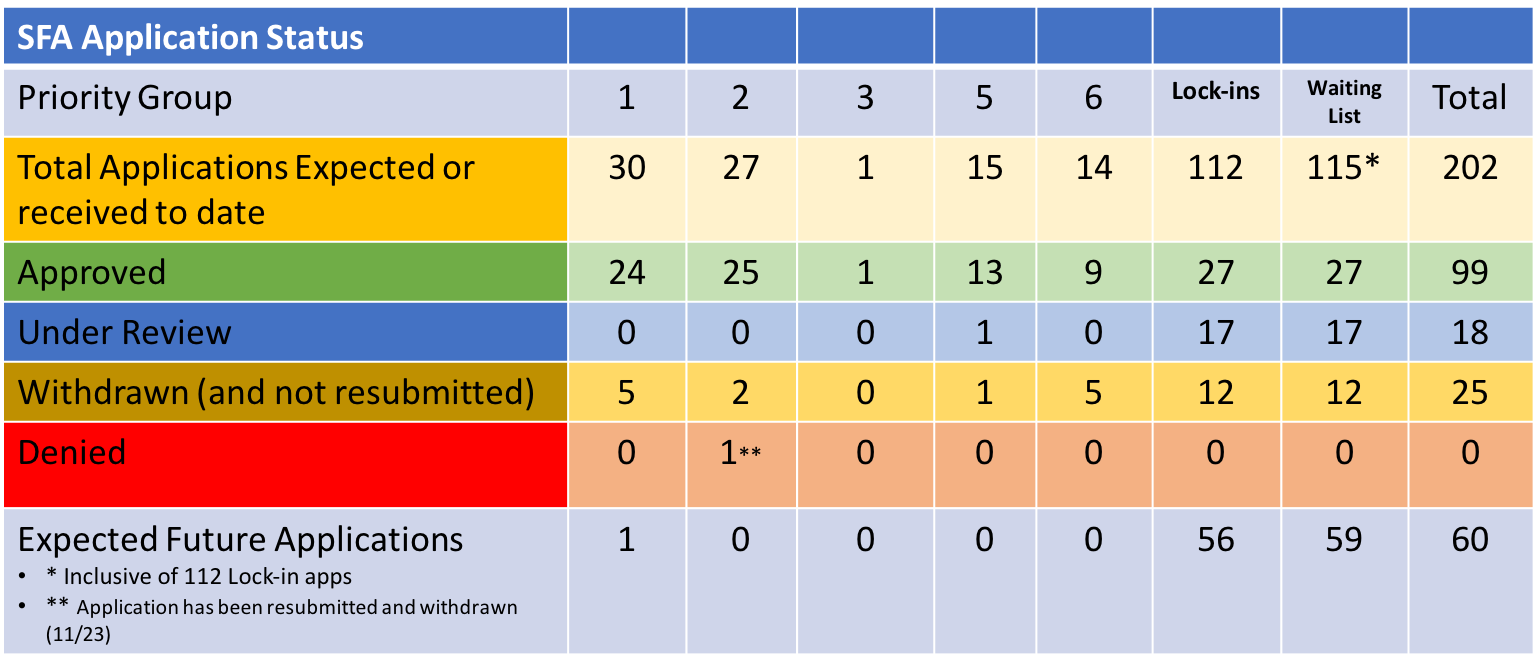
There were four applications filed last week, including the following pension plans: Roofers and Slaters Local No. 248 Pension Plan, Pension Plan of the Asbestos Workers Philadelphia Pension Fund, Local 1783 I.B.E.W. Pension Plan, and Cement Masons Local Union No. 567 Pension Plan. These plans are not seeking significant sums as far as the SFA goes, as in total they are seeking $92.6 million for 2,637 participants. The IBEW plan out of Armonk, NY submitted a revised application. The other three were the initial filings for these plans.

Pleased to report that Local 360 Labor-Management Pension Plan received approval for its revised application. This fund will receive $30.4 million for the 6,117 members of the plan. This fund initially filed an SFA application in early 2023 only to withdraw it in July 2023. Good for them that they were finally successful in receiving the grant.

Local 810 Affiliated Pension Plan wasn’t as fortunate as Local 360, as they withdrew the initial application that had been seeking $104.1 million for 1,437 members of the plan. In addition to the four new filings, the one withdrawal, and the one approved application, the PBGC also was involved in negotiating two repayment of excess SFA due to census errors. Iron Workers Local 17 Pension Fund
Bricklayers and Allied Craftsmen Local 7 Pension Plan returned $260,471.70 representing only 19 bps of the SFA grants awarded. To date, 25 funds have returned a total of $149.9 million representing 0.38% of the awarded grants.

Recessionary expectations have waned in the last couple of months and flows into bonds, which had been strong for most of the year have recently turned negative. As a result, US interest rates have backed up. It is a great time to secure the promised benefits (and expenses) through cash flow matching strategies. A rising rate environment will be quite bearish for traditional fixed income shops. We’ll be happy to provide you and your fund with a free analysis of what can be achieved through a defeasement strategy.

That’s Not Right!

By: Russ Kamp, Managing Director, Ryan ALM, Inc.

I’ve recently had a series of terrific meetings with consultants, actuaries, and asset owners (mostly pension plans) about cash flow matching (CFM). I believe that most folks see the merit in using CFM for liquidity purposes, but often fail to see the benefit of bringing certainty to a portfolio for that segment that is defeasing asset cash flows relative to liability cash flows (benefits and expenses). I’m not entirely sure why that is the case, but one question comes up regularly. Question: If I use 30% of my assets on lower yielding fixed income, how am I supposed to meet my ROA objective? I guess that they believe that the current 4.75% to 5% yielding investment grade corporate portfolio will be an anchor on the portfolio’s return.

What these folks fail to understand is the fact that the segment of the portfolio that is defeasing liability cash flows is matched as precisely as possible. The pension game has been won! If the defeased bond portfolio represents 30% of the total plan, the ROA objective is now only needed to be achieved for the 70% of assets not used to SECURE your plan’s liabilities. The capital markets are highly uncertain. Using CFM for a portion of the plan brings greater certainty to the management of these programs. Furthermore, we know that time (investing horizon) is one of the most important investment tenets. The greater the investing horizon the higher the probability of achieving the desired outcome, as those assets can now grow unencumbered as they are no longer a source of liquidity.  It bears repeating… a major benefit of CFM is that it buys time for the growth assets to grow unencumbered.

Plan sponsors should be looking to secure as much of the liability cash flows (through a CFM portfolio) as possible eliminating the rollercoaster return pattern that ultimately leads to higher contribution expenses. As mentioned above, capital markets are highly uncertain. The volatility associated with a traditional asset allocation framework has recently been calculated by Callan as +/-33.6% (2 standard deviations or 95% of observations). Why live with that uncertainty? In addition, Goldman Sachs equity strategy team “citing today’s high concentration in just a few stocks and a lofty starting valuation” forecasts that the S&P 500 “will produce an annualized nominal total return of just 3% the next 10 years, according to the team led by David Kostin, which would rank in just the 7th percentile of 10-year returns since 1930.” (CNBC)

Given that forecast, I wouldn’t worry about the 5% fixed income YTW securing my pension liabilities. Instead, I’d worry about all the “growth” assets not used to secure the promises, as they will likely be struggling to even match the YTW on a CFM corporate bond portfolio.

Hall of Famer? She Absolutely is!

By: Russ Kamp, Managing Director, Ryan ALM, Inc.

Markets Group has published an interview that Christine Giordano conducted with Robin Diamonte, CIO, RTX. In addition, Markets Group will hold a ceremony inducting Robin into the Chief Investment Officer Hall of Fame in Boston during the 11th Annual New England Institutional Forum on Sept 25-26. I wish that I could be there to help celebrate Robin’s splendid career.

The interview should be required reading for anyone in the pension arena. She got a wonderful start in this industry working for and with Britt Harris, another outstanding CIO, while they were at Verizon (I knew them when it was GTE).

Here are a couple of quotes that truly speak to her knowledge of the space. They just so happen to echo what we at Ryan ALM, Inc. have been espousing for decades. “It’s about understanding what the focus is or the mission of your group. Back in the 1990s, chief investment officers and investment teams really didn’t understand what liabilities were. All we were really is a moneymaker for the company. We provided great returns. We outperformed our liabilities.” There are still a lot of plans that pay little heed to the promises that have been given, focusing instead on achieving the ROA, which even if attained, doesn’t guarantee success.

Robin added, “Then over time, we had a couple of crises. We had the tech bubble bust, and then the global financial crisis. We had perfect storms during those periods where equity markets went down and interest rates went down at the same time. Many of the corporations found that their funded status went from well over 100% down into the 70s, and that happened with UTC (United Technologies).” Yes, markets can behave like rollercoasters leading to significant swings in the plan’s funded status and contribution expenses.

She continued, “I think it was the immediate realization of our mission is not to get great investment returns, our mission is to get great investment returns, but also understand what our liabilities were.” Yes, you, as a plan sponsors, have made a promise and we believe that the promise is what should drive asset allocation decisions and not some ROA that is often chosen for other reasons.

That realization lead her to this conclusion, “the mission at that point when our funded level was only 70% was, “Let’s fill in the gap so that we get to 100% or 110% or whatever is needed. We do that in a way that we’re not taking a lot of risk versus our liabilities.” Absolutely right! That is why she is a Hall of Famer in my book.

I also want to commend her for the outstanding work she did as a member of the PBGC’s Advisory Committee. She was instrumental in bringing ALM/LDI insights to the PBGC which has helped them to greatly improve this organizations balance sheet. Congratulations, Robin. There is no finer plan sponsor to induct into the CIO hall of fame than you.

POB Discussions Back on the Table?

By: Russ Kamp, Managing Director, Ryan ALM, Inc.

Cash Flow Matching (CFM) has enjoyed a renaissance within the pension community since US interest rates began rising in March 2022. The expanded use has not been limited to the beneficiaries of the Special Financial Assistance (SFA) paid through grants as a result of the ARPA pension reform being passed in March 2021. As a reminder, SFA proceeds are to be used exclusively to fund benefits (and expenses) as far into the future as the allocation will go. Protecting the precious grant proceeds has led to multiemployer pension plan sponsors and their advisors mostly using the 67+% in fixed income in defeasement strategies. We, at Ryan ALM, have certainly benefitted from this trend and applaud them for this decision.

In addition to multiemployer plans, both public and private (corporate) pension plans, as well as E&Fs have used CFM to bring an element of cash flow certainty (barring any defaults) to the management of pension assets and the generation of liquidity without being forced to sell assets, which can be very painful during periods of great uncertainty/volatility. These entities join insurance companies and lottery systems that have engaged in CFM activities for decades.

However, there remains a belief that CFM strategies only work during periods of high interest rates. We disagree, since liquidity is needed on a continuous basis. We believe that the use of CFM should be dictated by a number of factors, such as the entities funded status, ability to contribute, and the current fixed income exposure, as well as those liquidity needs. Unfortunately, it appears that interest rates have peaked for the time being. During the Summer of 2023, we were constructing CFM portfolios with a 6+% YTW, capturing most of the average ROA with little volatility. It was a wonderful scenario that unfortunately was not taken advantage of by most sponsors.

Today we are still able to build through our investment grade corporate bond focus portfolios with a YTW around 4.6%. Given the aggressive move down in Treasury yields during the last few months, we think that bond investors have gotten ahead of the Fed at this point as they are discounting about 150 bps of Fed rate cutting. Despite progress in the inflation fight, “sticky” inflation remains in excess of 4%. The US labor market’s unemployment rate is only 4.2%. Wage growth remains above 4%, while initial jobless claims remain at modest levels. Furthermore, the Atlanta Fed’s GDPNow model is forecasting growth for Q3’24 at 3.0% as of September 17, 2024. None of these metrics signal recession to me. How about you?

If you are of the mindset that a 4.6% YTW isn’t providing you with enough return, just think what you’d get from traditional active fixed income portfolios should rates rise once more. Please remember 2022’s -13% total return for the BB Aggregate Index. We frequently write about the need for plan sponsors to think outside the box as it relates to the allocation of assets. We believe that your plan’s assets should be bifurcated into two buckets – liquidity and growth. While the CFM portfolio is providing your plan with the necessary liquidity on a monthly basis, the growth assets can now grow unencumbered. These assets will be used at a later date to meet future benefits and expenses. With a CFM portfolio, plan sponsors can reduce or eliminate the need to do a “cash sweep” that takes away reinvestment in the growth portfolio.

In addition to believing that CFM is still a viable strategy in this environment, the decline in US Treasury yields is once again opening a door for sponsors to consider a pension obligation bond (POB). The 10-year Treasury Note yield is only 3.66% as of 6 pm EST (9/17) or roughly slightly more than half of the average public fund ROA. Estimates place the average funded ratio for public plans at 80%. For a plan striving for 7%, an 8.4% annual return must be created, or the plan’s funded status will continue to deteriorate unless contributions are increased to offset the shortfall. For plans that have funded ratios below the “average” plan, it is imperative that the deficit is closed more quickly. Issuing a POB and using the proceeds to close that gap is a very effective strategy. Corporate plans frequently issue debt and use the proceeds for a number of purposes, including the funding of pension funds.

We’d recommend once again that the proceeds received from a POB be used in a defeasement strategy to meet current liquidity needs and not invested in a traditional asset allocation framework with all of the uncertainty that comes from investing in our capital markets. Why risk potential losses on those assets when a CFM strategy can secure the Retired Lives Liability? It is truly unfortunate that most plan sponsors with underfunded plans didn’t take advantage of the historically low interest rates in 2020 and 2021. Cheap money was available for the taking. It is also unfortunate, that those plans that did take advantage of the rate environment likely invested those proceeds into the existing asset allocation. As you might recall, not only did the BB Aggregate decline -13% in 2022, the S&P 500 fell -18% that year, too.

Managing a DB pension plan comes with a lot of uncertainty. At Ryan ALM, we are trying to bring investment strategies to your attention that will provide certainty of cash flows, which will help stabilize the fund’s contributions and funded status. Don’t be the victim of big shifts in US interest rate policy. Use bonds for their cash flows and secure the promises for which your plan exists in the first place. A defeasment strategy mitigates interest rate risk because the promises (benefits and expenses) are future values, which are not interest rate sensitive. That should be quite comforting. Let us know how we can help you. We stand ready to roll.

The Proof’s in the Pudding!

By: Russ Kamp, Managing Director, Ryan ALM, Inc.

Not sure why I used the title that I did, but I recently had pudding (vanilla) over the holiday weekend, so maybe that inspired me, and boy, was it good! That said, we, at Ryan ALM, Inc., are frequently challenged about the benefits of Cash Flow Matching (CFM) versus other LDI strategies, most notably duration matching. There seems to be singular focus on interest rate risk without any consideration for the need to create the necessary liquidity to meet monthly benefit payments. Given that objective, it isn’t surprising that duration matching strategies have been the dominant investment strategy for LDI mandates. But does that really make sense?

Are duration matching strategies that use an average duration or several key rate durations along the Treasury curve truly the best option for hedging interest rate risk? There are also consulting firms that espouse the use of several different fixed income managers with different duration objectives such as short-term, intermediate, and long-term duration mandates. Again, does this approach make sense? Will these strategies truly hedge a pension plan’s interest rate sensitivity? Remember, duration is a measure of the sensitivity of a bond’s price to changes in interest rates. Thus, the duration of a bond is constantly changing.

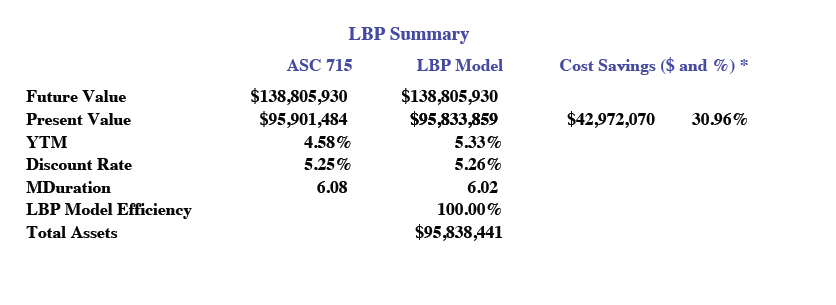
We, at Ryan ALM, Inc., believe that CFM provides the more precise interest rate hedge and duration matching, while also generating the liquidity necessary to meet ongoing benefits (and expenses (B&E)) when needed. How? In a CFM assignment, every month of the mandate is duration matched (term structure matched). If we are asked to manage the next 10-years of liabilities, we will match 120 durations, and not just an “average” or a few key rates. In the example below, we’ve been asked to fund and match the next 23+ years. In this case, we are funding 280 months of B&E chronologically from 8/1/24 to 12/31/47. As you can see, the modified duration of our portfolio is 6.02 years vs. 6.08 years for liabilities (priced at ASC 715 discount rates). This nearly precise match will remain intact as US interest rates move either up or down throughout the assignment.

Furthermore, CFM is providing monthly cash flows, so the pension plan’s liquidity profile is dramatically improved as it eliminates the need to do a cash sweep of interest, dividends, and capital distributions or worse, the liquidation of assets from a manager, the timing of which might not be beneficial. Please also note that the cost savings (difference between FV and PV) of nearly 31% is realized on the day that the portfolio is constructed. Lastly, the securing of benefits for an extended time dramatically improves the odds of success as the alpha/growth assets now have the benefit of an extended investing horizon. Give a manager 10+ years and they are likely to see a substantial jump in the probability of meeting their objectives.

In this US interest rate environment, where CFM portfolios are producing 5+% YTMs with little risk given that they are matched against the pension plan’s liabilities, why would you continue to use an aggressive asset allocation framework with all of the associated volatility, uncertainty, and lack of liquidity? The primary objective in managing a pension plan is to SECURE the promised benefits at a reasonable cost and with prudent risk. It is not an arms race designed on producing the highest return, which places most pension plans on the asset allocation rollercoaster of returns.