Cash Flow Matching Done Right!

By: Russ Kamp, Managing Director, Ryan ALM, Inc.

Most of us seek to climb the “ladder to success”. We also use ladders for important everyday activities. I’ll soon be back on a ladder myself, as year-end approaches and the Christmas lights are placed on my home. Despite the usefulness of ladders, there is one place where they aren’t necessarily beneficial. I’m specifically addressing the use of ladders for bond management as a replacement for a defeasement strategy.

There are still so many misconceptions regarding Cash Flow Matching (CFM). Importantly, CFM is NOT a “laddered bond portfolio”, which would be quite inefficient and costly. It IS a highly sophisticated cost optimization process that maximizes cost savings by emphasizing longer maturity bonds (within the program’s parameters capped at the maximum year to be defeased) and higher yielding corporate bonds, such as A and BBB+.

Furthermore, it is not just a viable strategy for private pension plans, as it has been deployed successfully in public and multiemployer plans for decades, as well as E&Fs. It is also NOT an all or nothing strategy. The exposure to CFM is a function of several factors, including the plan’s funded status, current allocation to core fixed income, and the Retired Lives Liability, etc. Many of our clients have chosen to defease their pension liabilities from 5-30 years or beyond. When asked, we recommend a minimum of 10 years, but again that will be a function of each plan’s unique funding situation.

CFM strategies are NOT “buy and hold” programs. CFM implementations must be dynamic and responsive to changes in the actuary’s forecasts of benefits, expenses, and contributions. There are also continuous changes in the fixed income environment (I.e. yields, spreads, credits) that might provide additional cost savings that need to be monitored and managed. Plan sponsors may seek to extend the initial length (years) of the program as it matures which will often necessitate a restructuring or rebalancing of the original portfolio to maximize potential funding coverage and cost reductions.

CFM programs CANNOT be managed against a generic index, as no pension plan’s liabilities will look like the BB Aggregate or any other generic index. Importantly, no pension plan’s liabilities will look like another pension plan given the unique characteristics of that plan’s workforce and plan provisions. The appropriate management of CFM requires the construction of a Custom Liability Index (CLI) that maps the plan’s liabilities in multiple dimensions and creates the path forward for the successful implementation of the asset/liability match.

Importantly, CFM programs are NOT going to negatively impact the plan’s ability to achieve its desired ROA. In fact, a successful CFM program, such as the one we produce, will actually enhance the probability of achieving the return target. How? Your plan likely has an allocation to core fixed income. Our implementation will likely outyield that portfolio over time creating alpha as well as SECURING the promised benefits. Given the higher corporate bond interest rates, an allocation to this asset class can generate a significant percentage of the ROA target with risks substantially below those of other asset classes.

When done right, a successful CFM implementation achieves the following:

Provides liquidity to meet benefits and expenses

Secures benefits for the time horizon the CFM portfolio is funding (1-10 years +)

Buys time for the alpha assets to grow unencumbered

Out yields active bond management… enhances ROA

Reduces Volatility of Funded Ratio/Status

Reduces Volatility of Contribution costs

Reduces Funding costs (roughly 2% per year in this rate environment)

Mitigates Interest Rate Risk for that portion of the portfolio using CFM as benefits are future values that are not interest rate sensitive.

No laddered bond portfolio can provide the benefits listed above. Whether you are responsible for a DB pension, an endowment or foundation, a HNW individual, or any other pool of assets, you likely have liquidity needs regularly. CFM done right will greatly enhance this process. Call on us. We’ll gladly provide an initial analysis on what can be achieved, and we will do it for FREE.

Sometimes You Just Have To Shake Your Head

By: Russ Kamp, Managing Director, Ryan ALM, Inc.

CIO Magazine recently published an article chronicling the trials and tribulations of the Dallas Police and Fire and Dallas Employees pension systems. This is not the first time that these systems have been highlighted given the current funded status of both entities, especially the F&P plan currently funded at 39%. The article was based on a “commissioned” study by investment adviser Commerce Street Investment Management, that compiled and in June presented its report to the city’s ad hoc committee on pensions. According to the CIO Magazine article, they were “tasked with assessing the pension funds’ structure and portfolio allocation; reviewing the portfolios’ performance and rate of return; and evaluating the effectiveness of the pension funds’ asset allocation strategy.” That’s quite the task. What did they find?

Well, for one thing, they were comparing the asset allocation strategies of these two plans with similarly sized Texas public fund plans, including three Houston-based systems: the Houston Firefighters’ Relief and Retirement Fund, the Houston Police Officers’ Pension System, and the Houston Municipal Employees Pension System. The practice of identifying “peers” is a very silly concept given that each system’s characteristics, especially the pension liabilities, are as unique as snowflakes. The Dallas plans should have been viewed through a very different lens, one that looked at the current assets relative to the plan’s liabilities.

Unfortunately, they didn’t engage in a review of assets vs. liabilities, but they did perform an asset allocation review that indicated that the two Dallas plans did not have enough private equity which contributed to the significant underfunding. Really? Commerce Street highlighted the fact that “Houston MEPS’ private equity allocation is 28.2%, and the average private equity allocation among the peer group is 21.3%, compared with the DPFP and Dallas ERF’s allocations of 12.2% and 10.5%, respectively.” How has private equity performed during the measurement period? According to the report, Dallas P&F’s plan performed woefully during the 5-years, producing only a 4.8% return, which paled in comparison to peers. Was it really a bad thing that Dallas didn’t have more PE based on the returns that its program produced?

Why would the recommendation be to increase PE when it comes with higher fees, less liquidity, little transparency, and the potential for significant crowding out due to excess migration of assets into the asset class? During the same time that Dallas P&F was producing a 4.8% 5-year PE return, US public equities, as measured by the S&P 500, was producing a 15.7% (ending 12/31/23) or 15.1% 5-year return ending 3/31/24. It seems to me that having less in PE might have been the way to go.

The Commerce report recommended that “to improve the pension funds’ returns and funded ratios, the city should: analyze what top performing peers have done; collaborate to find new investment strategies; improve governance policies and procedures; and provide recommendations for raising the funds’ investment performance.” Well, there you have it. How about returning to pension basics? Dallas is going to have to contribute significantly more in order to close the funding gap. They are not going to be able to create an asset allocation that will dramatically outperform the ROA target. Remember: if a plan is only 50% funded, achieving the ROA will result in the funded status deteriorating even more. They need to beat the ROA target by 100% in order to JUST maintain the deficit.

I’ve railed about pension systems needing to get off the asset allocation rollercoaster to ruin. This recommendation places the Dallas systems on a much more precarious path. So much for bringing some certainty to the management of pension plans. No one wins with this strategy. Not the participant, sponsor, or the taxpayers.

Oh, The Games That Are Played!

By: Russ Kamp, Managing Director, Ryan ALM, Inc.

Managing a defined benefit pension plan should be fairly straightforward. The plan sponsor has made a promise to each participant which is based on time of service, salary, and a multiplier as the primary inputs. The plan sponsor hires an actuary to do the nearly impossible of predicting the future benefits, administrative expenses, salaries, mortality, etc., which for the most part, they do a terrific job. Certainly in the short-term. Since we have a reasonable understanding of what that promise looks like, the objective should be to SECURE that promise at a reasonable cost and with prudent risk. Furthermore, sufficient contributions should be made to lessen the dependence on investment returns, which can be quite unstable.

Yet, our industry has adopted an approach to the allocation of assets that has morphed from focusing on this benefit promise to one designed to generate a target return on assets (ROA). In the process, we have placed these critically important pension funds on a rollercoaster of uncertainty. How many times do we have to ride markets up and down before we finally realize that this approach isn’t generating the desired outcomes? Not only that, it is causing pension systems to contribute more and more to close the funding gap.

Through this focus on only the asset-side of the equation, we’ve introduced “benchmarks” that make little sense. The focus of every consultant’s quarterly performance report should be a comparison of the total assets to total liabilities. When was the last time you saw that? Never? It just doesn’t happen. Instead, we get total fund performance being compared to something like this:

Really?

Question: If each asset class and investment manager beat their respective benchmark, but lost to liability growth, as we witnessed during most of the 2000s: did you win? Of course not! The only metric that matters is how the plan’s assets performed relative to that same plan’s liabilities. It really doesn’t matter how the S&P 500 performed or the US Govt/Credit index, or worse, a peer group. Why should it matter how pension fund XYZ performed when ABC fund has an entirely different work force, funded status, ability (desire) to contribute, and set of liabilities?

It is not wrong to compare one’s equity managers to an S&P or Russell index, but at some point, assets need to know what they are funding (cash flows) and when, which is why it is imperative that a Custom Liability Index (CLI) be constructed for your pension plan. Given the uniqueness of each pension liability stream, no generic index can ever replicate your liabilities.

Another thing that drives me crazy is the practice of using the same asset allocation whether the plan is 60% funded or 90% funded. It seems that if 7% is the return target, then the 7% will determine the allocation of assets and not the funded status. That is just wrong. A plan that is 90% funded has nearly won the game. It is time to take substantial risk out of the asset allocation. For a plan that is 60% funded, secure your liquidity needs in the short-term allowing for a longer investment horizon for the alpha assets that can now grow unencumbered. As the funded status improves continue to remove more risk from the asset allocation.

DB plans are too critically important to continue to inject unnecessary risk and uncertainty into the process of managing that fund. As I’ve written on a number of occasions, bringing certainty to the process allows for everyone involved to sleep better at night. Isn’t it time for you to feel great when you wake up?

Different Levels of Certainty

By: Russ Kamp, Managing Director, Ryan ALM, Inc.

A friend of mine in the industry emailed me a copy of Howard Marks’ latest memo titled, “The Folly of Certainty”. As they normally are, this piece is excellent. As regular readers of this blog know, I’ve encouraged plan sponsors and their advisors to bring more certainty to defined benefit plans through a defeasement strategy known as cash flow matching. I paused when I read the title, thinking, “oh, boy”, I’m at odds with Mr. Marks and his thoughts. But I’m glad to say after reading the piece that I’m not.

What Howard is referring to are the forecasts, predictions, and/or estimates made with little to no doubt concerning the outcome. He cited a few examples of predictions that were given with 100% certainty. How silly. Forecasts always come with some degree of uncertainty (standard deviation around the observation), and it is the humble individual who should doubt, to some degree, those predictions. I’ve often said that hope isn’t an effective investment strategy, but that thought doesn’t seem to have resonated with a majority of the investment community.

Ryan ALM’s pursuit of greater certainty is brought about through our ability to create investment grade bond portfolios whose cash flows match with certainty (barring a default) the liability cash flows of benefits and expenses. We accomplish this objective through our highly sophisticated and trade-marked optimization model. We are not building our portfolios with interest rate forecasts, based on economic variables that come with a very high degree of uncertainty. No, we build our portfolios based on the client’s specific liability cash flows and implement them in chronological order. Importantly, once those portfolios are created, we’ve locked in a significant cost reduction that is a function of the rate environment and the length of the mandate.

As stated previously, I have a great appreciation for Howard Marks and what he’s accomplished. He is absolutely correct when he questions any forecast that has little expectation for being wrong. In most cases, the forecaster is not in control of the outcome, which should lend itself to being more cautious. In the case of the Ryan ALM cash flow matching strategy, we are in control. Having the ability to bring some certainty in our pursuit of securing the promised benefits should be greatly appreciated by the plan sponsor community. Because of the uncertain economic environment that we are currently living in, bringing some certainty should be an immediate goal. Care to learn more?

Milliman: Improved Corporate Pension Funding Continues

By: Russ Kamp, Managing Director, Ryan ALM, Inc.

Milliman has once again produced its monthly update of the Milliman 100 Pension Funding Index (PFI), which analyzes the 100 largest U.S. corporate pension plans. Thank goodness they can still find 100 corporate plans to evaluate. Despite my snarkiness, it is good to read that Milliman is reporting improved funding for the sixth consecutive month in 2024, with a slight increase in the funded ratio from 103.6 to 103.7. The surplus remained the same at $46 billion.

June’s investment return of 1.22% matched the $9 billion increase in liabilities as the discount rate fell 7 bps to 5.46%. “The first half of 2024 has seen nothing but funded ratio improvements,” said Zorast Wadia, author of the PFI. “However, with markets at all-time highs and concerns that discount rates may eventually fall, the forecast for the second half of 2024 may not be as sanguine, and liability-matching portfolios will continue to be prudent strategies for plan sponsors.”

We absolutely agree with Zorast’s assessment of what may transpire in 2024’s second half. There has clearly been a slowing in economic activity as seen by the GDP in Q1’24 (1.4%) and Q2’24 is not looking much more robust, as the Atlanta Fed’s GDPNow model presently forecasts a 2.0% real GDP annualized return for the second quarter. If economic weakness were to develop, as a result of the Fed’s campaign to stem inflation by raising the Fed Fund’s rate (presently 5.25% – 5.5%), US interest rates could fall, while equities could also cool off as a result of the economic weakness. A combination such as this would be quite detrimental to pension funding.

In related news, FundFire has published an article highlighting the fact that “fixed income products now make up about 54% of defined-benefit portfolios, according to Mike Moran, senior pension strategist at Goldman Sachs Asset Management. He is obviously speaking about corporate plans, as both public and multiemployer exposures to fixed income are much more modest. Happy to see that Moran was quoted as saying that he “urges pension managers to act quickly to de-risk.” He went on to say, “This is a period of strength, a position of strength, for plan sponsors, and history shows us that the position of strength can sometimes be fleeting,” We absolutely agree.

We’ve been encouraging plan sponsors of all types to act to reduce risk and secure the promised benefits before the Fed or market participants reduce rates from these two-decade high levels.

The Proof’s in the Pudding!

By: Russ Kamp, Managing Director, Ryan ALM, Inc.

Not sure why I used the title that I did, but I recently had pudding (vanilla) over the holiday weekend, so maybe that inspired me, and boy, was it good! That said, we, at Ryan ALM, Inc., are frequently challenged about the benefits of Cash Flow Matching (CFM) versus other LDI strategies, most notably duration matching. There seems to be singular focus on interest rate risk without any consideration for the need to create the necessary liquidity to meet monthly benefit payments. Given that objective, it isn’t surprising that duration matching strategies have been the dominant investment strategy for LDI mandates. But does that really make sense?

Are duration matching strategies that use an average duration or several key rate durations along the Treasury curve truly the best option for hedging interest rate risk? There are also consulting firms that espouse the use of several different fixed income managers with different duration objectives such as short-term, intermediate, and long-term duration mandates. Again, does this approach make sense? Will these strategies truly hedge a pension plan’s interest rate sensitivity? Remember, duration is a measure of the sensitivity of a bond’s price to changes in interest rates. Thus, the duration of a bond is constantly changing.

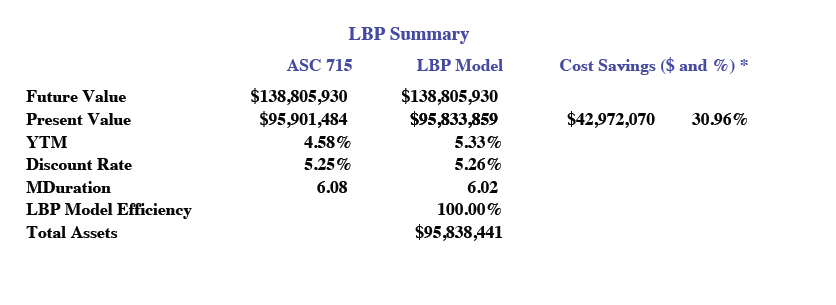
We, at Ryan ALM, Inc., believe that CFM provides the more precise interest rate hedge and duration matching, while also generating the liquidity necessary to meet ongoing benefits (and expenses (B&E)) when needed. How? In a CFM assignment, every month of the mandate is duration matched (term structure matched). If we are asked to manage the next 10-years of liabilities, we will match 120 durations, and not just an “average” or a few key rates. In the example below, we’ve been asked to fund and match the next 23+ years. In this case, we are funding 280 months of B&E chronologically from 8/1/24 to 12/31/47. As you can see, the modified duration of our portfolio is 6.02 years vs. 6.08 years for liabilities (priced at ASC 715 discount rates). This nearly precise match will remain intact as US interest rates move either up or down throughout the assignment.

Furthermore, CFM is providing monthly cash flows, so the pension plan’s liquidity profile is dramatically improved as it eliminates the need to do a cash sweep of interest, dividends, and capital distributions or worse, the liquidation of assets from a manager, the timing of which might not be beneficial. Please also note that the cost savings (difference between FV and PV) of nearly 31% is realized on the day that the portfolio is constructed. Lastly, the securing of benefits for an extended time dramatically improves the odds of success as the alpha/growth assets now have the benefit of an extended investing horizon. Give a manager 10+ years and they are likely to see a substantial jump in the probability of meeting their objectives.

In this US interest rate environment, where CFM portfolios are producing 5+% YTMs with little risk given that they are matched against the pension plan’s liabilities, why would you continue to use an aggressive asset allocation framework with all of the associated volatility, uncertainty, and lack of liquidity? The primary objective in managing a pension plan is to SECURE the promised benefits at a reasonable cost and with prudent risk. It is not an arms race designed on producing the highest return, which places most pension plans on the asset allocation rollercoaster of returns.

Good Ideas Are Often Overwhelmed!

By: Russ Kamp, Managing Director, Ryan ALM, Inc.

We have a tendency in our industry to overwhelm good ideas with much too much money. Asset flows can be evil as they drive valuations up as too much money pursues to few good ideas. The “winner” in the bidding competition frequently (eventually) becomes the loser in the long run. I recently wrote about this phenomenon as it related to private credit. Well, we have a similar, if not more egregious example as it pertains to private equity. With more than $3.2 trillion tied up in aging, closely held companies at the end of 2023, according to Preqin data. 

I recently read a refreshingly honest post on LinkedIn.com about the current state of private equity. The comments referred to a discussion given by a “leading” voice within the industry who mentioned that the “types of PE returns it (our industry) enjoyed for many years, you know, up to 2022, you’re not going to see that until the pig moves through the python. And that is just the reality of where we are.” That is quite the image. It speaks to my point about too much money chasing too few good ideas. Pension America has pursued a return objective in lieu of one that stresses the securing of the pension promise. Striving for return has forced most participants to load up on gimmicky alternatives, including real estate, private credit, private equity and worst of all, hedge funds.

For the early adopters, returns above those produced by the public markets were achievable, but again, once someone has a decent idea we tend to jump on that bandwagon until the horse can’t pull the cart any longer. What happens next is usually not pretty. This leading voice also mentioned that “fewer realizations and lower returns” were on the horizon until the proverbial pig was digested. Unfortunately, PE firms are holding onto these aging companies and they will need to be refinanced at much higher interest rates which will further reduce expected returns.

In other news, Heather Gillers, WSJ, reported that the honeymoon may be over between pension America and private equity managers. The promise of high returns may not be realized after all. According to Ms. Gillers, payouts from these expensive offerings have all but dried up. As a result, many pension funds are unloading their investments at significant discounts through secondary markets. According to this article, large public pension systems have migrated roughly 14% of the plan’s AUM into PE. What once looked like an investment that could produce a premium return is struggling to match returns of the S&P 500.

Worse, about 50% of the private equity investors have assets tied up in “Zombie funds”, which hadn’t paid out on the expected timeframe. Needing liquidity (should have invested in a cash flow matching strategy), these pension funds are getting an average of about 85% of the value of assets that were assigned just three to six months prior. According to Jefferies Financial Group about $60 billion was transacted in secondhand sales by PE investors last year.

Despite the lack of liquidity and the idea that too much money has been chasing too few good ideas, the “honest’ assessment by our industry “leading voice” stopped at their doorstep. You see, his firm believes that by 2026 (beginning or end of year???) their alternative assets under management will rocket from $651 billion to $1 trillion. Wow! Now how will that pig pass through the python? Are we to believe that growth of that magnitude will not negatively impact that firm or our industry? I guess that the news to date hasn’t been sufficiently ugly to stop this rampage into PE. I’ve seen this movie before. Spoiler alert – the train barrels forward until it goes over a cliff where the tracks used to be. I’d suggest getting off the next stop.

Money Managers Recaptured 1/2 the 2022 losses – Should We Be Pleased?

By: Russ Kamp, Managing Director, Ryan ALM, Inc.

P&I has produced an article highlighting the fact that money managers recaptured nearly half of the institutional assets lost (-$9 trillion) in 2022’s market correction. They mention that this was accomplished despite “lingering economic and political uncertainties that kept a lot of money sidelined, including a record $6 trillion parked in money market funds alone.”

According to Pensions & Investments’ 2023 survey of the largest money managers, institutional assets for 411 managers around the globe rose 9.7%, or $4.89 trillion, to $55.23 trillion as of Dec. 31, 2023 for a recovery rate of 52.5%. This recapture of assets was primarily driven by equities, both US (+26%) and global X US (+18%), while bonds were up 5.6% domestically and abroad.

Obviously, it was great to see the “rally” despite wide-spread uncertainty related to the economy, inflation, interest rates, and the labor market. Issues that are still impacting perceptions today. But the real question one should ask has to do with the cyclical nature of markets and what plan sponsors and their advisors can do to mitigate the peaks and valleys. As I reported earlier this week, since 2000, public pension plans have seen a tripling (or more) in contribution expenses as a % of pay, while the funded status of Piscataqua research’s universe of 127 state and local plans has fallen by 25%.

Isn’t it time to get off the asset allocation rollercoaster? The nearly singular focus on return (ROA) by pension plan sponsors has placed pension funding on a ride that does little to guarantee success, but has certainly exacerbated volatility. In the process, contributions into these critically important retirement systems have skyrocketed. Let’s stop thinking that the only way to fund pensions is through outsized market returns. Today’s interest rate environment is providing plan sponsors with a wonderful opportunity to SECURE a portion of their future promises by carefully constructing a defeased bond portfolio that matches and funds asset cash flows of principal and interest with liability cash flows of benefits and expenses.

By doing so, you eliminate the impact of drawdowns, as the assets and liabilities will now move in tandem. How refreshing! Because you are defeasing a future benefit, you are also eliminating interest rate risk, as future values are not interest rate sensitive. Furthermore, you have now created a liquidity profile that is enhanced, as the bond portfolio now pays all of the benefits and expenses chronologically as far into the future as the allocation to the cash flow matching program lasts. Lastly, the growth or alpha assets can now grow unencumbered, as they are no longer a source of funding. The need for a cash sweep has been replaced by cash flow matching with bonds.

Let’s stop having to celebrate recovery rates of roughly 50%, when we can institute investment programs that eliminate these massive and harmful drawdowns. They aren’t helpful to the sustainability of DB pension plans, which we so desperately need if we are to provide a dignified retirement to the American worker. Let’s get back to the fundamentals, as the true objective of a pension is to fund benefits in a cost-efficient manner with prudent risk. It isn’t a performance arms race!

The Status Quo Isn’t Working

By: Russ Kamp, Managing Director, Ryan ALM, Inc.

Anyone who has read just a handful of the >1,400 blog posts that I’ve produced knows that I am a huge fan of defined benefit (DB) plans. That I’ve come to loathe the fact that DB plans were/are viewed as dinosaurs, and as a result have been mostly replaced by ineffective defined contribution plans. As a result, the American worker is less well-off given the greater uncertainty of their funding outcome. A dignified retirement is getting further out of reach for a majority of today’s workers.

That said, just because I desire to see DB plans maintained as the primary retirement vehicle, doesn’t mean that I appreciate how many of them have been managed. The pension plan asset allocations remain focused on the wrong objective, which continues to be the ROA and NOT the plan’s liabilities. It is this mismatch in the primary objective that has exacerbated the volatility of the funded ratio/status and contribution expenses. As I’ve stated many times, it is time to get off the asset allocation rollercoaster. We need to bring an element of certainty to the investment structure despite the fact that outcomes within the capital markets are highly uncertain.

How bad have things been? According to a recently produced analysis by Piscataqua Research, Inc., which regularly reviews the performance of both assets and liabilities for 127 state and local retirement systems, since 2000 contributions as a % of pay have tripled, while funded status has declined by more than 25%. Again, I’m not here to bash public funds. On the contrary, I am here to offer a potential solution to the volatility exhibited. I wrote a piece many years (1/17) ago titled, “Perpetual Doesn’t Mean Sustainable” in which I discussed the need to bring stability to these critically important retirement plans because at some point there might just be a revolt from the taxpayers that are lacking defined benefit participation themselves. We can’t afford to have tens of millions of American public fund workers added to the federal social safety net God forbid their retirement plans are terminated and benefits frozen prematurely.

There is only one asset class – bonds – in which the future performance is known on the day that the bond is acquired. You can’t tell me what Amazon or Tesla will be worth in 10 years or the value of a building or private equity portfolio, but I can tell you how much interest and principal you will have earned on the day that the bond matures, whether that be 3-, 5-, 10- or 30-years from now. That information is incredibly valuable and can be used to match and SECURE the pension plan’s liabilities. That portion of the plan’s assets will now provide stability and certainty reducing the ups and downs exhibited through normal market behavior. Why continue to embrace an asset allocation that has NO certainty? An asset allocation that can create the explosion in contribution expenses that we’ve witnessed.

DB plans need to be protected and preserved! Ryan ALM’s focus is solely on achieving that lofty goal. It should be your goal, too. Let us help you get off the asset allocation rollercoaster before markets reach their peak and we once again ride those market down creating a funding deficit that will take years and major contributions to overcome.

Does This Look Like Success?

By: Russ Kamp, Managing Director, Ryan ALM, Inc.

The following was a headline for a MarketWatch.com article, “The 401(k)’s success has been overlooked and will help even more Americans”, which I saw on a LinkedIn.com post earlier today. Sure, some American workers have benefited from their ability to fund a DC account, but the vast majority of Americans are struggling.

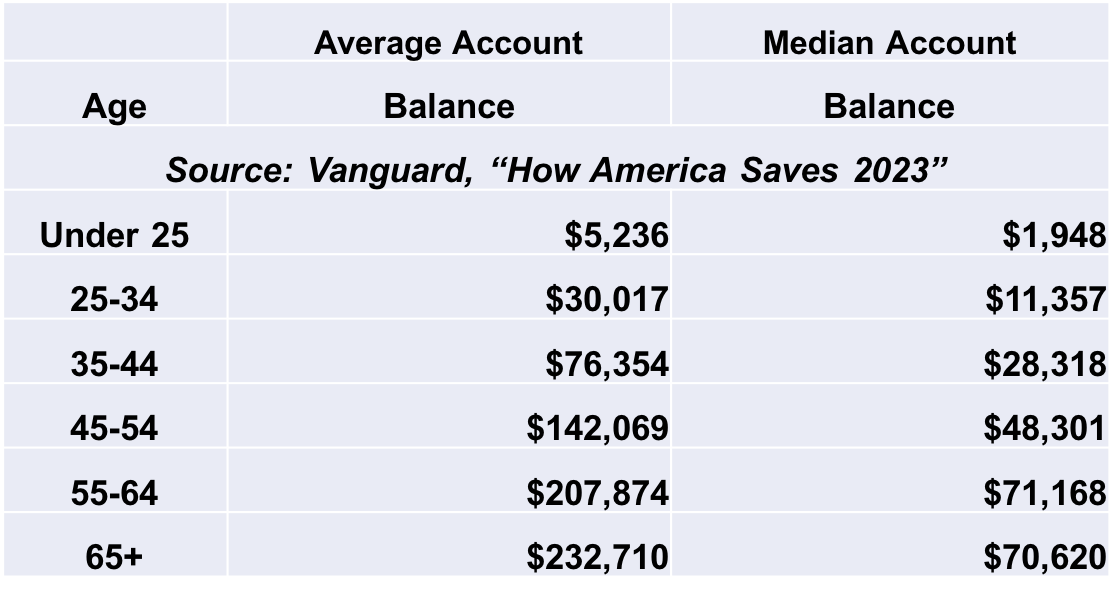
Does This look like success?

Perhaps the level of savings would be okay if DC plans were actually supplemental retirement vehicles, but since they have morphed into the primary retirement program for most workers, this is a disaster. I’m tired of the fact that we only ever see “average” balances reported. Of course, a few well-funded balances will drive the average up. Let’s focus on the MEDIAN account balances. Does a $70,620 account balance for a 65+ year-old participant look like a successful outcome? How much would that balance provide on a monthly basis for a roughly 20-year retirement?

If I were fortunate to have a defined benefit plan that provided $2,000/month (which isn’t a lot) for 20-years, I would receive $480K in retirement which is 6.8Xs what the 65+ year-old with the median account balance has today. It is a far cry when compared to the view that $1.4 million is the balance needed to have a dignified retirement today. It is silly to believe that the average American has the disposable income, investment acumen, and predictive ability to gauge how long they will live in order to allocate this meager balance to ensure that the recipient doesn’t outlive their savings.

The investment industry can celebrate all they want as it relates to the total accumulated wealth in defined contribution plans, but for the “median” American, it just isn’t close to being enough. Defined benefit plans should be the backbone of our retirement system, while DC plans occupy the supplemental role for which they were designed. As someone in that LinkedIn.com post stated, “the numbers don’t lie”. I would certainly agree, but that doesn’t mean that the #s are revealing success!