How Comforting is $1,305.54/year?

By: Russ Kamp, Managing Director, Ryan ALM, Inc.

One doesn’t have to spend much time on LinkedIn.com these days without seeing a discussion about the pros and cons of Defined Benefit (DB) vs. Defined Contribution (DC) aka 401(k) plans. Anyone who has read just a few of the >1,500+ posts on this blog know that I and Ryan ALM, Inc. are huge supporters of DB plans. Based on the following, it becomes apparent why that is the case.

One topic frequently mentioned among our peers is financial literacy. As a former member of two boards of education (11 years in total), I have witnessed first-hand how little financial literacy is shared with our high school students, especially as it relates to saving and investing. That said, as important as education is, the greatest issue for me is the lack of disposable income for the average American worker.

Frequently we read about the spending habits of younger generations, including being the “avocado toast” crowd. Examples often used include the daily purchase of a Starbucks drink or two, the use of Uber Eats, and similar examples of perceived wasteful spending. They fail to mention that even “well-paid” workers (>$100k) are burdened by a mortgage or rent payment, they likely have student loan debt, they have to buy insurance in order to use their car, which is also a very expensive purchase, they are required to have health insurance, homeowners or rental insurance, and God forbid that they have a spouse and a couple of kids. Childcare expenses have gotten to be insane. Is there any wonder that funding one’s own retirement has proven to be incredibly challenging?

So how are we doing? Unfortunately, most of the literature on the subject uses average balances to represent 401(k) savings. This practice needs to stop. According to Vanguard the average balance in 2024 is $134,128, but the median balance is $35,285. In addition, Morningstar has just published an article stating that retirees should use only a 3.7% withdrawal rate (no longer 4%) to safely use a 401(k) retirement balance given the recent performance of equity markets and the current interest rate environment. Let’s see: 3.7% * $35,285 = $1,305.54. That is an annual withdrawal, although it looks like it should be a monthly payout! What kind of retirement will that level of annual withdrawals provide? For comparison purposes, the average DB payout in the private sector is $11k and nearly $25k in public pensions.

As a reminder, DC plans were intended to be supplemental to DB plans. It is highly regrettable that they have morphed into most everyone’s primary means of “accumulating” retirement resources. This migration in proving to be an unmitigated failure and the consequences will be untenable. The American worker needs access to a DB plan. Let’s work together to protect and preserve those that remain, while encouraging former sponsors of these plans to rethink the decision to freeze or terminate. There are also state sponsored entities that afford employees in smaller companies access to a DB-like plan. That said, please manage them with a focus on the pension promise (securing benefits). Don’t rely on markets and all the volatility that comes with that exposure to “fund” these essential programs. That strategy hasn’t worked!
“Peace of Mind” – How Beneficial Would That Be?

By: Russ Kamp, Managing Director, Ryan ALM, Inc.

As a member of the investment community do you often feel stressed, worried, insecure, uneasy, or are you just simply too busy to be at peace? In the chaotic world of pension management, finding peace of mind can sometimes be hard, if not impossible. How much would it mean to you if you could identify an investment strategy that provides you with just that state of being?

At Ryan ALM, Inc. our mission is to protect and preserve DB pension plans through a cash flow matching (CFM) strategy that ensures, barring any defaults, that the liabilities (benefits and expenses) that YOU choose to cover are absolutely secured chronologically. You’ll have the liquidity to meet those obligations in the amounts and at the time that they are to be used. There is no longer the worry and frustration about finding the necessary “cash” to meet those promises. CFM provides you with that liquidity and certainty of cash flows.

Furthermore, you are buying time for the growth (alpha or non-bond) assets to now grow unencumbered, as they are no longer a source of liquidity. You don’t have to worry about drawdowns, as the CFM portfolio creates a bridge over the challenging markets with no fear of locking in losses due to cash flow needs. Don’t you just feel yourself nodding off with the knowledge that there is a way to get a better night’s sleep?

How much would you “spend” to achieve such peace of mind? Most pension systems cobble together disparate asset classes and products, many which come with hefty price tags, in the HOPE of achieving the desired outcome. With CFM, YOU choose the coverage period to be defeased, which could be as short as 3-5 years or as long as it takes to cover the last liability. The longer the time horizon the greater the potential cost reduction. As an FYI, most of our clients have chosen a coverage period of roughly 10-years. Knowing that you have SECURED your plan’s obligations for the next 10-years, and locked in the cost reduction, which can be substantial (2% per year = 20% for 1-10 years), on the very first day in which the portfolio is constructed, has to be just an incredible feeling compared to living in an environment in which traditional pension asset allocations can have significant annual volatility and no certainty of providing either the desired return or cash flow when needed.

Remember, the amount of peace of mind is driven by your decisions. If you desire abundant restful nights, use CFM for longer timeframes. If you believe that you only need “peace of mind” in the near-term, engage a CFM strategy for a shorter 3-5 years. In any case, I guarantee that the pension plan’s exposure to CFM won’t be the reason why you are restless when you put your head on the pillow. Oh, and by the way, we offer the CFM strategy at fee rates that are substantially below traditional fixed income strategies, let alone, non-bond capabilities. Call us. We want to be your sleep doctor!

Another Example of the Games That Are Played

By: Russ Kamp, Managing Director, Ryan ALM, Inc.

I continue to be involved in programs associated with the Florida Public Pension Trustees Association (FPPTA) for which I remain quite grateful. If you’ve been exposed to their conferences, you know that they do a terrific job of bringing critical education to Florida’s trustee community and have since its founding in 1984. I’m pleased to highlight an expansion of their program to include the Trustee Leadership Council (TLC). This program brings together a small collection of experienced trustees who want to delve more deeply into the workings of defined benefit pensions – both assets and liabilities. Furthermore, the instruction is mostly done through case studies that provide them with the opportunity to roll up their sleeves and really get into the nitty gritty of pension management. Great stuff!

I could go on for days about the FPPTA and their programming, but I want to raise another issue. During a recent conversation with the TLC leadership, information was shared from one particular case study (a non-Florida-based pension plan). This information was for a substantial public pension plan that has had a troubling past from a funding standpoint. We also had info shared from a much smaller Florida-based system. There appeared to be a stark difference in performance of these two systems, as measured by the funded ratios, with a particular focus on 2022’s results. Upon further review, the one actuarial report used a 10-year smoothing for the funded ratio, while the Florida plan highlighted the performance for just 2022 and the impact that had on that plan’s funded ratio. As you can imagine, given the very challenging return environment in 2022, funded ratios took a hit. Question answered!

However, in looking at the actuarial report for the larger system, I saw that 2023’s funded ratio dramatically improved from the depths of 2022’s hit. It seemed outsized given what I knew about the environment that year. Diving a little deeper into the report – is there anything drier than an actuarial report – I found information related to a change in the discount rate that had occurred during 2023. It seems that this system had come up with its own funding method, but that was going to lead to the system becoming insolvent relatively soon. As a result, they passed legislation mandating that future contributions were going to be determined on an actuarial basis. How novel!

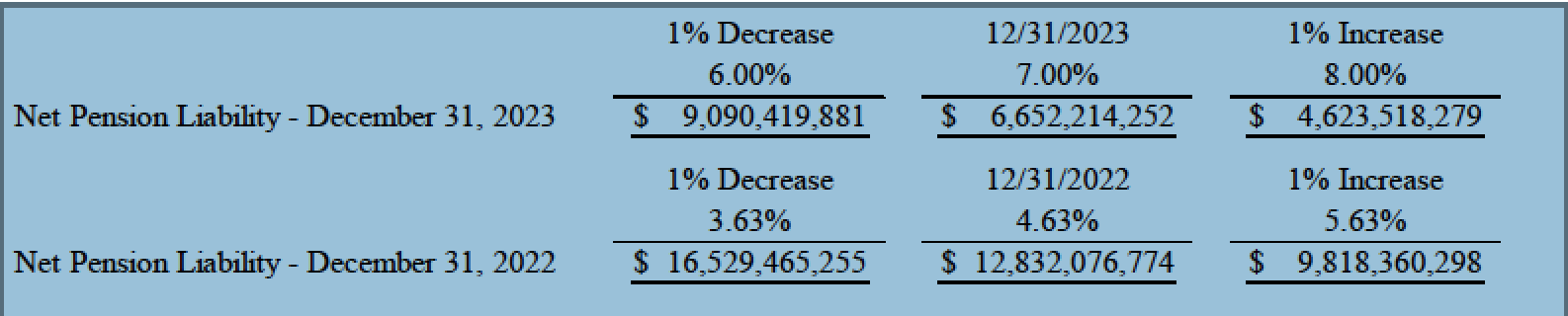
As a result of the move from a 4.63% blended rate (used a combination of the ROA (7%) and a municipal rate) they have now adopted a straight 7% discount rate equivalent to the fund’s return on asset assumption. Here is the result of that action:

As one can see, the present value (PV) of those future promises based on a 4.63% blended rate creates a net pension liability of -$12.8 billion. Using a 7% discount rate creates a PV of those net liabilities of “only ” -$6.7 billion. The dramatic improvement in the funded status from 48.4% to 64.1% is primarily the result of changing the discount rate, as a higher rate reduces the PV of your promise to plan participants. It really doesn’t change the promise, just how you are accounting for it.

The trustees who will participate in the TLC program offered by the FPPTA will receive a wonderful education that will allow them to dive into issues as referenced above. Knowing the ins and outs of pension management and finance will lead to more appropriate decisions related to benefits, contributions, asset allocation, etc.

And So It Is!

By: Russ Kamp, Managing Director, Ryan ALM, Inc.

Milliman has released the results for its Public Pension Funding Index (PPFI), which analyzes data from the nation’s 100 largest public defined benefit plans. They are reporting that the collective funded ratio deteriorated during the last month from 82.8% as of September 30th, to 81.2% as of October 31st, as the combined investments of these plans fell for the first time since April. The estimated return for the PFFI was -1.6%, as losses ranged from -2.9% to -0.6%. The $s lost were roughly $80 billion during the month. The funding deficit now stands at about $1.1 trillion.

You may recall that on November 8th, I produced a blog post titled, “Another Inconsistency”, in which I wrote about Milliman’s reporting of its corporate index that highlighted the fact that the collective funded ratio improved during the month despite asset losses due to the fact that liabilities fell to a great extent as interest rates rose.

I also wrote the following, “what do you think will happen in public fund land? Well, given weak markets, asset levels for Milliman’s public fund index will likely fall” (they did, as reported above). “Given that the discount rate for public pension systems is the ROA, there will be no change in the present value of public pension plans’ future benefit obligations (silly). As a result, instead of witnessing an improvement in the collective funded status of public pensions, we will witness a deterioration.” (and we did!) The inconsistency is startling!

Decisions with regards to benefits and contributions are made all the time based on information related to the funded ratio/status of these pension plans. Using different accounting standards clearly produces different outcomes that might just lead to inappropriate conclusions and the subsequent decisions. Oh, boy!

It Doesn’t Have to be This Way

By: Russ Kamp, Managing Director, Ryan ALM, Inc.

The Financial Times (FT) recently published an article highlighting the struggles of Ivy League schools trying to manage liquidity in the face of an extended downturn in the performance of private markets. Collectively, this august group of institutions continues to underperform the average return for higher education endowments of 10.3% for fiscal year 2024, with only 6 of 8 universities outperforming. This follows an even more challenging fiscal 2023 in which all 8 universities failed to top that year’s 6.8% average return. This difficult period in which distributions have dried up considerably, is forcing some, including Princeton, to issue bonds in order to support the operations of the schools. Haven’t we seen this story play out before?

Despite the troubles, there seems to be this reluctance to alter a strategy first adopted nearly four decades ago when Yale began to invest heavily in these strategies. In the article, Roger Vincent, former head of private equity at Cornell University said, “Everybody still believes in having as big an allocation to private equity as possible.” Really? Why? No asset class will always outperform. The problem with private equity at this time is the fact that too much money has chased to few quality deals driving up the costs of acquisition and lowering future returns. In the process, managers have become reluctant to reduce valuations in order to sell these portfolio companies which has crushed liquidity.

As I’ve written on many occasions, assets shouldn’t be lumped into one bucket focused on return either to meet benefit payments, or in this case, a spending policy. There should be two buckets – liquidity and growth. If the Ivies had structured their portfolios with this design in mind, they would have had sufficient liquidity when needed and issuing bonds wouldn’t have been necessary. Endowments and foundations would be well-served to adopt this structure. Liquidity can be managed through a cash flow matching (CFM) process, which will ensure (barring any defaults) that the cash will be on hand monthly, quarterly, and/or annually depending on the needs of the organization.

I’ve witnessed too many times throughout my 40+ year career investment ideas that got overwhelmed by cash flows. We’ve had booms and busts in real estate, equities (Dot Com era), quantitatively managed equities, gold/commodities, emerging markets, Japan, hedge funds, and on and on and… Why would “investors” believe that private equity would be immune to such action? Again, if an investment is deemed to be all weather, money will naturally flow to that “opportunity” thus reducing future prospects. One way to minimize the short-term impact of these cycles is to build in a liquidity strategy that bridges these troubled times.

ARPA Update as of November 15, 2024

By: Russ Kamp, Managing Director, Ryan ALM, Inc.

I can’t believe that Thanksgiving is next week. It appears that the PBGC was motivated to get some things done in anticipation of that holiday, as we witnessed more activity last week than we’ve been seeing in the most recent past.

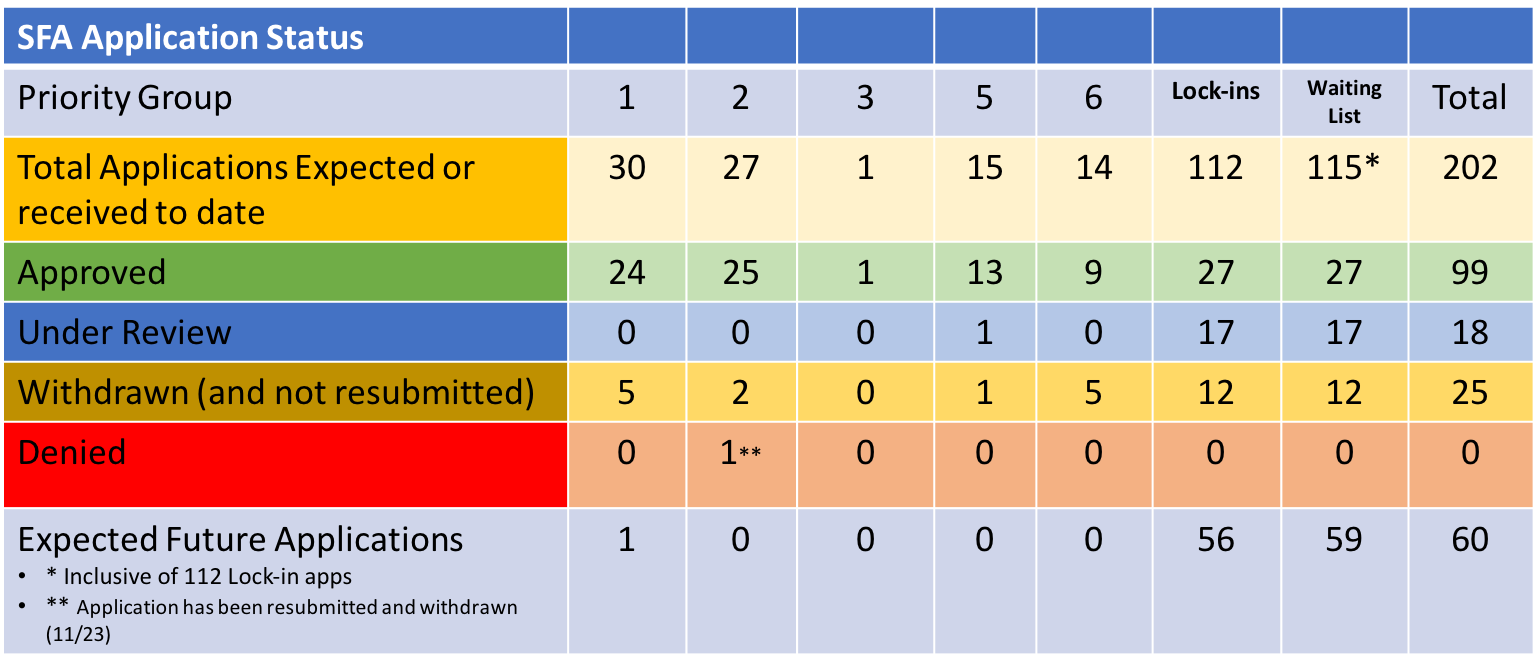
There were four applications filed last week, including the following pension plans: Roofers and Slaters Local No. 248 Pension Plan, Pension Plan of the Asbestos Workers Philadelphia Pension Fund, Local 1783 I.B.E.W. Pension Plan, and Cement Masons Local Union No. 567 Pension Plan. These plans are not seeking significant sums as far as the SFA goes, as in total they are seeking $92.6 million for 2,637 participants. The IBEW plan out of Armonk, NY submitted a revised application. The other three were the initial filings for these plans.

Pleased to report that Local 360 Labor-Management Pension Plan received approval for its revised application. This fund will receive $30.4 million for the 6,117 members of the plan. This fund initially filed an SFA application in early 2023 only to withdraw it in July 2023. Good for them that they were finally successful in receiving the grant.

Local 810 Affiliated Pension Plan wasn’t as fortunate as Local 360, as they withdrew the initial application that had been seeking $104.1 million for 1,437 members of the plan. In addition to the four new filings, the one withdrawal, and the one approved application, the PBGC also was involved in negotiating two repayment of excess SFA due to census errors. Iron Workers Local 17 Pension Fund
Bricklayers and Allied Craftsmen Local 7 Pension Plan returned $260,471.70 representing only 19 bps of the SFA grants awarded. To date, 25 funds have returned a total of $149.9 million representing 0.38% of the awarded grants.

Recessionary expectations have waned in the last couple of months and flows into bonds, which had been strong for most of the year have recently turned negative. As a result, US interest rates have backed up. It is a great time to secure the promised benefits (and expenses) through cash flow matching strategies. A rising rate environment will be quite bearish for traditional fixed income shops. We’ll be happy to provide you and your fund with a free analysis of what can be achieved through a defeasement strategy.

The Joke’s On Us!

By: Russ Kamp, Managing Director, Ryan ALM, Inc.

According to a P&I article, the ECB has undertaken an “exploratory review of bank exposures to private equity and private credit funds in order to better understand these channels and to assess banks’ risk management approaches.” According to P&I, the overarching message was that “complex exposures to private equity and credit funds require sophisticated risk management.”

Yesterday, there was a FundFire article that questioned the effectiveness of the “Yale Model” given the heavy dependence on alternatives and the weak performance associated with those products in recent periods. According to the article, the greater the alts exposure the likely weaker fiscal performance.

In a recent article by Richard Ennis, founder and former chairman of investment consultant EnnisKnupp, he estimates that Harvard University, with about 80% of its endowment assets in alternative investments, spends roughly 3% of endowment value on money management fees annually, including the operation of its investment office.

Given the concerns noted above with respect to fees, risk management, and the overall success of investing in alternative strategies, one would believe that a cautionary tone would be delivered at this time. But alas that isn’t the case when it comes to forging ahead with plans to introduce alternatives into DC plans where the individual participant lacks the necessary sophistication to undertake a review of such investments. According to yet another FundFire article in recent days, Apollo and Franklin are plowing forward with plans to make available alternative investments to the DC participant through a new CIT. Shameful!

I’ve commented numerous times that it is pure madness to believe that the average American worker has the disposable income, investment acumen, and/or the necessary crystal ball to effectively manage distributions upon retirement through a DC offering. Given this lack of investment knowledge, I find it so distasteful that “Wall Street” continues to look at these plans as just another source of high fees and revenue. Where are the FIDUCIARIES?

If the ECB doesn’t believe that their banks have the necessary tools in place to handle these complex investments, how on Earth will my neighbor, family member, former teacher, etc.? Can we please stop this madness!

Have You Ever Wondered?

By: Russ Kamp, Managing Director, Ryan ALM, Inc.

Ever wonder why future pension contributions aren’t part of the funded ratio calculation, yet future benefit payments are? Ironically, under GASB 67/68, which requires an Asset Exhaustion Test (AET), which is a test of a pension plan’s solvency, future contributions are an instrumental part of the equation. Why the disconnect? 

Also, the fact that future contributions, which in many cases are mandated by legislation or through negotiations, are not in the funded ratio means that the average funded ratio is likely understated. Furthermore, given the fact that the funded ratio is likely understated, the asset allocation, which should reflect the funded status, is likely too aggressive placing the plan’s assets on a more uncertain path leading to bigger swings in the funded ratio/status of the plan as the capital markets do what they do.

As part of the Ryan ALM turnkey LDI solution, we provide an AET, which often highlights the fact that the annual target return on asset assumption (ROA) is too high. A more conservative ROA would likely lead to a much more conservative asset allocation resulting in far smaller swings and volatility associated with annual contributions and the plan’s funded status. As you will soon read, contributions are an important part of the AET for public pensions. When performing the test, you need to account for future contributions from both employees and employers. These contributions, along with investment returns, help to sustain the pension plan’s assets relative to liabilities over time.

Here’s a quick summary of how contributions fit into the asset exhaustion test:

  1. Current Assets: Start with the current market value of the plan’s assets.
  2. Benefit Payments: Forecast the actuarial projections for future benefit payments
  3. Administrative Expenses: Add in the actuarial projections for administrative expenses
  4. Future Contributions: Subtract the actuarial projections for future contributions from employees and employers to get a net liability cash flow.
  5. Investment Returns: Grow the current market value of plan’s assets at the expected investment return on the plan’s assets (ROA) plus a matrix of lower ROAs to create an annual asset cash flow
  6. Year-by-Year Projection: Perform a year-by-year projection to see if the asset cash flows will fully fund the net liability cash flows. Choose the lowest ROA that will fully fund net liability cash flows as the new target ROA for asset allocation

By including contributions in the test, you get a more accurate picture of the plan’s long-term sustainability. So, I ask again, why aren’t future contributions included in the Funded Ratio calculation? Isn’t it amazing how one factor (not including those contributions) can lead to so many issues? With less volatility in funded status and contributions, DB plans would likely have many more supporters among sponsors and the general public (aka taxpayer) . It is clearly time to rethink this issue.

3% Return for the Decade? It Isn’t Far-fetched!

By: Russ Kamp, Managing Director, Ryan ALM, Inc.

This blog is a follow up to a post that I published last week. In that post I cited a recent analysis by Goldman Sach’s forecasting a 3% 10-year return. I concluded the blog with the following: “I wouldn’t worry about the 5% fixed income yield-to-worst (YTW) securing my pension liabilities. Instead, I’d worry about all the “growth” assets not used to secure the promises, as they will likely be struggling to even match the YTW on a CFM corporate bond portfolio.”

How likely is it that Goldman and other financial institutions are “right” in forecasting such a meager return for the next decade? I’m sure that plan sponsors and their advisors are pondering the same question. Well, here is more insight into how one forecasts long-term equity returns (not necessarily Goldman’s forecasting technique) and how one might arrive at such a low equity return (S&P 500 as the proxy) that, if realized, would likely crush pension funding.

Inputs necessary to forecast the future return for the S&P 500 are the current S&P EPS ($255), future expected EPS growth (5.5%) and an assumed P/E multiple in 10 years. Finally, add in the dividend yield (1.3%) and you have your expected annualized return.

Charles DuBois, my former Invesco research colleague, provided me with his thoughts on the following inputs. He believes that nominal earnings growth will be roughly 5.5% during the next decade, reflecting 4% nominal GDP growth coupled with a small boost from increasing federal deficits as a share of GDP and a boost for net share buybacks (1.5% in total). 

Right now, earnings per share for the S&P 500 are forecasted to be about $255 in 2024. If earnings grow by the 5.5%/per annum described above, in 10 years earnings for the S&P 500 will be $428 per share.

The S&P is currently trading at 5,834, which is 22.9X (high by any measure) the current EPS. Let’s assume a more normal, but still historically high, multiple of 18X in 10 years. That gets you to an S&P 500 level of 7,704 or a 2.8% annual rate of gain over the next 10 years.  Add in a 1.3% dividend yield gets you to 4.1%. Not Goldman’s 3%, but close. It is still much lower than the long-term average for the market or the average ROA for most public and multiemployer pension plans.

If one were to assume a 15X P/E multiple in 10 years, the return to the S&P 500 is 0.64%/annum and the “total” return is slightly less than 2.0%. UGLY! Obviously, the end of the 10-year period multiple is the key to the return calculation. But all in all, the low returns that most investment firms (including Goldman) are forecasting seem to be in the right neighborhood given these expectations.

Given the potential challenges for Pension America to achieve the desired return (ROA objective) outcome, a cash flow matching (CFM) strategy will help a pension plan bridge this potentially difficult period. Importantly, by having the necessary liquidity to meet monthly benefits and expenses, assets won’t have to be sold to meet those obligations thus eliminating the potential to lock in losses. Lastly, the roughly 5% yield-to-worse (YTW) on the CFM portfolio looks to be superior to future equity returns – a win/win!

It just might be time to rethink your plan’s asset allocation. Don’t place all of your assets into one return bucket. Explore the many benefits of dividing pension assets into liquidity and growth buckets. Want more info? Ryan ALM, Inc. has a ton of research on this idea. Please go to RyanALM.com/research.

That’s Not Right!

By: Russ Kamp, Managing Director, Ryan ALM, Inc.

I’ve recently had a series of terrific meetings with consultants, actuaries, and asset owners (mostly pension plans) about cash flow matching (CFM). I believe that most folks see the merit in using CFM for liquidity purposes, but often fail to see the benefit of bringing certainty to a portfolio for that segment that is defeasing asset cash flows relative to liability cash flows (benefits and expenses). I’m not entirely sure why that is the case, but one question comes up regularly. Question: If I use 30% of my assets on lower yielding fixed income, how am I supposed to meet my ROA objective? I guess that they believe that the current 4.75% to 5% yielding investment grade corporate portfolio will be an anchor on the portfolio’s return.

What these folks fail to understand is the fact that the segment of the portfolio that is defeasing liability cash flows is matched as precisely as possible. The pension game has been won! If the defeased bond portfolio represents 30% of the total plan, the ROA objective is now only needed to be achieved for the 70% of assets not used to SECURE your plan’s liabilities. The capital markets are highly uncertain. Using CFM for a portion of the plan brings greater certainty to the management of these programs. Furthermore, we know that time (investing horizon) is one of the most important investment tenets. The greater the investing horizon the higher the probability of achieving the desired outcome, as those assets can now grow unencumbered as they are no longer a source of liquidity.  It bears repeating… a major benefit of CFM is that it buys time for the growth assets to grow unencumbered.

Plan sponsors should be looking to secure as much of the liability cash flows (through a CFM portfolio) as possible eliminating the rollercoaster return pattern that ultimately leads to higher contribution expenses. As mentioned above, capital markets are highly uncertain. The volatility associated with a traditional asset allocation framework has recently been calculated by Callan as +/-33.6% (2 standard deviations or 95% of observations). Why live with that uncertainty? In addition, Goldman Sachs equity strategy team “citing today’s high concentration in just a few stocks and a lofty starting valuation” forecasts that the S&P 500 “will produce an annualized nominal total return of just 3% the next 10 years, according to the team led by David Kostin, which would rank in just the 7th percentile of 10-year returns since 1930.” (CNBC)

Given that forecast, I wouldn’t worry about the 5% fixed income YTW securing my pension liabilities. Instead, I’d worry about all the “growth” assets not used to secure the promises, as they will likely be struggling to even match the YTW on a CFM corporate bond portfolio.