Falling Rates – Not A Panacea For Pensions

By: Russ Kamp, Managing Director, Ryan ALM, Inc.

Milliman has reported that pension funding for Corporate plans declined in August. The Milliman 100 Pension Funding Index (PFI) recorded its most significant decline of 2024, as the funded ratio fell from 103.6% to 102.8% as of August 31, 2024. No, it wasn’t because markets behaved poorly, as the month’s investment gains of 1.81% lifted the combined plans’ market value by $17 billion, to $1.347 trillion at the end of the period. It was the result of falling US interest rates that impacted the liability discount rate on those future promises.

According to Milliman, the discount rate fell from 5.3% in July to 5.1% by the end of August. That 20 basis points move in rates increased the projected benefit obligations (PBO) for the index constituents by $27 billion. As a result, the $10 billion decline in funded status reduced the funded ratio by 0.8%. The index’s surplus is now at $36 billion.

Markets seem to be cheering the prospects of lower US interest rates that may be announced as early as September 18, 2024 following the next FOMC. Remember, falling rates may be good for consumers and businesses, but they aren’t necessarily good for defined benefit pension plans unless the fall in rates rallies markets to a greater extent than the drop in rates impacts the growth in pension liabilities.

“With markets falling from all-time highs and discount rates starting to show declines, pension funded status volatility is likely in the months ahead, underscoring the prudence of asset-liability matching strategies for plan sponsors”, said Zorast Wadia, author of the PFI. We couldn’t agree more with Zorast. As we’ve discussed many times, Pension America’s typical asset allocation places the funded status for DB pension on an uncomfortable rollercoaster. Prudent asset-liability strategies can significantly reduce the uncertainty tied to current asset allocation practices. Thanks, Milliman and Zorast, for continuing to remind the pension community of the impact that interest rates have on a plan’s funded status.

Corporate Pension Funding Improves Once More – Milliman

By: Russ Kamp, Managing Director, Ryan ALM, Inc.

Milliman is reporting improvement in the funded status for the largest corporate plans. According to the Milliman 100 Pension Funding Index (PFI), corporate funding improved from 103.1% to 103.4% during May, marking the fifth consecutive monthly improvement to start 2024. Milliman attributed the improved funding to asset gains driven by the year’s best month at 2.29% driving the indexes assets up by $22 billion to $1.3 trillion. With the decline in the discount rate of 15 bps, pension liabilities grew by $18 billion and now stand at $1.25 trillion. According to Zorast Wadia, the discount rate used by Milliman is the FTSE Pension Liability Index, which is similar to ASC 715 rates. As a reminder, Ryan ALM, Inc. has produced ASC 715 rates since 2007. The $4 billion difference between pension assets and plan liabilities produced the 0.3% funding improvement.

Milliman’s monthly reporting also includes scenario testing. In the latest work, Milliman forecasts 2024 and 2025 interest rates and asset returns. In the optimistic case they forecast the discount rate at 5.88% at the end of 2024 and 6.48% at the end of 2025, while assets grow at 10.4% per annum during that time. If achieved, the funded status for the Pension Funding Index would ratchet up to 110% at the end of 2024 and 123% by 2025’s conclusion. These levels would rival what we had at the end of 1999, when Pension America should have defeased the liabilities.

A pessimistic forecast has the discount rate falling to 5.18% by the end of 2024 and 4.58% by December 31, 2025. Assets under this scenario produce only a 2.4% annualized return. If this forecast were to become reality, the PFI funded status would be 98% by the end of 2024 and 89% by the end of 2025. Since most of us have no clue where rates are going in the next couple of years, why play the game. Defease your plan’s liabilities at the current level of rates. We’ve seen too often greed creep into the equation instead of sound risk management. Use this opportunity to substantially reduce risk by matching and funding benefits and expenses with asset cash flows of interest and principal.

CFM: Buy Time and Reduce Risk

By: Russ Kamp, Managing Director, Ryan ALM, Inc.

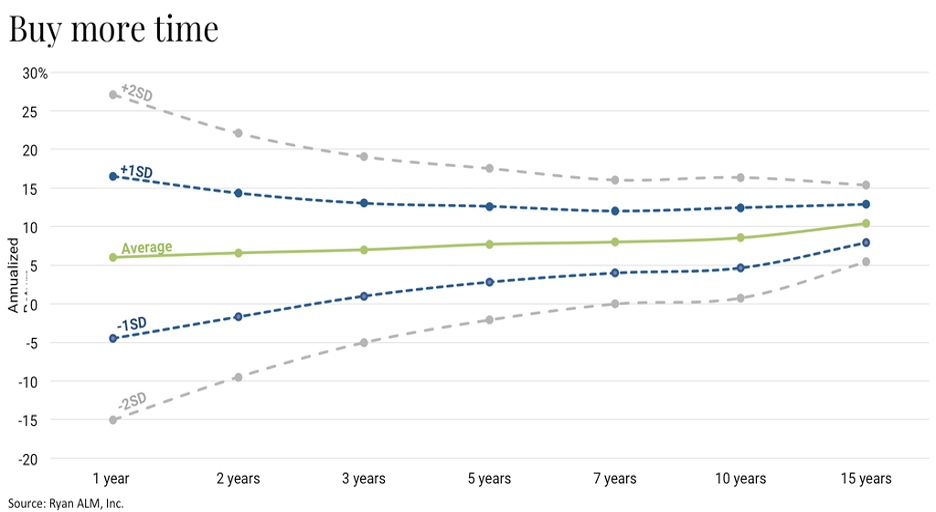
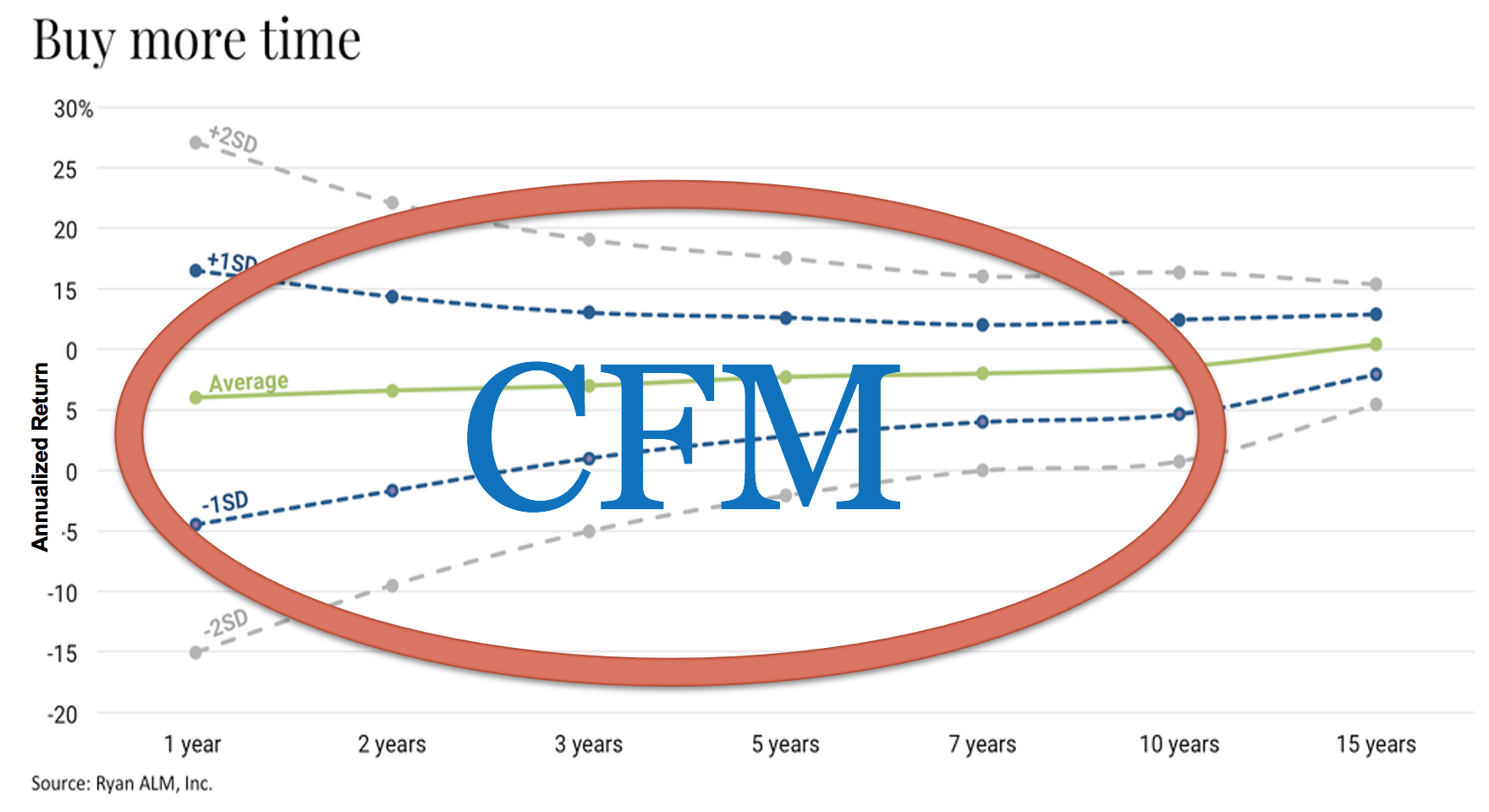
A traditional DB plan’s asset allocation comes with a lot of annual volatility (see the graph below). That volatility gets reduced as one extends the investing horizon, but it is still quite uncertain until you extend sufficiently, such as 10 or more years. However, as plan sponsors and investment managers, we have been living in a quarter-to-quarter measurement cycle for decades. In that environment, a 1 standard deviation (1 SD) measurement for a 1-year time frame (Ryan ALM asset allocation model since 1999) is +/- 10.5%. In the example below, 68% of the observations (1 SD) will fall between 16.5% and -4.5%. A 2 SD measurement would have the range for 95% of the observations between 27% and -15%. That gap, or should I say canyon, is a 1-year observation. Extend the measurement period to 5-years and the range of results is still wide but less so at +/- 9.8% for 2 SDs. It isn’t until you get beyond 10 years that the volatility associated with a fairly traditional asset allocation gets to a reasonable level.

Is there a way to bring more certainty to the asset allocation process that would allow for longer observation periods and less volatility? Absolutely! A plan sponsor and their advisors can adopt a bifurcated asset allocation in which a liquidity bucket is created that will fund and match the plan’s liability cash flows of benefits and expenses chronologically from the next month as far out as the allocation will cover (10+ years) allowing for the remainder of the alpha assets (all non-bond assets) to now grow unencumbered. The task for those assets is to meet future liabilities.

As the graph below highlights, a carefully constructed cash flow matching (CFM) portfolio can help plan sponsors wade through the volatility associated with shorter timeframes. The CFM portfolio will consist of investment grade bonds whose cash flows of interest and principal will be matched to the liability cash flows. This process now ensures (absent defaults) that the necessary liquidity is available when needed as those future promises have been SECURED. The remaining assets can now be managed as aggressively as the plan’s funded status dictates.

With this process, short-term market dislocations will no longer impact the plan’s ability to meet its obligations. There will be no forced selling to meet benefit payments. The alpha assets can now grow without fear of being sold at an unreasonable level. The CFM program takes care of your needs while establishing a buffer (longer investing horizon) from market corrections that happen on a fairly regular basis. This structure should also lead to less volatility related to contributions and the plan’s funded status.

Given the elevated US interest rate environment, now is the time to engage in this process. CFM will provide a level of certainty that doesn’t exist in a traditional asset allocation. This is a “sleep well at night” strategy that should become the core holding for DB pensions. As I mentioned in an earlier blog post today, bonds should only be used for the cash flows they produce. They should not be used as total return-seeking instruments. Leave that task to the alpha assets that will benefit from a longer investing period.

Healthier Than Ever? Nah!

By: Russ Kamp, Managing Director, Ryan ALM, Inc.

P&I produced an article yesterday titled, “Corporate Pension Funds Are Fully Funded, Healthier Than Ever. Now What?” According to Milliman, corporate pension plans are averaging roughly a funded ratio of 106%. This represents a healthy funded status, but it is by no means the healthiest ever. One may recall that corporate plans were funded in excess of 120% as recently as 2000. In what might be more shocking news, public pension plans were too when using a market discount rate (ASC 715 discount rate). Today, those public pension plans have a funded status of roughly 80% according to Milliman’s latest public fund report.

The question, “Now what”? is absolutely the right question to be asking. Many corporate plans have already begun de-risking, as the average exposure to fixed income is >45% according to P&I’s asset allocation survey through November 2023. Unfortunately, public pension systems still sit with only about 18% exposure to US fixed income, preferring a “let it ride” mentality as equities and alternatives account for more than 75% of the average plan’s asset allocation. Is this the right move? No. The move into alternatives has dried up liquidity, increased fees, and reduced transparency. Furthermore, just because a public plan believes that its sponsor is perpetual, does that make the system sustainable? You may want to be reminded about Jacksonville Police and Fire. There are other examples, too.

Whether the pension plan is corporate, multiemployer, or public, the asset allocation should reflect the funded status. There is no reason that a 60% funded plan should have the same asset allocation as one that is 90% or better funded. All plans should have both liquidity and growth buckets. The liquidity bucket will be a bond allocation (investment grade corporates in our case) that matches asset cash flows to liability cash flows of benefits and expenses. That bucket will provide all of the necessary liquidity as far into the future as the pension system can afford. The remaining assets will be focused on outperforming future liability growth. These assets will be non-bonds that now have the benefit of an extended investing horizon to grow unencumbered. Forcing liquidity in environments in which natural liquidity has been compromised only serves to exacerbate the downward spiral.

Pension America has the opportunity to stabilize the funded status and contribution expenses. They also have the chance to SECURE a portion of the promises. How comforting! We saw this movie a little more than 20 years ago. Are we going to treat this opportunity as a Ground Hog Day event and do nothing or are we going to be thoughtful in taking appropriate measures to reduce risk before the markets bludgeon the funded status? The time to act is now. Not after the fact.

Milliman Reports Improved Funding For Public Fund Pension Plans as of March 31, 2024

By: Russ Kamp, Managing Director, Ryan ALM, Inc.

Milliman recently released results for its Public Pension Funding Index (PPFI), which covers the nation’s 100 largest public defined benefit plans.

Positive equity market performance in March increased the Milliman 100 PPFI funded ratio from 78.6% at the end of February to 79.7% as of March 31, representing the highest level since March 31, 2022, prior to the Fed’s aggressive rate increases. The previous high-water mark stood at 82.7%. The improved funding for Milliman’s PPFI plans was driven by an estimated 1.7% aggregate return for March 2024. Total fund performance for these 100 public plans ranged from an estimated 0.9% to 2.6% for the month. As a result of the relatively strong performance, PPFI plans gained approximately $85 billion in MV in March. The asset growth was offset by negative cash flow amounting to about $9 billion. It is estimated that the current asset shortfall relative to accrued liabilities is about $1.271 trillion as of March 31. 

In addition, it was reported that an additional 4 of the PPFI members had achieved a 90% or better funded status, while regrettably, 15 of the constituents remain at <60%. Given that changing US interest rates do not impact the calculation for pension liabilities under GASB accounting, the improvement in March’s collective funded status may be underreported, as US rates continued the upward trajectory begun as the calendar turned to 2024.

Corporate Funding Improves in March – Milliman

By: Russ Kamp, Managing Director, Ryan ALM, Inc.

Milliman released the results of its latest Milliman 100 Pension Funding Index (PFI), which analyzes the 100 largest U.S. corporate pension plans. Pension funding improved for the third consecutive month to start the year, which now stands at 105.6% from 105.3% at the end of February. March was a bit different, however, as the discount rate declined 11 basis points increasing the collective liabilities by $14 billion to $1.299 trillion at the end of the quarter. Despite the increase in liabilities, investment performance was once again strong leading to a gain of $19 billion. Total assets now stand at $1.373 trillion.

Zorast Wadia, author of the PFI, stated, “the funded status gains may dissipate unless plan sponsors adhere to liability-matching investment strategies. Zorast’s observation is outstanding. Should rates fall from these levels, the cost to defease pension liabilities will grow. Now is the time to take risk off the table. Create certainty by getting off the asset allocation rollercoaster. Engaging in Cash Flow Matching (CFM) does not necessitate being an all or nothing strategy. Start your cash flow matching mandate and extend it as the funded status improves.

Return-seeking bond strategies will lose in an environment of rising rates. However, once a plan engages in CFM, the relationship between plan assets and liabilities is locked. Done correctly, assets and liabilities will move in tandem. It doesn’t matter what interest rates do, as benefit payments are future values that are not interest rate sensitive.

Act now to create some certainty! You’ll appreciate the great night’s sleep that you’ll start to have.

Pension America – Taking Control Of One’s Destiny

For pension plan participants defined benefit plans (DB) must remain the backbone of the US Retirement Industry

The true objective of a pension plan is to fund liabilities (monthly benefits) in a cost effective manner with reduced risk over time. Unfortunately, it has been nearly impossible to get a true understanding of a plan’s liabilities outside of the actuary’s report, which is received by sponsors and trustees only on an annual basis, at best, and usually many months delinquent.

Fortunately, a plan’s liabilities can now be monitored and reviewed on a monthly basis through a groundbreaking index developed by Ron Ryan and his firm, Ryan ALM – The Custom Liability Index (CLI). The CLI is similar to any index serving the asset side of the equation (S&P 500, Russell 1000, Barclays U.S. Aggregate, etc.), except that the CLI measures your plan’s specific liabilities and not some generic liability stream. This critically important tool calculates the present value, growth rate, term-structure, interest rate sensitivity of your plan’s liabilities, and other important statistics such as, average yield, duration, etc. With a more transparent view of liabilities, a plan can get a truer understanding of the funded ratio / funded status.

The use of the CLI enables plan sponsors, trustees, finance officials, and asset consultants to do a more effective job allocating assets and determining funding requirements (contributions). The return on asset assumption (ROA), which has been the primary objective for most DB plans, should become secondary to a plan’s specific liabilities. Importantly, as the plan’s funded status changes, the plan’s asset allocation should respond accordingly.

Importantly, the CLI is created using readily available information from the plan’s actuary (projected annual benefits and contributions), and it is updated as necessary to reflect plan design changes, COLAs, work force and salary changes, longevity forecasts, etc. In addition, the CLI is an incredibly flexible tool in which multiple views, based on various discount rates, can be created. These views may include the ROA, ASC 715, PPA, GASB 67/68, and market-based rates (risk-free), with and without the impact of contributions.

Why should a DB plan adopt the CLI? As mentioned above, DB plans only exist to fund a benefit that has been promised in the future. As a plan’s financial health changes the asset allocation should be adjusted accordingly (dynamic). Without having the greater transparency provided by the CLI, it is impossible to know when to begin de-risking the plan. You’ve witnessed through the last 15 years the onerous impact of market volatility on the funded status of DB plans and contribution costs. Ryan ALM and KCS can help you reduce the likelihood of a repeat, and very painful, performance.

Let Kamp Consulting Solutions Be Your DB Plan Advocate

Since KCS’s founding in August 2011, we have worked tirelessly to preserve defined benefit plans as the retirement vehicle of choice for both employees and employers.  Now, more than ever, our effort is needed.  With each passing day, week, month and year, it is becoming increasingly obvious that defined contribution plans are nothing more than glorified savings accounts, at best!

The Federal Reserve’s Household survey, released earlier this week, highlights the challenges facing or employees in trying to save and manage their retirements, as a significant portion of our labor force have accumulated nothing for retirement.  As we’ve stated on numerous occasions, there will be profound social and economic consequences for the US if we can’t manage its workforce through a dignified retirement.

The US economy is still only muddling through 6+ years following the great financial crisis. Much of the “credit” for the muted recovery and lower demand for goods and services can be attributable to weak wage growth.  Importantly, the modest growth in wages doesn’t just impact demand today, but it makes saving for tomorrow that much more challenging.

We need to secure our employee’s retirements through a monthly annuity structure that is best achieved through a DB plan or DB-like structure, such as Double DB. Unfortunately, the elimination of DB plans has been on an accelerated path, and according to the DOL, there are fewer than 25,000 active DB plans today (down from roughly 150,000 in ’86). We’ve seen estimates that the median DC account balance is <$15,000.  An account balance of that size will hardly get one through a year, let alone a retirement.

Furthermore, we shouldn’t be vilifying those employees who are fortunate to be in DB plans, but we should explore opportunities to extend their reach for those that aren’t.  Despite the fact that there are many plans that appear to be dramatically (and maybe unsustainably) underfunded, there are new approaches to the management of DB plans that can be implemented, which will set a plan on a glide path to financial wellness.  We sincerely appreciate that funding volatility can create havoc for both corporate and public entities, but that funding volatility can be mitigated, too.

The last thing that we want to witness is the further erosion in the use of DB plans in favor of DC offerings.  No one is going to win if that occurs. The impact on the employee is obvious, but has corporate America truly assessed the impact from a failed retirement system on the ability of US citizens to remain active members of the economy? KCS has the tools to stabilize and improve the funded status of your DB plans to truly make them viable offerings for the long-term. Let us be your advocate, especially if there is an attempt to freeze or terminate your plan at this time.

Rethink the Use of Fixed Income in a Defined Benefit Plan

With the closure of the first quarter, we’d like to remind you of a blog post that we first published in early January.  Our thoughts are still relevant, especially given the market action within fixed income during the quarter and what is transpiring in US fixed income today.  The 10-year Treasury has rallied 2% today, and we think that it may continue to move lower.  The following paragraphs are what we originally posted.

What I’d like to highlight today is a new use for a plan’s current fixed income exposure. In day two of the conference, I attended a panel discussion titled, “Opportunities in Fixed Income and Credit Markets”.  The panel was occupied by 4 senior investment pros (plan sponsor, consultant, and investment managers).  They generally discussed the likelihood that interest rates were going to rise (I’m beginning to wonder if there is anyone out their who doesn’t think that rates will rise), and the implications of that movement on traditional fixed income portfolios.  Most of the panelists talked about various sub-sectors (mortgages, asset backs, bank loans, etc) and which ones might hold up better. There was discussion about shortening duration, etc. They also talked about fixed income’s traditional role as an anchor to windward, a risk reducer, and a provider of liquidity.

However, only one individual mentioned taking a step back to truly contemplate the “role” of fixed income.  He didn’t provide any further perspective, which is why I’m addressing the issue here and today.  I believe (as do my partners at KCS) that a plan’s liabilities should be the focal point of any pension discussion.  As such, they need to be the primary objective for the plan, the driver of asset allocation decisions and investment / portfolio structure.  The asset class most similar in characteristic to liabilities is fixed income.  As such, fixed income needs to play a prominent role in a defined benefit plan.

Instead of worrying about the implications from a rising interest rate environment on an LDI strategy that currently consists of long duration corporates, change the emphasis to matching near-term liabilities, by converting your current fixed income portfolio into a Treasury STRIP portfolio that matches cash flows with projected benefits (Beta portfolio).  First, you are improving liquidity.  Second, duration is shortened in an environment that may not be conducive to long bonds.  Third, you are lengthening the investing time horizon for the balance of the corpus, which will allow asset classes / products with a liquidity premium a chance to capture that performance increment (Alpha portfolio). Finally, the funded status and contribution costs should begin to stabilize.  As the Alpha portfolio outperforms liability growth (hopefully), siphon excess profits and extend the beta portfolio.

This is a proactive move to restructure the fixed income portfolio in an environment of uncertainty.

Lastly, I am not of the general school of thought that interest rates are definitely going to rise, and soon.  I believe that we still have slack demand in our economy, brought on by underemployment, which will keep inflation in check and provide room for stable to slightly lower rates.

Ryan ALM Pension Newsletter

Ryan ALM Pension Newsletter

The Ryan Pension Letter December 2013 
Ryan ALM Pension Letter is a quarterly newsletter that measures pension asset growth vs. pension liability growth based on ASC 715, PPA spot rates, PPA MAP-21, GASB and market discount rates. Ryan ALM Pension Letter also reviews a wide range of topical subjects related to pensions and global economic events.

Ryan ALM is a KCS strategic partner providing custom liability indexes to the KCS DB clients.  Ron’s work is cutting edge.  Enjoy!