Something Has Got to Give

By: Russ Kamp, CEO, Ryan ALM, Inc.

Not surprisingly, the U.S. Federal Reserve’s FOMC lowered rates another 25 bps today. The new target is 3.75%-4.0%, down from 4.5%-4.75% during the last 3 meetings. Currently, the 10-year Treasury yield (4.145% at 3:21 pm EST) is only marginally greater than the median CPI (Latest reading from the Cleveland Fed is 3.5% annually).

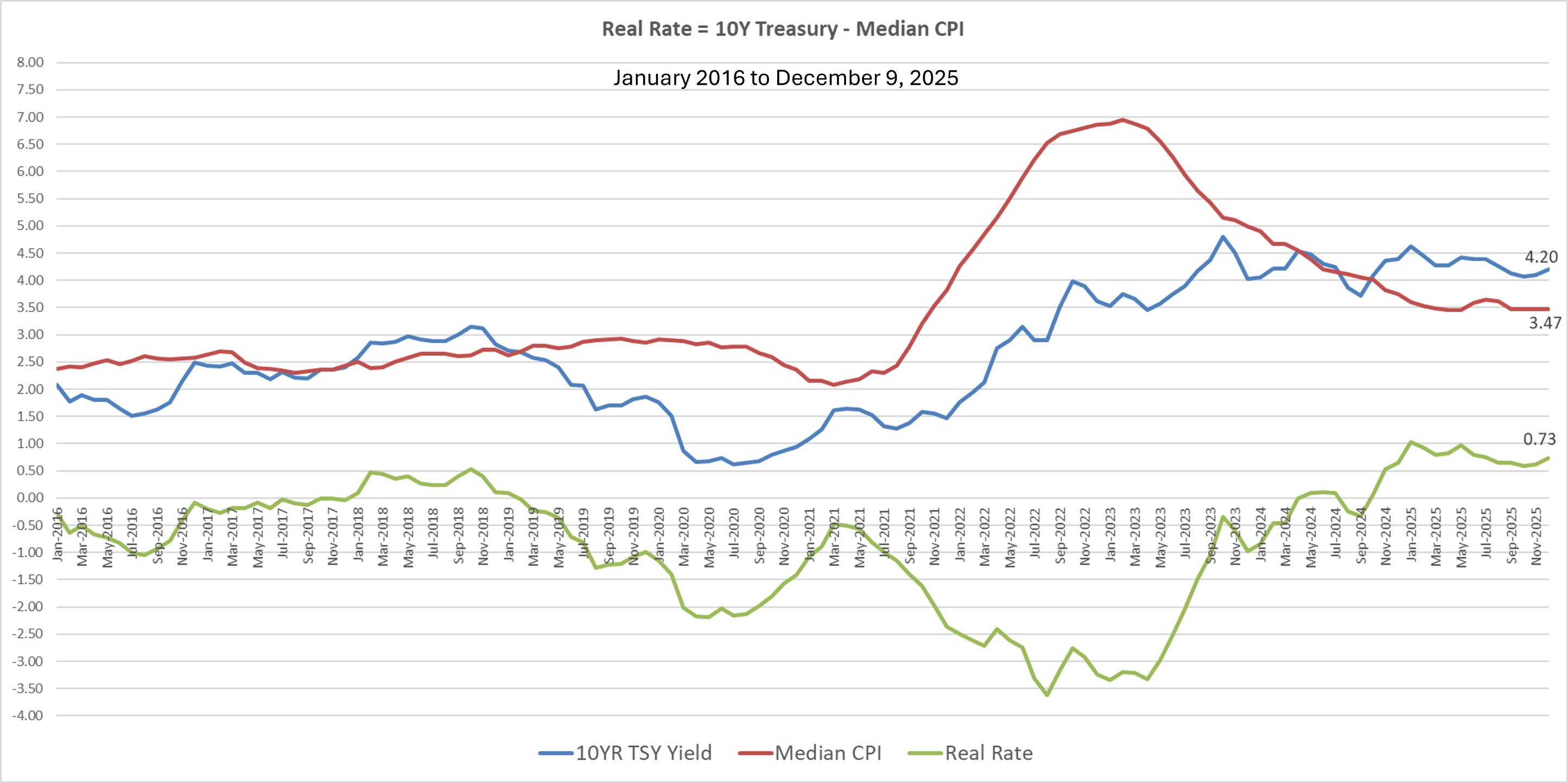
Ryan ALM, Inc.’s Head Trader, Steve DeVito put together the following comparison.

Steve is comparing the 10-year Treasury note yield (blue) versus the Median CPI (red) since January 2016. The green line is the “real” yield (10-year Treasury – the median CPI). For this period of time, there has been very little real yield, as U.S. rates were driven to historic lows before inflation spiked due to Covid-19 factors. However, historically (1962-2025), the real yield has average 2%. With rates down and inflation remaining stubbornly steady to increasing slightly, the real yield that investors are willing to take is, and has been, quite modest (0.17% since 2008). Why? Were the historically low rates in reaction to covid-19 an anomaly, or has something changed from an investor standpoint? Given today’s fundamentals, one might assume that investors are anticipating a sudden reversal in inflation, but is that a smart bet?

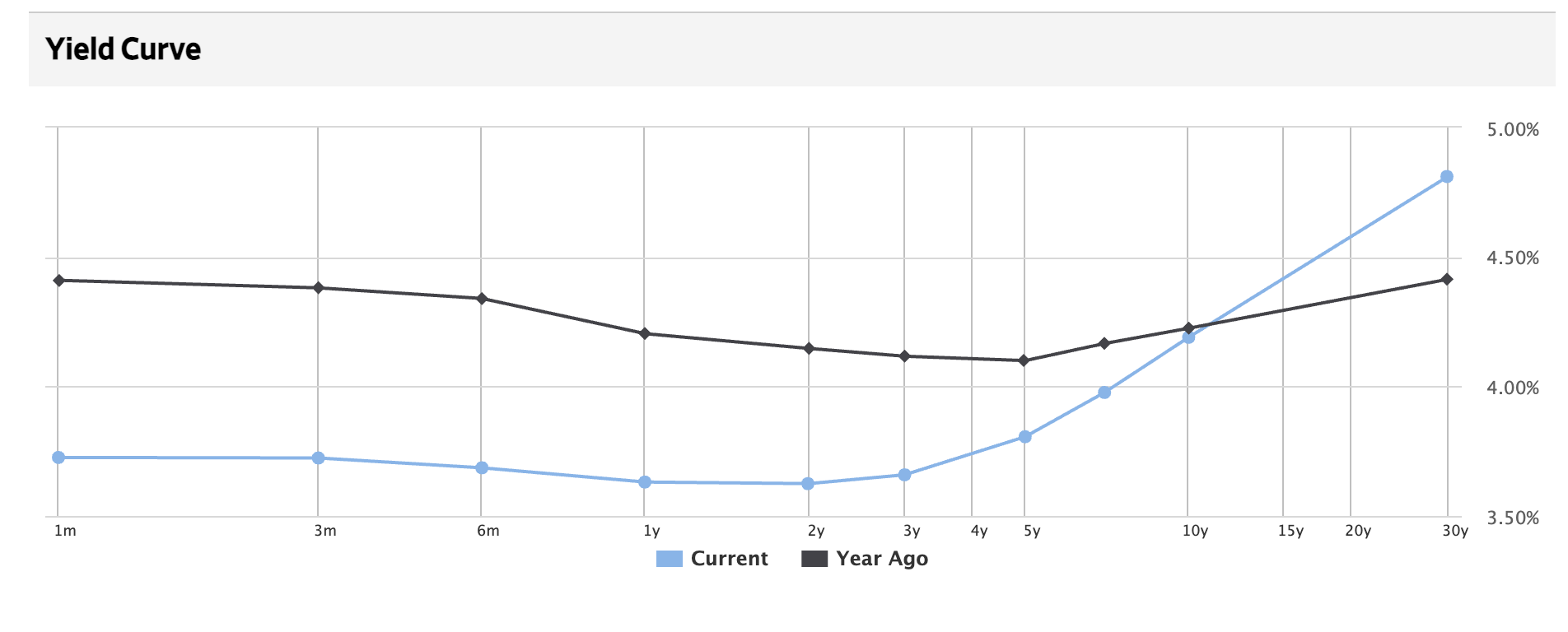
The WSJ produced the graph in today’s edition highlighting the change in the U.S. Treasury yield curve during the last year. As one can clearly see, the yield curve has gotten much steeper with the 30-year Treasury bond yield 0.4% above last year’s level (at 4.81%). That steepness would indicate to me that there is more risk longer term from inflation potentially rising.

So, it seems as if something has to give. If inflation remains at these levels, the yield on the 10-year Treasury note should be about 1.25% greater than today. If in fact, yields were to rise to that level, active core fixed income managers would see significant principal losses. However, cash flow matching managers and their clients would see the potential for greater cost reduction in the defeasing of pension liabilities, especially for longer-term programs. Bond math is very straight forward. The longer the maturity and the higher the yield, the greater the cost savings.

Managing a pension plan should be all about cash flows. That is asset cash flows versus liability cash flows of benefits and expenses. Higher yields reduce the future value of those promises. Remember, a CFM strategy is unique in that it brings an element of certainty (barring a default) to the management of pensions which live in a world of great uncertainty. Aren’t you ready for a sleep-well-at-night strategy?

U.S. Rates Likely to Fall – Here’s the Good and Bad

By: Russ Kamp, CEO, Ryan ALM, Inc.

Unfortunately, there exists weakness in the U.S. labor force, as a notable deterioration in job creation, initial jobless claims, and job openings is taking place at this time. This weakness will likely lead the Federal Reserve to lower U.S. interest rates at the next FOMC, which takes place next week with an announcement on the 18th. The current consensus is for a 0.25% reduction in the Fed Fund’s Rate to 4.0%-4.25%. There is also a rising expectation that the “cut” could be larger. That might be more hope than reality at this time, given the CPI’s 0.4% posting today.

So, if rates were to be lowered, who benefits and who gets hurt? Well, individuals seeking loans – mortgages, cars, student loans – certainly benefit. But individuals hoping to generate some income from savings and retirement assets get hurt, especially since these rates tend to be shorter maturity instruments. Who else is impacted? Fixed income asset managers will benefit if they are holding coupon bonds, as falling rates drive bond prices upward. However, those holding bonds with adjustable yields won’t benefit as much.

How about DB pension funds? Yes, those pension funds invested in U.S. fixed income will likely see asset appreciation. However, both public and multiemployer plans have dramatically reduced their average exposure to this asset class. According to P&I’s annual survey, multiemployer plans have 18.2% in U.S. domestic fixed income, while public plans have roughly 18.7% of plan assets dedicated to U.S. fixed income. As a point of reference, corporate plans have nearly half of the plan’s assets dedicate to fixed income (45.4%). As rates fall, these plans will see some appreciation providing a boost in their quest to achieve the desired ROA. Great!

However, let us not forget that pension liabilities will be negatively impacted by falling rates, as they are bond-like in nature and the present value of those liabilities will grow. This is what crushed DB pensions during the massive decline in interest rates from 1982 until 2021. A move down in rates will directly benefit less than 50% of the assets, if we are talking about a corporate plan, and <20% of the assets for multiemployer and public funds. However, 100% of the liabilities will be impacted! Doesn’t seem like a good trade-off. As a result, funded ratios will decline and funded status shortfalls will grow, leading to greater contributions.

Given the mismatch identified above, I’d recommend that you not celebrate a potential decline in rates if you are a plan sponsor or asset consultant, unless you are personally looking for a loan. I would also recommend that you align your plan’s asset cash flows (principal and income from bonds) with your liability cash flows (benefits and expenses) while rates remain moderately high. As I’ve stated many times in this blog, Pension America had a great opportunity to de-risk DB pensions in 1999 but failed to act. Please don’t let this opportunity slip by without appropriate action.

Not So Fast

By: Russ Kamp, CEO, Ryan ALM, Inc.

In addition to publishing my thoughts through this blog, I frequently put sound bites out through LinkedIn.com. The following is an example of such a comment: Given Powell’s statement about “balancing dual mandates”, it seems premature to assume that the Fed’s next move on rates is downward. Tariffs have only recently kicked in and their presence could create a very challenging situation for the Fed should inflation continue on its path upward. Market reaction seems overblown. September’s CPI/PPI numbers could be very interesting.

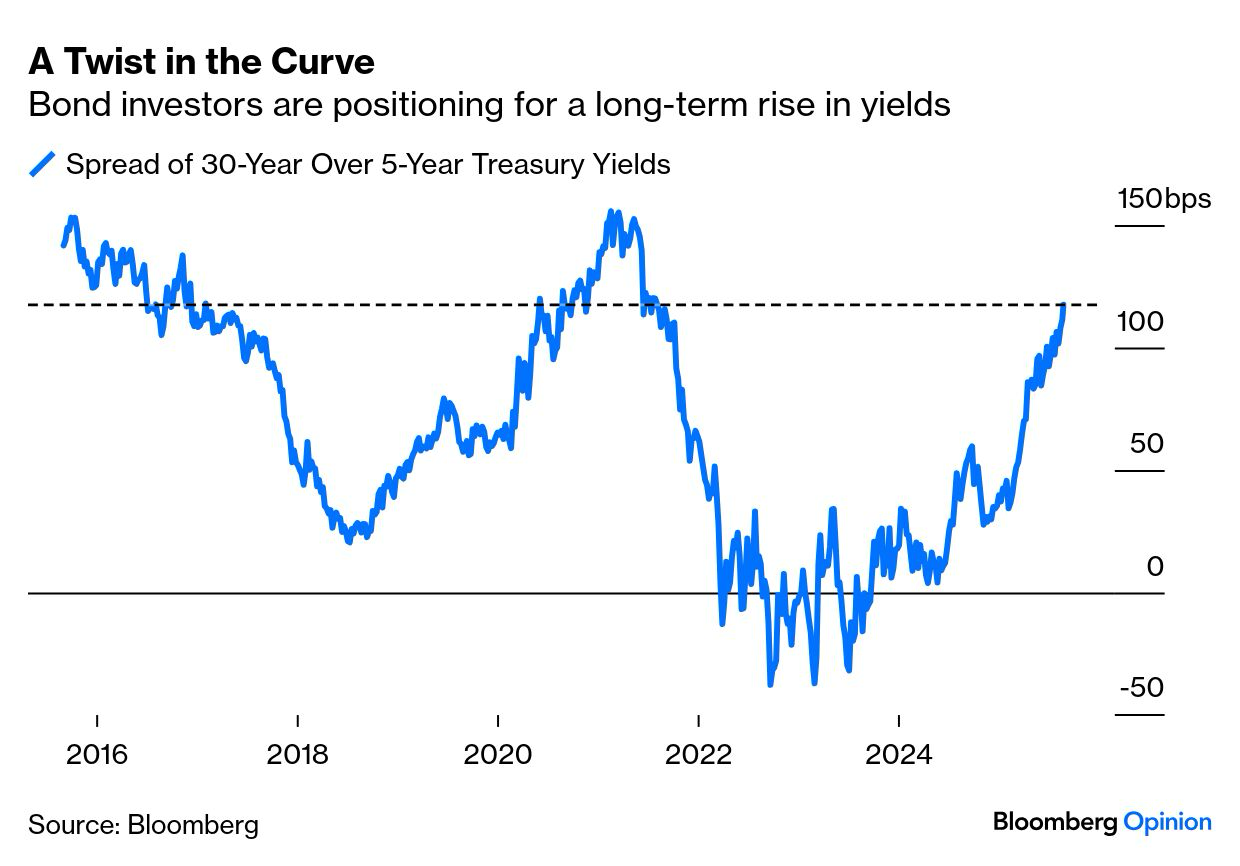
As a follow-up to that comment, here is a graph from Bloomberg highlighting the recent widening in the spread between 5-year and 30-year Treasuries, which is at its widest point in the last 4 years.  This steeping of the yield curve would suggest that inflation is being more heavily anticipated on the long end.

As I mentioned above, the reaction to Powell’s comments from Wyoming last Friday seemed overblown given the rethinking about “dual mandates”. Inflation has recently reversed the downward trajectory and with the impact of tariffs yet to be truly felt, it is doubtful that we’ll see inflation fall to levels that would provide comfort to the U.S. Federal Reserve policy makers. Yes, there may be a small (25 bps) cut in September, but should inflation continue to be a concern the spread in Treasury yields referenced above could continue to widen. President Trump’s goal of jumpstarting the housing market through lower mortgage rates would not likely occur.

From a pension perspective, higher rates reduce the present value of those future promised benefits. They also provide implementers of cash flow matching (CFM) strategies, such as Ryan ALM Advisers, LLC, the opportunity to defease those pension liabilities at a lower cost (greater cost savings). Bond math is very straight forward. The higher the yield and the longer the maturity, the greater the cost savings. Although higher rates might not be good for U.S. equities, especially given their current valuations, the ability to reduce risk at this time through a CFM strategy should be comforting.

Bifurcate your asset allocation into two buckets – liquidity and growth. The liquidity bucket will house the CFM strategy, providing all the necessary liquidity to meet ongoing monthly obligations as far into the future as the allocation will cover. The remaining assets (all non-core bonds) in the growth or alpha portfolio will now have more time to just grow unencumbered, as they are no longer a source of liquidity. Time is a critical investment tenet, and with more time, the probability of meeting the expected return is enhanced.

There is tremendous uncertainty in our markets and economy currently. One can bring an element of certainty to the management of pensions, live with great uncertainty.