Ryan ALM discount rates: ASC 715 and ASC 842

By: Russ Kamp, CEO, Ryan ALM, Inc.

As we enter the final third of 2025 (how is that possible?), actuaries, accounting firms, and pension plan sponsors may begin reviewing their current discount rate relationship(s). If you are one of those, you may want to speak with us about the Ryan ALM discount rates. Since FAS 158 became effective December 15, 2006, Ryan ALM has created a series of discount rates in conformity to then FAS 158 (now ASC 715). Our initial and continuous client is a BIG 4 accounting firm, which hopefully testifies to the integrity of our data.

The benefits of the Ryan ALM ASC 715 Discount Rates are:

  1. Selection – we provide four yield curves: High End Select (top 10% yields), Top 1/3, Above Median (top 50%), Full Universe
  2. Transparency – we provide very detailed info for auditors to assess accuracy and acceptability of our rates
  3. Precision – precise and consistent reflection of current/changing market environment (more maturity range buckets, uses actual bond yields rather than spreads added to Treasury yield curve, no preconceived curve shape/slope bias relative to maturity/duration) than most other discount rate alternatives  
  4. Competitive Cost – our discount rates are quite competitive versus other vendors and can be purchased with a monthly, quarterly, or annual subscription
  5. Flexibility – we react monthly to market environment (downgrades, gaps at certain maturities) with flexibility in model parameters to better reflect changing environment through variable outlier exclusion rules, number of maturity range buckets, and minimum numbers of bonds in each maturity range bucket to better capture observed nuances in the shape of the curve, especially at/near the 30 year maturity point where the market is sparse or nonexistent at times.
  6. Clients – our rates are used by individual plan sponsors, several actuarial and accounting firms including, as stated above, a Big 4 accounting firm
  7. Integration into Ryan ALM products – we use ASC 715 discount rates for our Custom Liability Index and Liability Beta Portfolio™ (cash flow matching) products

Development of our discount rates is the first step in our turnkey system to defease pension liabilities through a cash flow matching (CFM) implementation. Our Custom Liability Index (CLI) and Liability Beta Portfolio (LBP) are the other two critical products in our de-risking process/capability.

In addition to ASC 715, Ryan ALM provides ASC 842 rates, which is the lease accounting standard issued by the Financial Accounting Standards Board (FASB). This standard supersedes ASC 840 and became effective December 15, 2018, for public companies and December 15, 2021, for private companies and nonprofit organizations. Given the widespread prevalence of off-balance sheet leasing activities, the revised lease accounting rules are intended to improve financial reporting and increase transparency and comparability across organizations. ASC 842 will provide management better insight into the true extent of their lease obligations and lead to improvements in capital allocation, budgeting and lease versus buy decisions.

The discount rate to be used is the rate implicit in each lease. This could be difficult and not readily determined. In that case ASC 842 requires the lessee to use the rate that the company borrows at based on their credit rating. Ryan ALM can provide the ASC 842 discount rates based on each lessee borrowing rate or credit rating (i.e. A or BBB). We can provide these discount rates monthly, quarterly or whatever frequency is needed.

We’d be pleased to discuss with you our discount rates or any element of this state-of-the-art capability.
Corporate Pension Funding – UP!

By: Russ Kamp, CEO, Ryan ALM, Inc.

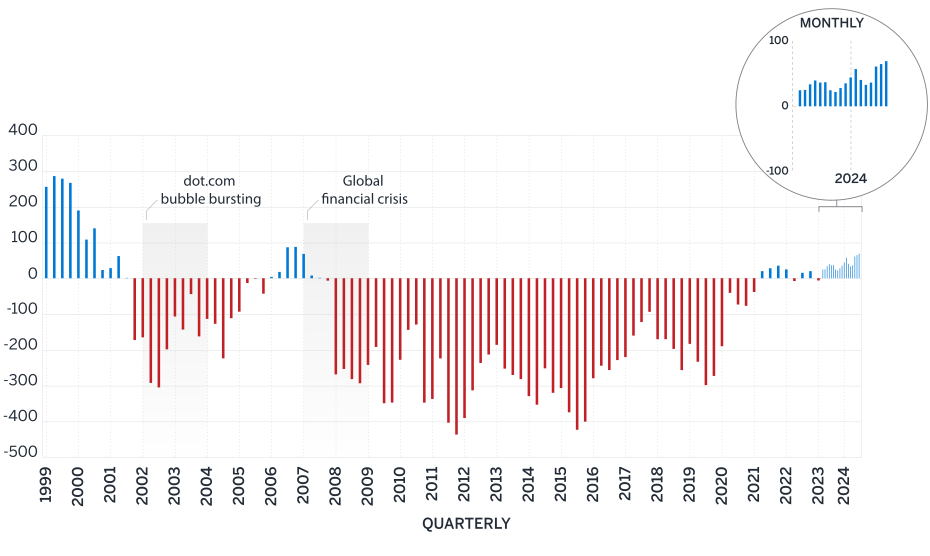
I was out of the office last week, and as a result I am trying to play catch-up on some of the stories that I think you’d be interested in. Happy to report that Milliman released its monthly Milliman 100 Pension Funding Index (PFI), which, as you know, analyzes the 100 largest U.S. corporate pension plans. Importantly, the news continues to be good for corporate pension funding.

For July, a discount rate increase of 3 bps helped stabilize corporate pension funding, lowering the Milliman PFI projected benefit obligation (PBO) by $6 billion to $1.213 trillion as of July 31. Anticipated investment returns were marginally subpar at 0.38%. After taking into consideration a higher discount rate, marginal investment gains, and net outflows, overall corporate pension funding increased by $4 billion for the month.

The Milliman 100 PFI funded ratio now stands at 105.3% up from June’s 105.7%. For the last 12-months, the funded ratio has improved by 2.8%, as the collective funded status position improved by $32 billion. “July marks four straight months of funding improvement, with levels not seen since late 2007, before the global financial crisis,” said Zorast Wadia, author of the PFI. “In order to preserve funded status gains, plan sponsors should be thinking about asset-liability management strategies to help mitigate potential discount rate declines in the future.” We couldn’t agree more with you, Zorast!

As highlighted below, overall corporate pension funding has improved dramatically. A significant contributor to this improvement has been the rise in U.S. interest rates which significantly lowered the present value of those future benefits. Let’s hope that the current funding will encourage plan sponsors to maintain their DB pension plans for the foreseeable future. You have to love pension earnings as opposed to pension expense!

Figure 1: Milliman 100 Pension Funding Index — Pension surplus/deficit

View the complete Pension Funding Index.

The Benefits of Using Multiple Discount Rates in a Public Pension Plan

By: Russ Kamp, CEO, Ryan ALM, Inc.

Public pension plan sponsors frequently ask us about the impact of investing in a cash flow matching (CFM) strategy on the fund’s ability to achieve the ROA, which is also the discount rate used to value the plan’s liabilities under GASB accounting. As we’ve discussed many times, the plan’s ROA is actually a blend of ROAs with an “expected” return target assigned to each asset class, except for bonds, which uses the YTM of the index benchmark, and then those forecasts are averaged based on the weight of the exposure within the total asset base. So, despite the fact that GASB requires a single rate to discount the plan’s liabilities, multiple ROA targets have been used for years.

We believe that this process can, and should, be refined even more. We believe that the ROA target should be focused on the plan’s liabilities and not just the assets. With a liability focus one gets the following benefits when using multiple discount rates, including:

  • Risk Matching: Applying different discount rates to different asset or liability segments can better reflect the varying risk profiles of those segments. For example, using a lower, market-based rate for secured benefits (through a CFM process) and a higher rate for more uncertain, investment-backed benefits can align present value (PV) calculations more closely with the actual risks being taken within the fund.
  • Improved Accuracy: Multiple rates may provide a more accurate estimate of liabilities, especially when plan assets are invested in a mix of instruments with different risk and return characteristics.
  • Transparency in Funding Status: By separating liabilities based on funding source or risk, stakeholders get a clearer picture of which obligations are well-secured (those that are defeased through CFM) and which may be more vulnerable to market fluctuations (the growth assets).
  • Policy Flexibility: Using a blended discount rate can help manage the transition when lowering the overall discount rate, avoiding sudden shocks to contribution requirements.

We often discuss the need to bring an element of certainty to the management of DB pension plans, which have embraced uncertainty for years. Bifurcating your plans liabilities (retired lives and actives) and assets (liquidity and growth) into two buckets and applying different discount rates to each brings greater certainty to the management of a pension plan. There is no longer any guessing as to how your liquidity bucket will perform, as the asset cash flows are matched to liability cash flows with certainty and the fund’s cost savings and return are both know on the day that the portfolio is constructed. How wonderful!

Milliman – Corporate Pension Funding Falls in March

By: Russ Kamp, CEO, Ryan ALM, Inc.

Milliman has just released its monthly Milliman 100 Pension Funding Index (PFI), which analyzes the 100 largest U.S. corporate pension plans. Weak investment returns, estimated at -1.4%, drove the PFI asset level down by $25 billion during March. Current assets for the top 100 plans are now $1.3 trillion. The fall in assets was only partially offset by the rise in the discount rate (13 bps) during the month. As a result, the surplus fell by $7 billion to $51 billion as of March 31, 2025.

The discount rate ended the month at 5.49%, which reduced plan liabilities by $18 billion, to $1.25 trillion by the end of March. As a result of assets falling by more than liabilities, the PFI funded ratio dropped from 104.6% at the end of February to 104.1% at the end of March. For the quarter, discount rates fell 10 basis points and the Milliman 100 plans lost $8 billion in funded status.   

“While the slight rise in discount rates in March led to a monthly decline in plan liabilities, plan assets fell even further due to poor market performance, which caused the funded status to fall below the 104.8% level seen at the beginning of 2025,” said Zorast Wadia, author of the PFI. Given market action during the first 10 days of April, it will be interesting to see if the impact from rising rates can offset the dramatic fall in asset values. Inflation fears fueled by tariffs could lead to rising bond yields, which will help mitigate some of the risk to equities given the possibility of declining earnings. As Zorast mentioned in the Milliman release, “plan sponsors will want to consider asset-liability matching strategies to preserve their balance sheet gains from last year”, especially given that 30-year corporates are once again yielding close to 6%.