Different Levels of Certainty

By: Russ Kamp, Managing Director, Ryan ALM, Inc.

A friend of mine in the industry emailed me a copy of Howard Marks’ latest memo titled, “The Folly of Certainty”. As they normally are, this piece is excellent. As regular readers of this blog know, I’ve encouraged plan sponsors and their advisors to bring more certainty to defined benefit plans through a defeasement strategy known as cash flow matching. I paused when I read the title, thinking, “oh, boy”, I’m at odds with Mr. Marks and his thoughts. But I’m glad to say after reading the piece that I’m not.

What Howard is referring to are the forecasts, predictions, and/or estimates made with little to no doubt concerning the outcome. He cited a few examples of predictions that were given with 100% certainty. How silly. Forecasts always come with some degree of uncertainty (standard deviation around the observation), and it is the humble individual who should doubt, to some degree, those predictions. I’ve often said that hope isn’t an effective investment strategy, but that thought doesn’t seem to have resonated with a majority of the investment community.

Ryan ALM’s pursuit of greater certainty is brought about through our ability to create investment grade bond portfolios whose cash flows match with certainty (barring a default) the liability cash flows of benefits and expenses. We accomplish this objective through our highly sophisticated and trade-marked optimization model. We are not building our portfolios with interest rate forecasts, based on economic variables that come with a very high degree of uncertainty. No, we build our portfolios based on the client’s specific liability cash flows and implement them in chronological order. Importantly, once those portfolios are created, we’ve locked in a significant cost reduction that is a function of the rate environment and the length of the mandate.

As stated previously, I have a great appreciation for Howard Marks and what he’s accomplished. He is absolutely correct when he questions any forecast that has little expectation for being wrong. In most cases, the forecaster is not in control of the outcome, which should lend itself to being more cautious. In the case of the Ryan ALM cash flow matching strategy, we are in control. Having the ability to bring some certainty in our pursuit of securing the promised benefits should be greatly appreciated by the plan sponsor community. Because of the uncertain economic environment that we are currently living in, bringing some certainty should be an immediate goal. Care to learn more?

ARPA Update as of July 12, 2024

By: Russ Kamp, Managing Director, Ryan ALM, Inc.

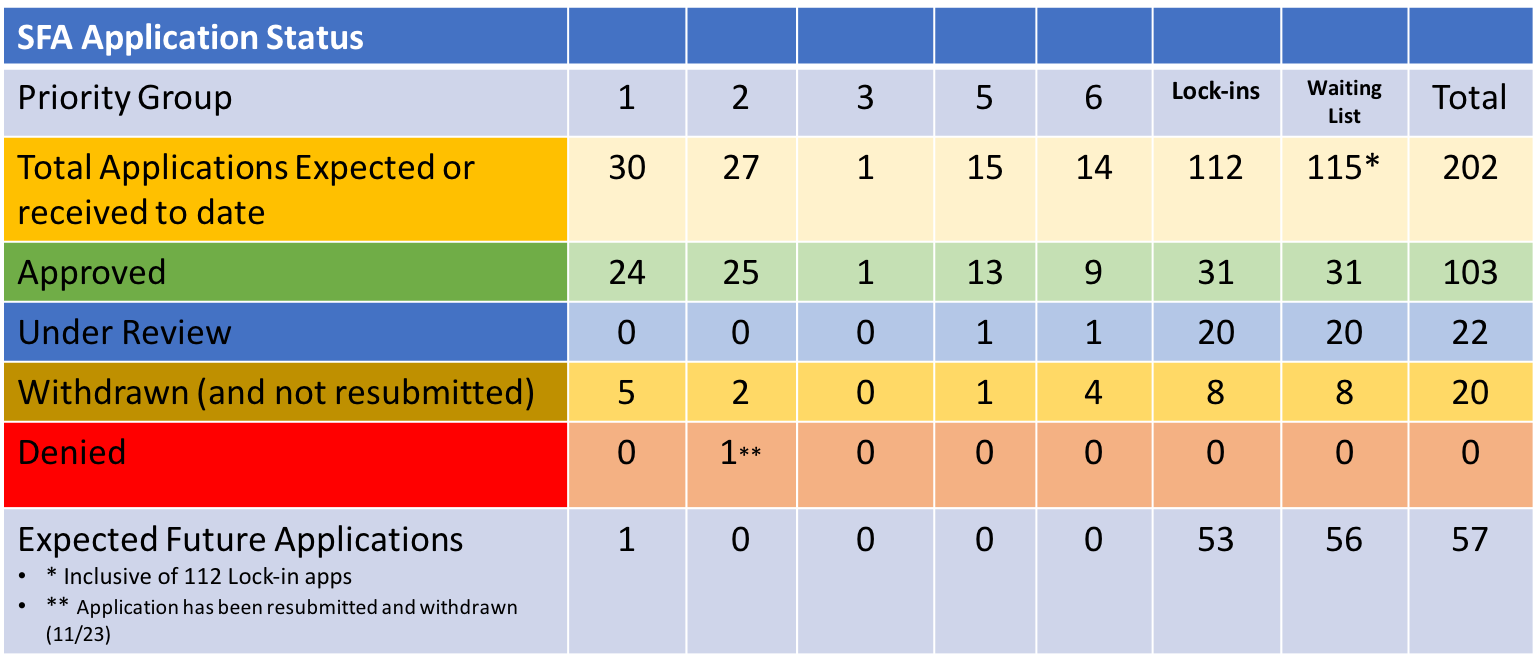
Not only has the weather heated up, but so has the activity at the PBGC as it relates to the implementation of the ARPA pension legislation. During the past week two non-priority group plans submitted applications. In the case of the Carpenters Pension Trust Fund – Detroit & Vicinity, it was a revised application seeking nearly $600 million in Special Financial Assistance (SFA), while the Laborers’ Local No. 265 Pension Plan put forward its initial filing seeking $55.6 million. In total, more than 24,000 plan participants would enjoy a more secure retirement with the approval of these applications.

In other ARPA news, the American Federation of Musicians and Employers’ Pension Plan finally received approval. This fund had multiple filings throughout the process, which began on March 10, 2023 with the initial filing followed by two other applications. The wait was certainly worth it, as they will receive >$1.5 billion to reinforce the pensions of nearly 50,000 eligible participants.

There were no applications denied during the past week, but one fund, the United Food and Commercial Workers Union and Participating Food Industry Employers Tri-State Pension Plan, withdrew its application that had been seeking $638.3 million in SFA for 29+k members. There were no plans that were forced to repay excess SFA assets and no new plans added to the waitlist.

We’ve all heard the phrase with uncertainty comes opportunity, and that may very well be true, but the uncertainty comes with a certain level of risk, too. Given all of the uncertainty in the economic and political spheres at this time, is the opportunity greater than the risk? We would encourage plan sponsors of all plan types to look to reduce some of the risk in their funds, especially given the elevated multiples on which the equity markets are currently trading. The higher US interest rates are providing a unique opportunity not available to us in the past two decades. Secure some of the promises (benefits) by defeasing your liabilities through a cash flow matching strategy. We are happy to discuss this suggestion in far greater detail or you can go to RyanALM.com to read myriad research articles and blog posts on the subject.

Milliman: Improved Corporate Pension Funding Continues

By: Russ Kamp, Managing Director, Ryan ALM, Inc.

Milliman has once again produced its monthly update of the Milliman 100 Pension Funding Index (PFI), which analyzes the 100 largest U.S. corporate pension plans. Thank goodness they can still find 100 corporate plans to evaluate. Despite my snarkiness, it is good to read that Milliman is reporting improved funding for the sixth consecutive month in 2024, with a slight increase in the funded ratio from 103.6 to 103.7. The surplus remained the same at $46 billion.

June’s investment return of 1.22% matched the $9 billion increase in liabilities as the discount rate fell 7 bps to 5.46%. “The first half of 2024 has seen nothing but funded ratio improvements,” said Zorast Wadia, author of the PFI. “However, with markets at all-time highs and concerns that discount rates may eventually fall, the forecast for the second half of 2024 may not be as sanguine, and liability-matching portfolios will continue to be prudent strategies for plan sponsors.”

We absolutely agree with Zorast’s assessment of what may transpire in 2024’s second half. There has clearly been a slowing in economic activity as seen by the GDP in Q1’24 (1.4%) and Q2’24 is not looking much more robust, as the Atlanta Fed’s GDPNow model presently forecasts a 2.0% real GDP annualized return for the second quarter. If economic weakness were to develop, as a result of the Fed’s campaign to stem inflation by raising the Fed Fund’s rate (presently 5.25% – 5.5%), US interest rates could fall, while equities could also cool off as a result of the economic weakness. A combination such as this would be quite detrimental to pension funding.

In related news, FundFire has published an article highlighting the fact that “fixed income products now make up about 54% of defined-benefit portfolios, according to Mike Moran, senior pension strategist at Goldman Sachs Asset Management. He is obviously speaking about corporate plans, as both public and multiemployer exposures to fixed income are much more modest. Happy to see that Moran was quoted as saying that he “urges pension managers to act quickly to de-risk.” He went on to say, “This is a period of strength, a position of strength, for plan sponsors, and history shows us that the position of strength can sometimes be fleeting,” We absolutely agree.

We’ve been encouraging plan sponsors of all types to act to reduce risk and secure the promised benefits before the Fed or market participants reduce rates from these two-decade high levels.

ARPA Update as of June 14, 2024

By: Russ Kamp, Managing Director, Ryan ALM, Inc.

We hope that you enjoyed a wonderful Father’s Day. I’m blessed to still have my Dad with us (95 years young). In addition, I have two sons and two sons-in-law who are wonderful fathers. It was a terrific day!

Regarding ARPA and the PBGC’s implementation of that critical pension legislation, there was some activity during the previous week. However, the filing portal remains temporarily closed for those plans still seeking relief through the SFA grants. That said, there are still 17 applications that are currently being reviewed with 6 of those nearing the 120 deadline for action. Those six plans are seeking nearly $5.5 billion in SFA. As a result, the rest of June is going to be busy for the PBGC.

The Pension Plan for the Arizona Bricklayers’ Pension Trust Fund received approval for its application. They will receive $10.7 million to protect the pensions for the 666 members of the plan. This non-priority plan received approval on their initial application. In other news, there were no applications either denied or withdrawn. However, the Graphic Communications Conference of the International Brotherhood of Teamsters National Pension Fund joined Central States as the only other plan to repay excess SFA as a result of a death audit. In this case, they are repaying just over $8 million.

Have a great week. Don’t hesitate to reach out to us if you like to learn more about cash flow matching and how it can be used to extend and protect the SFA grant assets so vital to ensuring that the pension promises are met for your participants.

Corporate Pension Funding Improves Once More – Milliman

By: Russ Kamp, Managing Director, Ryan ALM, Inc.

Milliman is reporting improvement in the funded status for the largest corporate plans. According to the Milliman 100 Pension Funding Index (PFI), corporate funding improved from 103.1% to 103.4% during May, marking the fifth consecutive monthly improvement to start 2024. Milliman attributed the improved funding to asset gains driven by the year’s best month at 2.29% driving the indexes assets up by $22 billion to $1.3 trillion. With the decline in the discount rate of 15 bps, pension liabilities grew by $18 billion and now stand at $1.25 trillion. According to Zorast Wadia, the discount rate used by Milliman is the FTSE Pension Liability Index, which is similar to ASC 715 rates. As a reminder, Ryan ALM, Inc. has produced ASC 715 rates since 2007. The $4 billion difference between pension assets and plan liabilities produced the 0.3% funding improvement.

Milliman’s monthly reporting also includes scenario testing. In the latest work, Milliman forecasts 2024 and 2025 interest rates and asset returns. In the optimistic case they forecast the discount rate at 5.88% at the end of 2024 and 6.48% at the end of 2025, while assets grow at 10.4% per annum during that time. If achieved, the funded status for the Pension Funding Index would ratchet up to 110% at the end of 2024 and 123% by 2025’s conclusion. These levels would rival what we had at the end of 1999, when Pension America should have defeased the liabilities.

A pessimistic forecast has the discount rate falling to 5.18% by the end of 2024 and 4.58% by December 31, 2025. Assets under this scenario produce only a 2.4% annualized return. If this forecast were to become reality, the PFI funded status would be 98% by the end of 2024 and 89% by the end of 2025. Since most of us have no clue where rates are going in the next couple of years, why play the game. Defease your plan’s liabilities at the current level of rates. We’ve seen too often greed creep into the equation instead of sound risk management. Use this opportunity to substantially reduce risk by matching and funding benefits and expenses with asset cash flows of interest and principal.

What A Ride!

By: Russ Kamp, Managing Director, Ryan ALM, Inc.

In 1971, Bread produced the song If. The song starts off with David Gates singing the lyrics, “if a picture paints a thousand words”. Looking at the graph below, I think that Bread and David could have used a number far greater than 1,000 to describe the impact that this picture might produce.

It never ceases to amaze me how momentum builds for an idea driving perceptions to depths or altitudes not supported by the underlying fundamentals. We see it so often in our markets whether discussing bonds, equities, or alternatives. In the case above, the “Street” became convinced that the US Federal Reserve was going to have to drive US interest rates down as our economy was about to collapse. A “please do something” cry could almost be heard from market participants who thrived on nearly four decades of Fed support. They were so accustomed to the Fed stepping in anytime that there was a wobble in the markets that it became part of the investment strategy.

It got so silly, that fixed income managers drove rates down substantially from the end of October to the end of 2023. In the process, they created an environment that was once again very “easy” and supportive of economic growth. But, that wasn’t the end of the story. I can recall a near unanimous expectation that there was going to be anywhere from 4-6 cuts in the Fed Funds Rate and perhaps more during 2024. We had analysts predicting 250 – 300 bps of rate cuts. Was the world ending?

I’ve produced more than 40 blog posts since March of 2022 that used the phrase “higher for longer” in describing an economic and inflationary environment that I felt was to robust for the Fed to reduce rates. Of course, there were many more posts in which I questioned the wisdom of the deflationary and lower rates crowd where I didn’t precisely utter those three words. Well, fortunately for pension America and the American worker, the US economy has held up in far greater fashion than predicted. The labor market remains fairly robust keeping Americans working and spending.

While inflation remains sticky and elevated, US rates have remained at decade highs providing defined benefit sponsors the opportunity to take substantial risk from the plan’s asset allocation framework through asset/liability strategies (read Cash Flow Matching) that secure the promises at substantially lower cost. As the chart above highlights, expectations for rate cuts have fallen from 4-6 or more to fewer than 2 at this point, as only a -31 bps decline is currently priced in. We’ve seen quite a repricing in 2024, and I suspect that we might need to see more, as “higher for longer” seems to be the approach being taken by the Fed.

While this is the case, plan sponsors would be wise to secure as many years of promised benefits as possible. Plan sponsors and their advisors let 2000 come and go without securing the benefits only to see two major market declines sabotage the opportunity and your plan’s funded status. Riding the asset allocation rollercoaster hasn’t worked. Is the car that you are riding in nearing the peak at this time?

Kinda Silly Question

By: Russ Kamp, Managing Director, Ryan ALM, Inc.

If you ask the average person the following questions, I suspect that most people would answer in the affirmative.

Are you handsome?

Are you intelligent?

Are you honest?

So, I found it somewhat humorous when I saw the headline from a recent conference that said, “Private Credit managers say their is more room for growth”. Are you surprised? How many investment management organizations turn down new business when it presents itself? Does it really matter that private debt has seen something like 10X asset growth in the last couple of decades? Perhaps these managers have such a unique niche that they honestly believe that their product can manage through any challenge, especially one as “trivial” as natural capacity. How many times have you heard the following: “Our maximum capacity that we previously cited was just a target amount. Now that we actually have assets under management, it is clearer that we have much more capacity than initially anticipated.” Seems convenient, doesn’t it?

I can recall a few difficult conversations with both sales and senior management when I was leading an investment team at a previous shop. Our research and portfolio management teams did an outstanding job of determining the appropriate capacity for each strategy, and we had 50+ optimizations that each represented a strategy/product. We were particularly cognizant of the capacity associated with our market neutral product, which was roughly $3 billion in AUM. We had to be most careful with shorting stocks given the borrowing rates being charged by our prime brokers. The size of trades were always a concern. Yet, it really didn’t matter to outside parties that just wanted to see assets flow into our products. It didn’t matter whether or not we would be able to generate the return/risk characteristics as previously defined by our investment team.

These awkward conversations occur all too frequently, especially for investment companies that are public and have quarterly earnings expectations that must be met. I’ve never understood how the investment management industry can claim to be “long-term” investors yet be driven by quarter-to-quarter earnings announcements that impact the investment teams when layoffs are announced. Has our industry just morphed into a number of large sales organizations? Do we have “investment” firms focused on generating appropriate return and risk characteristics? Do these firms truly understand the capacity based on trading metrics?

I don’t work for a company that participates in the Private Credit arena. I couldn’t tell you whether or not there remains adequate capacity to enable managers in that space to generate decent return and risk characteristics. But asking managers in that space whether or not they can take on more assets and generate more fees is kinda silly. I hope that the asset consulting community has the tools to evaluate capacity for not only this asset class, but any other being considered for use in a DB pension. Given that most “active” managers have failed over time to generate a return in excess of their respective benchmark, I would hazard a guess that the natural capacity for their strategy has been eclipsed. These excess assets lead to ever increasing trading costs of market impact and time delays (not commissions). Couple those costs with the fees that active managers charge and you create a hurdle that is difficult to overcome.