DC Participants: “Just Say No”

By: Russ Kamp, CEO, Ryan ALM, Inc.

Most everyone who lived through the ’80s will remember the slogan “Just Say No”. The slogan was created and championed by Nancy Reagan during her husband’s presidency. As you’ll recall, the slogan was part of the U.S.-led war on drugs.

I’d like to reuse the slogan of JUST SAY NO as it relates to using alternatives, especially private equity and credit in defined contribution (DC) plans. DC plans are proving to be a failed model for the vast majority of participants given the anemic median balances, as asking untrained individuals to fund, manage, and then disburse a “retirement” benefit with little to no disposable income, investment acumen, or a crystal ball to help with longevity is just silly policy. Trying to push alternatives onto these folks is maddening! They don’t need more offerings providing complicated structures, little transparency, high fees, and poor liquidity.

Importantly, what happened to being a “qualified or accredited” investor? As you may recall, private investments are restricted in most cases to individuals who meet certain financial thresholds that have been established by regulatory authorities. These considerations included minimum income levels (>$200k for some period of time and sustainable), net worth considerations at >$1 million not including your primary residence, and finally, investment knowledge, in which individuals need to demonstrate sufficient knowledge and experience in financial and business matters to evaluate the risks and merits of a prospective investment. Do you honestly think that the average 401(k) participant qualifies under any of these considerations?

The alternative suite of product offerings is proving to be challenging for many institutional investors/boards, often requiring the retention of a specialist consultant to support the plan’s generalist advisor. Given that reality, does it really make sense that an untrained individual will truly understand the potential risk and reward characteristics? Furthermore, these investments are NOT the magic elixir that they are made out to be. Performance results range far and wide and liquidity (capital distributions) is proving illusive. Do providers of these products really believe that more assets are needed at this time given how difficult it is to invest the current dry powder?

I put a similar comment to this post on LinkedIn.com earlier today. Somebody commented that a simple NO without exploration perhaps would violate my fiduciary responsibility. My answer: Someone needs to be the grown up in the room trying to keep our industry’s greedy hands off DC plans. I believe that I am acting very much in a fiduciary capacity.

I could apply the “Just Say No” slogan to so many practices within our pension industry, but for now I’ll restrict it to this one area of concern. This one rant!

It Doesn’t Have to be This Way

By: Russ Kamp, Managing Director, Ryan ALM, Inc.

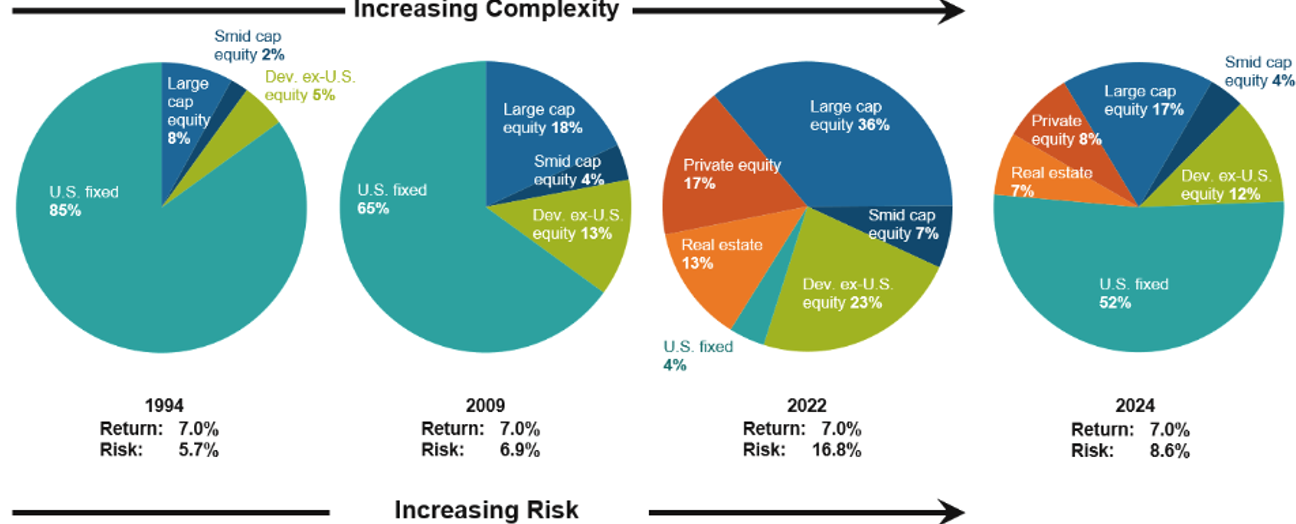
The Financial Times (FT) recently published an article highlighting the struggles of Ivy League schools trying to manage liquidity in the face of an extended downturn in the performance of private markets. Collectively, this august group of institutions continues to underperform the average return for higher education endowments of 10.3% for fiscal year 2024, with only 6 of 8 universities outperforming. This follows an even more challenging fiscal 2023 in which all 8 universities failed to top that year’s 6.8% average return. This difficult period in which distributions have dried up considerably, is forcing some, including Princeton, to issue bonds in order to support the operations of the schools. Haven’t we seen this story play out before?

Despite the troubles, there seems to be this reluctance to alter a strategy first adopted nearly four decades ago when Yale began to invest heavily in these strategies. In the article, Roger Vincent, former head of private equity at Cornell University said, “Everybody still believes in having as big an allocation to private equity as possible.” Really? Why? No asset class will always outperform. The problem with private equity at this time is the fact that too much money has chased to few quality deals driving up the costs of acquisition and lowering future returns. In the process, managers have become reluctant to reduce valuations in order to sell these portfolio companies which has crushed liquidity.

As I’ve written on many occasions, assets shouldn’t be lumped into one bucket focused on return either to meet benefit payments, or in this case, a spending policy. There should be two buckets – liquidity and growth. If the Ivies had structured their portfolios with this design in mind, they would have had sufficient liquidity when needed and issuing bonds wouldn’t have been necessary. Endowments and foundations would be well-served to adopt this structure. Liquidity can be managed through a cash flow matching (CFM) process, which will ensure (barring any defaults) that the cash will be on hand monthly, quarterly, and/or annually depending on the needs of the organization.

I’ve witnessed too many times throughout my 40+ year career investment ideas that got overwhelmed by cash flows. We’ve had booms and busts in real estate, equities (Dot Com era), quantitatively managed equities, gold/commodities, emerging markets, Japan, hedge funds, and on and on and… Why would “investors” believe that private equity would be immune to such action? Again, if an investment is deemed to be all weather, money will naturally flow to that “opportunity” thus reducing future prospects. One way to minimize the short-term impact of these cycles is to build in a liquidity strategy that bridges these troubled times.

The Joke’s On Us!

By: Russ Kamp, Managing Director, Ryan ALM, Inc.

According to a P&I article, the ECB has undertaken an “exploratory review of bank exposures to private equity and private credit funds in order to better understand these channels and to assess banks’ risk management approaches.” According to P&I, the overarching message was that “complex exposures to private equity and credit funds require sophisticated risk management.”

Yesterday, there was a FundFire article that questioned the effectiveness of the “Yale Model” given the heavy dependence on alternatives and the weak performance associated with those products in recent periods. According to the article, the greater the alts exposure the likely weaker fiscal performance.

In a recent article by Richard Ennis, founder and former chairman of investment consultant EnnisKnupp, he estimates that Harvard University, with about 80% of its endowment assets in alternative investments, spends roughly 3% of endowment value on money management fees annually, including the operation of its investment office.

Given the concerns noted above with respect to fees, risk management, and the overall success of investing in alternative strategies, one would believe that a cautionary tone would be delivered at this time. But alas that isn’t the case when it comes to forging ahead with plans to introduce alternatives into DC plans where the individual participant lacks the necessary sophistication to undertake a review of such investments. According to yet another FundFire article in recent days, Apollo and Franklin are plowing forward with plans to make available alternative investments to the DC participant through a new CIT. Shameful!

I’ve commented numerous times that it is pure madness to believe that the average American worker has the disposable income, investment acumen, and/or the necessary crystal ball to effectively manage distributions upon retirement through a DC offering. Given this lack of investment knowledge, I find it so distasteful that “Wall Street” continues to look at these plans as just another source of high fees and revenue. Where are the FIDUCIARIES?

If the ECB doesn’t believe that their banks have the necessary tools in place to handle these complex investments, how on Earth will my neighbor, family member, former teacher, etc.? Can we please stop this madness!