ARPA Update as of July 26, 2024

By: Russ Kamp, Managing Director, Ryan ALM, Inc.

The “dog days” of summer don’t seem to be impacting the activity level at the PBGC, as we had a plethora of activity last week. As mentioned on the PBGC website, the e-filing website is open, but limited. “The e-Filing Portal is open only to plans at the top of the waiting list that have been notified by PBGC that they may submit their applications. Applications from any other plans will not be accepted at this time.” That’s interesting, as there are still 16 pension plans in Priority Groups 1-6 that have potential applications that are not currently being reviewed. Are they excluded, too?

During the week, three funds that had been on the waitlist submitted applications, including, Local 810 Affiliated Pension Plan, the Upstate New York Engineers Pension Fund, and the Alaska Plumbing and Pipefitting Industry Pension Plan. They are seeking a total of $282.1 million for the 9,620 plan participants. This is each plan’s initial submission. As always, the PBGC has 120 from the filing date to conclude the review.

In other news, two plans received approval of their applications, including the Pension Plan of the Moving Picture Machine Operators Union Local 306, a Priority Group 5 member, and the New England Teamsters Pension Plan, that was a Priority Group 6 member. The Moving Picture machinists will receive $20.7 million to support its 542 members, while the NE Teamsters get a whopping $5.7 billion for just over 72k participants. With these latest approvals, the PBGC has now granted through ARPA $67.7 billion in Special Financial Assistance (SFA) that will support the financial futures of 1.34 million American retirees.
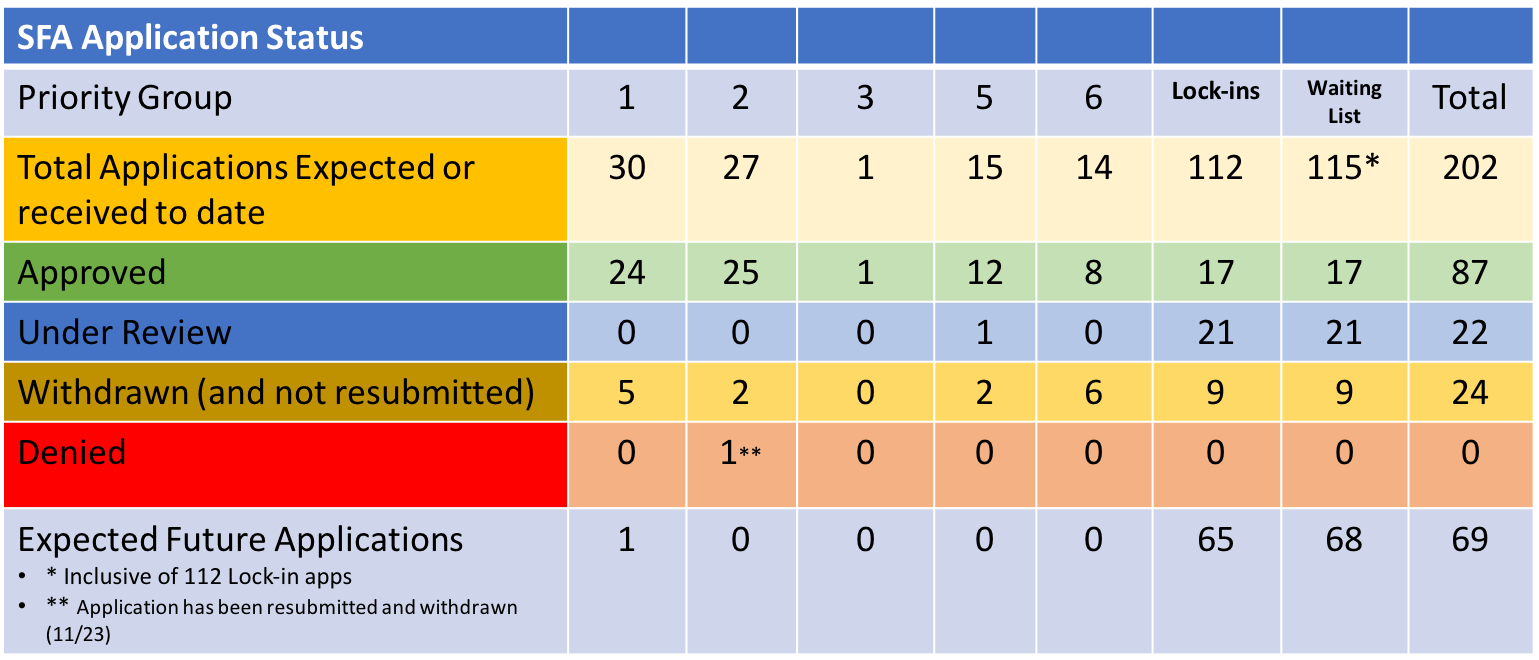
On July 23, the Production Workers Pension Plan was added to the waitlist, becoming the 115th member on that list, with 47 having seen some activity (approved, under review, or withdrawn) regarding their applications. In other news, there were no applications denied or withdrawn. Furthermore, none of the previous SFA recipients were asked to repay a portion of the grant due to overpayment. Have a great week, and don’t hesitate to reach out to us if we can provide any assistance to you as you think through your investment strategy as it relates to the SFA grant.

Ryan ALM, Inc. Celebrates 20th Anniversary!

By: Russ Kamp, Managing Director, Ryan ALM, Inc.

Congratulations to Ron Ryan, a true visionary, and the Ryan ALM, Inc. team as they (we) celebrate the 20th anniversary of the firm. Ryan ALM was incorporated in Delaware on June 15, 2004. Ronald J, Ryan, founder, says that “we created our company to be dedicated to asset liability management (ALM) as our name suggests. We are quite proud of our progress and achievements in ALM. We have built a turnkey system of products that are quite unique in the ALM industry”.

We strive every day to protect and preserve defined benefit plans for the American worker. We continue to believe that the primary objective in managing a pension is to SECURE the promised benefits at low cost and with prudent risk. We thank all of our clients and their advisors who have provided us with the opportunity to support their efforts on a daily basis. Please don’t hesitate to reach out to us. We’ll work with you to find a unique solution to your specific issue(s).

Here’s to the next 20!

Healthier Than Ever? Nah!

By: Russ Kamp, Managing Director, Ryan ALM, Inc.

P&I produced an article yesterday titled, “Corporate Pension Funds Are Fully Funded, Healthier Than Ever. Now What?” According to Milliman, corporate pension plans are averaging roughly a funded ratio of 106%. This represents a healthy funded status, but it is by no means the healthiest ever. One may recall that corporate plans were funded in excess of 120% as recently as 2000. In what might be more shocking news, public pension plans were too when using a market discount rate (ASC 715 discount rate). Today, those public pension plans have a funded status of roughly 80% according to Milliman’s latest public fund report.

The question, “Now what”? is absolutely the right question to be asking. Many corporate plans have already begun de-risking, as the average exposure to fixed income is >45% according to P&I’s asset allocation survey through November 2023. Unfortunately, public pension systems still sit with only about 18% exposure to US fixed income, preferring a “let it ride” mentality as equities and alternatives account for more than 75% of the average plan’s asset allocation. Is this the right move? No. The move into alternatives has dried up liquidity, increased fees, and reduced transparency. Furthermore, just because a public plan believes that its sponsor is perpetual, does that make the system sustainable? You may want to be reminded about Jacksonville Police and Fire. There are other examples, too.

Whether the pension plan is corporate, multiemployer, or public, the asset allocation should reflect the funded status. There is no reason that a 60% funded plan should have the same asset allocation as one that is 90% or better funded. All plans should have both liquidity and growth buckets. The liquidity bucket will be a bond allocation (investment grade corporates in our case) that matches asset cash flows to liability cash flows of benefits and expenses. That bucket will provide all of the necessary liquidity as far into the future as the pension system can afford. The remaining assets will be focused on outperforming future liability growth. These assets will be non-bonds that now have the benefit of an extended investing horizon to grow unencumbered. Forcing liquidity in environments in which natural liquidity has been compromised only serves to exacerbate the downward spiral.

Pension America has the opportunity to stabilize the funded status and contribution expenses. They also have the chance to SECURE a portion of the promises. How comforting! We saw this movie a little more than 20 years ago. Are we going to treat this opportunity as a Ground Hog Day event and do nothing or are we going to be thoughtful in taking appropriate measures to reduce risk before the markets bludgeon the funded status? The time to act is now. Not after the fact.

Corporate Funding Improves in March – Milliman

By: Russ Kamp, Managing Director, Ryan ALM, Inc.

Milliman released the results of its latest Milliman 100 Pension Funding Index (PFI), which analyzes the 100 largest U.S. corporate pension plans. Pension funding improved for the third consecutive month to start the year, which now stands at 105.6% from 105.3% at the end of February. March was a bit different, however, as the discount rate declined 11 basis points increasing the collective liabilities by $14 billion to $1.299 trillion at the end of the quarter. Despite the increase in liabilities, investment performance was once again strong leading to a gain of $19 billion. Total assets now stand at $1.373 trillion.

Zorast Wadia, author of the PFI, stated, “the funded status gains may dissipate unless plan sponsors adhere to liability-matching investment strategies. Zorast’s observation is outstanding. Should rates fall from these levels, the cost to defease pension liabilities will grow. Now is the time to take risk off the table. Create certainty by getting off the asset allocation rollercoaster. Engaging in Cash Flow Matching (CFM) does not necessitate being an all or nothing strategy. Start your cash flow matching mandate and extend it as the funded status improves.

Return-seeking bond strategies will lose in an environment of rising rates. However, once a plan engages in CFM, the relationship between plan assets and liabilities is locked. Done correctly, assets and liabilities will move in tandem. It doesn’t matter what interest rates do, as benefit payments are future values that are not interest rate sensitive.

Act now to create some certainty! You’ll appreciate the great night’s sleep that you’ll start to have.

Pension America – Taking Control Of One’s Destiny

For pension plan participants defined benefit plans (DB) must remain the backbone of the US Retirement Industry

The true objective of a pension plan is to fund liabilities (monthly benefits) in a cost effective manner with reduced risk over time. Unfortunately, it has been nearly impossible to get a true understanding of a plan’s liabilities outside of the actuary’s report, which is received by sponsors and trustees only on an annual basis, at best, and usually many months delinquent.

Fortunately, a plan’s liabilities can now be monitored and reviewed on a monthly basis through a groundbreaking index developed by Ron Ryan and his firm, Ryan ALM – The Custom Liability Index (CLI). The CLI is similar to any index serving the asset side of the equation (S&P 500, Russell 1000, Barclays U.S. Aggregate, etc.), except that the CLI measures your plan’s specific liabilities and not some generic liability stream. This critically important tool calculates the present value, growth rate, term-structure, interest rate sensitivity of your plan’s liabilities, and other important statistics such as, average yield, duration, etc. With a more transparent view of liabilities, a plan can get a truer understanding of the funded ratio / funded status.

The use of the CLI enables plan sponsors, trustees, finance officials, and asset consultants to do a more effective job allocating assets and determining funding requirements (contributions). The return on asset assumption (ROA), which has been the primary objective for most DB plans, should become secondary to a plan’s specific liabilities. Importantly, as the plan’s funded status changes, the plan’s asset allocation should respond accordingly.

Importantly, the CLI is created using readily available information from the plan’s actuary (projected annual benefits and contributions), and it is updated as necessary to reflect plan design changes, COLAs, work force and salary changes, longevity forecasts, etc. In addition, the CLI is an incredibly flexible tool in which multiple views, based on various discount rates, can be created. These views may include the ROA, ASC 715, PPA, GASB 67/68, and market-based rates (risk-free), with and without the impact of contributions.

Why should a DB plan adopt the CLI? As mentioned above, DB plans only exist to fund a benefit that has been promised in the future. As a plan’s financial health changes the asset allocation should be adjusted accordingly (dynamic). Without having the greater transparency provided by the CLI, it is impossible to know when to begin de-risking the plan. You’ve witnessed through the last 15 years the onerous impact of market volatility on the funded status of DB plans and contribution costs. Ryan ALM and KCS can help you reduce the likelihood of a repeat, and very painful, performance.

Unintended Consequences

Unintended Consequences

Recently I had the opportunity to speak at the Financial Research Associates’ conference in NYC on non-traditional fixed income. I had the pleasure of participating on a panel with an industry icon – Ron Ryan, Ryan ALM  He and I presented on the topic “Taking a Close Look at the Liability Beta Portfolio”.  However, before presenting our views on the proper use of fixed income in a defined benefit plan, especially in a low interest rate environment, Ron and I addressed the unintended consequences from accounting rules, both GASB and FASB, that have lead to an under-reporting of plan liabilities and an overstatement of plans assets.  Given both, it is obvious that funded ratios are overstated, too.

The IASB (International Accounting Standards Board) has moved to a mark to market accounting of both pension liabilities and assets.  It isn’t too far fetched to believe that the US will adopt these same standards in the near future.  Unfortunately, since GASB uses the ROA to value plan liabilities, it becomes clear as to why the pension community continues to focus on the asset side of the equation instead of the liability side, which should be driving asset allocation and investment structure.

Attached for your review is our presentation.  We encourage you to reach out to us if you have any questions or challenges.


“The U.S. Pension Crisis”

Congratulations to Ron Ryan, CEO at Ryan ALM, on the publishing of his book titled, “The U.S. Pension Crisis”.  Ryan’s book articulates what needs to be done NOW to save America’s pensions. 

When testifying before the ERISA Committee in 2003, Ron highlighted the issues related to GASB and FASB accounting rules, and the distortions to contributions, funded ratios, earnings and balance sheets brought about by their failings.  This book is a must read for anyone who truly wants to understand why our defined benefit plans are in such a state right now.

Asset Consulting Firms and Their Consultants Aren’t Commodities

The environment for asset consulting firms is quite challenging.  Historically, there have been few barriers to entry, and measuring the value-add provided by the asset consulting firm has been difficult to gauge.  As such, hiring decisions have often come down to price, with the low bidder more often than not winning the assignment.  For those firms fortunate to be given an assignment, the life cycle of the relationship is generally fairly long (about 7 years), as it usually takes a departure of the consultant or a major screw up before the relationship is terminated.  This practice has to change.

Given the current state of defined benefit plans in the US and abroad, this is not the time to fiddle while Rome burns. It is imperative that asset consultants be judged for the value that they bring to a relationship, and they should be compensated based on that value-add.  There are many services that consultants provide, but the importance to the success or failure of a plan varies widely.  Establishing the right plan benchmark is critical, and it isn’t the ROA. We believe that it should be the plan’s specific liabilities. The investment structure and asset allocation that flows from a greater knowledge of the liabilities are key decisions that drive most of the plan’s subsequent return. However, it seems to us that most of the time (80/20 rule) is spent on trying to identify value-added managers. Get the wrong asset allocation and the best performing managers in the weakest asset class won’t help you much.

Let’s see if the industry can refocus on the importance of DB plans, so that we can stabilize the retirements for both our private and public workers.  As such, let’s begin to evaluate consulting firms that can improve the funded ratio and funded status, while minimizing contribution costs. These are the important metrics when evaluating a consulting firm and their consultants.  Experience matters in this industry.  We pay great homage to it on the asset management side of the business.  Why isn’t this as critical when evaluating asset consultants?  Remember: asset consultants have a greater impact on your plan than any individual manager does!