ARPA Update as of July 18, 2025

By: Russ Kamp, CEO, Ryan ALM, Inc.

I have the pleasure of drafting this post from beautiful Newport, RI, where I’m attending and speaking at the Opal Public Fund Forum East. The West forum’s location wasn’t too shabby either as it took place in Scottsdale last January! Business travel isn’t as glamorous as those who don’t travel think, but there are some nice perks, too. As they say in real estate: location, location, location!

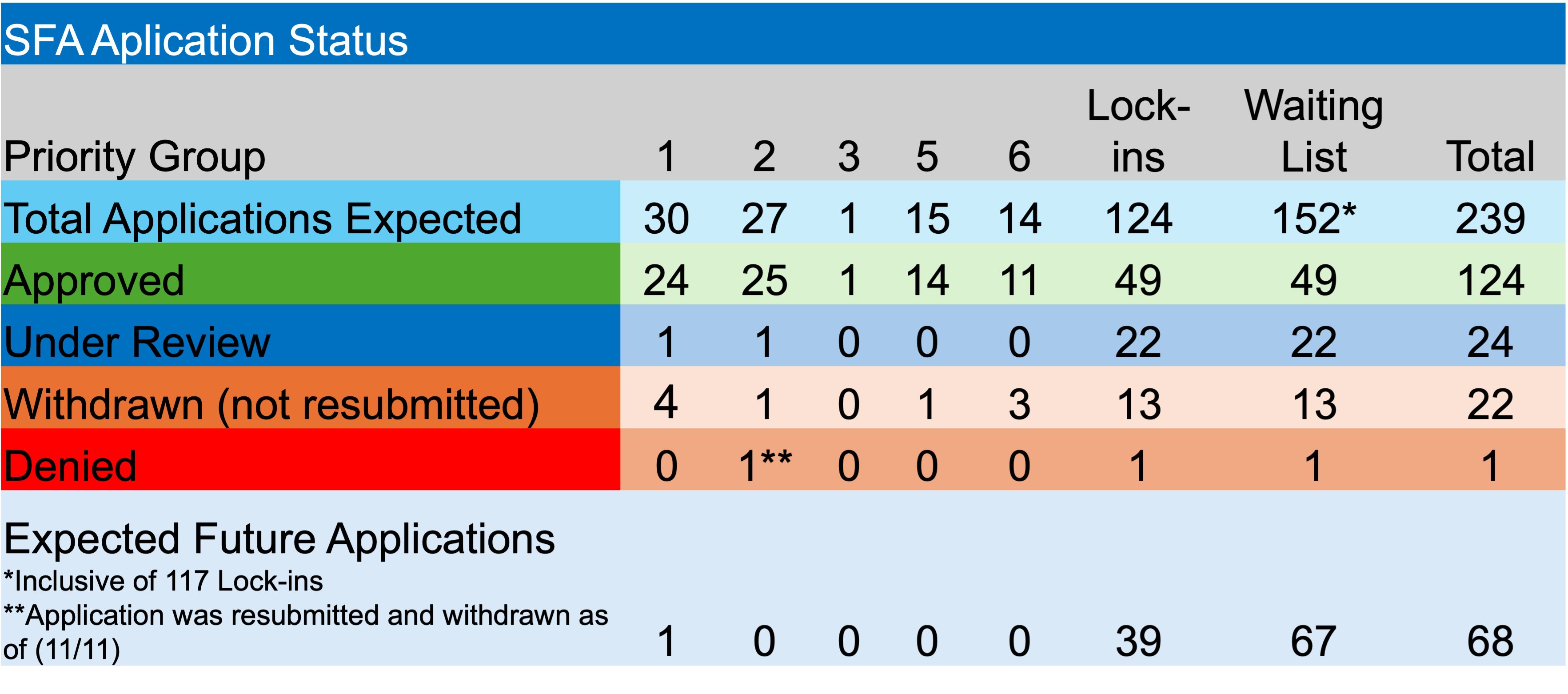
With regard to ARPA, since you likely didn’t decide to open post this to find Waldo or Russ, the PBGC was fairly busy during the previous week, as there was one new application, one approved application, two new additions to the waitlist and two funds that locked-in their measurement date. Now the details.

I’m pleased to report that the Roofers Local 88 Pension Plan, a Canton OH-based fund, has filed a revised application seeking $9 million for their 484 participants. As usual, the PBGC has 120-days to act on the application or it is automatically approved. In addition, Union de Tronquistas de Puerto Rico Local 901 Pension Plan, a San Juan, PR-based fund, a Priority Group One member will receive $49 million in SFA and interest for the 3,397 members.

In other news, Local 400 Food Terminal Employees Pension Trust Fund and the Textile Processors Service Trades Health Care Professional and Technical Employees International Union Local No. 1 Pension Fund (that name is a mouth full) have both added their funds to the PBGC’s waitlist for the submission of an SFA application. Good luck. There were also two funds from the waitlist, Iron Workers Local 473 Pension Plan and Greenville Plumbers and Pipefitters Pension Fund have locked in their measurement date and both chose April 30, 2025.

Lastly, there were no applications denied or withdrawn, and none of the previous SFA recipients were asked to rebate a portion of their proceeds due to census errors. As reported previously, the PBGC has their work cut out for them, as all of the outstanding applications need to be filed by year-end.
ARPA Update as of June 20, 2025

By: Russ Kamp, CEO, Ryan ALM, Inc.

Despite the chaotic nature of our markets and geopolitics, it is comforting that I can report weekly on the progress being made by the PBGC implementing the critical ARPA legislation. That is not to say, that the 2nd Circuit’s recent ruling isn’t creating a bit of chaos, too.

Regarding last week’s activity, the PBGC’s efiling portal must have been wide open, as they accepted initial applications from 5 pension plans residing on the waitlist. The PBGC will now have 120-days to act on these submissions.

There were no applications approved, denied, or withdrawn last week, but that isn’t to say that the PBGC rested on its laurels. There were two more plans that repaid a portion of the SFA received, as census errors were corrected. International Association of Machinists Motor City Pension Plan and Western States Office and Professional Employees Pension Fund repaid 1.61% and 1.08% of the SFA, respectively. In total, 57 plans have “settled” with the PBGC, including four funds that had no census errors. To date, $219 million was repaid from grants exceeding $48 billion or 0.45% of the grant.

In other ARPA news, another 16 funds have been added to the waitlist resulting from the 2nd Circuit’s determination that previously terminated plans can seek SFA. We do believe that it will prove beneficial for these plans, but it will stress the resources of the PBGC to meet ARPA imposed deadlines.

Given the highly unpredictable nature of war and tariffs on inflation and U.S interest rates, it isn’t surprising that the U.S. Federal Reserve held the Fed Funds Rate steady last week. We encourage those plans receiving SFA grants to secure the promised benefits through a cash flow matching strategy. Who knows how markets will impact bonds and stocks for the remainder of the year.

$6 billion – Is That All?

By: Russ Kamp, CEO, Ryan ALM, Inc.

A recent ruling by the 2nd Circuit has opened the door for roughly 100+ multiemployer plans to pursue Special Financial Assistance (SFA) that were originally deemed ineligible because the plans had terminated. The PBGC’s inspector general, in a “risk advisory”, has estimated that the cost to provide the SFA to these newly eligible plans could be as much as $6 billion. Is that all? Let’s not focus on the $s, but the number of American workers and their families that this additional expenditure will support.

As I reported last week in my weekly update related to ARPA’s pension reform, the PBGC had denied the application for the Bakery Drivers Local 550 and Industry Pension Fund, a New York-based terminated pension plan, because it had terminated. The plan covered 1,094 participants in 2022 and was 6.3% funded, according to their Form 5500. Regrettably, the plan terminated in 2016 by mass withdrawal after Hostess Brands, Inc., its largest contributor, went bankrupt. However, the court stated, that despite terminating in 2016, the plan “continued to perform audits, conduct valuations, file annual reports, and make payments to more than 1,100 beneficiaries.”

As of June 13, 2025, the PBGC had already received 223 applications for SFA with $73.0 billion approved supporting the retirements for 1.75 million American workers. What an incredible outcome! However, according to the inspector general’s letter, the potential $6 billion in added cost would include $3.5 billion to repay the PBGC’s earlier loans to approximately 91 terminated plans, which was described as a “potential waste”. He went on to state that the potential repayment to the PBGC would be a waste of taxpayer funds due to the positive current and projected financial condition of the multiemployer program. “PBGC’s multiemployer program is in the best financial condition it has been in for many years. PBGC’s 2023 Projections Report states that PBGC’s multiemployer program is projected to ‘likely remain solvent for at least 40 years.’” GREAT!

Perhaps the repayment of $3.5 billion in loans could enable the PBGC to lower the annual premiums on the cost to insure each participant, which might keep some plans from seeking termination due to excessive costs to administer the program. Something needs to be done with private DB plans, too, as those costs per participant are far greater, but that’s a story for another blog post.

As regular readers of this blog know, we’ve celebrated the success of this program since its inception (July 2021). The fact that 1.75 million American workers to date have had their promised benefits secured, and in some cases, restored, is wonderful. Think of the economic impact that receiving and spending a monthly pension check has on their communities. Furthermore, think about what the cost would have been for each of these folks had the Federal government been needed to provide social services. None of these workers/retirees did anything wrong, yet they bore the brunt.

The estimated $6 billion in additional “investment” in American workers is a drop in the bucket relative to the annual budget deficit, which has been running from $1-$2 trillion annually. Restoring and supporting the earned retirement benefits is the right thing to do.

Eligible For SFA

By: Russ Kamp, CEO, Ryan ALM, Inc.

Regular followers of this blog know that I provide a weekly update on the ARPA pension legislation and the PBGC’s progress implementing this critical support for multiemployer pension plans. We reported way back in January 2023 that the Bakery Drivers Local 550 and Industry Pension Fund’s application seeking Special Financial Assistance (SFA) had been denied due to ineligibility. We also reported that the Bakery Drivers had submitted a revised application on May 30, 2025. We observed at the time that unlike all the other applications that had been submitted, this one did not have a 120-day window for the PBGC to act on the submission. We now know why.

The Bakers were cooking up an argument that was presented to the courts on why their application seeking SFA was appropriate and they were right. “The U.S. 2nd Circuit Court of Appeals says that a multiemployer pension plan that qualifies for a grant under the Pension Benefit Guaranty Corporation’s (PBGC) Special Financial Assistance (SFA) program cannot be excluded just because that plan was previously terminated.”

“Because we do not read the pertinent provision of the SFA statute to exclude plans based solely on a prior termination,” the court ruled, the plan should be eligible for a SFA grant. As a result, the court ruled in favor of the fund, “vacated the PBGC’s denial and remanded the application to the PBGC for reconsideration.”

A little history. The Bakery Drivers Local 550 and Industry Pension Fund, a fund based in Floral Park, NY. The plan covered 1,094 participants in 2022 and was 6.3% funded, according to their Form 5500. Regrettably, the plan terminated in 2016 by mass withdrawal after Hostess Brands, Inc., its largest contributor, went bankrupt. However, the court stated, that despite terminating in 2016, the plan “continued to perform audits, conduct valuations, file annual reports, and make payments to more than 1,100 beneficiaries.”

The court ruled that the statute said that any multiemployer plan that was in critical and declining status from 2020 to 2022 was potentially eligible, and the plan was in critical and declining status in Sept. 2022 when it applied. Importantly, “these provisions do not, by their terms, exclude a plan that was terminated by mass withdrawal.”

According to the PBGC’s status of applications weekly report, the United Food and Commercial Workers Unions and Employers Pension Plan, a non-priority group member, is the only other applicant to have its submission denied due to ineligibility. I wonder if they will have a similar argument as the Bakery Drivers. More to come.

Milliman: Improved Corporate Pension Funding Continues

By: Russ Kamp, Managing Director, Ryan ALM, Inc.

Milliman has once again produced its monthly update of the Milliman 100 Pension Funding Index (PFI), which analyzes the 100 largest U.S. corporate pension plans. Thank goodness they can still find 100 corporate plans to evaluate. Despite my snarkiness, it is good to read that Milliman is reporting improved funding for the sixth consecutive month in 2024, with a slight increase in the funded ratio from 103.6 to 103.7. The surplus remained the same at $46 billion.

June’s investment return of 1.22% matched the $9 billion increase in liabilities as the discount rate fell 7 bps to 5.46%. “The first half of 2024 has seen nothing but funded ratio improvements,” said Zorast Wadia, author of the PFI. “However, with markets at all-time highs and concerns that discount rates may eventually fall, the forecast for the second half of 2024 may not be as sanguine, and liability-matching portfolios will continue to be prudent strategies for plan sponsors.”

We absolutely agree with Zorast’s assessment of what may transpire in 2024’s second half. There has clearly been a slowing in economic activity as seen by the GDP in Q1’24 (1.4%) and Q2’24 is not looking much more robust, as the Atlanta Fed’s GDPNow model presently forecasts a 2.0% real GDP annualized return for the second quarter. If economic weakness were to develop, as a result of the Fed’s campaign to stem inflation by raising the Fed Fund’s rate (presently 5.25% – 5.5%), US interest rates could fall, while equities could also cool off as a result of the economic weakness. A combination such as this would be quite detrimental to pension funding.

In related news, FundFire has published an article highlighting the fact that “fixed income products now make up about 54% of defined-benefit portfolios, according to Mike Moran, senior pension strategist at Goldman Sachs Asset Management. He is obviously speaking about corporate plans, as both public and multiemployer exposures to fixed income are much more modest. Happy to see that Moran was quoted as saying that he “urges pension managers to act quickly to de-risk.” He went on to say, “This is a period of strength, a position of strength, for plan sponsors, and history shows us that the position of strength can sometimes be fleeting,” We absolutely agree.

We’ve been encouraging plan sponsors of all types to act to reduce risk and secure the promised benefits before the Fed or market participants reduce rates from these two-decade high levels.