Capital Distributions From Private Equity Collapse

By: Russ Kamp, CEO, Ryan ALM, Inc.

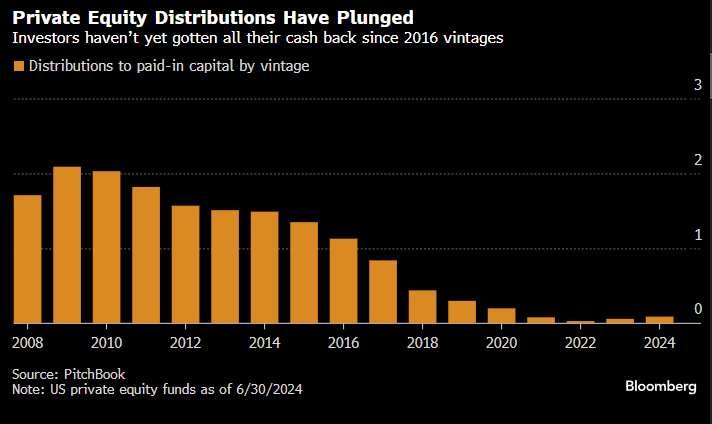
I recently published a blog titled, Problem – Solution: Liquidity, in which I discussed the impact of pension plan sponsors cobbling together interest, dividends, and capital distributions from their roster of managers, and how that practice was not beneficial, especially during periods of stress in the markets. Well, one of those three legs of the “gotta, but how am I gonna, meet my monthly payment of benefits and expenses”, is really falling short at this time.

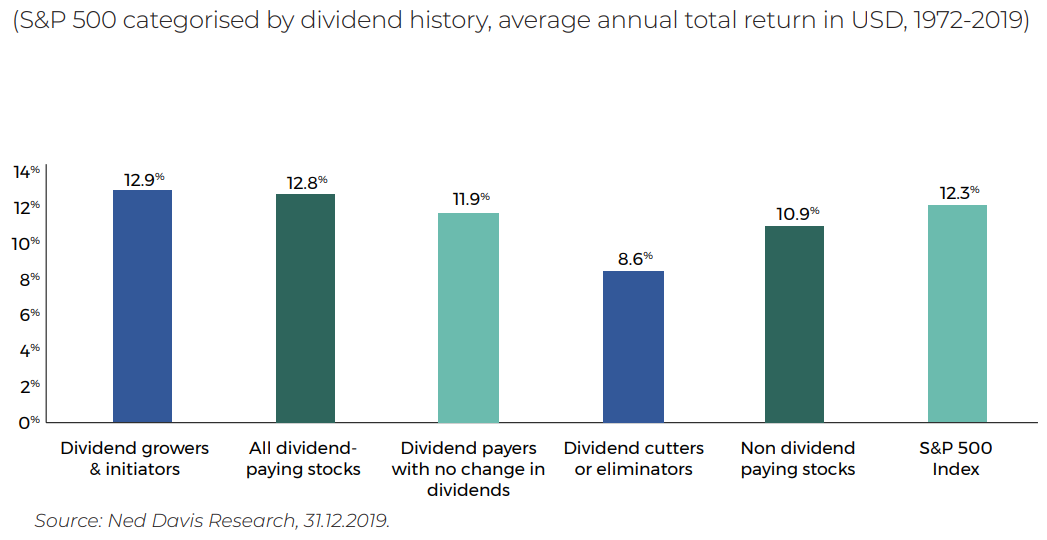
Dividends are far lower these days than they once were when equities were perceived to be quite risky. In fact, it wasn’t until 1958 that dividend income fell below interest income from bonds. Couple that phenomenon with the fact that capital distributions have plummeted, and plan sponsors are placing far greater emphasis on capturing interest from bonds than ever before. Yes, thankfully interest rates have risen, but the YTM on the BB Aggregate index is still only in the 4.7% range. That is not likely sufficient to meet monthly payouts, which means that bonds will have to be sold, too. The last thing one should want to do in a rising rate environment is to sell securities at a loss.

However, if the plan sponsor engaged a Cash Flow Matching (CFM) manager in lieu of an active core fixed income manager, the necessary liquidity would be made available each and every month of the assignment, as asset cash flows would be carefully matched against liability cash flows. Both interest and maturing principal would be used to meet those benefits and expenses. No forced selling. No scurrying around to “find” liquidity. A far more secure and certain process.

What if my plan isn’t fully funded. Does it make sense to use CFM? Of course, given that benefits and expenses are paid each month whether your plan is fully invested or not, wouldn’t it make more sense to have those flows covered with certainty? Sure, a poorly funded plan may only be able to use CFM for the next 3-5-years, but that’s the beauty of CFM. It is a dynamic process providing a unique solution for each pension plan. No off the shelf products.

Problem – Solution: Liquidity

By: Russ Kamp, CEO, Ryan ALM, Inc.

Plan Sponsors of defined benefit pension plans don’t have an easy job! The current focus on return/performance and the proliferation of new, and in some cases, complicated and opaque products, make navigating today’s market environment as challenging as it has ever been.

At Ryan ALM, Inc. we want to be our clients’ and prospects’ first call for anything related to de-risking/defeasing pension liabilities. Ryan ALM is a specialty firm focused exclusively on Asset/Liability Management (ALM) and how best to SECURE the pension promise. For those of you who know Ron Ryan and the team, you know that this have been his/our focus for 50+ years. I think that it is safe to say that we’ve learned a thing or two about managing pension liabilities along the way. Have a problem? We may just have the solution. For instance:

Problem – Plan sponsors need liquidity to meet monthly benefits and expense. How is this best achieved since many plan sponsors today cobble together monthly liquidity by taking dividends, interest, and capital distributions from their roster of investment advisors or worse, sell securities to meet the liquidity needs?

Solution – Create an asset allocation framework that has a dedicated liquidity bucket. Instead of having all of the plan’s assets focused on the return on asset (ROA) assumption, bifurcate the assets into two buckets – liquidity and growth. The liquidity bucket will consist of investment grade bonds whose cash flows of interest and principal will be matched against the liability cash flows of benefits and expenses through a sophisticated cost-optimization model. Liquidity will be available from the first month of the assignment as far out as the allocation to this bucket will secure – could be 5-years, 10-years, or longer. In reality, the allocation should be driven by the plan’s funded status. The better the funding, the more one can safely allocate to this strategy. Every plan needs liquidity, so even poorly funded plans should take this approach of having a dedicated liquidity bucket to meet monthly cash flows.

By adopting this framework, a plan sponsor no longer must worry where the liquidity is going to come from, especially for those plans that are in a negative cash flow situation. Also, removing dividend income from your equity managers has a long-term negative effect on the performance of your equity assets. Finally, during periods of market dislocation, a dedicated liquidity bucket will eliminate the need to transact in less than favorable markets further preserving assets.

We’re often asked what percentage of the plan’s assets should be dedicated to the liquidity bucket. As mentioned before, funded status plays an important role, but so does the sponsors ability to contribute, the current asset allocation, and the risk profile of the sponsor. We normally suggest converting the current core fixed income allocation, with all of the interest rate risk, to a cash flow matching (CFM) portfolio that will be used to fund liquidity as needed.

We’ll be producing a Problem – Solution blog on a variety of DB plan topics. Keep an eye out for the next one in the series. Also, if you have a problem, don’t hesitate to reach out to us. We might just have an answer. Don’t delay.

Opportunity Cost Goes Both Ways

By: Russ Kamp, CEO, Ryan ALM, Inc.

I had an interesting conversation at the IFEBP Investment forum. It wasn’t the first time that this topic has been raised and I am willing to state that it won’t be the last. I was discussing the benefits of cash flow matching (CFM) with a trustee who raised concern about locking in the asset / liability match, suggesting that by defeasing a period longer than 3-5-years may lead to “regret” if there had been an opportunity to generate a greater return from those assets used to defease a portion of the liabilities.

Anytime an asset allocation decision is taken, there is always the possibility that some combination of asset classes and products would have produced a greater return in the short-term. However, opportunity cost can easily be opportunity lost. When one engages in a CFM strategy, one does so because they understand that the primary objective in managing a DB pension is to SECURE the promised benefits at a reasonable cost and with prudent risk. Managing a pension fund is not a return game despite the prevailing orthodoxy in our industry.

Why would one not want to secure a portion of the asset base providing the necessary liquidity to meet benefits and expenses? It is so comforting, or it should be, not to have to worry about raising liquidity in challenging markets. At the same time, the CFM strategy is buying time for the alpha (risk) assets to grow unencumbered. We normally suggest that a 10-year CFM be implemented, but that decision is predicated on a number of factors specific to that plan. We can, and have, engaged in assignments shorter than 10-years, and CFM provides the same benefits, even if the cost savings may be less than that provided by a longer assignment.

Furthermore, there is always the question of maintaining the maturity of the assignment (5-, 7-, 10- or more years) once the program is up and running. Plan sponsors must decide if the assignment should be allowed to run out after the initial allocation, be maintained at the same maturity, or extended given improved funding. If markets don’t behave there is no obligation to extend the program. If markets get crushed and the sponsor feels that liquidating the CFM portfolio assets could be used to buy “low” that is available given the liquidity profile of investment grade bonds. We don’t understand why one would want to do that since the matching of assets and liabilities creates certainty, which is missing in traditional pension management.

DB pension plans are critical to the long-term financial security of the participants. Securing the promised benefits reduces the possibility that adverse outcomes don’t result in the fund having to take dramatic action such as additional tiers or worse, the freezing of the plan. CFM stabilizes both the funded status for that portion of the fund and contributions. I would think that getting as much into CFM and reducing the uncertainty of managing the plan given our volatile markets should be an unquestionable goal.

Benefits of Cash Flow Matching (CFM)

By: Ronald J. Ryan, CFA, Chairman, Ryan ALM, Inc.

The true objective of a pension is to secure and fund benefits in a cost-efficient manner with prudent risk. This is best accomplished by cash flow matching (CFM). In the 1970s and 1980s it was greatly in vogue and called Dedication. CFM aligns the cash flows of assets to match and fully fund the liability cash flows (benefits + expenses (B+E)) chronologically. Since bonds are the only asset class with the certainty of cash flows (principal and interest), bonds have always been the choice to CFM liability cash flows. The benefits of the Ryan ALM CFM approach are numerous and significant:

Reduces Risk – Risk is best defined as the uncertainty of achieving the objective. CFM will secure the objective of paying benefits with certainty.

    Reduces Cost – The cost to fund future B+E is reduced by about 2% per year (1-10 years = 20%).

    Enhances the ROA – There is a ROA for each asset class. For bonds, it is usually the YTM of a generic bond index. The Ryan ALM CFM is heavily skewed to A/BBB+ corporate bonds and will outyield these bond indexes thereby enhancing the ROA for the bond allocation.

    Mitigates Interest Rate Risk – CFM matches and funds actuarial projections of B+E which are all future values. Importantly, future values are not interest rate sensitive. Future values of B+E should be the focus of a pension objective. Present values are interest rate sensitive but that is not the objective. Since CFM will match the liability cash flows it will have the same or similar duration profile and present value interest rate sensitivity. 

    Eliminates Cash Sweep– Many pensions do a cash sweep of all assets to find the liquidity needed to fund current B+E. CFM will provide this liquidity so there is no need for a cash sweep that harms asset growth. This should enhance the ROA of growth assets whose dividends may have been used to fund current B+E. According to a Guinness Global study of the S&P 500 dating back to 1940, dividends + dividends reinvested accounted for about 49% of the S&P 500 total return for rolling 10-year periods and 57% for 20-year periods. CFM buys time for the growth assets to grow unencumbered.

        Reduces Volatility of Funded Ratio and Contributions – CFM will match and fully fund the liability cash flows chronologically thereby reducing or eliminating any funding ratio volatility for the period it is funding. This should help reduce the volatility of contributions as well.

          Provides Accurate Pension Inflation Hedge – The actuarial projections of B+E include inflation. As a result, CFM not only is the proper liability cash flow hedge but is the only accurate way to hedge pension inflation (benefits, expenses, salary, etc.). Please note that pension inflation is not equal to the CPI but can vary greatly.

          Reduces Pension Expense – For corporations, the present value growth of assets versus the present value growth of liabilities in $s creates a line item called pension expense. Corporations want asset growth to match liability growth in $s to avoid a hit to earnings and use a duration match strategy to hedge. CFM will provide a more accurate duration match since it funds monthly liability cash flows and not an average duration. Public plans do not have this earnings issue.

          Don’t hesitate to reach out to us if you’d like to learn more about how Ryan ALM’s Cash Flow Matching capability can benefit your plan. You can always visit RyanALM.com to get additional research insights . Finally, we are always willing to provide a free analysis. All we need are the projected benefits, expenses, and contributions. The further into the future those projection cover the greater the insights.

              Verus: “LDI for Public Sponsors”

              By: Russ Kamp, CEO, Ryan ALM, Inc.

              Dan Hougard, FSA and Associate Director, Actuarial Services at Verus has recently published an excellent thought piece on LDI for public pension plans. In this case, the LDI refers to Cash Flow Matching (CFM). We at Ryan ALM, believe that LDI is the label in which sits both CFM and duration matching strategies. Furthermore, we absolutely agree with Dan’s assessment that public pension plans can benefit in this environment of higher yields despite the accounting differences that may not make the use of CFM obvious.

              As most readers of this blog know, we often criticize public pension accounting (GASB) for pension liabilities that allow the use of the ROA assumption to “discount” liabilities, while corporate/private pension plans use a market-based interest rate (FASB). We applaud Dan for stating that “the purpose of a pension plan’s investment portfolio (assets) is to ensure that the promised benefits (liabilities) can be paid to beneficiaries as they come due”. We at Ryan ALM believe that the primary objective in managing a DB plan is to SECURE the benefits at a reasonable cost and with prudent risk.

              Key highlights from Dan’s research:

              Many plan sponsors approach their investment policy without explicitly focusing on the liabilities

              Because public plans discount liabilities at the ROA the perceived benefit of LDI (CFM) is not as obvious

              Public plans could match longer-duration cashflows combined with “market-based” reporting for a portion of the liabilities – such as all current retirees.

              The lowest risk asset class for pension investors are fixed income securities, as income is used to pay benefits, and securities are held to maturity so there is no interest rate risk.

              During periods of market stress, negative cash flow plans may be forced to sell assets at depressed prices.

              CFM can overcome that challenge by providing the needed cash flow to cover obligations while the return-seeking portfolio grows unencumbered.

              IG credit yields haven’t been this attractive since 2010.

              Public pension portfolios tend to have very uncertain outcomes and carry “tremendous” asset-liability mismatch.

              Finally, CFM “investing can offer considerable value for many pension plans”!

              It is wonderful to see a thoughtful article on this subject. We, at Ryan ALM, often feel as if we are all alone in our quest to protect and preserve defined benefit plans for the masses through cash flow matching, which SECURES the promised benefits at a reasonable cost and with prudent risk. It also allows for a wonderful night’s sleep during periods of excessive uncertainty.

              P&I: “Not The Time To Panic” – Frost

              By: Russ Kamp, CEO, Ryan ALM, Inc.

              There is hardly ever a good time to panic when managing a defined benefit pension plan. No one ever wants to be a forced seller because liquidity is needed and not available. Too often what looks like a well-diversified portfolio suddenly has all assets correlating to 1. I’ve seen that unfold many times during my nearly 44-years in the business.

              It is critically important that the appropriate asset allocation framework be put in place long before one might be tempted to panic. As we’ve mentioned many times before, having all of your eggs (assets) in one basket focused on a return objective (ROA) is NOT the correct approach. Dividing assets among two buckets – liquidity and growth – is the correct approach. It ensures that you have the necessary liquidity to meet benefits and expenses as incurred, and it creates a bridge over uncertain markets by extending the investing horizon, as those growth assets are no longer needed to fund monthly payments.

              Furthermore, the liquidity portfolio should be managed against the plans liabilities from the first month as far out as the allocation to the liquidity bucket will take you. Why manage against the liabilities? First, the only reason the plan exists is to meet a promise given to the participant. The primary objective managing a pension should be to SECURE the promised benefits at a reasonable cost and with prudent risk. Second, a cash bucket, laddered bond portfolio or generic core portfolio is very inefficient. You want to create a portfolio that defeases those promises with certainty. A traditional bond portfolio managed against a generic index is subject to tremendous interest rate risk, and there certainly seems to be a lot of that in the current investing environment.

              The beauty of Cash Flow Matching (CFM) is the fact that bonds (investment grade corporate bonds in our case) are used to defease liabilities for each and every month of the assignment (5-, 10-, 20- or more years). Liabilities are future values (FV) and as such, are not interest rate sensitive. A $1,000 benefit payment next month or any month thereafter is $1,000 whether rates are at 2% or 10%. If one had this structure in place before the market turbulence created by the tariff confusion, one could sleep very comfortably knowing that liquidity was available when needed (no forced selling) and a bridge over trouble waters had been built providing ample time for markets to recover, which they will.

              Yes, now is not the time to panic, but continuing to ride the rollercoaster of performance created by a very inefficient asset allocation structure is not the answer either. Rethink your current asset allocation framework. Allow your current funded status to dictate the allocation to liquidity and growth. The better funded your plan, the less risk you should be taking. DB pension plans need to be protected and preserved. Creating an environment in which only volatility is assured makes little sense. It is time to bring an element of certainty to the management of pensions.

              Risk On or Risk Off?

              By: Russ Kamp, CEO, Ryan ALM, Inc.

              I have the pleasure of speaking at the Opal/LATEC conference on Thursday. My panel has been given the topic of Risk On or Risk Off: How Are You Adjusting Your Portfolio, and Which Investment Risks Concern You Most? I think it is an incredibly timely discussion given the many cross-currents in the markets today.

              Generally speaking, what is risk? At Ryan ALM, Inc. we would say that risk is the failure to achieve the objective. What is the objective in managing a defined benefit pension plan? We believe that the primary objective is to secure the promised benefits at a reasonable cost and with prudent risk. We don’t believe that it is a return objective.

              However, most DB pension systems are NOT focused on securing the promised benefits, but they are engaged in developing an asset allocation framework that cobbles together diversified (overly perhaps) asset classes and investment strategies designed to achieve an annual return (ROA) target that has been established through the contributions of the asset consultant, actuary, board of trustees, and perhaps internal staff, if the plan is of sufficient size to warrant (afford) an internal management capability.

              Once that objective has been defined, the goal(s) will be carefully addressed in the plan’s investment policy statement (IPS), which is a road map for the trustees and their advisors to follow. It should be reviewed often to ensure that those goals still reflect the trustees’ wishes. The review should also incorporate an assessment of the current market environment to make sure that the exposures to the various asset classes reflect today’s best thinking.

              There are numerous potential risks that must be assessed from an investment standpoint. Some of those include market (beta), credit, liquidity, interest rates, and inflation. For your international managers, currency and geopolitical risk must be addressed. From the pension management standpoint, one must deal with both operational and regulatory risk. Some of these risks carry greater weight, such as market risk, but each can have an impact on the performance of your pension plan.

              However, there are going to be times when a risk such as inflation will dominate the investing landscape (see 2022). Understanding where inflation MAY be headed and its potential impact on interest rates and corporate earnings is a critical input into how both bonds and stocks will likely perform in the near-term. Being able to assess these potential risks as a tool to adjust your funds asset allocation could reduce risk and help mitigate the negative impact of significant drawdowns that will impact the plan’s funded status and contribution expenses. Of course, the ability to reduce or increase exposures will depend on the ranges that have been established around asset class exposures (refer to your IPS).

              So, where are we today? Is it risk on or risk off as far as the investing community is concerned? It certainly appears to me that most investors continue to take on risk despite extreme equity valuations, sticky, and perhaps worsening inflation, leading to an uncertain path for U.S. interest rates, and geopolitical risk that can be observed in multiple locations from the Middle East, to Ukraine/Russia, and China/Taiwan. The recent change in the administration and policy changes related to the use of tariffs has created uncertainty, if not anxiety, among the investment community.

              So, how are you adjusting your portfolio? If your plan is managed similarly to most where all the assets are focused on the ROA, the ability to adjust allocations based on the current environment is likely limited to those ranges that I described above. Also, who can market time? I would suggest that the best way to adjust your portfolio given today’s uncertainty is to adopt an entirely different asset allocation framework. Instead of having all of the assets focused on that ROA objective, bifurcate your asset allocation into liquidity and growth buckets.

              By adopting this strategy, liquidity is guaranteed to be available when needed to make those pesky monthly benefit payments. In addition, you’ve just bought time, an extremely important investment tenet, for the remainder of the assets (growth/alpha) to now grow unencumbered. The liquidity bucket will provide a bridge over choppy waters churned up by underperforming markets. Yes, there appears to be significant uncertainty in today’s investment environment. Instead of throwing up your hands and accepting the risks because you have limited means to act, adopt the new asset allocation structure before it is too late to protect your plan’s funded status.

              It Doesn’t Have to be This Way

              By: Russ Kamp, Managing Director, Ryan ALM, Inc.

              The Financial Times (FT) recently published an article highlighting the struggles of Ivy League schools trying to manage liquidity in the face of an extended downturn in the performance of private markets. Collectively, this august group of institutions continues to underperform the average return for higher education endowments of 10.3% for fiscal year 2024, with only 6 of 8 universities outperforming. This follows an even more challenging fiscal 2023 in which all 8 universities failed to top that year’s 6.8% average return. This difficult period in which distributions have dried up considerably, is forcing some, including Princeton, to issue bonds in order to support the operations of the schools. Haven’t we seen this story play out before?

              Despite the troubles, there seems to be this reluctance to alter a strategy first adopted nearly four decades ago when Yale began to invest heavily in these strategies. In the article, Roger Vincent, former head of private equity at Cornell University said, “Everybody still believes in having as big an allocation to private equity as possible.” Really? Why? No asset class will always outperform. The problem with private equity at this time is the fact that too much money has chased to few quality deals driving up the costs of acquisition and lowering future returns. In the process, managers have become reluctant to reduce valuations in order to sell these portfolio companies which has crushed liquidity.

              As I’ve written on many occasions, assets shouldn’t be lumped into one bucket focused on return either to meet benefit payments, or in this case, a spending policy. There should be two buckets – liquidity and growth. If the Ivies had structured their portfolios with this design in mind, they would have had sufficient liquidity when needed and issuing bonds wouldn’t have been necessary. Endowments and foundations would be well-served to adopt this structure. Liquidity can be managed through a cash flow matching (CFM) process, which will ensure (barring any defaults) that the cash will be on hand monthly, quarterly, and/or annually depending on the needs of the organization.

              I’ve witnessed too many times throughout my 40+ year career investment ideas that got overwhelmed by cash flows. We’ve had booms and busts in real estate, equities (Dot Com era), quantitatively managed equities, gold/commodities, emerging markets, Japan, hedge funds, and on and on and… Why would “investors” believe that private equity would be immune to such action? Again, if an investment is deemed to be all weather, money will naturally flow to that “opportunity” thus reducing future prospects. One way to minimize the short-term impact of these cycles is to build in a liquidity strategy that bridges these troubled times.

              Liquidity Management Needs to be a Focus!

              By: Russ Kamp, Managing Director, Ryan ALM, Inc.

              I’ve produced several posts addressing the important issue of liquidity for pension plans. You may recall my 8/14/24 post titled “A Liquidity Crunch?” that referenced issues within private equity as a result of the lack of distributions or the March 28, 2024 post titled, “The Importance of Liquidity”, which referred to a terrific article penned by Jack Boyce. There have been several others, but the issue isn’t being addressed with the appropriate urgency, so I’ll continue to elevate our concerns. As we’ve stated many times, the only reason that a pension plan exists is because of promised benefits that have been made to the plan participant. It is that promise that must be met each and every month upon retirement. There are costs associated with meeting this commitment, so both the benefit and those expenses must be funded effectively and efficiently. At present, they are not!

              Is the above picture representative of the available liquidity in your plan? Has the significant movement into alternatives reduced for you the number of investment strategies within your asset allocation framework that can provide liquidity when called upon? Is the changing shape (steepening) of the US Treasury yield curve reducing the return available on cash thus making the holding of cash reserves less palatable? Has your practice of doing a “cash sweep” of dividends, interest, and capital distributions each and every month created headaches for you?

              We’d like to speak with you about a strategy – cash flow matching (CFM) – that can dramatically improve your liquidity, while enhancing the return associated with “cash reserves” thus reducing the potential negative impact on your pursuit of the required ROA. Wouldn’t you like liquidity to be abundant similar to the picture below? How comforting would it be to know that each and every month your plan has the necessary asset cashflows to meet the liability cashflows of benefits and expenses without having to liquidate assets that may be transacted at less than opportune times?

              Cash flow matching (CFM) has been around for decades. CFM is often how insurance companies and lottery systems meet their future obligations. They take a present value calculation of that future promise and they fund an investment grade bond program that will carefully match asset cash flows with the liability cash flows so that your required liquidity is available monthly. There is no need to do a cash sweep! If you aren’t familiar with Guinness Global Investors (UK), they have determined through their research that the practice of sweeping dividends is harmful (very) to long-term equity returns. In fact, they found that on a 10-year rolling basis going back to 1940, that dividends contributed 47% of the total return. More starkly, on a 20-year rolling basis, that contribution escalates to 57% – wow! The ability to reinvest those dividends into potentially higher returning equities is quite powerful. A CFM strategy will enable your plan to eliminate the ill effects of the cash sweeping practice and allow growth assets to grow unencumbered.

              At Ryan ALM, Inc., liquidity management has always been a focus of ours since all we do is provide asset cash flows through our CFM product to meet those pesky monthly obligations. Let us help you craft a “liquidity policy” that makes sense. Furthermore, through our Custom Liability Index (CLI) we will map for you the needed liquidity as far into the future as you want to fund. Lastly, we’ll construct an investment grade bond portfolio that will ensure the necessary asset cash flows are available monthly (barring any defaults, which are incredibly rare within the IG universe). This portfolio should be the core holding within your plan. All other assets now have seen the investing horizon extended since they are no longer a source of liquidity. As you know, time is a critical variable in the success or failure of an investment program. The more time that one has to invest, the higher the probability of success. We stand ready to assist you.

              Healthier Than Ever? Nah!

              By: Russ Kamp, Managing Director, Ryan ALM, Inc.

              P&I produced an article yesterday titled, “Corporate Pension Funds Are Fully Funded, Healthier Than Ever. Now What?” According to Milliman, corporate pension plans are averaging roughly a funded ratio of 106%. This represents a healthy funded status, but it is by no means the healthiest ever. One may recall that corporate plans were funded in excess of 120% as recently as 2000. In what might be more shocking news, public pension plans were too when using a market discount rate (ASC 715 discount rate). Today, those public pension plans have a funded status of roughly 80% according to Milliman’s latest public fund report.

              The question, “Now what”? is absolutely the right question to be asking. Many corporate plans have already begun de-risking, as the average exposure to fixed income is >45% according to P&I’s asset allocation survey through November 2023. Unfortunately, public pension systems still sit with only about 18% exposure to US fixed income, preferring a “let it ride” mentality as equities and alternatives account for more than 75% of the average plan’s asset allocation. Is this the right move? No. The move into alternatives has dried up liquidity, increased fees, and reduced transparency. Furthermore, just because a public plan believes that its sponsor is perpetual, does that make the system sustainable? You may want to be reminded about Jacksonville Police and Fire. There are other examples, too.

              Whether the pension plan is corporate, multiemployer, or public, the asset allocation should reflect the funded status. There is no reason that a 60% funded plan should have the same asset allocation as one that is 90% or better funded. All plans should have both liquidity and growth buckets. The liquidity bucket will be a bond allocation (investment grade corporates in our case) that matches asset cash flows to liability cash flows of benefits and expenses. That bucket will provide all of the necessary liquidity as far into the future as the pension system can afford. The remaining assets will be focused on outperforming future liability growth. These assets will be non-bonds that now have the benefit of an extended investing horizon to grow unencumbered. Forcing liquidity in environments in which natural liquidity has been compromised only serves to exacerbate the downward spiral.

              Pension America has the opportunity to stabilize the funded status and contribution expenses. They also have the chance to SECURE a portion of the promises. How comforting! We saw this movie a little more than 20 years ago. Are we going to treat this opportunity as a Ground Hog Day event and do nothing or are we going to be thoughtful in taking appropriate measures to reduce risk before the markets bludgeon the funded status? The time to act is now. Not after the fact.