Falling Rates – Not A Panacea For Pensions

By: Russ Kamp, Managing Director, Ryan ALM, Inc.

Milliman has reported that pension funding for Corporate plans declined in August. The Milliman 100 Pension Funding Index (PFI) recorded its most significant decline of 2024, as the funded ratio fell from 103.6% to 102.8% as of August 31, 2024. No, it wasn’t because markets behaved poorly, as the month’s investment gains of 1.81% lifted the combined plans’ market value by $17 billion, to $1.347 trillion at the end of the period. It was the result of falling US interest rates that impacted the liability discount rate on those future promises.

According to Milliman, the discount rate fell from 5.3% in July to 5.1% by the end of August. That 20 basis points move in rates increased the projected benefit obligations (PBO) for the index constituents by $27 billion. As a result, the $10 billion decline in funded status reduced the funded ratio by 0.8%. The index’s surplus is now at $36 billion.

Markets seem to be cheering the prospects of lower US interest rates that may be announced as early as September 18, 2024 following the next FOMC. Remember, falling rates may be good for consumers and businesses, but they aren’t necessarily good for defined benefit pension plans unless the fall in rates rallies markets to a greater extent than the drop in rates impacts the growth in pension liabilities.

“With markets falling from all-time highs and discount rates starting to show declines, pension funded status volatility is likely in the months ahead, underscoring the prudence of asset-liability matching strategies for plan sponsors”, said Zorast Wadia, author of the PFI. We couldn’t agree more with Zorast. As we’ve discussed many times, Pension America’s typical asset allocation places the funded status for DB pension on an uncomfortable rollercoaster. Prudent asset-liability strategies can significantly reduce the uncertainty tied to current asset allocation practices. Thanks, Milliman and Zorast, for continuing to remind the pension community of the impact that interest rates have on a plan’s funded status.

Pension Myth #1: Earn the ROA…All is Well!

By: Russ Kamp, Managing Director, Ryan ALM, Inc.

We are pleased to share with you a recent white paper produced by Ron Ryan, Ryan ALM’s CEO. In this excellent piece, Ron reminds us of the fallacy that achieving the ROA as an underfunded DB pension system will make everything good – it won’t! As he correctly points out, the funded ratio may remain the same, but the funded status will continue to deteriorate. If the pension plan is 60% funded, at a market value of $100, that system has a funded status deficit of $40. If that 60% funded plan achieves the 7% ROA, assets will grow by $4.20. However, liabilities at that same discount rate will grow at $7. After 5 years, the funded status will have deteriorated by >40% and the deficit will now be >$56.

DB Pension systems that are poorly funded need to work extra hard to keep pace with the growth in the promised benefits or contribute significantly more to close the funding gap. There aren’t many plan sponsors in a position to contribute whatever is necessary to keep the plan in good funded status. Ron also discusses the need for plan sponsors to produce an Asset Exhaustion Test (AET), which is a requirement under GASB 67/68. It is a test of solvency. Ryan ALM modifies the AET to accurately determine the required ROA to fully fund the liability cash flows. Has your actuary produced the AET for your plan? If not, would you like Ryan ALM to calculate the ROA needed to fully fund your plan?

Please don’t hesitate to reach out to us with any questions that you might have regarding this white paper. Also, don’t hesitate to go to RyanALM.com for all the research that we’ve produced throughout the years. We look forward to being a resource for you.

Oh, The Games That Are Played!

By: Russ Kamp, Managing Director, Ryan ALM, Inc.

Managing a defined benefit pension plan should be fairly straightforward. The plan sponsor has made a promise to each participant which is based on time of service, salary, and a multiplier as the primary inputs. The plan sponsor hires an actuary to do the nearly impossible of predicting the future benefits, administrative expenses, salaries, mortality, etc., which for the most part, they do a terrific job. Certainly in the short-term. Since we have a reasonable understanding of what that promise looks like, the objective should be to SECURE that promise at a reasonable cost and with prudent risk. Furthermore, sufficient contributions should be made to lessen the dependence on investment returns, which can be quite unstable.

Yet, our industry has adopted an approach to the allocation of assets that has morphed from focusing on this benefit promise to one designed to generate a target return on assets (ROA). In the process, we have placed these critically important pension funds on a rollercoaster of uncertainty. How many times do we have to ride markets up and down before we finally realize that this approach isn’t generating the desired outcomes? Not only that, it is causing pension systems to contribute more and more to close the funding gap.

Through this focus on only the asset-side of the equation, we’ve introduced “benchmarks” that make little sense. The focus of every consultant’s quarterly performance report should be a comparison of the total assets to total liabilities. When was the last time you saw that? Never? It just doesn’t happen. Instead, we get total fund performance being compared to something like this:

Really?

Question: If each asset class and investment manager beat their respective benchmark, but lost to liability growth, as we witnessed during most of the 2000s: did you win? Of course not! The only metric that matters is how the plan’s assets performed relative to that same plan’s liabilities. It really doesn’t matter how the S&P 500 performed or the US Govt/Credit index, or worse, a peer group. Why should it matter how pension fund XYZ performed when ABC fund has an entirely different work force, funded status, ability (desire) to contribute, and set of liabilities?

It is not wrong to compare one’s equity managers to an S&P or Russell index, but at some point, assets need to know what they are funding (cash flows) and when, which is why it is imperative that a Custom Liability Index (CLI) be constructed for your pension plan. Given the uniqueness of each pension liability stream, no generic index can ever replicate your liabilities.

Another thing that drives me crazy is the practice of using the same asset allocation whether the plan is 60% funded or 90% funded. It seems that if 7% is the return target, then the 7% will determine the allocation of assets and not the funded status. That is just wrong. A plan that is 90% funded has nearly won the game. It is time to take substantial risk out of the asset allocation. For a plan that is 60% funded, secure your liquidity needs in the short-term allowing for a longer investment horizon for the alpha assets that can now grow unencumbered. As the funded status improves continue to remove more risk from the asset allocation.

DB plans are too critically important to continue to inject unnecessary risk and uncertainty into the process of managing that fund. As I’ve written on a number of occasions, bringing certainty to the process allows for everyone involved to sleep better at night. Isn’t it time for you to feel great when you wake up?

Milliman: Improved Corporate Pension Funding Continues

By: Russ Kamp, Managing Director, Ryan ALM, Inc.

Milliman has once again produced its monthly update of the Milliman 100 Pension Funding Index (PFI), which analyzes the 100 largest U.S. corporate pension plans. Thank goodness they can still find 100 corporate plans to evaluate. Despite my snarkiness, it is good to read that Milliman is reporting improved funding for the sixth consecutive month in 2024, with a slight increase in the funded ratio from 103.6 to 103.7. The surplus remained the same at $46 billion.

June’s investment return of 1.22% matched the $9 billion increase in liabilities as the discount rate fell 7 bps to 5.46%. “The first half of 2024 has seen nothing but funded ratio improvements,” said Zorast Wadia, author of the PFI. “However, with markets at all-time highs and concerns that discount rates may eventually fall, the forecast for the second half of 2024 may not be as sanguine, and liability-matching portfolios will continue to be prudent strategies for plan sponsors.”

We absolutely agree with Zorast’s assessment of what may transpire in 2024’s second half. There has clearly been a slowing in economic activity as seen by the GDP in Q1’24 (1.4%) and Q2’24 is not looking much more robust, as the Atlanta Fed’s GDPNow model presently forecasts a 2.0% real GDP annualized return for the second quarter. If economic weakness were to develop, as a result of the Fed’s campaign to stem inflation by raising the Fed Fund’s rate (presently 5.25% – 5.5%), US interest rates could fall, while equities could also cool off as a result of the economic weakness. A combination such as this would be quite detrimental to pension funding.

In related news, FundFire has published an article highlighting the fact that “fixed income products now make up about 54% of defined-benefit portfolios, according to Mike Moran, senior pension strategist at Goldman Sachs Asset Management. He is obviously speaking about corporate plans, as both public and multiemployer exposures to fixed income are much more modest. Happy to see that Moran was quoted as saying that he “urges pension managers to act quickly to de-risk.” He went on to say, “This is a period of strength, a position of strength, for plan sponsors, and history shows us that the position of strength can sometimes be fleeting,” We absolutely agree.

We’ve been encouraging plan sponsors of all types to act to reduce risk and secure the promised benefits before the Fed or market participants reduce rates from these two-decade high levels.

The Truth Will Set You Free!

By: Russ Kamp, Managing Director, Ryan ALM, Inc.

Managing a pension plan should be all about securing the promised benefits at a reasonable cost and with prudent risk. I believe that most plan sponsors would agree, yet that is not how plans are managed, especially public and multiemployer plans that continue to pursue the return on asset assumption (ROA) as if it were the Holy Grail. I’ve written quite a bit on this subject, including discussing asset consulting reports that should have the relationship of plan assets to plan liabilities on page one of the quarterly performance reports.

We know that pension liabilities are like snowflakes, as there are no two pension liability streams that are the same given the unique characteristics of each labor force. Furthermore, most pension actuaries only produce an annual update making more frequent (monthly/quarterly) updates more challenging. Would plan sponsors want a more frequent view of the liabilities if they were available? I think that they would. Again, if securing the promised benefits are the primary objective when it comes to managing a pension plan, then plan sponsors need a more frequent view of the relationship between assets and liabilities.

Why is this important? First and foremost, the capital markets are constantly moving, and the changes impact the value of the plan’s assets all the time. But it isn’t just the asset-side that is being impacted, as liabilities are bond-like in nature and they change as interest rates change. We’ve highlighted this activity in both the Ryan ALM Pension Monitor and the Ryan ALM Quarterly Newsletter. However, accounting rules for both multiemployer and public plans allow a static discount rate equivalent to the plan’s ROA to be used that hides the impact of those changing interest rates on the value of a plan’s liabilities and funded status.

What if a more frequent analysis was available at a modest cost. Would plan sponsors want to see how the funded status was behaving? Would they want that comparison available to help with asset allocation changes, especially if it meant reducing risk as funding improved? I suspect that they would. Well, there is good news. Ryan ALM, Inc. created a Custom Liability Index (CLI) in 1991. The CLI is designed to be the proper benchmark for liability driven objectives. The CLI calculates the present value of liabilities based on numerous discount rates (ASC 715 (FAS 158), PPA – MAP 21, PPA – Spot Rates, GASB 67, Treasury STRIPS and the ROA). The CLI calculates the growth rate, summary statistics, and interest rate sensitivity as a series of monthly or quarterly reports depending on the client’s desired frequency.

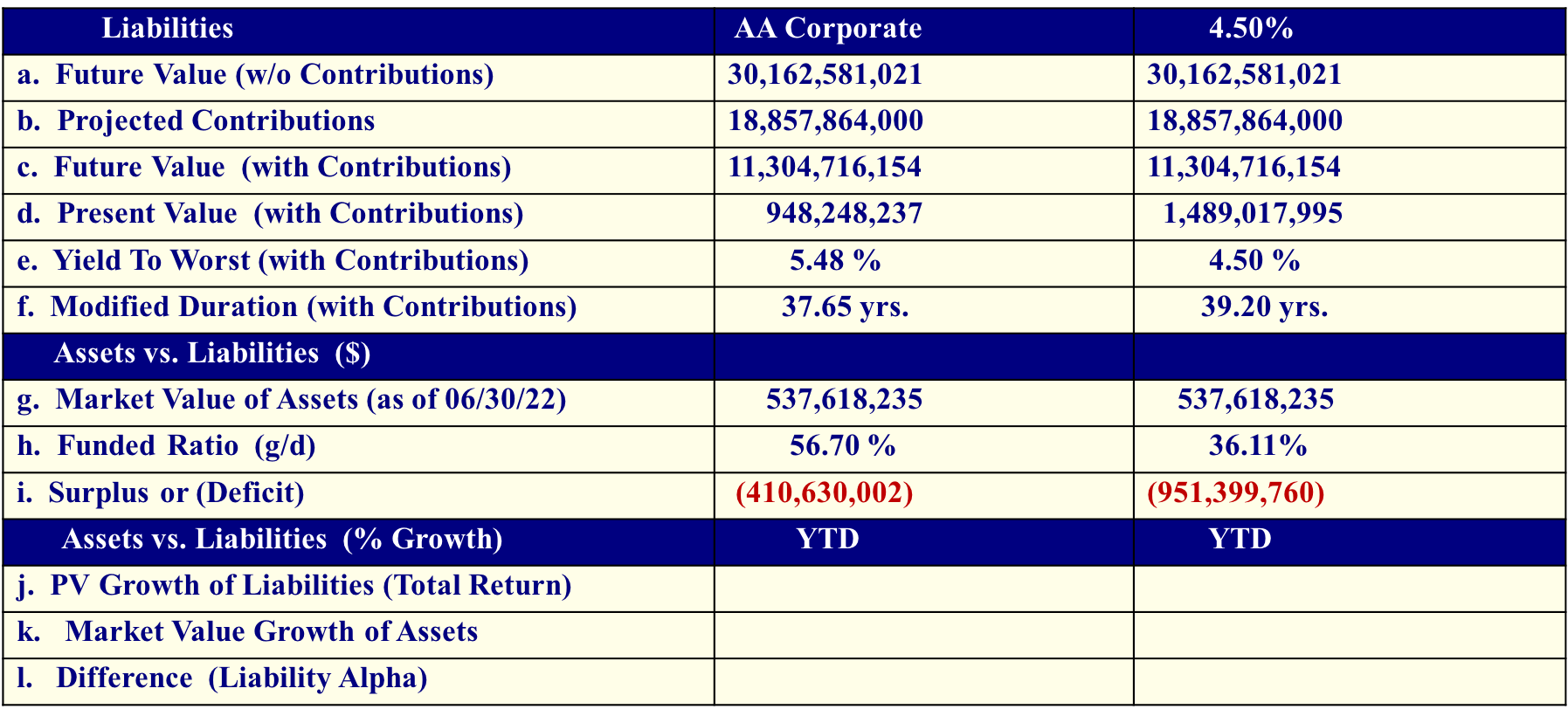
The above information is for an actual client, who we’ve been providing a CLI for 15+ years. This client has elected to receive quarterly reviews. They’ve also chosen to see the impact on liabilities for multiple discount rates, including a constant 4.5% ROA, which could easily be a pension plan’s ROA of say 7%. As you will note, the present value (PV) of those future value (FV) liabilities are different, and they could be dramatic, depending on the interest rate used. In this case, the AA Corporate rate (5.48% YTW) produces a funded ratio of 56.7%, while the flat 4.5% rate increases the PV liabilities thus reducing the funded status by more than 20%.

Using Treasury STRIPS as the discount rate produces the lowest funded ratio of 33.7% or 23% lower than using the AA Corporate discount rate.

With this information, plan sponsors and their advisors (consultants and actuaries) can make informed decisions related to contributions and asset allocation. Most plan sponsors are currently blind to these facts. As a result, decisions may be taken without having all of the necessary facts. Pension plans need to be protected and preserved (Ryan ALM’s mission). Having a complete understanding of what those future promises look like is essential.

You’ve made a promise: measure it – monitor it – manage it – and SECURE it…   

Get off the pension funding rollercoaster – sleep well!

Corporate Funding Improves in March – Milliman

By: Russ Kamp, Managing Director, Ryan ALM, Inc.

Milliman released the results of its latest Milliman 100 Pension Funding Index (PFI), which analyzes the 100 largest U.S. corporate pension plans. Pension funding improved for the third consecutive month to start the year, which now stands at 105.6% from 105.3% at the end of February. March was a bit different, however, as the discount rate declined 11 basis points increasing the collective liabilities by $14 billion to $1.299 trillion at the end of the quarter. Despite the increase in liabilities, investment performance was once again strong leading to a gain of $19 billion. Total assets now stand at $1.373 trillion.

Zorast Wadia, author of the PFI, stated, “the funded status gains may dissipate unless plan sponsors adhere to liability-matching investment strategies. Zorast’s observation is outstanding. Should rates fall from these levels, the cost to defease pension liabilities will grow. Now is the time to take risk off the table. Create certainty by getting off the asset allocation rollercoaster. Engaging in Cash Flow Matching (CFM) does not necessitate being an all or nothing strategy. Start your cash flow matching mandate and extend it as the funded status improves.

Return-seeking bond strategies will lose in an environment of rising rates. However, once a plan engages in CFM, the relationship between plan assets and liabilities is locked. Done correctly, assets and liabilities will move in tandem. It doesn’t matter what interest rates do, as benefit payments are future values that are not interest rate sensitive.

Act now to create some certainty! You’ll appreciate the great night’s sleep that you’ll start to have.

Ryan ALM, Inc. Pension Monitor Q1’24

By: Russ Kamp, Managing Director, Ryan ALM, Inc.

We are pleased to share with you the Ryan ALM, Inc. Q1’24 pension monitor. This quarterly report compares different liability growth rates (based on a 12-year average duration) versus the asset growth rate for public, multiemployer, and corporate funds based on the P&I asset allocation survey of the top 1,000 plans which is updated annually.

With regard to Q1’24, Public pension funds (2.2%) underperformed Corporate Pension plans (3.7%) by 1.5% as ASC 715 discount rates showed a negative growth rate of -1.5% for Q1’24 while the discount rate using the average ROA (GASB accounting) would have appreciated by 1.8%. This outperformance by corporate pension plans was accomplished despite the much greater exposure to US fixed income within corporate pension plans (45.4%) versus both public (18.7%) and multiemployer (18.2%) and the far less exposure to US equities (12.6%) versus publics (21.9%) and multiemployer (22.2%).

Please don’t hesitate to reach out to us with any questions that you might have regarding this monitor.

Future Contributions Into A DB Plan Should Be Considered An Asset Of The Fund

Recently, Mary Williams Walsh, NY Times, penned an article titled,

“Standards Board Struggles With Pension Quagmire”.

The gist of the article had to do with what role did the actuaries and actuarial accounting play in the current state of public pension funding. Many of the actuaries felt that they were pressed by politicians into reverse-engineering their calculations to achieve a predetermined result (contribution cost). “That can’t be good public policy,” said Bradley D. Belt, a former pension regulator, who is now the vice chairman of Orchard Global Capital Group.

According to Ms. Walsh, “he called for additional disclosures by states and cities, including the current value of all pensions promised, calculated with a so-called risk-free discount rate, which means translating the future benefits into today’s dollars with the rate paid on very safe investments, like Treasury bonds.”

Actuaries currently use higher discount rates, which complies with their professional standards but flies in the face of modern asset-pricing theory. Changing their practice to resolve this is one of the most hotly contested proposals in the world of public finance, because it would show the current market value of public pensions and probably make it clear that some places have promised more than they can deliver.

But, if we are going to require DB plans to mark-to-market their fund’s liabilities, inflating future promised benefits, we should also include future contributions as an asset of the plan. Since many, if not most plans, have a legal obligation to fund the plan at an actuarial determined level or through negotiations, these contributions are likely to be made (NJ is one of the exceptions).

When valuing liabilities at “market” without taking into consideration future contributions, plans are artificially lowering their funded ratio, while negatively exacerbating their funded status. Most individuals (tax payers) would not understand the “accounting”, but they would certainly comprehend the negative publicity of a < 50% funded plan.

Most public pension plans derive a healthy percent of their assets through contributions.  Not reflecting these future assets in the funded ratio creates the impression that these funds are not sustainable, which for most public plans is not close to reality.

We need DB plans to be the backbone of the US retirement industry. Only marking to market liabilities without giving a nod to future contributions doesn’t fairly depict the whole story. We can do better.

KCS Second Quarter 2015 Update

We are pleased to share with you the KCS Second Quarter Update.  As we previously reported through this blog, 2015 has been a better year for pension funding than 2014 was despite the lower market returns, as interest rates have backed up creating a negative growth rate for plan liabilities.  We hope that you find our update insightful. Have a wonderful day.

Click to access KCS2Q15.pdf

Market Volatility Giving You The Woollies?

I’ve witnessed many market declines during my more than 33 years in the investment industry, and I would be lying if I told you that I called the beginning, end, and ultimate magnitude of any of the sell-offs.  Market declines are part of the investing game.  But just knowing that isn’t enough, as unfortunately, they can have a profound impact on retirement plans and retirement planning, both institutional and individual, as they impact the psyche of the investors.

It is well documented how individuals tend to buy high and sell low. The market crash of 2007 – 2009 drove many individuals out of equities at or near the bottom, and many of those “investors” have kept their allocations to equities below 2007 levels. It hasn’t been that much better for the average institutional investor either.  We are aware of a number of situations (NJ for one) that plowed into expensive, absolute-return product at the bottom of the equity market only to see that portfolio dramatically underperform very inexpensive beta, as the equity markets have rallied since March 2009.

In some cases, the selling “pressure” was the result of liquidity needs, which lead to the tremendous explosion in the secondary markets for private equity, real estate, etc. in 2009.  The E&F asset allocation model, made so famous by Yale, was the undoing for many retirement plans, as the failure to secure adequate liquidity exacerbated market losses. Who knows whether the turmoil in Greece will lead to their exit (expulsion) from the Euro, but there is certainly heightened fear and volatility in the global markets? Are you currently prepared to meet your liquidity needs?

As we’ve discussed within both the Fireside Chats and on the KCS blog, the development of a hybrid asset allocation model geared specifically to your plan’s liabilities, can begin to de-risk your plan, while dramatically improving liquidity.  The introduction of the beta / alpha concept will provide plan sponsors with an inexpensive cash matching strategy that meets near-term benefit needs, while extending the investing horizon for the less liquid investments in your portfolio. By not being forced to sell into the market correction, your investments have a greater chance of rebounding when the market settles.

Traditional asset allocation models subject the entire portfolio to market movements, while the beta / alpha approach only subjects the alpha assets to volatility.  But, since one doesn’t have to sell alpha assets to meet liquidity needs given that the beta portfolio is used for that purpose, the volatility doesn’t matter. Don’t fret about Greece and its potential implications for the global markets and your plan. Let us help you design an asset allocation that improves liquidity, extends the investment horizon for your alpha assets, and begins to de-risk your plan, as the funded ratio and status improve.