Nothing Here! Really?

By: Russ Kamp, CEO, Ryan ALM, Inc.

Yesterday’s financial news delivered an inflation surprise (0.5% vs. 0.3%), at least to me and the bond market, if not to the U.S. equity market. The Federal reserve had recently announced a likely pause in their rate reduction activity given their concerns about the lack of pace in the inflation march back to its 2% target. This came on the heels of “Street” expectations after the first 0.5% cut in the FFR that there were “likely” to be eight (8!) interest rate cuts by the summer of 2025. Oh, well, the two cuts that we’ve witnessed since that first move last September may be all we get for a while. “Ho hum” replied the U.S. stock market.

The discounting of yesterday’s inflation release is pretty astounding. Like you, I’ve read the financial press and the many emails that have addressed the CPI data 52 ways to Sunday. Much of the commentary proclaims this data point as a one-off event. For instance, the impact of egg price increases (13.8% last month alone) is temporary, as bird flu will be contained shortly. Seasonal factors impacting “sticky-priced” products tend to be announced in January. I guess those increases shouldn’t matter since they only impact the consumer in January. As a reminder, Core inflation (minus food and energy) rose from 3.1% to 3.3% last month. That seems fairly significant, but we are told that the other three core readings were down slightly, so no big deal. Again, really? Each of those core measures are >3% or more than 1% greater than the Fed’s target.
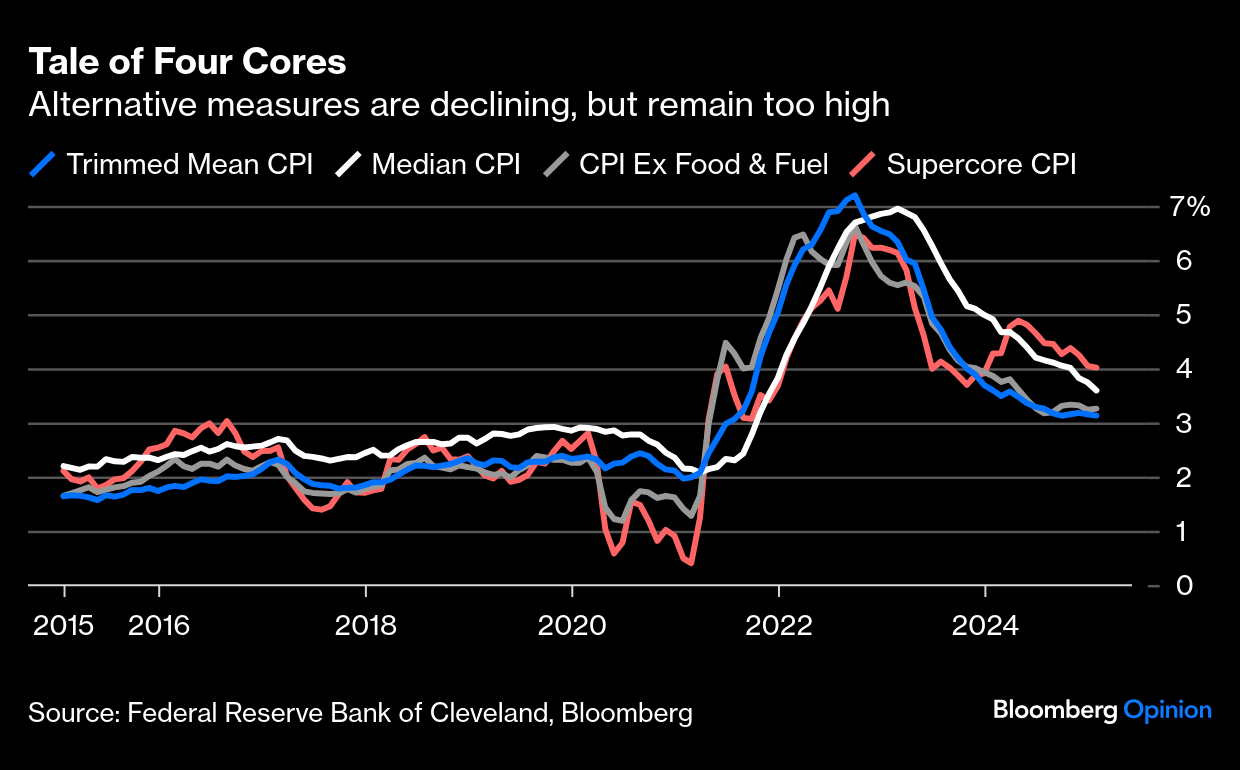
Then there are those that say, “what is significant about the Fed’s 2% inflation objective anyway”? It is an arbitrary target. Well, that may be the case, but for the millions of Americans that are marginally getting by, the difference between 2% and 3% inflation is fairly substantial, especially when we come up with all of these measures that exclude food, energy, housing (shelter), etc. Are you kidding?
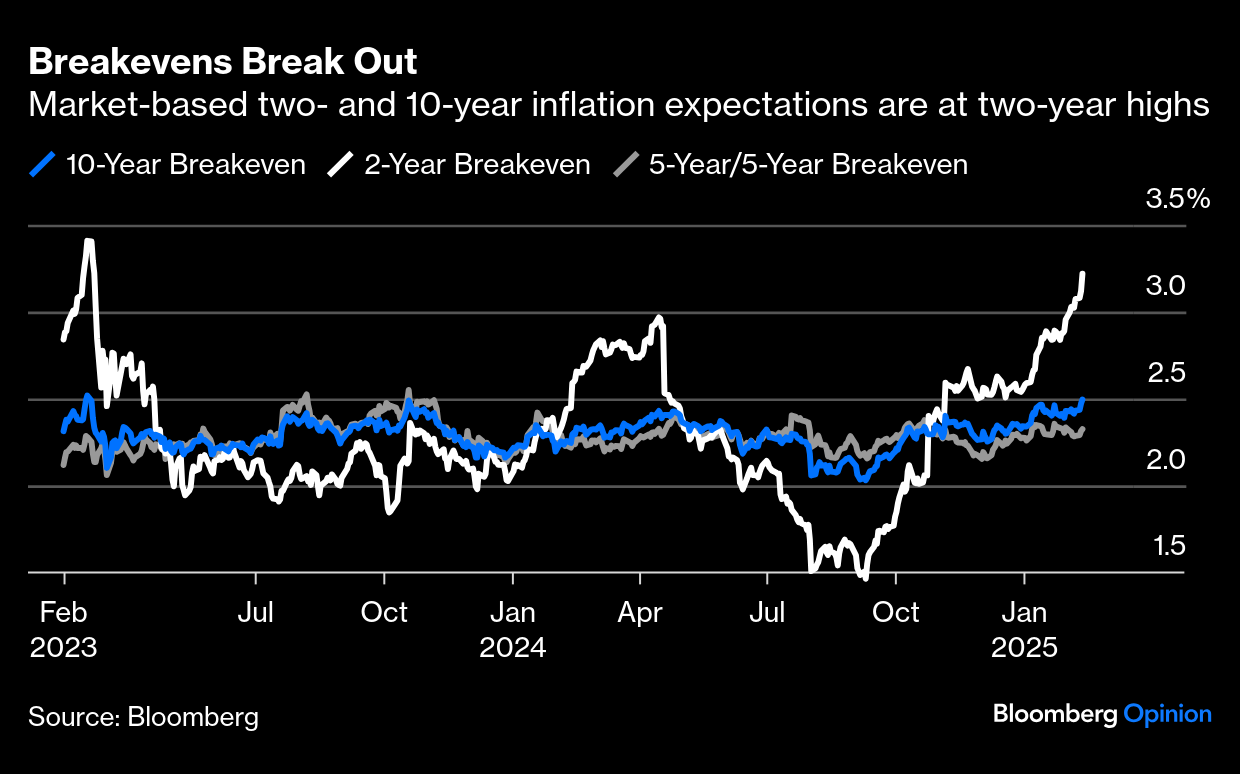
As mentioned previously, expectations for a massive cut in interest rates due to the perception that inflation was well contained have shifted dramatically. Just look at the graph above (thanks, Bloomberg). Following the Fed’s first FFR cut of 50 bps, inflation expectations plummeted to below 1.5% for the two-year breakeven. Today those same expectations reveal a nearly 3.5% expectation. Rising inflation will certainly keep the Fed in check at this time.

As mentioned earlier in this post, U.S. equities shrugged off the news as if the impact of higher inflation and interest rates have no impact on publicly traded companies. Given current valuations for U.S. stocks, particularly large cap companies, any inflation shock should send a shiver down the spines of the investing community. Should interest rates rise, bonds will surely become a more exciting investment opportunity, especially for pension plans seeking a ROA in the high 6% area. How crazy are equity valuations? Look at the graph below.
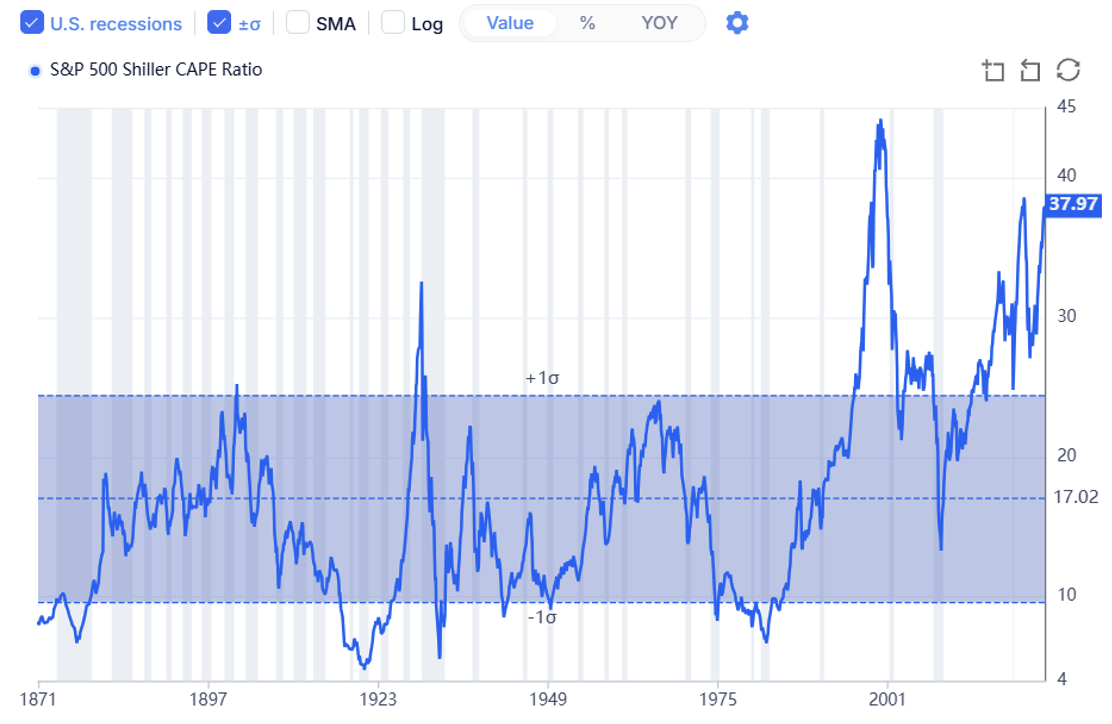
The current CAPE reading has only been greater during the late 1990s and we know what happened as we entered 2000. The bursting of the Technology bubble wasn’t just painful for the Information Technology sector. All stocks took a beating. Should U.S. interest rates rise as a result of the current inflationary environment, there is a reasonable (if not good) chance that equities will get spanked. Why live with this uncertainty? It is time to get out of the game of forecasting economic activity. Why place a bet on the direction of rates? Why let your equity “winnings” run? As a reminder, managing a DB pension plan should be all about SECURING the promised benefits at a reasonable cost and with prudent risk. Is maintaining the status quo prudent?


That’s comforting!

By: Russ Kamp, Managing Director, Ryan ALM, Inc.

The Fed’s meeting notes from the September 17-18 FOMC have recently been released. Here are a few tidbits:

Some officials warned against lowering rates “too late or too little” because this risked harming the labor market.

At the same time, other officials said cutting “too soon or too much” might stall or reverse progress on inflation.

Here’s my favorite:

Officials also don’t seem in agreement over how much downward pressure the current level of the Fed’s benchmark rate was putting on demand.

I have an idea, why don’t we just have each member of the Federal Reserve’s board of governors stick their finger in the air and see which way the economic winds are blowing. It may be just as effective as what we currently seem to be getting.

Given that the economy continues to hum along with annual GDP growth of roughly 3% and “full employment” at 4.1%, I’d suggest that having a Fed Funds Rate at 5.25%-5.50% wasn’t too constraining, if constraining at all. We’ve highlighted in this blog on many occasions the fact that US rates had been historically higher for extended periods in which both the economy and markets (equities) performed exceptionally well – see the 1990’s as one example.

Furthermore, as we’ve also highlighted, there is a conflict between current fiscal and monetary policy, as the fiscal 2024 federal deficit came in at $1.8 trillion or about $400 billion greater than the anticipated deficit at the beginning of the year. That $400 billion is significant extra stimulus that leads directly to greater demand for goods and services. How likely is it that the fiscal deficit for 2025 will be any smaller?

I believe that there are many more uncertainties that could lead to higher inflation. The geopolitical risks that reside on multiple fronts seem to have been buried at this time. Any one of those conflicts – Russia/Ukraine, Israel/rest of the Middle East, and China/Taiwan – could produce inflationary pressures, even if it just results in the US increasing the federal budget deficit to support our allies.

If just sticking one’s finger in the air doesn’t help us solve our current confusion, there is always this strategy:

We Suggested That It Might Just Be Overbought

By: Russ Kamp, Managing Director, Ryan ALM, Inc.

Regular readers of this blog might recall that on September 5th we produced a post titled, “Overbought?” that suggested that bond investors had gotten ahead of themselves in anticipation of the Fed’s likely next move in rates. At that time, we highlighted that rates had moved rather dramatically already without any action by the Fed. Since May 31, 2024, US Treasury yields for both 2-year and 3-year maturities had fallen by >0.9% to 9/5. By almost any measure, US rates were not high based on long-term averages or restrictive.

Sure, relative to the historically low rates during Covid, US interest rates appeared inflated, but as I’ve pointed out in previous posts, in the decade of the 1990s, the average 10-year Treasury note yield was 6.52% ranging from a peak of 8.06% at the end of 1990 to a low of 4.65% in 1998. I mention the 1990s because it also produced one of the greatest equity market environments. Given that the current yield for the US 10-year Treasury note was only 3.74% at that point, I suggested that the present environment wasn’t too constraining. In fact, I suggested that the environment was fairly loose.

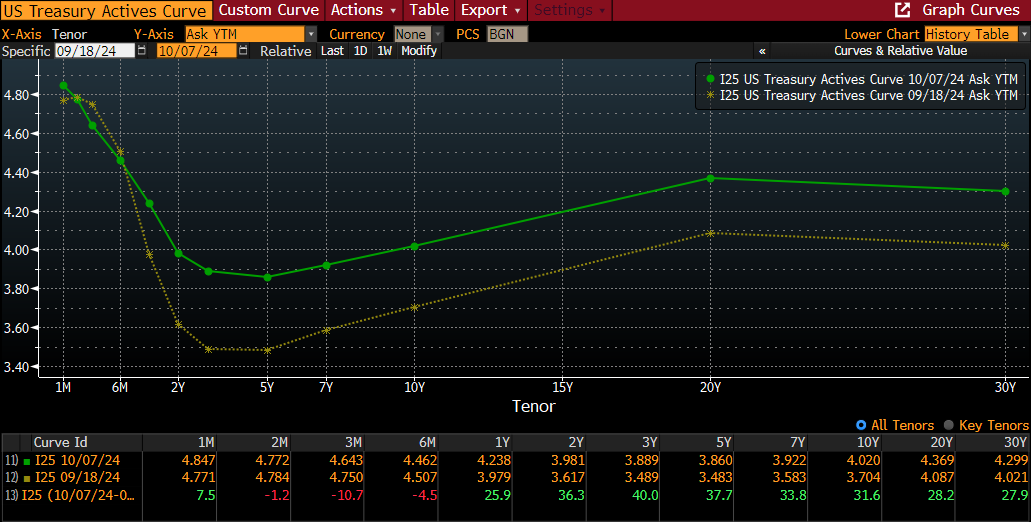
Well, as we all know, the US Federal Reserve slashed the Fed Funds Rate by 0.5% on September 18th (4.75%-5.0%). Did this action lead bond investors to plow additional assets into the market driving rates further down? NO! In fact, since the Fed’s initial rate cut, Treasury yields have risen across the yield curve with the exceptions being ultra-short Treasury bills. Furthermore, the yield curve is positively sloping from 5s to 20s.

Again, managing cash flow matching portfolios means that we don’t have to be in the interest rate guessing game, but we are all students of the markets. It was out thinking in early September that markets had gotten too far ahead of the Fed given that the US economy remained on steady footing, the labor market continued to be resilient, and inflation, at least sticky inflation, remained stubbornly high relative to the Fed’s target of 2%. Nothing has changed since then except that the US labor market seems to be gaining momentum, as jobs growth is at a nearly 6-month high and the unemployment rate has retreated to 4.1%.

There will be more gyrations in the movement of US interest rates. But anyone believing that the Fed and market participants were going to drive rates back to ridiculously low levels should probably reconsider that stance at this time.

A Little History Lesson is in Order

By: Russ Kamp, Managing Director, Ryan ALM, Inc.

I continue to be surprised by the constant droning that US interest rates are too high and financial conditions are too tight. Compared to what? If the reference point is Covid-19 induced levels then you are probably right, but if the comparison is to almost any other timeframe then those proclaiming that the sky is about to fall should refer to one of the greatest decades for equities in my lifetime – the 1990s. I think most investors would agree that the 1990s provided a nearly unprecedented investing environment. One in which the S&P 500 produced an 18.02% annualized performance.

Was the economic environment of the 1990s so much better than today’s? Heck no, but let’s take a closer look. The average 10-year Treasury note yield was 6.52% ranging from a peak of 8.06% at the end of 1990 to a low of 4.65% in 1998. Given that the current yield for the US 10-year Treasury note is 4.56%, I’d suggest that the present environment isn’t too constraining. Furthermore, let’s look at the employment picture from the ’90s. If US rates aren’t high by 1990 standards, unemployment must have been very low. You’d be wrong if that was your guess. In fact, unemployment in the US ranged from 7.5% at the end of 1992 to a low of 4.2% in 1999. For the decade, we had to deal with an average of 5.75% unemployment. Today, we sit with a 3.9% unemployment rate. That level doesn’t seem too constraining, and initial unemployment claims remain quite modest.

So, current US interest rates and unemployment look attractive versus what we experienced during the ’90s. It must be that economic growth was incredibly robust to support such strong equity markets. Well, again you’d be wrong. Sure economic growth averaged 3.2% during the decade, but the Atlanta Fed’s GDPNow model is forecasting a 3.5% growth rate currently for Q2’24. This comes on the heels of a rather surprising 2023 growth rate. What else could have contributed to the 1990’s successful equity market performance that isn’t evident today? How about fiscal deficits? Perhaps the US annual deficit during the ’90s contributed significant stimulus which would have led to enhanced demand for goods and services?

I don’t think that was the case either, as the cumulative US fiscal deficit of $1.336 trillion during the 1990s, including surpluses in 1998 and 1999, is roughly $400 billion less than that which occurred in fiscal 2023 and what is predicted for 2024. Oh, my. The largest fiscal deficit during the 1990s was only $290 billion. That’s equivalent to about 2 months-worth today.

I’m confused, the 1990s produced an incredible equity market despite higher rates, higher unemployment, lower GDP growth, and little to no fiscal stimulus provided by deficit spending, yet today’s environment is constraining? Come, on. Inflation remains sticky. The American worker is enjoying (finally) some real wage growth and is gainfully employed. Rates are not too high by almost any reasonable comparison. US GDP growth is forecasted to be >3%. Where is the recession? Fiscal stimulus continues to be in direct conflict with the Fed’s monetary policy. Something that those investing during the 1990s didn’t need to worry about. Taken all together, is 2024’s environment something to be concerned about, especially relative to what transpired in the 1990s? Should the Fed be looking to reduce rates? I’ll be quite surprised if they come to that conclusion anytime soon.

What’s The Hurry?

By: Russ Kamp, Managing Director, Ryan ALM, Inc.

“Fed To Cut Rates in September, Say Nearly Two-thirds of Economists.”

This pronouncement was in large bold font on an email that I received this morning from the Wealth Advisor. Should I be skeptical? You bet!!

As you may recall, there was near unanimity among “economists” late last year that the US Federal Reserve would begin reducing rates RAPIDLY as the calendar flipped to 2024. In fact, consensus was fairly strong that there were going to be 4-6 cuts of between 1.0%-1.5%. There was even a leading bank that saw the need to reduce rates by 2.5% – oh, my. What happened? At this time I’m particularly interested in the 1/3 of economists that were predicting huge cuts at the end of 2023 that aren’t buying a September cut at this time. Those are the ones that I want to hear from.

What has changed from late last year when the labor market was strong, inflation was sticky, economic growth was stronger than expected, the stock market was raging ahead, and fiscal policy was in direct conflict with the Fed’s monetary objectives? Nothing has changed!

What is the urgency to cut rates? The Atlanta Fed’s GDPNow model is predicting a 4.2% annualized growth rate for Q2’24 (latest update as of May 8th). Does a growth rate of that magnitude warrant a rate cut? Heck no! Yes, there is the issue that most of today’s investors don’t remember the 1970s, if they were even born, but I do. Fed missteps lead directly to incredibly high inflation and US interest rates. Today’s rate environment is nothing compared to that era. Why risk a repeat? Stagflation became a reality. Is that something that you want to witness again?

Seniors and those living on a fixed income can finally earn some interest on their investments without having to dive into strategies that they don’t understand just to earn a little more interest. Pension plans can finally use fixed income to secure some or all of their promises to plan participants by matching bond cash flows of interest and principal with pension liabilities (benefits and expenses). Endowments and foundations can invest more cautiously knowing that they can earn a return from less risky assets that will help them achieve a return commensurate with their spending policy. This is all good stuff! Use this environment to take some of your assets off the asset allocation rollercoaster before our capital markets reach the apex of their journey. The next downward trajectory could be a doozy!