“Peace of Mind” – How Beneficial Would That Be?

By: Russ Kamp, Managing Director, Ryan ALM, Inc.

As a member of the investment community do you often feel stressed, worried, insecure, uneasy, or are you just simply too busy to be at peace? In the chaotic world of pension management, finding peace of mind can sometimes be hard, if not impossible. How much would it mean to you if you could identify an investment strategy that provides you with just that state of being?

At Ryan ALM, Inc. our mission is to protect and preserve DB pension plans through a cash flow matching (CFM) strategy that ensures, barring any defaults, that the liabilities (benefits and expenses) that YOU choose to cover are absolutely secured chronologically. You’ll have the liquidity to meet those obligations in the amounts and at the time that they are to be used. There is no longer the worry and frustration about finding the necessary “cash” to meet those promises. CFM provides you with that liquidity and certainty of cash flows.

Furthermore, you are buying time for the growth (alpha or non-bond) assets to now grow unencumbered, as they are no longer a source of liquidity. You don’t have to worry about drawdowns, as the CFM portfolio creates a bridge over the challenging markets with no fear of locking in losses due to cash flow needs. Don’t you just feel yourself nodding off with the knowledge that there is a way to get a better night’s sleep?

How much would you “spend” to achieve such peace of mind? Most pension systems cobble together disparate asset classes and products, many which come with hefty price tags, in the HOPE of achieving the desired outcome. With CFM, YOU choose the coverage period to be defeased, which could be as short as 3-5 years or as long as it takes to cover the last liability. The longer the time horizon the greater the potential cost reduction. As an FYI, most of our clients have chosen a coverage period of roughly 10-years. Knowing that you have SECURED your plan’s obligations for the next 10-years, and locked in the cost reduction, which can be substantial (2% per year = 20% for 1-10 years), on the very first day in which the portfolio is constructed, has to be just an incredible feeling compared to living in an environment in which traditional pension asset allocations can have significant annual volatility and no certainty of providing either the desired return or cash flow when needed.

Remember, the amount of peace of mind is driven by your decisions. If you desire abundant restful nights, use CFM for longer timeframes. If you believe that you only need “peace of mind” in the near-term, engage a CFM strategy for a shorter 3-5 years. In any case, I guarantee that the pension plan’s exposure to CFM won’t be the reason why you are restless when you put your head on the pillow. Oh, and by the way, we offer the CFM strategy at fee rates that are substantially below traditional fixed income strategies, let alone, non-bond capabilities. Call us. We want to be your sleep doctor!

Another Example of the Games That Are Played

By: Russ Kamp, Managing Director, Ryan ALM, Inc.

I continue to be involved in programs associated with the Florida Public Pension Trustees Association (FPPTA) for which I remain quite grateful. If you’ve been exposed to their conferences, you know that they do a terrific job of bringing critical education to Florida’s trustee community and have since its founding in 1984. I’m pleased to highlight an expansion of their program to include the Trustee Leadership Council (TLC). This program brings together a small collection of experienced trustees who want to delve more deeply into the workings of defined benefit pensions – both assets and liabilities. Furthermore, the instruction is mostly done through case studies that provide them with the opportunity to roll up their sleeves and really get into the nitty gritty of pension management. Great stuff!

I could go on for days about the FPPTA and their programming, but I want to raise another issue. During a recent conversation with the TLC leadership, information was shared from one particular case study (a non-Florida-based pension plan). This information was for a substantial public pension plan that has had a troubling past from a funding standpoint. We also had info shared from a much smaller Florida-based system. There appeared to be a stark difference in performance of these two systems, as measured by the funded ratios, with a particular focus on 2022’s results. Upon further review, the one actuarial report used a 10-year smoothing for the funded ratio, while the Florida plan highlighted the performance for just 2022 and the impact that had on that plan’s funded ratio. As you can imagine, given the very challenging return environment in 2022, funded ratios took a hit. Question answered!

However, in looking at the actuarial report for the larger system, I saw that 2023’s funded ratio dramatically improved from the depths of 2022’s hit. It seemed outsized given what I knew about the environment that year. Diving a little deeper into the report – is there anything drier than an actuarial report – I found information related to a change in the discount rate that had occurred during 2023. It seems that this system had come up with its own funding method, but that was going to lead to the system becoming insolvent relatively soon. As a result, they passed legislation mandating that future contributions were going to be determined on an actuarial basis. How novel!

As a result of the move from a 4.63% blended rate (used a combination of the ROA (7%) and a municipal rate) they have now adopted a straight 7% discount rate equivalent to the fund’s return on asset assumption. Here is the result of that action:

As one can see, the present value (PV) of those future promises based on a 4.63% blended rate creates a net pension liability of -$12.8 billion. Using a 7% discount rate creates a PV of those net liabilities of “only ” -$6.7 billion. The dramatic improvement in the funded status from 48.4% to 64.1% is primarily the result of changing the discount rate, as a higher rate reduces the PV of your promise to plan participants. It really doesn’t change the promise, just how you are accounting for it.

The trustees who will participate in the TLC program offered by the FPPTA will receive a wonderful education that will allow them to dive into issues as referenced above. Knowing the ins and outs of pension management and finance will lead to more appropriate decisions related to benefits, contributions, asset allocation, etc.

Good Job, PBGC!

By: Russ Kamp, Managing Director, Ryan ALM, Inc.

Did you know that there exists an oversight body for the Pension Benefit Guaranty Corporation (PBGC)? The 1988 amendments to the Inspector General Act of 1978 created the PBGC Office of the Inspector General (OIG) of the PBGC. They are responsible for providing independent and objective audits, inspections, evaluations, and investigations to help Congress, the PBGC Board of Directors, and the PBGC itself to protect pension benefits for both multiemployer and private plans.

The latest report, covering the period April 1-September 30, 2024, has been sent to Congress. The PBGC has received mostly positive results. As a reminder, the PBGC ensures the pension benefits of more than 31 million American workers and retirees who participate in more than 24,500 private-sector pension plans through its single-employer and multiemployer insurance programs. Quite the effort!

Furthermore, as regular readers of this blog know, the PBGC has been engaged since 2021 in implementing the Special Financial Assistance (SFA) program, that was housed in the ARPA legislation. As of September 30, 2024, the report highlights the following stats regarding the PBGC’s effort:

  • received 165 SFA applications requesting $76 billion;
  • approved 127 of the SFA applications; (includes supplemental applications of which there were 35)
  • provided $68 billion in SFA; and
  • was reviewing 22 SFA applications, requesting a total of $2.5 billion.

One area of concern, which seems to have been corrected, was the census data possibly being wrong in the various applications leading to overpayment of SFA grants. According to the OIG report, there could be incorrect census data on applications leading to as much as $250 million in overpayments. To date, the PBGC has recouped $144 million from 19 plans. This sum is a small percentage (<0.5%) of what has been paid out to date.

The OIG says it “determined that the PBGC’s SFA procedures were generally sufficient to ensure that increases in projected benefit payments were (1) consistently identified, (2) evaluated against appropriate criteria, and (3) documented. In addition, the OIG reports that the PBGC responded to its findings and recommendations regarding the SFA program, which is says has significantly improved the PBGC’s SFA procedures.”

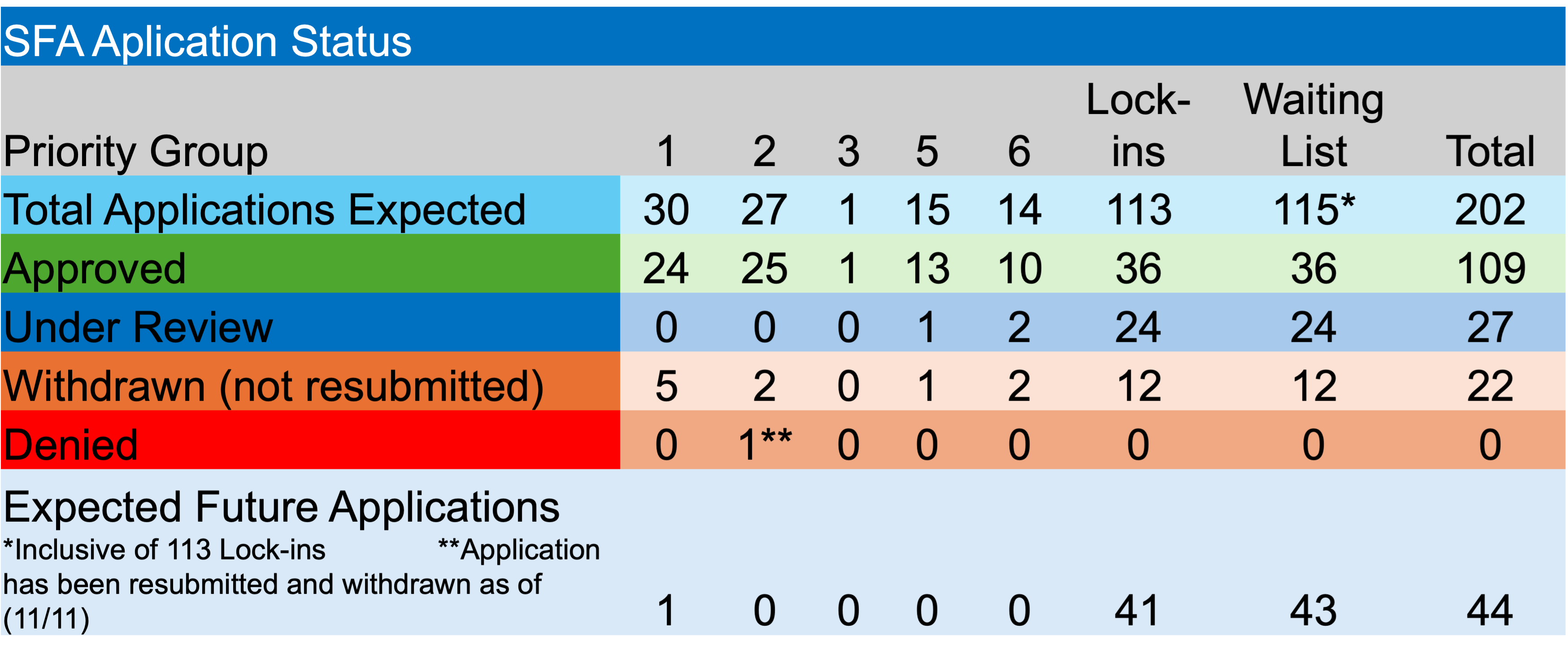
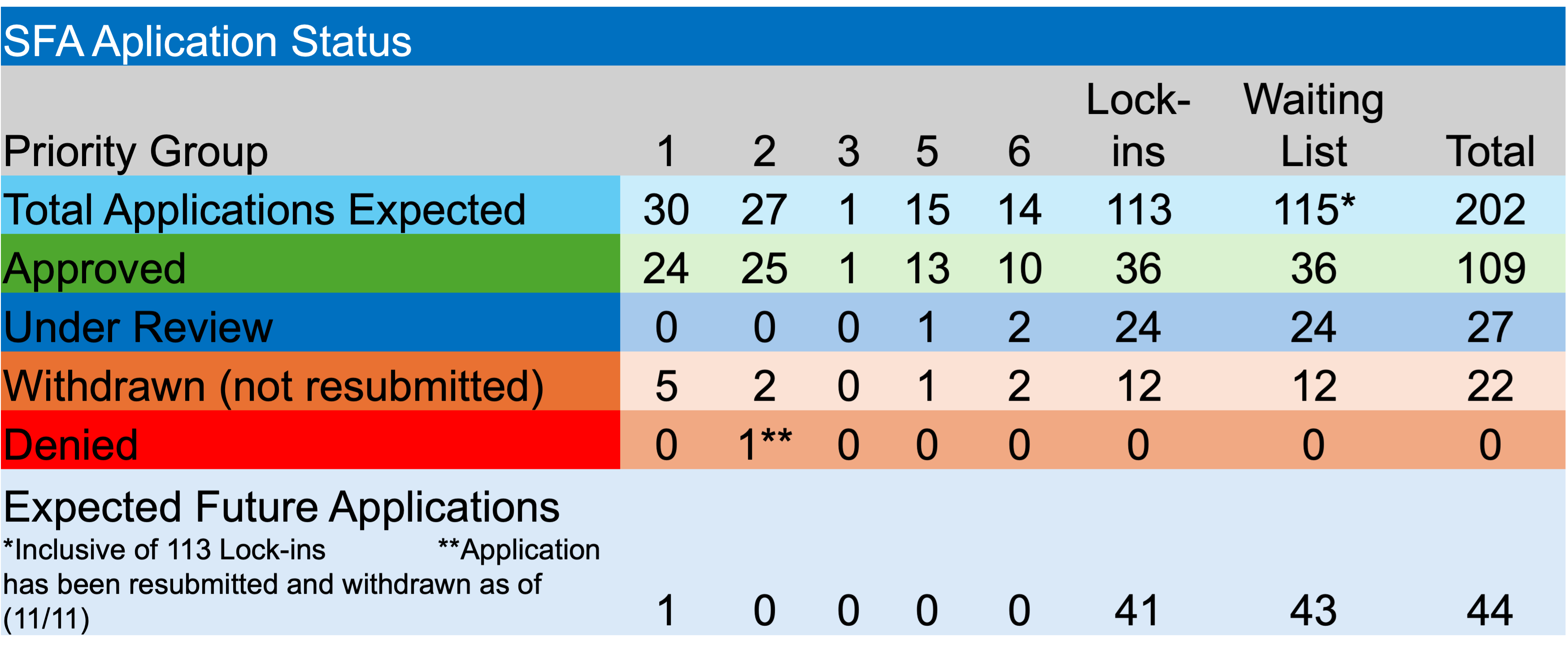
According to our analysis, there are potentially 202 applicants seeking SFA grants. With 102 funds having received approval to date, there remains much work is left to be done. There is no time to sit on one’s laurels!

ARPA Update as of November 29, 2024

By: Russ Kamp, Managing Director, Ryan ALM, Inc.

We hope that you had a very enjoyable holiday weekend. Welcome to December. That doesn’t seem possible.

Despite the holiday shortened week, the PBGC was quite busy, announcing that four multiemployer plans had submitted applications seeking Special Financial Assistance (SFA). Those funds included Laborers’ Local No. 91 Pension Plan, Southwestern Pennsylvania and Western Maryland Area Teamsters and Employers Pension Fund, Oregon Processors Seasonal Employees Pension Plan, and The Legacy Plan of the UNITE HERE Retirement Fund. Local 91’s application was its initial attempt at getting the SFA, while the other three submitted revised applications. In total, these four are seeking a total of just over $1 billion for the 102,356 plan participants. A significant majority of the assets being requested and plan members are in the UNITE HERE fund.

With regard to the Teamsters’ plan, they withdrew and then resubmitted the application on November 27th. That plan is hoping to receive $120.7 million in SFA for the 2,759 members of its fund. In other news, two funds received approval for their applications, including Lumber Industry Pension Plan and Local 1034 Pension Plan. Both plans had submitted revised applications. In total, they will get $159.6 million in SFA and interest for 7,155 plan participants. I suspect that the announcement of a successful PBGC approval made for a wonderful Thanksgiving celebration.

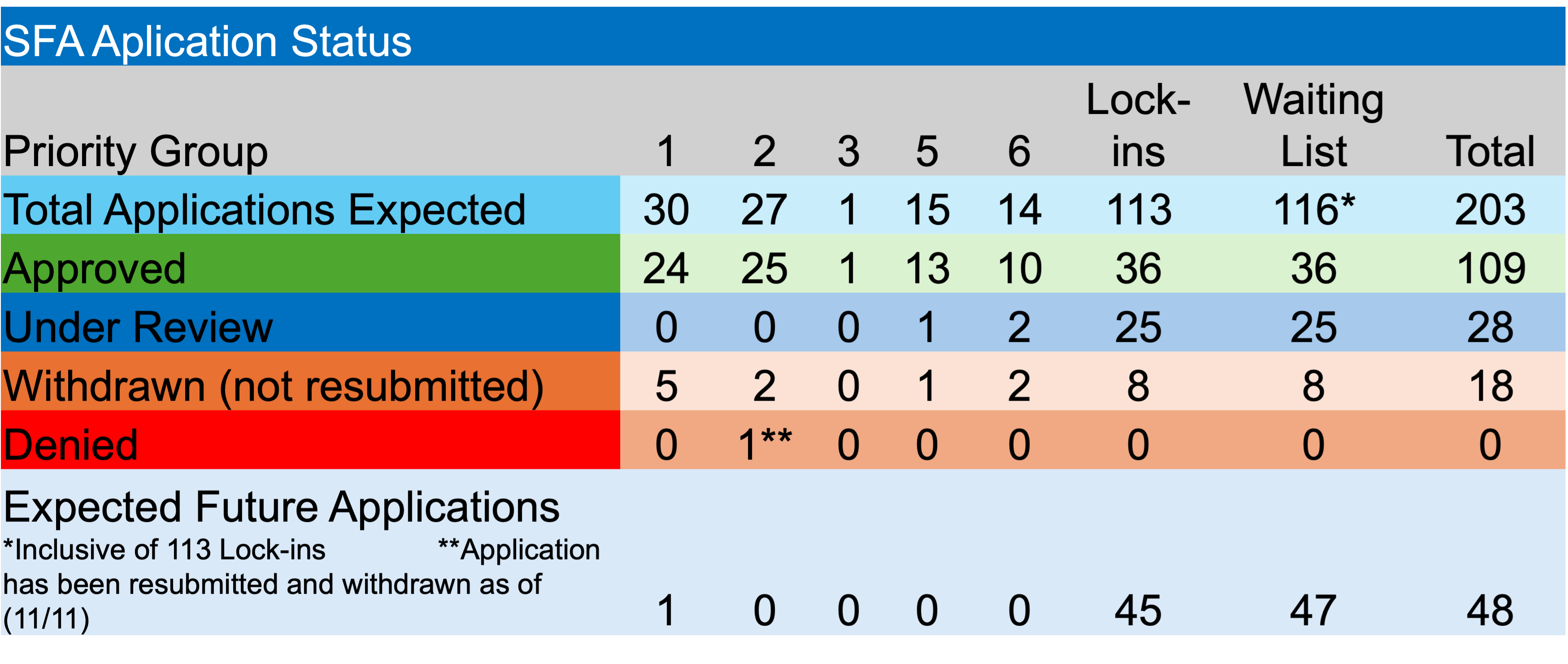
Finally, there were no applications denied, no funds repaid excess SFA, and no plans sought to be added to the waitlist at this time, which continues to list 53 non-priority plans that have not yet been allowed to submit an initial application.

The two plans that received approval for the SFA last week brings to 102 the number of plans that have been awarded SFA grants ($69.7 billion) since the program launched in July 2021. There are still 100 plans that may be eligible to receive this special financing.

Happy Thanksgiving to You and Yours!

By: Russ Kamp, managing Director, Ryan ALM, Inc.

I want to wish you and yours a Happy Thanksgiving holiday from my family and me. May the beginning of this holiday season be truly memorable! I wish that I could thank each person individually who has played such an important and meaningful role in who I am today, but there are just so many. THANK YOU! Your support and encouragement have been amazing.

As a nation, we are blessed in so many ways, but there are many among us who are in need of assistance at this time. During this holiday season, let us ALL strive to do just a little more to help our family members, friends, neighbors, and perfect strangers overcome their unique challenges.

In 1863, President Abraham Lincoln proclaimed that a day should be set aside to reflect on all our blessings. Lincoln saw the reason for thanks despite trying times (the country was in the grip of the Civil War). Given the challenging times that many in our country have faced this year (illness, fires, floods, hurricanes, poverty, etc.), a day such as Thanksgiving is critically important for all of us to reflect on how truly fortunate we are. Let us collectively make tomorrow better for all and as good as possible!

These are Essential Programs!

By: Russ Kamp, Managing Director, Ryan ALM, Inc.

I initially posted most of these thoughts directly on LinkedIn.com yesterday, but the message seems to have struck a chord with a good number of my contacts. Glad to see that we are of a similar mindset. Putting this out on my blog is one way to record my thoughts (I’ve now published 1,509 posts) and refer back when appropriate to do so. Here is yesterday’s post.

I received an email from Seeking Alpha this morning that discussed priorities under the new Department of Government Efficiency (DOGE), with the mandate to “cut the federal government down to size.” They began with the following, “the hardest area to tackle has been popular (my emphasis) entitlement programs like Medicare, Medicaid and Social Security,…”

I don’t know about you, but to describe Medicare, Medicaid, and Social Security as “popular” really irked me. These are essential, and often lifesaving, programs counted on by millions of Americans, who, more often than not, have no other place to turn for support. The use of the word “popular” puts these in the same category as my favorite soda, film, song, sports team, etc.

The US enjoys the benefit of a fiat currency and the ability to deficit spend. That “deficit” is an asset of the private sector. The concern should be the enhanced demand for goods and services that is created by this stimulus and not the level of debt. I produced a post on August 24, 2024, called “Social Security and the Misplaced Scare Mongering” in which I wrote it is a fallacy to believe that there exists an “operational constraint on the government’s ability to meet all Social Security payments.”

According to the SSA, 70.6 million Americans are receiving some form of support. I’m sure that most feel that they’ve earned this benefit. Just as I’m sure that workers in the multiemployer plans supported by the ARPA/SFA also feel that they earned the right to collect a monthly pension benefit that was promised. When the private sector isn’t doing enough for Americans, thank God that we have a federal government with the capacity to support us.

Let us NOT compound our daily financial challenges by misunderstanding how our monetary system truly works. Americans deserve much better.

ARPA Update as of November 22, 2024 – #100!!!

By: Russ Kamp, Managing Director, Ryan ALM, Inc.

Welcome to Thanksgiving Holiday week. We wish for you and your family a day filled with love, laughs, and lots of great eating. I wish for myself a TV blackout so that I don’t have to watch the Giants!

We are thrilled to report that the PBGC has approved the Special Financial Assistance (SFA) for the 100th multiemployer plan. Employers’ – Warehousemen’s Pension Plan, a Los Angeles, CA, based non-priority plan will receive $41.4 million in SFA grants and interest for its 1,821 plan participants. The PBGC has now approved grants in the amount of $69.5 billion. By our estimate, there are still 102 funds in the queue to potentially receive an SFA allocation. Clearly, there is much more to do.

In other news from last week, Laborers’ Local No. 265 Pension Plan was permitted to submit a revised application seeking just over $55 million to support its 1,460 members. Rounding out the week, there were no applications denied or withdrawn. There were no excess SFA funds returned. Finally, no pension funds sought to be added to the waitlist, which currently has 58 funds waiting to submit an initial application.

As we enter the Thanksgiving holiday week, let us be incredibly thankful for how beneficial the ARPA legislation has been for the 1,414,505 plan participants who have seen their promised benefits SECURED. For many of these pensioners who were in pension plans on the verge of collapse, the securing of these benefits through the SFA grants has been the difference between supporting oneself or being at the mercy of the Federal social safety net through no fault of their own. The nearly $70 billion may seem like a steep price to pay to some, but it is far less expensive than the cost of a pay-as-you-go system to support those 1.4 million American workers who buy goods and services with their pension checks. We all benefit from that activity. Great job ARPA and the PBGC.

And So It Is!

By: Russ Kamp, Managing Director, Ryan ALM, Inc.

Milliman has released the results for its Public Pension Funding Index (PPFI), which analyzes data from the nation’s 100 largest public defined benefit plans. They are reporting that the collective funded ratio deteriorated during the last month from 82.8% as of September 30th, to 81.2% as of October 31st, as the combined investments of these plans fell for the first time since April. The estimated return for the PFFI was -1.6%, as losses ranged from -2.9% to -0.6%. The $s lost were roughly $80 billion during the month. The funding deficit now stands at about $1.1 trillion.

You may recall that on November 8th, I produced a blog post titled, “Another Inconsistency”, in which I wrote about Milliman’s reporting of its corporate index that highlighted the fact that the collective funded ratio improved during the month despite asset losses due to the fact that liabilities fell to a great extent as interest rates rose.

I also wrote the following, “what do you think will happen in public fund land? Well, given weak markets, asset levels for Milliman’s public fund index will likely fall” (they did, as reported above). “Given that the discount rate for public pension systems is the ROA, there will be no change in the present value of public pension plans’ future benefit obligations (silly). As a result, instead of witnessing an improvement in the collective funded status of public pensions, we will witness a deterioration.” (and we did!) The inconsistency is startling!

Decisions with regards to benefits and contributions are made all the time based on information related to the funded ratio/status of these pension plans. Using different accounting standards clearly produces different outcomes that might just lead to inappropriate conclusions and the subsequent decisions. Oh, boy!

It Doesn’t Have to be This Way

By: Russ Kamp, Managing Director, Ryan ALM, Inc.

The Financial Times (FT) recently published an article highlighting the struggles of Ivy League schools trying to manage liquidity in the face of an extended downturn in the performance of private markets. Collectively, this august group of institutions continues to underperform the average return for higher education endowments of 10.3% for fiscal year 2024, with only 6 of 8 universities outperforming. This follows an even more challenging fiscal 2023 in which all 8 universities failed to top that year’s 6.8% average return. This difficult period in which distributions have dried up considerably, is forcing some, including Princeton, to issue bonds in order to support the operations of the schools. Haven’t we seen this story play out before?

Despite the troubles, there seems to be this reluctance to alter a strategy first adopted nearly four decades ago when Yale began to invest heavily in these strategies. In the article, Roger Vincent, former head of private equity at Cornell University said, “Everybody still believes in having as big an allocation to private equity as possible.” Really? Why? No asset class will always outperform. The problem with private equity at this time is the fact that too much money has chased to few quality deals driving up the costs of acquisition and lowering future returns. In the process, managers have become reluctant to reduce valuations in order to sell these portfolio companies which has crushed liquidity.

As I’ve written on many occasions, assets shouldn’t be lumped into one bucket focused on return either to meet benefit payments, or in this case, a spending policy. There should be two buckets – liquidity and growth. If the Ivies had structured their portfolios with this design in mind, they would have had sufficient liquidity when needed and issuing bonds wouldn’t have been necessary. Endowments and foundations would be well-served to adopt this structure. Liquidity can be managed through a cash flow matching (CFM) process, which will ensure (barring any defaults) that the cash will be on hand monthly, quarterly, and/or annually depending on the needs of the organization.

I’ve witnessed too many times throughout my 40+ year career investment ideas that got overwhelmed by cash flows. We’ve had booms and busts in real estate, equities (Dot Com era), quantitatively managed equities, gold/commodities, emerging markets, Japan, hedge funds, and on and on and… Why would “investors” believe that private equity would be immune to such action? Again, if an investment is deemed to be all weather, money will naturally flow to that “opportunity” thus reducing future prospects. One way to minimize the short-term impact of these cycles is to build in a liquidity strategy that bridges these troubled times.

ARPA Update as of November 15, 2024

By: Russ Kamp, Managing Director, Ryan ALM, Inc.

I can’t believe that Thanksgiving is next week. It appears that the PBGC was motivated to get some things done in anticipation of that holiday, as we witnessed more activity last week than we’ve been seeing in the most recent past.

There were four applications filed last week, including the following pension plans: Roofers and Slaters Local No. 248 Pension Plan, Pension Plan of the Asbestos Workers Philadelphia Pension Fund, Local 1783 I.B.E.W. Pension Plan, and Cement Masons Local Union No. 567 Pension Plan. These plans are not seeking significant sums as far as the SFA goes, as in total they are seeking $92.6 million for 2,637 participants. The IBEW plan out of Armonk, NY submitted a revised application. The other three were the initial filings for these plans.

Pleased to report that Local 360 Labor-Management Pension Plan received approval for its revised application. This fund will receive $30.4 million for the 6,117 members of the plan. This fund initially filed an SFA application in early 2023 only to withdraw it in July 2023. Good for them that they were finally successful in receiving the grant.

Local 810 Affiliated Pension Plan wasn’t as fortunate as Local 360, as they withdrew the initial application that had been seeking $104.1 million for 1,437 members of the plan. In addition to the four new filings, the one withdrawal, and the one approved application, the PBGC also was involved in negotiating two repayment of excess SFA due to census errors. Iron Workers Local 17 Pension Fund
Bricklayers and Allied Craftsmen Local 7 Pension Plan returned $260,471.70 representing only 19 bps of the SFA grants awarded. To date, 25 funds have returned a total of $149.9 million representing 0.38% of the awarded grants.

Recessionary expectations have waned in the last couple of months and flows into bonds, which had been strong for most of the year have recently turned negative. As a result, US interest rates have backed up. It is a great time to secure the promised benefits (and expenses) through cash flow matching strategies. A rising rate environment will be quite bearish for traditional fixed income shops. We’ll be happy to provide you and your fund with a free analysis of what can be achieved through a defeasement strategy.