The Importance of Liquidity

By: Russ Kamp, Managing Director, Ryan ALM, Inc.

I recently came across an article written by a friend of mine in the industry. Jack Boyce, former Head of Distribution for Insight, penned a terrific article for Treasury and Risk in July 2020. The title of Jack’s article was “We Need to Talk About the Armadillo in the Room”. It isn’t just a funny title, but an incredible simile for the two primary stages of a pension plan, notably the accumulation and decumulation stages of pension cash flows. The move from a positive cash flow environment to a negative cash flow environment creates a hump that is reminiscent of the shape of an armadillo.

I stumbled on an armadillo at TexPERS last summer and truthfully didn’t think at that time that I was looking at a pension funding cycle, but I’ll never look at an armadillo again without thinking about Jack’s comparison. But the most important aspect of Jack’s writing wasn’t that he correctly associated the funding cycle with a less than cuddly animal, it was the fact that he highlighted a critically important need for pension plan sponsors of all types – liquidity! I’ve seen far too often the negative impact on pension plans and endowments and foundations when appropriate and necessary liquidity is not available to meet the promises, whether they be a monthly benefit, grant, or support of operations.

The last thing that you want to have happen when cash is needed is to be forced to raise liquidity when natural liquidity is absent from the market. There have been many times when even something as liquid as a Treasury note can’t be sold. Just harken back to 2008, if you want a prime example of not being able to transact in even the most liquid of instruments. Bid/ask spreads all of a sudden resemble the Grand Canyon. As we, at Ryan ALM have been saying, sponsors of these funds should bring certainty to a process that has become anything but certain. Jack correctly points out that “a typical LDI approach focuses on making sure the market value of a plan’s assets and the present value of its liabilities move in lockstep.” However, too often “these calculations fail to factor in the timing of cash flows.” We couldn’t agree more. Where is the certainty?

His recommendation mirrors ours, in that cash flow matching should be a cornerstone of any LDI program. Using the cash flow of interest and principal from investment grade bonds to carefully match (defease) the liability cash flows secures the necessary liquidity chronologically for as long as the allocation is sustained. By creating a liquidity bucket, one buys time for the remaining assets in the corpus to now grow unencumbered. As we all know, time is an extremely important attribute when investing. I wouldn’t feel comfortable counting on a certain return over a day, week, month, year, or even 5 years. But give me 10-years or more and I’m fairly confident that the expected return profile will be achieved.

Jack wrote, “pension plan sponsors need thoughtful solutions”. We couldn’t agree more and have been bringing ideas such as this to the marketplace for decades. Like Jack, “we believe a CDI approach can simultaneously improve a plan’s overall efficiency and the certainty of reaching its long-term outcome.” Certainty is safety! We should all be striving for this attribute.

Public Pension Funding Improves – Milliman

By: Russ Kamp, Managing Director, Ryan ALM, Inc.

Milliman is reporting that funding for public pensions improved in February. According to Milliman’s Public Pension Funding Index (PPFI), which analyzes data from the nation’s 100 largest public defined benefit plans, the average funded ratio improved from 77.7% at the end of January to 78.6% as of February 29, 2024. This represents the highest funded status since May 2022, which was just after the Fed (March) started raising US interest rates.

The PPFI plans returned an estimated 1.7% in aggregate for February. “Individual plan returns ranged from an estimated 0.0% to 3.2% for the month, while the plans gained around $79 billion in total market value”, according to the report. The current deficit between assets and liabilities now stands at $1.33 trillion following an improvement of $56 billion in the past month.

According to Becky Sielman, co-author of Milliman’s PPFI, by the end of February “we’re holding on to the gains we saw in Q4 of last year, with 21 plans above 90% funded, and 15 plans below 60% funded.” Please note that accounting rules for public pensions allow for the discounting of liabilities at the plan’s return on asset assumption (ROA). The median rate stood at 7% in this study. US interest rates have backed up nicely during the first 2+ months of calendar year 2024. The actual improvement in the average funded status may be understated.

ARPA Update as of March 22, 2024

By: Russ Kamp, Managing Director, Ryan ALM, Inc.

“March Madness” is upon us. How’s your bracket doing? I still have my champion in the running, but not much more than that.

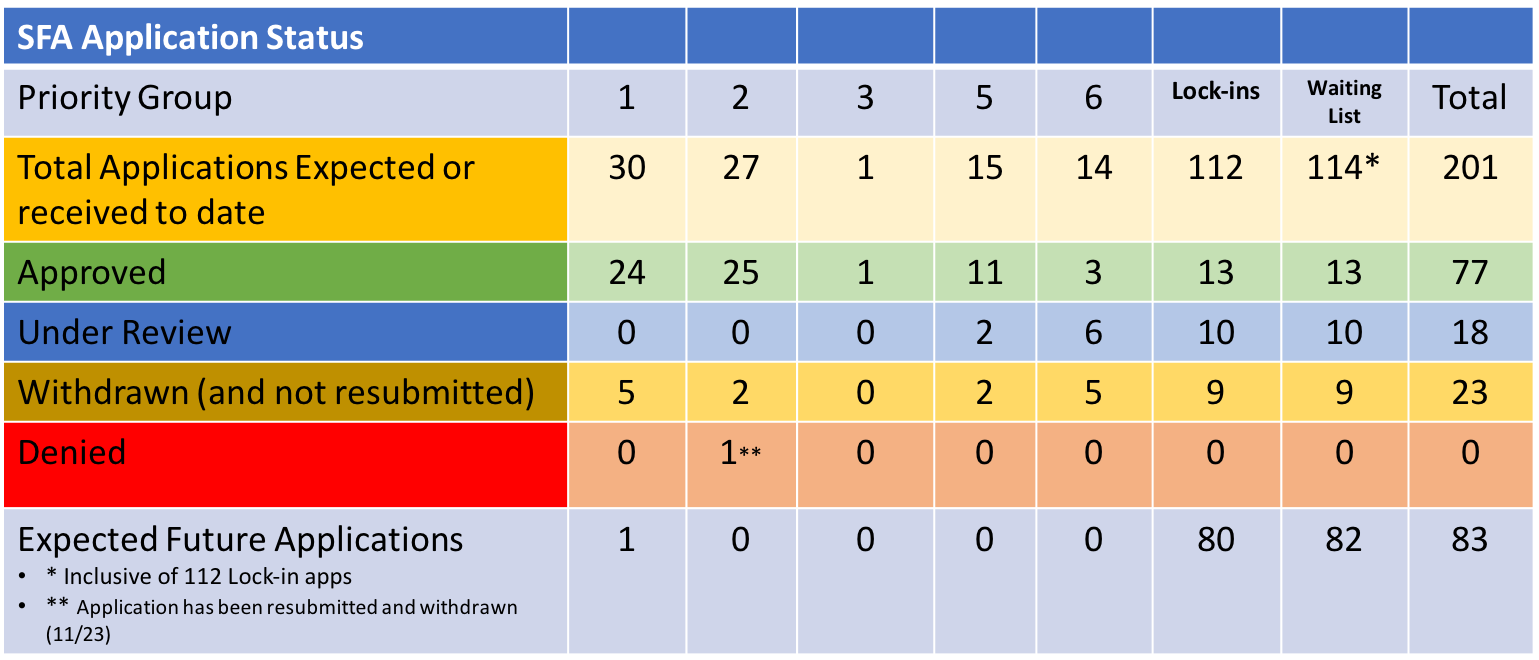
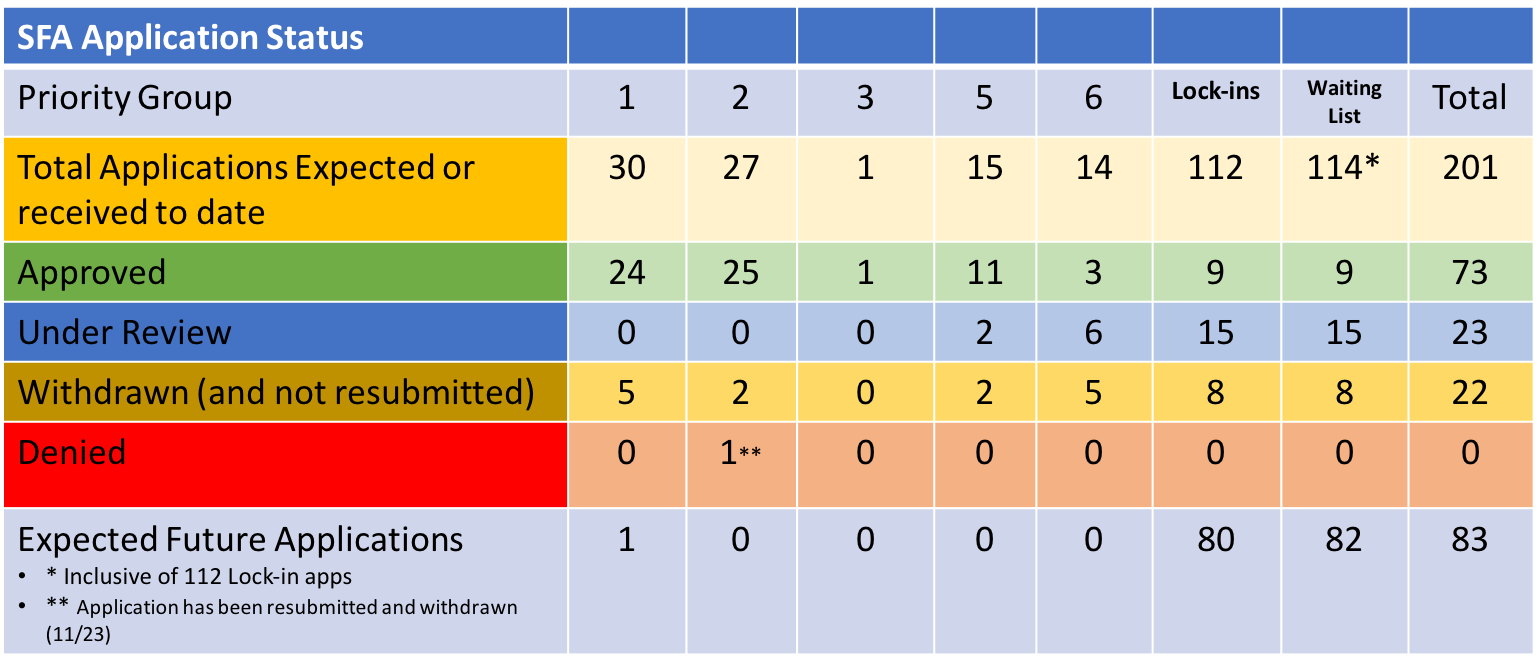
The past week was very quiet with regard to the ARPA legislation and activity associated with its implementation. We did have one fund submit an application for Special Financial Assistance (SFA). United Food and Commercial Workers Union and Participating Food Industry Employers Tri-State Pension Plan, a Priority Group 6 member, submitted a revised application on March 16th. This fund is seeking SFA in the amount of $638.3 million for the fund’s 29,233 members. The PBGC will now have until July 14, 2024 to act on the application.

Besides the filing by the UFCW, there was little to show last week, as there were no applications approved, denied, or withdrawn. Furthermore, unlike the prior week, there were no additions to the waitlist which continues to have 113 funds listed of which 27 have been invited to submit an application. To-date, 71 funds have received SFA in the amount of $53.6 billion. These proceeds include the grant, interest, and any FA loan repayments.

Like the picking of the NCAA tournament bracket, for which there are no perfect submissions remaining, the capital markets are highly uncertain. Yes, the US equity market has enjoyed a robust 5-6 months period, but how predictive is that for the next six months or longer? Those yet to receive the SFA should seriously consider an investment strategy that takes the uncertainty of the markets out of the equation. I am specifically referring to the use of investment grade bonds to defease the promised benefit payments as far into the future that the SFA allocation will cover. Once the matching of asset cash flows to the plan’s liability cash flows is done, that relationship is locked in no matter what transpires in the capital markets. Any risk taken by recipients of these assets should be done in the legacy portfolio where a longer investing horizon has been created. Fortunately, US interest rates remain elevated significantly from when the ARPA program began in 2021. The timing couldn’t have been better.

Are We Witnessing a Heavy Weight Fight?

By: Russ Kamp, Managing Director, Ryan ALM, Inc.

Most everyone is aware that monetary policy has gotten much tighter than we’ve witnessed in multiple decades, especially on the heels of the Fed’s zero interest rate policy (ZIRP). As a reminder, the Federal Reserve began raising the Fed Funds Rate (FFR) on March 17, 2022. After 2 years of their tightening action designed to combat inflation, the Fed Funds Rate sits at 5.25%-5.5%, where it has been for the last 1/2 year. Has the Fed’s action achieved its primary objective of price stability? No, but they’ve certainly made strides toward that quest seeing inflation fall from a high of 8.4% in July 2022 to February’s 3.2% reading. Furthermore, neither the economy nor the labor force have collapsed.

I recall when the Fed first began raising the FFR, they anticipated that both the economy and labor force would be impacted. In fact, I remember seeing estimates that the unemployment rate would likely elevate to between 4.5% and 5% as a result of this action, and the economy would most likely fall into recession. Thankfully, neither event has occurred. Why? Despite the aggressive Fed action to raise interest rates, financial conditions are not that tight. In fact, as I wrote in yesterday’s post, by some measures, financial conditions are actually easier than they were before the first rate increase.

Could it be that the Federal government’s budget is the reason behind the economy and labor market’s strength despite “aggressive” monetary policy? The Office of Management and Budget (OMB) estimates that the Federal budget for fiscal year 2024 will ultimately produce a deficit of roughly $1.6 trillion. Furthermore, 2025’s budget is forecast to create a deficit of $1.8 trillion. This is incredible stimulus that is being provided to the US economy. It is in direct conflict to what the Fed is trying to accomplish. First, I don’t believe that the current level of interest rates is that high, especially by historical standards, but they definitely aren’t high enough to combat the government’s deficit spending at this time.

As a reminder, when the government deficit spends, those $s flow into the private sector in the form of income which leads to greater spending and corporate profits, which we are witnessing at this time. This conflict between monetary policy and fiscal policy is what I’m defining as the heavyweight battle. Which policy action will ultimately prevail? Back in the 1970’s monetary policy became quite aggressive leading to double digit interest rates that bled into the early 1980s. There were many factors that created the excessive inflation that ultimately had to be curtailed with unprecedented Fed action. What the Fed didn’t have to do was fight the Federal government budget.

During the 1970s, the average budget deficit was only $35 billion. Yes, that is correct. The peak deficit occurred in 1976 at $74.7 billion , while 1970’s deficit of $2.8 billion was the lowest. In case you are wondering, the $35 billion average deficit would equate to roughly $153 billion in today’s $s or <1/10th of 2024’s expected deficit. Clearly, there was little excess spending/stimulus created by the Federal government at that time for which monetary policy had to combat. So, again, the US doesn’t have a debt problem. It has an income problem! The excess stimulus is elevating economic activity, keeping workers employed and spending, while corporate America produces the goods and services that are being demanded, leading to excess profit growth that continue to fuel the stock market.

As you can see, this tug of war or heavy weight battle is far from decided. I don’t believe that US interest rates are high enough to truly impact economic activity and the labor force, which continues to enjoy sub 4% unemployment rates. We either need rates to rise more, government deficits to shrink, or a combination of both before we see the Fed achieve its goal of a 2% sustained inflation rate. Let’s pray that our very uncertain geopolitical environment doesn’t take a turn for the worse with further escalation of the Ukraine/Russia war or worse yet, conflict in Southeast Asia between China and Taiwan. Our inflation story could get much worse under those scenarios.

Financial Conditions Are Not Tight

By: Russ Kamp, Managing Director, Ryan ALM, Inc.

Yesterday we received the latest update from the Federal Reserves and the message was pretty straightforward. They indicated that they are observing “higher growth and slower deceleration of inflation”. They once again stressed the “possibility” of three rate cuts later this year. But clearly that will depend on how much growth and how slow the path of inflation to their 2% target.

As if on cue, we got two more pieces of economic news today that highlight the economy’s current strength. First, initial jobless claims came in light at 210k versus an expectation of 213k. Despite all of the headlines forecasting major job cuts, IJCs continue to remain at levels that are quite low. In addition, we had the release of existing home sales for February. The investment community had forecasted annual sales of 3.95 million. The reality far outpaced the predictions as annual sales came in at 4.38 million. Clearly, the higher mortgage rates are not keeping folks from purchasing homes despite upward pressure on prices as a result of low inventory. Furthermore, the graph below highlights four indexes that each measure current financial conditions. I’ve referenced the Chicago and Goldman indexes in previous blog posts.

Each of these indexes are showing a similar easing in financial conditions, which makes the Fed’s job more challenging. In some cases, conditions are currently easier than they were at the start of the Fed’s rising interest rate cycle. As we discussed recently, today’s rate environment might be high relative to the Covid-19 era, but they certainly aren’t high by historical standards. This reality is also apparent in the estimates for Q1’24 GDP growth, which continue to forecast >2% growth following a strong 2023.

The Fed should remain diligent in its quest to bring inflation back to target. I lived through the ’70s and witnessed first hand what transpires when the brake on inflation is released too quickly. There are potential shockwaves related to our geopolitical climate that aren’t being factored into the equation to the extent that they should be. Inflation shocks that force the Fed to keep rates higher, if not elevated from this level, could begin to weigh on other markets.

Overpayment of SFA to be Refunded

By: Russ Kamp, Managing Director, Ryan ALM, Inc.

As those who regularly follow the Ryan ALM Inc. blog know, we report each week on the status of the PBGC’s effort to implement the ARPA legislation for multiemployer plans. In those updates, we have been reporting that the apparent slowdown in the processing of the special financial assistance (SFA) applications had to do with incorrect population surveys funds that have filed applications and in some circumstances have received SFA payouts.

We are finally starting to get some clarity on the situation in terms of who is involved and what is required of the funds that have received excess SFA grant money. In the most notable example, Central States, Southeast & Southwest Areas Pension Plan (CS) which received $35.8 billion in SFA in December 2022, has been informed that an excess SFA payment of $127 million was granted. This was the result of including 3,479 deceased participants in the eligible population. As a result, CS is required to repay the excess grant proceeds.

According to the Department of Labor, there are no consequences for those plans that have received excess grant money provided that they return those funds. According to a ai-cio.com article, “the DOL noted that this mistake was not made by the pension plan.” Unfortunately, the PBGC did not use the Social Security Administration’s death master file (DMF), a database that pension plans can’t access, when initially auditing SFA applications. They have since begun to use the DMF as of November 2023. “While these excess payment amounts may represent only a small fraction of total SFA payments, they would not otherwise have been paid and, as such, must be refunded to the United States government,” the PBGC said in a statement.

ARPA Update as of March 15, 2024

By: Russ Kamp, Managing Director, Ryan ALM, Inc.

We hope that you enjoyed your St. Patty’s Day weekend.

Here is your weekly ARPA update on the progress of the PBGC as it implements the legislation. Last week saw a little action. Importantly, Employers’ – Warehousemen’s Pension Plan and American Federation of Musicians and Employers’ Pension Plan each filed revised applications. The Warehousemen’s plan, a non-priority group member, is seeking just over $40 million in SFA for its 1,821 plan participants. The AFM, a Priority Group 6 member, is seeking $1.44 billion for its nearly 50k members. The PBGC has 120 days to respond to these applications although I suspect that the necessary timeframe to evaluate the worthiness of the SFA applications will be shorter due to previous submissions.

In other news, there were no applications denied, approved, or withdrawn, but there was an additional plan added to the waitlist, which now #s 113 members, although 27 have been submitted to the PBGC through their portal. The newest addition to the waiting list is PMPS-ILA Pension Trust Fund. They have elected not to lock in their valuation date at this time.

The US Treasury rate environment continues to rise from fourth quarter 2023’s bond rally. The increase in yields will allow for some greater cost reduction, and thus a longer coverage period for future benefits, for plan’s looking to defease those liabilities through a cash flow matching strategy. Since the beginning of 2024, the Treasury yield curve has shifted up about 40 bps for each key rate. As positive as this trend is for those looking to cash flow match, active, return-seeking fixed income products will have generated losses, especially for those with a longer duration objective. As a reminder, a portfolio with a 10-year duration will have lost about 4% in principal value.

Corporate Pension Funding Continues to Improve

By: Russ Kamp, Managing Director, Ryan ALM, Inc.

The Milliman organization does a terrific of providing frequent and very useful updates through their Milliman 100 Pension Funding Index (PFI). They are reporting that the funded status improved by $26 billion in February for the largest 100 corporate defined benefit pension plans. The funded status at the end of February sat at 104.9% up from 102.8% at the end of January 2024.

All of the improvement in the funded status is the result of a higher discount rate that reduced the present value of those future pension promises. Unlike public pension plans, corporate accounting uses a AA corporate rate to value liabilities and not the ROA. Assets don’t need to rise in order for pension funds to show improvement in the funded status. In fact, during the month, Milliman estimates that liabilities fell in value by $30 billion. The current funding surplus for the members of this index stands at $63 billion at month end.

What’s next for these companies? Much of Corporate America has already begun to de-risk their plans. For those that haven’t the time is now to consider taking some risk out of the asset allocation. We certainly don’t want to see a repeat from 1999, when pensions were well over-funded on to see that funded status deteriorate rapidly with the advent of two major equity market declines. Importantly, de-risking doesn’t mean getting out of the pension game. it does mean that you, as the sponsor, don’t want to continue to ride the asset allocation rollercoaster up and down which can impact contribution expenses.

Migrate your fixed income from a return-seeking mandate to one that is now going to use bond cash flows of interest and principal to match the liability benefit payments. In an uncertain environment as to the direction of US interest rates, utilizing a cash flow matching (CFM) strategy will lock up the relationship with those pesky liabilities and eliminate interest rate risk for that portion of the portfolio. How comforting is that?

ARPA Update as of March 8, 2024

By: Russ Kamp, Managing Director, Ryan ALM, Inc.

March has certainly blown in like a lion, especially on the east coast, where we’ve been living under wind advisors for the last few days. Fortunately, those haven’t been headwinds and as a result, the capital markets continue to be supportive of our retirement industry.

With regard to ARPA and the PBGC’s effort to provide Special Financial Assistance (SFA) to worthy and eligible multiemployer plans, the process has definitely slowed. In an email exchange with the sponsor of a fund that has recently had to withdraw their application, it was shared that the “death audit” being conducted by the PBGC on each of the applications has contributed to the slowing of the process. Hopefully, those plans that haven’t filed yet will go to the trouble of ensuring that the plan populations are accurate.

As far as the activity for the week ending 3/8, the PBGC has reported that no new applications were filed. Furthermore, none were rejected and there were no new withdrawals. We are pleased to report that one fund, Teamsters Union Local No. 73 Pension Plan, a non-priority group member, has had its application approved for $7.5 million in SFA for the plan’s 529 members.

As the chart above highlights, with 71 application approvals, the PBGC is 35.5% of its way through the current roster of potential SFA recipients. Much more to come!

A Contrarian Approach That is Becoming More Common?

By: Russ Kamp, Managing Director, Ryan ALM, Inc.

I suspect that some (perhaps) many folks in our industry are becoming a little tired of my constant drum beat requesting a change in how pension plans are managed. I’m sorry if that is the case, but I have a reason to speak out often, if not loudly. My goal/mission, and that of Ryan ALM, Inc., is to protect and preserve defined benefit plans for the masses. I believe wholeheartedly that DB plans are superior to any other retirement program since they provide the monthly promise with little involvement from the participant, who may have particularly wonderful skills used in their day-to-day lives, but investing isn’t likely one of them.

By espousing Cash Flow Matching (CFM) as an important investment strategy, particularly in this period of attractive interest rates, we are bringing pension management generally and asset allocation strategies specifically back to its roots. The SECURING of the pension promise must be the primary objective for plan fiduciaries. Better yet, it should be accomplished at a reasonable cost and with prudent risk. As I’ve discussed before, a CFM strategy brings an element of certainty to the management of pensions that have embraced uncertainty through asset allocation strategies that are subject to the whims of the markets.

The riding of the asset allocation rollercoaster in pursuit of a performance objective does little to secure the pension promise, but it certainly adds to annual volatility of both the funded status and contribution expenses. Is that the outcome that the sponsors of these plans and the participants want? Heck no! Are we at Ryan ALM tilting at or own windmills? I sure hope not.

I’ve been heartened recently to read several articles favoring a return to pension basics, including the focus on the pension promise to drive asset allocation through a CFM implementation. I’m not afraid to be a lone wolf, and nearly 1,400 blog posts support that claim, but it is comforting to have some company, as being a contrarian outside of the “herd” has been described as being as painful as chewing off one’s left arm – OUCH! In one specific instance, Stephen Campisi, recently posted his article on LinkedIn.com, in which he espoused a similar bifurcated approach – liquidity and growth buckets – to pension asset allocation. He also reminded everyone that “aiming” at the correct objective was essential. In this case, he correctly cited that the objective was the promise that had been given to the participant.

Nothing would please me more than to have the entire industry once again realize the significant importance of the defined benefit plan and its role in securing a dignified retirement. Eliminating the rollercoaster cycles of performance will go a long way to preserving their use. Adopting a CFM strategy that secures the monthly promises at a reasonable cost and with prudent risk is the first step in the process. I look forward to you jumping on our bandwagon.