A Little Late to the Party!

By: Russ Kamp, CEO, Ryan ALM, Inc.

P&I is running a story today about two U.S. Congressmen, Representatives Tim Walberg, R-Mich., and Rick Allen, R-Ga., who have produced a Feb. 20 letter to Attorney General Pam Bondi regarding excess Special Financial Assistance (SFA) payments to multiemployer plans under the ARPA pension legislation that has been implemented/overseen by the PBGC. They are demanding that the Justice Department look into the erroneous payments made to some of the SFA recipients base on incorrect census data.

This issue was first raised by the PBGC’s Office of Inspector General back in November 2023 when they found that while the agency required the pension fund to provide a list of all plan participants and proof of a search for deceased participants, “the PBGC did not cross-check that information with the Social Security Administration’s Death Master File — the source recommended by the Government Accountability Office for reducing improper payments to dead people.” Good catch, PBGC. Clearly, no one wants to see incorrect payments made, but for these Congressman to be encouraging a review at this time seems a little misplaced, as the repayment of excess funds has been ongoing since last April when Central States, Southeast & Southwest Areas Pension Plan repaid $126.7 million representing 0.35% of the SFA grant received.

Since the repayment by Central States, the PBGC has worked diligently with 60 pension plans that received SFA prior to the use of the SSA’s DMF to make sure that any excess SFA is recaptured. As of February 21, 2025, 38 plans have repaid $180 million in excess SFA from total grants paid of $43.6 billion or 0.41%. The 38 plans represent 63% of the cohort that might have received excess grant money. Is the $180 million earth-shattering? No. Will it dramatically impact the Federal budget deficit running at roughly $2 trillion per year? Again, no. Might this unfortunate situation tarnish the huge success that ARPA has been? Unfortunately, it just might.

For these Congressman to only now seek to get the Justice Department involved seems misplaced as nothing more than a political hit job. Instead of creating waves, they should be celebrating the fact that ARPA has helped to secure the rightfully earned retirement benefits for 1.53 million American workers and retirees (oh, and they are taxpayers, too) through nearly $71 billion in SFA grants to date. The amount of economic activity created from these monthly benefits will support local businesses and jobs for years to come. Fortunately, there are still more than 90 multiemployer plans that might yet collect some SFA grant money. Let’s hope that they do.

None of the members of these plans ever wanted to be in a situation where their earned benefits might be slashed or worse, eliminated. Yet, that’s exactly where they found themselves following the passage of MPRA. Thank goodness that ARPA was signed into law in March 2021 before more damage was done to struggling multiemployer funds. I’m not sure that I can point to another piece of pension legislation enacted during my 43-year career that has had such a beneficial impact on our pensioners. Most of what I’ve witnessed is the whittling away of benefits.

ARPA Update as of February 21, 2025

By: Russ Kamp, CEO, Ryan ALM, Inc.

Welcome to the last week in February. Spring can’t arrive soon enough in New Jersey!

Last week the Milliman organization published its annual review of the state of multiemployer pension plans. The news was quite positive, but in digger deeper, it became apparent that the payment of the Special Financial assistance (SFA) was the primary reason for the improved funding ratios. Given how critically important the SFA is to the ongoing success of many of these plans, let’s look at what transpired during the previous week.

According to the PBGC’s weekly spreadsheet, there were no new applications filed as the eFiling portal remains temporarily closed. In addition, no applications were approved or denied, but there was one application withdrawn, as non-priority plan Aluminum, Brick & Glass Workers International Union, AFL-CIO, CLC, Eastern District Council No. 12 Pension Plan (the plan’s name is longer than the fund’s size is large) pulled its application seeking $10.6 million for 580 participants.

There was some additional activity though, as five plans were asked to repay a portion of the previously agreed SFA due to census errors. In total, these plans repaid $16.3 million representing just 1.06% of the grants received. To date, $180.8 million has been reclaimed from grants totaling $43.6 billion or 0.41%.

In other news, we had Bricklayers & Allied Craftworkers Local No. 3 NY Niagara Falls-Buffalo Chapter Pension Plan, added to the waitlist (#116). This is the first addition to the list since July 2024. This plan did not elect to lock-in the interest rate for discount rate purposes, joining a couple other plans that have kept their options open.

We should witness dramatic improvement in the Milliman funded ratio study next year, as about 7% (85 funds) were funded at <60% in 2024. There are currently 94 plans seeking SFA support. If granted, they should all see meaningful improvement in the funded status of their plans. As a result, we could have a situation in which the multiemployer universe becomes fully funded. How incredible. Now, let’s not do something silly from an investment standpoint that would jeopardize this improved funding.

That Step Isn’t Necessary!

By: Russ Kamp, CEO, Ryan ALM, Inc

I recently stumbled over a brief article that touched on LDI. I’m always interested in absorbing everything that I can on this subject. I was particularly thrilled when the author stated, “since LDI was recognized as best practice for defined benefit (DB) plans…” – YES! I’m not sure where that proclamation came from, but I agree with the sentiments. The balance of that sentence read, “…sponsors have implemented investment strategies as a journey.”

The initial steps on this journey were for plan sponsors to “simply extend the duration of their fixed income using longer duration market-based benchmarks.” Clearly, the author is referencing duration matching strategies as the LDI product of choice during that phase. According to the author, the next phase in this LDI journey was the use of both credit and Treasuries to better align the portfolio with a plan’s liability risk profile.

Well, we are supposedly entering a third phase in this LDI journey given the improved funded status and “outsized” allocations to fixed income. The question they posed: “How do we diversify the growing fixed income allocation?” Their answer, add a host of non-traditional LDI fixed income products, including private debt and securitized products, to the toolkit to add further yield and return. No, no, and no!

As mentioned previously, funded status/ratios have improved dramatically. According to this report, corporate plans have a funded ratio of 111% at the end of 2024 based on their firm’s Pension Solutions Monitor. Given that level of funding, the only thing that these plans should be doing is engaging a cash flow matching (CFM) strategy to SECURE all the promises that have been given to the plan participants. You’ve WON the pension game. Congratulations! There is no reason for a third phase in the LDI journey. There likely wasn’t a need for the second phase, but that’s water over the dam.

We, at Ryan ALM, believe that CFM is a superior offering within the array of LDI strategies, as it not only provides the necessary liquidity to meet monthly liability cash flows, but it duration matches each and every month of an assignment. Ask us to CFM the next 10 years, we will have 120 duration matches. Most duration matching strategies use either an average duration or a few key rates along the yield curve. Since duration is price sensitive, it changes constantly.  In addition, yield curves do not move in parallel shifts making the management of duration a difficult target.

With CFM you can use STRIPS, Treasuries, investment grade corporates or a combination of these highly liquid assets. You don’t need to introduce less liquid and more complex products. A CFM strategy is all you need to accomplish the pension objective. A CFM strategy provides certainty of the cash flows which is a critical and necessary feature to fully fund liabilities. This feature does not exist in private debt and securitized products. As a reminder, the pension objective is not a return target. It is the securing of the promised benefits at a reasonable cost and with prudent risk. Don’t risk what you’ve achieved. Lock in your funded status and secure the benefits. This strategy is designed as a “sleep well at night” offering. I think that you deserve to sleep like a baby!

ARPA Update as of December 13, 2024

By: Russ Kamp, Managing Director, Ryan ALM, Inc.

Welcome to the last full week before the Christmas season kicks off. Most investors will be sorry to see 2024 come and go. For the PBGC, 2024 has been a year of great accomplishments, with the approval of Special Financial Assistance (SFA) for 35 multiemployer plans covering 458,171 participants with SFA grants totaling $16.2 billion – wow!

The last week was a continuation of the PBGC’s activity with seven more funds submitting applications seeking $638.2 million for nearly 27k members. The applications included five new submissions and 2 revised applications. The applicants included the Dairy Industry-Union Pension Plan for Philadelphia and Vicinity, Bricklayers Pension Fund of West Virginia, United Wire, Metal and Machine Pension Plan, Distributors Association Warehousemen’s Pension Trust, Local 945 I.B. of T. Pension Plan, Alaska Teamster – Employer Pension Plan, and the Local 888 Pension Fund. Grant requests ranged from United Wire’s $228.5 million to the Bricklayers $1.96 million for their 170 participants.

In addition to the new submissions, there was one approval. Teamsters Local 11 Pension Plan will receive $29.3 million for the 2,012 members of its plan. This North Haledon, NJ fund submitted a revised application on August 29, 2024. In other ARPA news, there were no applications denied or withdrawn during the previous 7 days. In addition, there were no new plans added to the waitlist or forced to repay a portion of the SFA due to census errors.

US Treasury interest rates backed up fairly significantly last week as inflation data came in a little higher than recent trends giving bonds investors reason to challenge the narrative that the Fed would continue pushing down the Fed Funds rate. The higher rates are providing plan sponsors with greater cost savings on future benefits through cash flow matching strategies.

How Comforting is $1,305.54/year?

By: Russ Kamp, Managing Director, Ryan ALM, Inc.

One doesn’t have to spend much time on LinkedIn.com these days without seeing a discussion about the pros and cons of Defined Benefit (DB) vs. Defined Contribution (DC) aka 401(k) plans. Anyone who has read just a few of the >1,500+ posts on this blog know that I and Ryan ALM, Inc. are huge supporters of DB plans. Based on the following, it becomes apparent why that is the case.

One topic frequently mentioned among our peers is financial literacy. As a former member of two boards of education (11 years in total), I have witnessed first-hand how little financial literacy is shared with our high school students, especially as it relates to saving and investing. That said, as important as education is, the greatest issue for me is the lack of disposable income for the average American worker.

Frequently we read about the spending habits of younger generations, including being the “avocado toast” crowd. Examples often used include the daily purchase of a Starbucks drink or two, the use of Uber Eats, and similar examples of perceived wasteful spending. They fail to mention that even “well-paid” workers (>$100k) are burdened by a mortgage or rent payment, they likely have student loan debt, they have to buy insurance in order to use their car, which is also a very expensive purchase, they are required to have health insurance, homeowners or rental insurance, and God forbid that they have a spouse and a couple of kids. Childcare expenses have gotten to be insane. Is there any wonder that funding one’s own retirement has proven to be incredibly challenging?

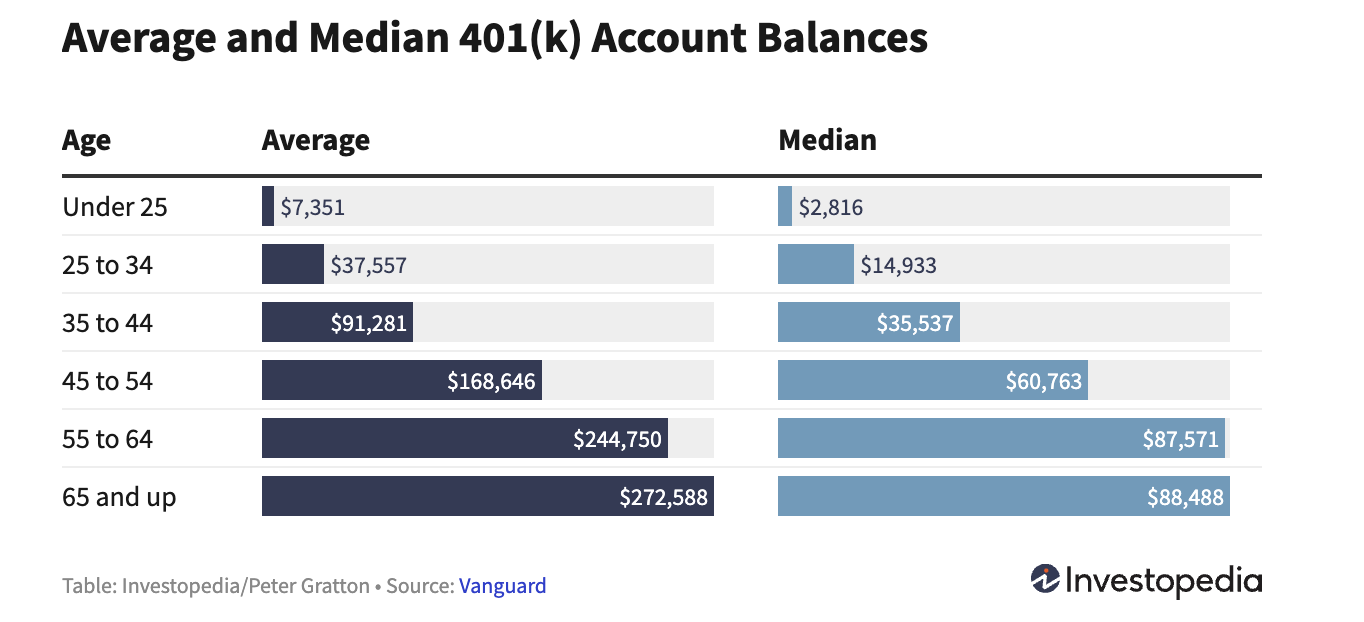
So how are we doing? Unfortunately, most of the literature on the subject uses average balances to represent 401(k) savings. This practice needs to stop. According to Vanguard the average balance in 2024 is $134,128, but the median balance is $35,285. In addition, Morningstar has just published an article stating that retirees should use only a 3.7% withdrawal rate (no longer 4%) to safely use a 401(k) retirement balance given the recent performance of equity markets and the current interest rate environment. Let’s see: 3.7% * $35,285 = $1,305.54. That is an annual withdrawal, although it looks like it should be a monthly payout! What kind of retirement will that level of annual withdrawals provide? For comparison purposes, the average DB payout in the private sector is $11k and nearly $25k in public pensions.

As a reminder, DC plans were intended to be supplemental to DB plans. It is highly regrettable that they have morphed into most everyone’s primary means of “accumulating” retirement resources. This migration in proving to be an unmitigated failure and the consequences will be untenable. The American worker needs access to a DB plan. Let’s work together to protect and preserve those that remain, while encouraging former sponsors of these plans to rethink the decision to freeze or terminate. There are also state sponsored entities that afford employees in smaller companies access to a DB-like plan. That said, please manage them with a focus on the pension promise (securing benefits). Don’t rely on markets and all the volatility that comes with that exposure to “fund” these essential programs. That strategy hasn’t worked!

ARPA Update as of December 6, 2024

By: Russ Kamp, Managing Director, Ryan ALM, Inc.

You have to be excited as a Mets fan given yesterday’s news that Juan Soto will be joining the organization on a massive contract. The $765 million is a staggering figure. Let’s see what happens to ticket prices and TV streaming services from a cost standpoint.

Since ARPA was passed in 2021 and signed into law in March of that year, there have been folks upset that the government is using “tax revenue” to rescue pensions for multiemployer plans. Well, in the latest update provided by the PBGC, we note that the Pressroom Unions’ Pension Plan, a non-priority group member, will receive $63.7 million to protect and preserve the promised pensions for 1,344 plan participants. That seems very reasonable since this grant will likely cover these benefit payments for roughly the same time frame that Soto will be a Met (15 years), at only $12.7 million more than just one year of Soto’s contract.

In other ARPA news, the e-filing portal is listed as “limited”, which according to the PBGC means that “the e-Filing Portal is open only to plans at the top of the waiting list that have been notified by PBGC that they may submit their applications. Applications from any other plans will not be accepted at this time.” PA Local 47 Bricklayers and Allied Craftsmen Pension Plan was the only plan to file an application (revised) last week. They are seeking $8.3 million in SFA for 296 members in the fund.

In other news, three funds, including Toledo Roofers Local No. 134 Pension Plan, Freight Drivers and Helpers Local Union No. 557 Pension Plan, and PACE Industry Union-Management Pension Plan, were asked to repay a total of $7 million in excess SFA due to census issues. The rebate represented 0.45% of the $1.6 billion received in SFA grants. Happy to report that there were no applications denied or withdrawn during the prior 7-day period.

As the chart above highlights, there are still 57 plans that have yet to file an application seeking SFA support. Estimates range from another $10 – $20 billion being allocated to the remaining entities.

“Peace of Mind” – How Beneficial Would That Be?

By: Russ Kamp, Managing Director, Ryan ALM, Inc.

As a member of the investment community do you often feel stressed, worried, insecure, uneasy, or are you just simply too busy to be at peace? In the chaotic world of pension management, finding peace of mind can sometimes be hard, if not impossible. How much would it mean to you if you could identify an investment strategy that provides you with just that state of being?

At Ryan ALM, Inc. our mission is to protect and preserve DB pension plans through a cash flow matching (CFM) strategy that ensures, barring any defaults, that the liabilities (benefits and expenses) that YOU choose to cover are absolutely secured chronologically. You’ll have the liquidity to meet those obligations in the amounts and at the time that they are to be used. There is no longer the worry and frustration about finding the necessary “cash” to meet those promises. CFM provides you with that liquidity and certainty of cash flows.

Furthermore, you are buying time for the growth (alpha or non-bond) assets to now grow unencumbered, as they are no longer a source of liquidity. You don’t have to worry about drawdowns, as the CFM portfolio creates a bridge over the challenging markets with no fear of locking in losses due to cash flow needs. Don’t you just feel yourself nodding off with the knowledge that there is a way to get a better night’s sleep?

How much would you “spend” to achieve such peace of mind? Most pension systems cobble together disparate asset classes and products, many which come with hefty price tags, in the HOPE of achieving the desired outcome. With CFM, YOU choose the coverage period to be defeased, which could be as short as 3-5 years or as long as it takes to cover the last liability. The longer the time horizon the greater the potential cost reduction. As an FYI, most of our clients have chosen a coverage period of roughly 10-years. Knowing that you have SECURED your plan’s obligations for the next 10-years, and locked in the cost reduction, which can be substantial (2% per year = 20% for 1-10 years), on the very first day in which the portfolio is constructed, has to be just an incredible feeling compared to living in an environment in which traditional pension asset allocations can have significant annual volatility and no certainty of providing either the desired return or cash flow when needed.

Remember, the amount of peace of mind is driven by your decisions. If you desire abundant restful nights, use CFM for longer timeframes. If you believe that you only need “peace of mind” in the near-term, engage a CFM strategy for a shorter 3-5 years. In any case, I guarantee that the pension plan’s exposure to CFM won’t be the reason why you are restless when you put your head on the pillow. Oh, and by the way, we offer the CFM strategy at fee rates that are substantially below traditional fixed income strategies, let alone, non-bond capabilities. Call us. We want to be your sleep doctor!

ARPA Update as of November 29, 2024

By: Russ Kamp, Managing Director, Ryan ALM, Inc.

We hope that you had a very enjoyable holiday weekend. Welcome to December. That doesn’t seem possible.

Despite the holiday shortened week, the PBGC was quite busy, announcing that four multiemployer plans had submitted applications seeking Special Financial Assistance (SFA). Those funds included Laborers’ Local No. 91 Pension Plan, Southwestern Pennsylvania and Western Maryland Area Teamsters and Employers Pension Fund, Oregon Processors Seasonal Employees Pension Plan, and The Legacy Plan of the UNITE HERE Retirement Fund. Local 91’s application was its initial attempt at getting the SFA, while the other three submitted revised applications. In total, these four are seeking a total of just over $1 billion for the 102,356 plan participants. A significant majority of the assets being requested and plan members are in the UNITE HERE fund.

With regard to the Teamsters’ plan, they withdrew and then resubmitted the application on November 27th. That plan is hoping to receive $120.7 million in SFA for the 2,759 members of its fund. In other news, two funds received approval for their applications, including Lumber Industry Pension Plan and Local 1034 Pension Plan. Both plans had submitted revised applications. In total, they will get $159.6 million in SFA and interest for 7,155 plan participants. I suspect that the announcement of a successful PBGC approval made for a wonderful Thanksgiving celebration.

Finally, there were no applications denied, no funds repaid excess SFA, and no plans sought to be added to the waitlist at this time, which continues to list 53 non-priority plans that have not yet been allowed to submit an initial application.

The two plans that received approval for the SFA last week brings to 102 the number of plans that have been awarded SFA grants ($69.7 billion) since the program launched in July 2021. There are still 100 plans that may be eligible to receive this special financing.

And So It Is!

By: Russ Kamp, Managing Director, Ryan ALM, Inc.

Milliman has released the results for its Public Pension Funding Index (PPFI), which analyzes data from the nation’s 100 largest public defined benefit plans. They are reporting that the collective funded ratio deteriorated during the last month from 82.8% as of September 30th, to 81.2% as of October 31st, as the combined investments of these plans fell for the first time since April. The estimated return for the PFFI was -1.6%, as losses ranged from -2.9% to -0.6%. The $s lost were roughly $80 billion during the month. The funding deficit now stands at about $1.1 trillion.

You may recall that on November 8th, I produced a blog post titled, “Another Inconsistency”, in which I wrote about Milliman’s reporting of its corporate index that highlighted the fact that the collective funded ratio improved during the month despite asset losses due to the fact that liabilities fell to a great extent as interest rates rose.

I also wrote the following, “what do you think will happen in public fund land? Well, given weak markets, asset levels for Milliman’s public fund index will likely fall” (they did, as reported above). “Given that the discount rate for public pension systems is the ROA, there will be no change in the present value of public pension plans’ future benefit obligations (silly). As a result, instead of witnessing an improvement in the collective funded status of public pensions, we will witness a deterioration.” (and we did!) The inconsistency is startling!

Decisions with regards to benefits and contributions are made all the time based on information related to the funded ratio/status of these pension plans. Using different accounting standards clearly produces different outcomes that might just lead to inappropriate conclusions and the subsequent decisions. Oh, boy!

ARPA Update as of November 15, 2024

By: Russ Kamp, Managing Director, Ryan ALM, Inc.

I can’t believe that Thanksgiving is next week. It appears that the PBGC was motivated to get some things done in anticipation of that holiday, as we witnessed more activity last week than we’ve been seeing in the most recent past.

There were four applications filed last week, including the following pension plans: Roofers and Slaters Local No. 248 Pension Plan, Pension Plan of the Asbestos Workers Philadelphia Pension Fund, Local 1783 I.B.E.W. Pension Plan, and Cement Masons Local Union No. 567 Pension Plan. These plans are not seeking significant sums as far as the SFA goes, as in total they are seeking $92.6 million for 2,637 participants. The IBEW plan out of Armonk, NY submitted a revised application. The other three were the initial filings for these plans.

Pleased to report that Local 360 Labor-Management Pension Plan received approval for its revised application. This fund will receive $30.4 million for the 6,117 members of the plan. This fund initially filed an SFA application in early 2023 only to withdraw it in July 2023. Good for them that they were finally successful in receiving the grant.

Local 810 Affiliated Pension Plan wasn’t as fortunate as Local 360, as they withdrew the initial application that had been seeking $104.1 million for 1,437 members of the plan. In addition to the four new filings, the one withdrawal, and the one approved application, the PBGC also was involved in negotiating two repayment of excess SFA due to census errors. Iron Workers Local 17 Pension Fund
Bricklayers and Allied Craftsmen Local 7 Pension Plan returned $260,471.70 representing only 19 bps of the SFA grants awarded. To date, 25 funds have returned a total of $149.9 million representing 0.38% of the awarded grants.

Recessionary expectations have waned in the last couple of months and flows into bonds, which had been strong for most of the year have recently turned negative. As a result, US interest rates have backed up. It is a great time to secure the promised benefits (and expenses) through cash flow matching strategies. A rising rate environment will be quite bearish for traditional fixed income shops. We’ll be happy to provide you and your fund with a free analysis of what can be achieved through a defeasement strategy.