A Call for Pension Reform – Five Years Later

By: Russ Kamp, CEO, Ryan ALM, Inc.

On March 25, 2020, I produced a post titled, “Why Pension Reform is Absolutely Necessary“. A few of you may recall that blog. I penned the post in reaction to a series of statistics that my friend John A. produced. John is a retired Teamster and an incredibly important driver behind efforts to reinstate benefits that had been cut under MPRA. John’s analysis was based on a survey that he conducted on multiemployer plans that had roughly 43,000 plan participants impacted by that misguided legislation. That universe of participants would grow to more than 75,000. What he discovered through his polling and outreach was shocking!

Their benefit reductions amounted to nearly $34,000,000 / month.  (That is a ton of lost economic activity.)

95% were not able to work.

72% were providing primary care for an ailing loved one.

65% were not able to maintain healthcare insurance.

60% had lost their home.

55% were forced to file for bankruptcy.

80% were living benefit check to benefit check.

100% of the PBGC maximum benefit payout was inadequate ($12,870 for a retiree with 30-years of work).

50% of the retirees were U.S. service veterans.

Shocked? I certainly was and continue to be that our government allowed the benefits to be cut for hard working American workers who rightfully earned them through years of employment.

Where are we today? Fortunately, the got the passage of ARPA pension reform (originally referred to as the Butch Lewis Act) which was signed into law by President Biden in March 2021. Responsibility to implement the legislation fell to the Pension Benefit Guaranty Corporation (PBGC). In my original blog post, I referred to a potential universe of 125 multiemployer plans that might be eligible for Special Financial Assistance (SFA). That list would eventually become 204 plans (see below).

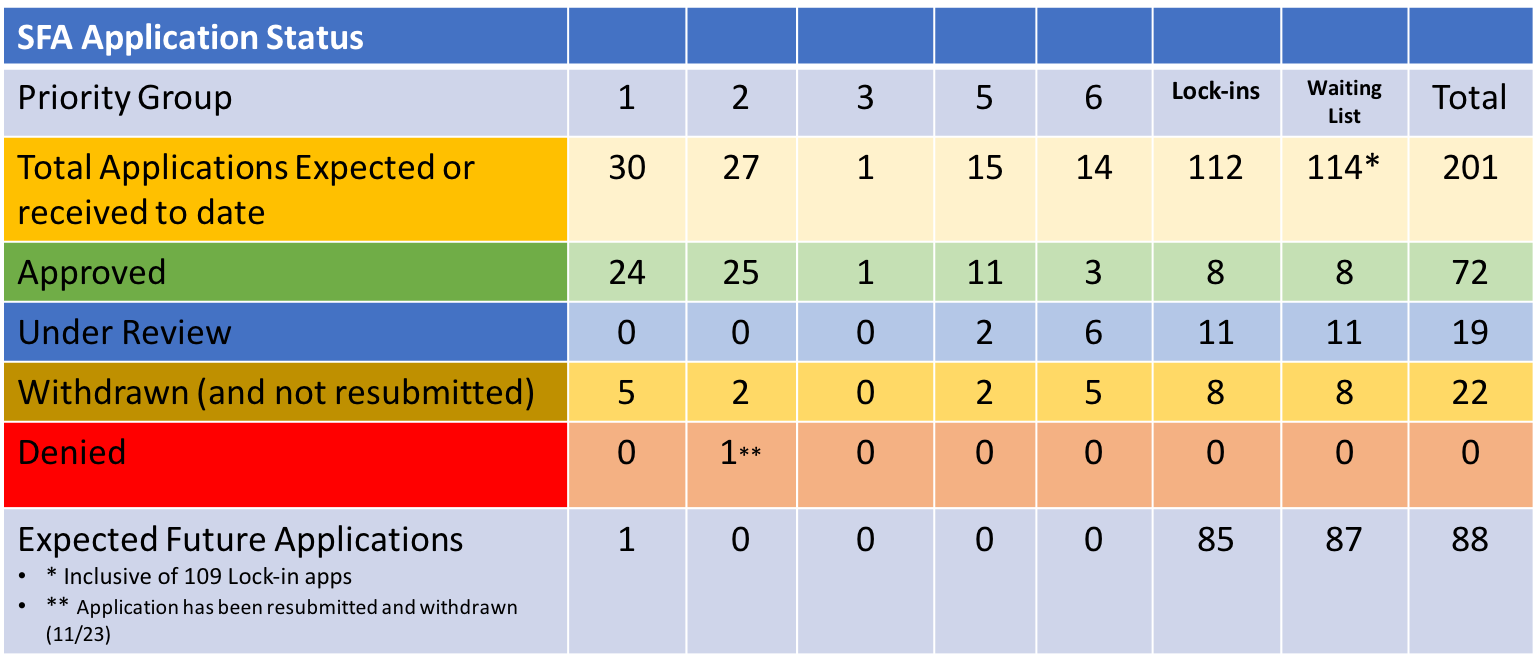
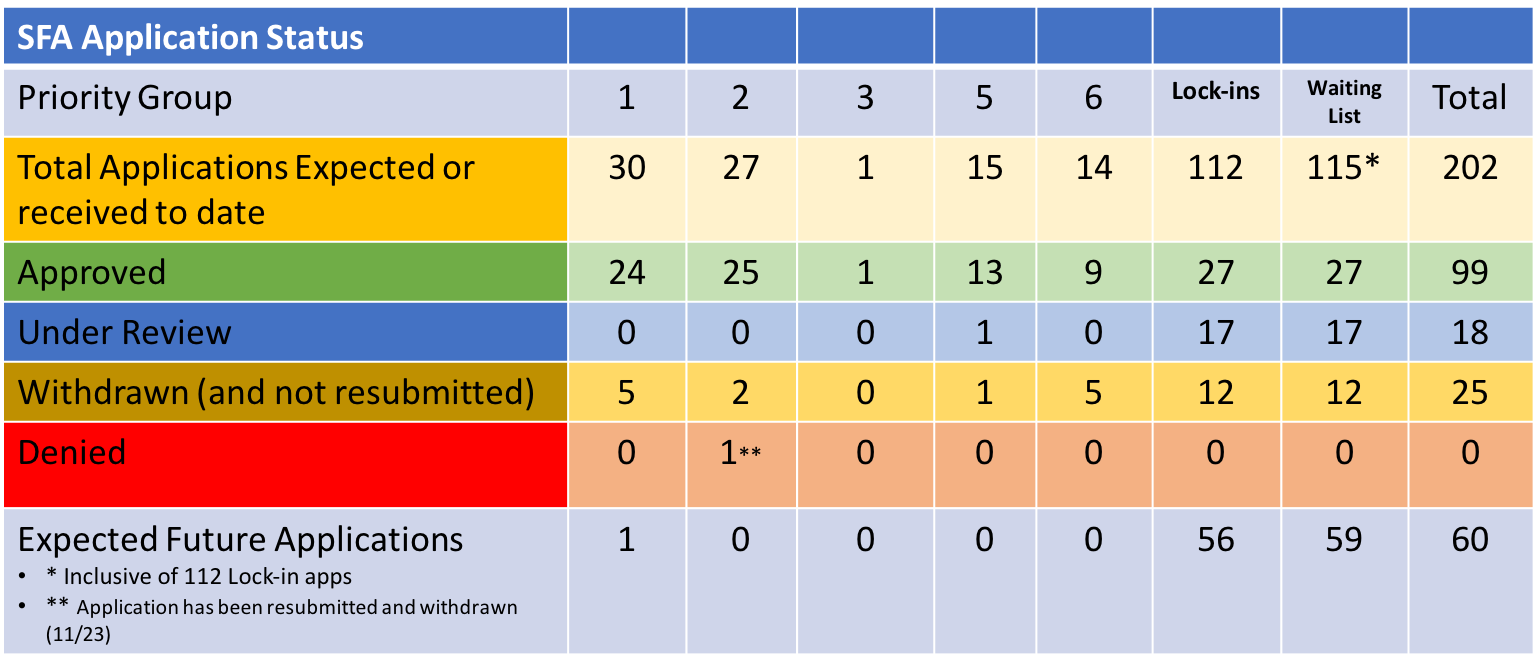
I’m extremely pleased to announce that 119 funds of the 204 potential recipients have received more than $71.6 billion in SFA and interest supporting the retirements of 1,555,460 plan participants. Awesome! There is still much to do, and hopefully, the sponsors of these funds will prove to be good stewards of the grant $s by conservatively investing the SFA and reserving the risk taking for the legacy assets that have time to wade through challenging markets.

What an incredible accomplishment! So many folks would have been subject to very uncertain futures. The securing of their benefits goes a long way to allowing them to enjoy their retirement years. Unfortunately, there are too many American workers that don’t have a defined benefit plan. In many cases they have an employer sponsored defined contribution plan, but we know how challenging it can be for those participants to fund, manage, and disburse that benefit. For many others, there is no employer sponsored benefit. Their financial futures are in serious jeopardy.

That said, what appeared to be a pipe dream once the U.S. Senate failed to take up the BLA legislation has become an amazing success story. Just think of all the economic activity that has been created through these monthly payments that certainly dwarf the $34 million/month mentioned above. Congrats to all who were instrumental in getting this legislation created and passed!
ARPA Update as of November 15, 2024

By: Russ Kamp, Managing Director, Ryan ALM, Inc.

I can’t believe that Thanksgiving is next week. It appears that the PBGC was motivated to get some things done in anticipation of that holiday, as we witnessed more activity last week than we’ve been seeing in the most recent past.

There were four applications filed last week, including the following pension plans: Roofers and Slaters Local No. 248 Pension Plan, Pension Plan of the Asbestos Workers Philadelphia Pension Fund, Local 1783 I.B.E.W. Pension Plan, and Cement Masons Local Union No. 567 Pension Plan. These plans are not seeking significant sums as far as the SFA goes, as in total they are seeking $92.6 million for 2,637 participants. The IBEW plan out of Armonk, NY submitted a revised application. The other three were the initial filings for these plans.

Pleased to report that Local 360 Labor-Management Pension Plan received approval for its revised application. This fund will receive $30.4 million for the 6,117 members of the plan. This fund initially filed an SFA application in early 2023 only to withdraw it in July 2023. Good for them that they were finally successful in receiving the grant.

Local 810 Affiliated Pension Plan wasn’t as fortunate as Local 360, as they withdrew the initial application that had been seeking $104.1 million for 1,437 members of the plan. In addition to the four new filings, the one withdrawal, and the one approved application, the PBGC also was involved in negotiating two repayment of excess SFA due to census errors. Iron Workers Local 17 Pension Fund
Bricklayers and Allied Craftsmen Local 7 Pension Plan returned $260,471.70 representing only 19 bps of the SFA grants awarded. To date, 25 funds have returned a total of $149.9 million representing 0.38% of the awarded grants.

Recessionary expectations have waned in the last couple of months and flows into bonds, which had been strong for most of the year have recently turned negative. As a result, US interest rates have backed up. It is a great time to secure the promised benefits (and expenses) through cash flow matching strategies. A rising rate environment will be quite bearish for traditional fixed income shops. We’ll be happy to provide you and your fund with a free analysis of what can be achieved through a defeasement strategy.

We Are # 29 – WOW!

By: Russ Kamp, Managing Director, Ryan ALM, Inc.

The  16th annual Mercer/CFA Institute Global Pension Index report was released on Oct. 15. I want to extend a big thank you to Mercer and the CFA for their collective effort to elevate retirement issues, while celebrating those countries who are getting it right. According to the survey, “the overall index value is based on three weighted sub-indices—adequacy (40%), sustainability (35%) and integrity (25%)—to measure each retirement income system. Adequacy looked at areas such as benefits, system design, savings and government support. Sustainability examined pension coverage, total assets, demography and other areas. Integrity encompassed regulation, governance and protection.” There are more than 50 indicators that support these three broad categories.

The United States was given a score of 60.4 (63 in 2023’s study), which placed our retirement readiness at 29 of 48 countries that were evaluated. That 29 is 7 spots lower than 2023’s rank. According to the Mercer CFA study, a score of 60.4 places us slightly below the average score (63.4) among those ranked and we were given a letter grade of C+. I don’t know about you but if I had scored a 60 (scale of 0-100) during my school days, my letter grade would have likely been an F. Based on how I feel that we are prepared as a nation, I think that an F is much more appropriate than a C+. What about you?

I’m not trying to pick on the U.S. retirement system, which scored 63.9 on adequacy, 58.4 on sustainability and 57.5 on integrity, with Integrity being the poorest ranking as it trailed the worldwide average score by >16 points at 74.1. Our retirement system was evaluated based on the Social Security system and voluntary private pensions, which may be job-related (DB or DC) or personal, such as an IRA. Other systems with comparable overall index values to the U.S. (60-65) included Colombia (63), Saudi Arabia (60.5) and Kazakhstan (64.0). I don’t know about you but being ranked among those countries doesn’t make me feel warm and fuzzy about our effort or achievement. Systems scoring the highest were the Netherlands (84.8), Iceland (83.4), Denmark (81.6), and Israel (80.2) – they were given an ‘A’ grade.

Anyone participating in our industry knows that can AND MUST do better. The loss of DB pension plans within the private sector is a very harmful trend. Leakage within DC plans makes them more like glorified savings accounts rather than retirement vehicles, and Social Security provides small relief for a majority of recipients. As I’ve uttered on many occasions, asking untrained individuals to fund, manage, and then disburse a “retirement benefit” without the financial means, investment skill, and a crystal ball to forecast longevity is just silly policy.

Mercer and the CFA institute recommended a series of potential reforms to improve the long-term success of the US retirement system. I just loved this one:

Promoting higher labor force participation at older ages, which will increase the savings available for retirement and limit the continuing increase in the length of retirement;

A truly amazing suggestion – if you never retire then you don’t have to worry about whether or not your system will provide an adequate benefit! Problem solved! Many Americans would welcome the opportunity to extend their careers/employment opportunities, but some jobs require physical labor not easily done at more mature ages, while many American companies are anxious to rid themselves of higher priced and experienced talent in favor of younger workers (ageism?).

When I wrote about this survey last year, I’d hoped that the higher US interest rate environment would begin to improve outcomes for our workers whether their plans are a defined benefit or defined contribution offering. Unfortunately, current trends have US rates falling again. That just puts more pressure on DB plans and individual participants in DC plans and encourages (forces) everyone to take more risk. That development isn’t going to help next year’s score!

Ryan ALM, Inc. 3Q’24 Pension Monitor

By: Russ Kamp, Managing Director, Ryan ALM, Inc.

We are pleased to share with you the Ryan ALM, Inc. Q3’24 pension monitor. This quarterly report compares different liability growth rates (based on a 12-year average duration) versus the asset growth rate for public, multiemployer, and corporate funds based on the P&I asset allocation survey of the top 1,000 plans which is updated annually each November.

With regard to Q3’24, Public Pension funds (4.9%) outperformed Corporate Pension plans (3.6%) by 1.3% net of liability growth, as public pension plans had a much greater exposure to US equities (21.9%) versus Corporates (12.6%). The S&P 500 continues to produce exceptionally strong returns in this uncertain environment. From a liability standpoint, the ASC 715 discount rates (+4.6%) marginally trailed liability growth for both public and multiemployer plans that operate under GASB accounting rules using the ROA.

Please don’t hesitate to reach out to us with any questions that you might have regarding this monitor.

You Have An Obligation – Fund it!

By: Russ Kamp, Managing Director, Ryan ALM, Inc.

I recently participated in a new program put on by the Florida Public Pension Trustees Association (FPPTA). They’ve introduced a higher-level program for trustees that really want to dive more deeply into pension issues. I’m thankful to have the opportunity to participate both as a speaker and a coach. At the inaugural event, the FPPTA leadership invited Von M. Hughes, the author of the book, U.S. Public Pension handbook”, which he described as a comprehensive guide for trustees and investment staff. During the Q&A session, Von was asked what differentiates a good fund from one that is performing poorly. His response was simple and direct. The pension systems that are best in class make the annual required contributions (ARC).

His response didn’t suggest anything about plans with internal staff versus those that outsource all investment functions. It had nothing to do with how complex the overall asset allocation was or the percentage allocated to alternatives. Furthermore, it didn’t matter about the size of the fund. It was simply, are you funding to a level required each and every year. Brilliant!

We all know which public funds are struggling and which are near full funding. There are enough entities reporting on the key metrics annual, if not more frequently. A closer look at these funds does support Von’s claim. But it isn’t just the lack of discipline in providing the necessary funding to secure the promises that have been met. There are also issues with regard to actuarial practices and legislative constraints. There is an interesting article in P&I with Brian Grinnell, former Chief Actuary, for the Ohio State Teachers’ Retirement System. Grinnell left the pension fund in May after more than 10 years, as the Chief actuary. According to Grinnell, he left the system because he “was not comfortable with the direction the plan was headed, and I didn’t feel like my continued participation would be positive.”

Grinnell discussed several issue, but the two that jumped out at me were the open amortization period and fixed contributions. In the case of the open amortization, Grinnell mentioned that “the amortization period for the retirement system’s unfunded pension liabilities under the STRS defined benefit plan had become infinite — meaning that it would never become fully funded.” Can you imagine having a mortgage with such a feature? With respect to the fixed-rate structure of both contributions and benefits, Grinnell mentioned that following a poor performance year the normal practice would be to increase contributions, which in the case of the Ohio plans is not possible without legislative action.

If creating a strong public pension system is predicated on the entity’s ability to meet the ARC, why would our industry agree to accounting and actuarial practices that restrict prudent action? Amortization periods should be fixed and contributions should be a function of how the plan is performing. As we’ve stated many times, DB pension plans are too critically important to millions of American workers. Investing is not easy. Forecasting the longevity of the participants is not easy. Let’s at least get the easy stuff right! Fund what is required!

ARPA Update as of September 27, 2024

By: Russ Kamp, Managing Director, Ryan ALM, Inc.

Welcome to the last update for September 2024. Let’s hope that today brings at least one Mets’ win in Atlanta. It would mark quite the turnaround from where this team was on June 1st.

With regard to the PBGC’s implementation of the ARPA legislation, the efiling portal still remains temporarily closed. As a result, new applications have not been forthcoming. There are presently 22 applications with the PBGC. Sixteen of those must be acted on by November 30th.

Activity was fairly limited during the past week. There were no applications approved or denied. There was one application withdrawn. Bricklayers Pension Fund of West Virginia withdrew the initial application seeking $1.2 million for the 170 plan participants. In addition, 3 funds repaid a portion of the SFA grant received. Mid-Jersey Trucking Industry and Teamsters Local 701 Pension and Annuity Fund, the Pension Plan of the Bakery Drivers and Salesmen Local 194 and Industry Pension Fund, and the Building Material Drivers Local 436 Pension Plan each returned a portion of the overfunding due to incorrect census data. In total, the three plans returned $2.7 million from the $348.3 million received in SFA or 0.78%. To date, 17 plans have returned $142.3 million or 0.36% of the grant monies received. Lastly, there were no additional plans seeking to be added to the waitlist, which remains at 68.

Please don’t hesitate to reach out to us with any questions that you might have regarding investment strategies for the SFA assets. We are always willing to model your plan’s forecasted cash flows so that various implementations can be reviewed.

Falling Rates – Not A Panacea For Pensions

By: Russ Kamp, Managing Director, Ryan ALM, Inc.

Milliman has reported that pension funding for Corporate plans declined in August. The Milliman 100 Pension Funding Index (PFI) recorded its most significant decline of 2024, as the funded ratio fell from 103.6% to 102.8% as of August 31, 2024. No, it wasn’t because markets behaved poorly, as the month’s investment gains of 1.81% lifted the combined plans’ market value by $17 billion, to $1.347 trillion at the end of the period. It was the result of falling US interest rates that impacted the liability discount rate on those future promises.

According to Milliman, the discount rate fell from 5.3% in July to 5.1% by the end of August. That 20 basis points move in rates increased the projected benefit obligations (PBO) for the index constituents by $27 billion. As a result, the $10 billion decline in funded status reduced the funded ratio by 0.8%. The index’s surplus is now at $36 billion.

Markets seem to be cheering the prospects of lower US interest rates that may be announced as early as September 18, 2024 following the next FOMC. Remember, falling rates may be good for consumers and businesses, but they aren’t necessarily good for defined benefit pension plans unless the fall in rates rallies markets to a greater extent than the drop in rates impacts the growth in pension liabilities.

“With markets falling from all-time highs and discount rates starting to show declines, pension funded status volatility is likely in the months ahead, underscoring the prudence of asset-liability matching strategies for plan sponsors”, said Zorast Wadia, author of the PFI. We couldn’t agree more with Zorast. As we’ve discussed many times, Pension America’s typical asset allocation places the funded status for DB pension on an uncomfortable rollercoaster. Prudent asset-liability strategies can significantly reduce the uncertainty tied to current asset allocation practices. Thanks, Milliman and Zorast, for continuing to remind the pension community of the impact that interest rates have on a plan’s funded status.

ARPA Update as of May 31, 2024

By: Russ Kamp, Managing Director, Ryan ALM, Inc.

Welcome to June and the latest update on the PBGC’s effort to implement the ARPA pension legislation. There isn’t much to report, but I’m happy to mention that two plans received approval of the SFA applications.

Maryland Race Track Employees Pension Plan and the Radio, Television and Recording Arts Pension Plan were granted approval for SFA totaling $89.6 million. Both plans were categorized as non-priority funds. In the case of the Maryland Race Trace Employees, they are galloping toward receiving $26.7 million for the 1,407 plan participants, while the Radio, Television and Recording Arts will no longer have to perform for their benefits as they will get $62.8 million for the plan’s 516 participants or roughly $121 K per participant.

The only other reported activity had the Carpenters Pension Trust Fund – Detroit & Vicinity pulling its application that was seeking $595.5 for more than 22,000 members of the plan. This non-priority plan from Troy, MI, pulled its initial application. There were no new applications filed or rejected. No plans were added to the waitlist and no pension funds returned excess SFA assets.

June looks to be shaping up as a busy month for the PBGC, as there are nine funds that have approval dates this month, including the Bakery and Confectionery Union and Industry International Pension Fund, that is seeking nearly $3.2 billion in SFA. In total, the nine funds are hoping to gather more than $6 billion in grants for 233,845 participants. Six of the nine funds are waiting to get approval from the PBGC on revised applications. Good luck.

ARPA Update as of May 10, 2024

By: Russ Kamp, Managing Director, Ryan ALM, Inc.

Another Monday brings the weekly update on the PBGC’s effort to implement the pension rescue under ARPA. As noted previously, activity has definitely slowed in recent weeks, and the week ending May 10, 2024 is no exception. I can report that the only activity on the PBGC’s ARPA spreadsheet is a withdrawal of a previously revised application. Employers’ – Warehousemen’s Pension Plan, a non-priority plan out of Los Angeles, was seeking $40 million in Special Financial Assistance (SFA) for just over 1,800 plan participants. The latest version of the application had been filed on March 4, 2024.

Unfortunately, there were no additional applications submitted or approved. At the same time, there were no additional applications withdrawn or denied. Lastly, no plans that might have received excess SFA have returned those excess assets at this tie outside of Central States. There remain 129 plans to still have their applications for SFA reviewed and approved.

Glen Eagle Trading reported the following in a recent email, that In 2023, a survey found that 78% of Americans live paycheck-to-paycheck, up six percentage points from the previous year. Unfortunately, in yet another survey 29% of Americans don’t earn enough to cover basic living costs. The ability to fund a retirement is getting to be more challenging than ever, which is why DB pension systems need to be be protected and preserved. The ARPA pension legislation is going a long way to securing pensions for millions of American workers who were on the verge of losing most, if not everything, that they had earned and counted on for their “golden years”.

Milliman Reports Improved Funding For Public Fund Pension Plans as of March 31, 2024

By: Russ Kamp, Managing Director, Ryan ALM, Inc.

Milliman recently released results for its Public Pension Funding Index (PPFI), which covers the nation’s 100 largest public defined benefit plans.

Positive equity market performance in March increased the Milliman 100 PPFI funded ratio from 78.6% at the end of February to 79.7% as of March 31, representing the highest level since March 31, 2022, prior to the Fed’s aggressive rate increases. The previous high-water mark stood at 82.7%. The improved funding for Milliman’s PPFI plans was driven by an estimated 1.7% aggregate return for March 2024. Total fund performance for these 100 public plans ranged from an estimated 0.9% to 2.6% for the month. As a result of the relatively strong performance, PPFI plans gained approximately $85 billion in MV in March. The asset growth was offset by negative cash flow amounting to about $9 billion. It is estimated that the current asset shortfall relative to accrued liabilities is about $1.271 trillion as of March 31. 

In addition, it was reported that an additional 4 of the PPFI members had achieved a 90% or better funded status, while regrettably, 15 of the constituents remain at <60%. Given that changing US interest rates do not impact the calculation for pension liabilities under GASB accounting, the improvement in March’s collective funded status may be underreported, as US rates continued the upward trajectory begun as the calendar turned to 2024.