That Step Isn’t Necessary!

By: Russ Kamp, CEO, Ryan ALM, Inc

I recently stumbled over a brief article that touched on LDI. I’m always interested in absorbing everything that I can on this subject. I was particularly thrilled when the author stated, “since LDI was recognized as best practice for defined benefit (DB) plans…” – YES! I’m not sure where that proclamation came from, but I agree with the sentiments. The balance of that sentence read, “…sponsors have implemented investment strategies as a journey.”

The initial steps on this journey were for plan sponsors to “simply extend the duration of their fixed income using longer duration market-based benchmarks.” Clearly, the author is referencing duration matching strategies as the LDI product of choice during that phase. According to the author, the next phase in this LDI journey was the use of both credit and Treasuries to better align the portfolio with a plan’s liability risk profile.

Well, we are supposedly entering a third phase in this LDI journey given the improved funded status and “outsized” allocations to fixed income. The question they posed: “How do we diversify the growing fixed income allocation?” Their answer, add a host of non-traditional LDI fixed income products, including private debt and securitized products, to the toolkit to add further yield and return. No, no, and no!

As mentioned previously, funded status/ratios have improved dramatically. According to this report, corporate plans have a funded ratio of 111% at the end of 2024 based on their firm’s Pension Solutions Monitor. Given that level of funding, the only thing that these plans should be doing is engaging a cash flow matching (CFM) strategy to SECURE all the promises that have been given to the plan participants. You’ve WON the pension game. Congratulations! There is no reason for a third phase in the LDI journey. There likely wasn’t a need for the second phase, but that’s water over the dam.

We, at Ryan ALM, believe that CFM is a superior offering within the array of LDI strategies, as it not only provides the necessary liquidity to meet monthly liability cash flows, but it duration matches each and every month of an assignment. Ask us to CFM the next 10 years, we will have 120 duration matches. Most duration matching strategies use either an average duration or a few key rates along the yield curve. Since duration is price sensitive, it changes constantly.  In addition, yield curves do not move in parallel shifts making the management of duration a difficult target.

With CFM you can use STRIPS, Treasuries, investment grade corporates or a combination of these highly liquid assets. You don’t need to introduce less liquid and more complex products. A CFM strategy is all you need to accomplish the pension objective. A CFM strategy provides certainty of the cash flows which is a critical and necessary feature to fully fund liabilities. This feature does not exist in private debt and securitized products. As a reminder, the pension objective is not a return target. It is the securing of the promised benefits at a reasonable cost and with prudent risk. Don’t risk what you’ve achieved. Lock in your funded status and secure the benefits. This strategy is designed as a “sleep well at night” offering. I think that you deserve to sleep like a baby!

Corporate Pension Funding Improves, Again: Milliman

By: Russ Kamp, Managing Director, Ryan ALM, Inc.

The Milliman 100 Pension Funding Index (PFI) has once again been produced (View the complete Pension Funding Index). The index, which includes the largest 100 U.S. corporate pension plans, reveals a positive change in the funded ratio for November 2024. Asset growth of 1.88% lifted the combined assets of these 100 plans by $18 billion, which was more than enough to overcome growth in the present value of the future benefit payments ($13 billion). The funded ratio improved to 103.5% from October’s 103.2%.

The discount rate for valuing pension liabilities now stands at 5.21% as of November 30, 2024. The current rate represents a 10 basis point decline from the end of October. “November saw the second consecutive month of improvement in the PFI funded ratio, with the 1.88% investment gain more than offsetting the rise in plan liabilities caused by falling discount rates,” said Zorast Wadia, author of the PFI.

Given the incredible performance of risk assets during the last two years, valuations appear very stretched. Many corporate plans have reduced risk through ALM strategies, including cash flow matching (CFM). It may be time to reduce asset allocation risk to a greater extent, especially for those plans that continue to manage the pension’s assets in a more traditional approach.

Another Example of the Games That Are Played

By: Russ Kamp, Managing Director, Ryan ALM, Inc.

I continue to be involved in programs associated with the Florida Public Pension Trustees Association (FPPTA) for which I remain quite grateful. If you’ve been exposed to their conferences, you know that they do a terrific job of bringing critical education to Florida’s trustee community and have since its founding in 1984. I’m pleased to highlight an expansion of their program to include the Trustee Leadership Council (TLC). This program brings together a small collection of experienced trustees who want to delve more deeply into the workings of defined benefit pensions – both assets and liabilities. Furthermore, the instruction is mostly done through case studies that provide them with the opportunity to roll up their sleeves and really get into the nitty gritty of pension management. Great stuff!

I could go on for days about the FPPTA and their programming, but I want to raise another issue. During a recent conversation with the TLC leadership, information was shared from one particular case study (a non-Florida-based pension plan). This information was for a substantial public pension plan that has had a troubling past from a funding standpoint. We also had info shared from a much smaller Florida-based system. There appeared to be a stark difference in performance of these two systems, as measured by the funded ratios, with a particular focus on 2022’s results. Upon further review, the one actuarial report used a 10-year smoothing for the funded ratio, while the Florida plan highlighted the performance for just 2022 and the impact that had on that plan’s funded ratio. As you can imagine, given the very challenging return environment in 2022, funded ratios took a hit. Question answered!

However, in looking at the actuarial report for the larger system, I saw that 2023’s funded ratio dramatically improved from the depths of 2022’s hit. It seemed outsized given what I knew about the environment that year. Diving a little deeper into the report – is there anything drier than an actuarial report – I found information related to a change in the discount rate that had occurred during 2023. It seems that this system had come up with its own funding method, but that was going to lead to the system becoming insolvent relatively soon. As a result, they passed legislation mandating that future contributions were going to be determined on an actuarial basis. How novel!

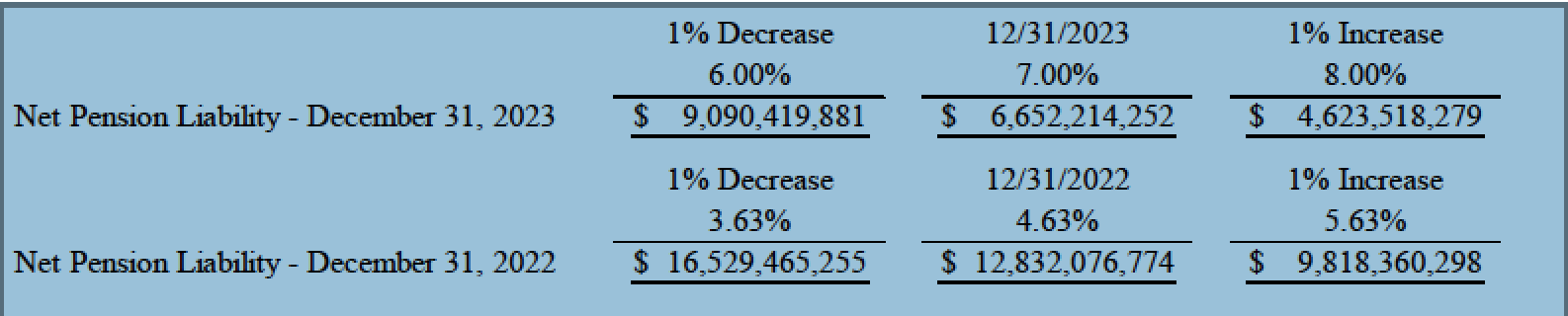
As a result of the move from a 4.63% blended rate (used a combination of the ROA (7%) and a municipal rate) they have now adopted a straight 7% discount rate equivalent to the fund’s return on asset assumption. Here is the result of that action:

As one can see, the present value (PV) of those future promises based on a 4.63% blended rate creates a net pension liability of -$12.8 billion. Using a 7% discount rate creates a PV of those net liabilities of “only ” -$6.7 billion. The dramatic improvement in the funded status from 48.4% to 64.1% is primarily the result of changing the discount rate, as a higher rate reduces the PV of your promise to plan participants. It really doesn’t change the promise, just how you are accounting for it.

The trustees who will participate in the TLC program offered by the FPPTA will receive a wonderful education that will allow them to dive into issues as referenced above. Knowing the ins and outs of pension management and finance will lead to more appropriate decisions related to benefits, contributions, asset allocation, etc.

Another Inconsistency

By: Russ Kamp, Managing Director, Ryan ALM, Inc.

The US pension industry is so critically important for the financial future of so many American workers. The defined benefit coverage is clearly not what it once was when more than 40% of workers were covered by traditional pension. There were a number of factors that led to the significantly reduced role of DB plans as the primary retirement vehicle. At Ryan ALM we often point out inconsistencies and head-scratching activities that have contributed to this troubling trend. One of the principal issues has been the conflict in accounting rules between GASB (public plans) and FASB (private plans). We frequently highlight these inconsistencies in our quarterly Pension Monitor updates.

The most striking difference between these two organizations is in the accounting for pension liabilities. Private plans use a AA corporate yield curve to value future liabilities, while public plans use the return on asset assumption (ROA) as if assets and liabilities move in lockstep (same growth rate) with one another. As a reminder, liabilities are bond-like in nature and their present values move with interest rates. I mention this relationship once more given market action during October.

Milliman has once again produced the results for the Milliman 100 Pension Funding Index (PFI), which analyzes the 100 largest US corporate pension plans (thank goodness that there are still 100 to be found). During the month of October, investment returns produced a -2.53% result. Given similar asset allocations, it is likely that investment results will prove to be negative for public plans, too. We’ll get that update later in the month from Milliman, also. Despite the negative performance result for the PFI members, their collective Funded Ratio improved from 102.5% at the end of September to 103.4% by the end of October.

The improved funding had everything to do with the change in the value of the PFI’s collective liabilities, as US rates rose significantly creating a -0.35%  liability growth rate and a discount rate now at 5.31%. This was the first increase in the discount rate in six months according to Zorast Wadia, author of the PFI. The upward move in the discount rate created a -$51 billion reduction in the projected benefit obligation of the PFI members. That was more than enough to overcome the -$41 billion reduction in assets.

What do you think will happen in public fund land? Well, given weak markets, asset levels for Milliman’s public fund index will likely fall. Given that the discount rate for public pension systems is the ROA, there will be no change in the present value of public pension plans’ future benefit obligations (silly). As a result, instead of witnessing an improvement in the collective funded status of public pensions, we will witness a deterioration. The inconsistency is startling!

Milliman: Public Pension Funded Ratio at 82.8%

By: Russ Kamp, Managing Director, Ryan ALM, Inc.

Milliman recently released results for its Public Pension Funding Index (PPFI), which covers the nation’s 100 largest public defined benefit plans.

Positive equity market performance in September increased the Milliman 100 PPFI funded ratio from 82.0% at the end of August to 82.8% as of September 30, representing the highest level since March 31, 2022, prior to the Fed’s aggressive rate increases. The previous high-water mark stood at 82.7%. The improved funding for Milliman’s PPFI plans was driven by an estimated 1.4% aggregate return for September 2024 (9.4% for the YTD period). Total fund performance for these 100 public plans ranged from an estimated 0.7% to 2.1% for the month. As a result of the relatively strong performance, PPFI plans gained approximately $72 billion in MV during the latest month. The asset growth was offset by negative cash flow amounting to about $10 billion. It is estimated that the current asset shortfall relative to accrued liabilities is about $1.138 trillion as of September 30. 

In addition, it was reported that an additional 5 of the PPFI members had achieved a 90% or better funded status (34 plans have now eclipsed this level), while regrettably, 14 of the constituents remain at <60%. Given that changing US interest rates do not impact the calculation for pension liabilities under GASB accounting, which uses the ROA as the liability discount rate, the improvement in the collective funded status may be overstated, as US rates continued to decline throughout the third quarter following an upward trajectory to start the calendar year.

Milliman: Corporate Pension Funding Weakens in September

By: Russ Kamp, Managing Director, Ryan ALM, Inc.

Milliman has released the latest results for the Milliman 100 Pension Funding Index (PFI). This index reviews the funding status each month of the top 100 U.S. corporate pension plans. The report indicated that the funded ratio declined to 102.4% at month-end from 102.6% at the end of August. Plan assets increased as a result of a 1.74% investment gain, but the discount rate declined by 0.14% to 4.96%. As a result, the growth in liabilities eclipsed asset growth leading to a $12 billion loss in funded surplus.

Assets for these combined plans now total $1.36 trillion as of September 30, while the projected benefit obligation is now $1.33 trillion giving these 100 corporate plans a $29 billion surplus. According to Zorast Wadia, author of the PFI, the current discount rate at 4.96% marks the first time since April 2023 that the rate hasn’t been >5.0%. However, so far in October we’ve witnessed a fairly significant move up in rates. If this trend continues, we could see the funded ratio for this index once again rising if the increase in rates doesn’t negatively impact the asset side of the pension equation.

Falling Rates – Not A Panacea For Pensions

By: Russ Kamp, Managing Director, Ryan ALM, Inc.

Milliman has reported that pension funding for Corporate plans declined in August. The Milliman 100 Pension Funding Index (PFI) recorded its most significant decline of 2024, as the funded ratio fell from 103.6% to 102.8% as of August 31, 2024. No, it wasn’t because markets behaved poorly, as the month’s investment gains of 1.81% lifted the combined plans’ market value by $17 billion, to $1.347 trillion at the end of the period. It was the result of falling US interest rates that impacted the liability discount rate on those future promises.

According to Milliman, the discount rate fell from 5.3% in July to 5.1% by the end of August. That 20 basis points move in rates increased the projected benefit obligations (PBO) for the index constituents by $27 billion. As a result, the $10 billion decline in funded status reduced the funded ratio by 0.8%. The index’s surplus is now at $36 billion.

Markets seem to be cheering the prospects of lower US interest rates that may be announced as early as September 18, 2024 following the next FOMC. Remember, falling rates may be good for consumers and businesses, but they aren’t necessarily good for defined benefit pension plans unless the fall in rates rallies markets to a greater extent than the drop in rates impacts the growth in pension liabilities.

“With markets falling from all-time highs and discount rates starting to show declines, pension funded status volatility is likely in the months ahead, underscoring the prudence of asset-liability matching strategies for plan sponsors”, said Zorast Wadia, author of the PFI. We couldn’t agree more with Zorast. As we’ve discussed many times, Pension America’s typical asset allocation places the funded status for DB pension on an uncomfortable rollercoaster. Prudent asset-liability strategies can significantly reduce the uncertainty tied to current asset allocation practices. Thanks, Milliman and Zorast, for continuing to remind the pension community of the impact that interest rates have on a plan’s funded status.

Healthier Than Ever? Nah!

By: Russ Kamp, Managing Director, Ryan ALM, Inc.

P&I produced an article yesterday titled, “Corporate Pension Funds Are Fully Funded, Healthier Than Ever. Now What?” According to Milliman, corporate pension plans are averaging roughly a funded ratio of 106%. This represents a healthy funded status, but it is by no means the healthiest ever. One may recall that corporate plans were funded in excess of 120% as recently as 2000. In what might be more shocking news, public pension plans were too when using a market discount rate (ASC 715 discount rate). Today, those public pension plans have a funded status of roughly 80% according to Milliman’s latest public fund report.

The question, “Now what”? is absolutely the right question to be asking. Many corporate plans have already begun de-risking, as the average exposure to fixed income is >45% according to P&I’s asset allocation survey through November 2023. Unfortunately, public pension systems still sit with only about 18% exposure to US fixed income, preferring a “let it ride” mentality as equities and alternatives account for more than 75% of the average plan’s asset allocation. Is this the right move? No. The move into alternatives has dried up liquidity, increased fees, and reduced transparency. Furthermore, just because a public plan believes that its sponsor is perpetual, does that make the system sustainable? You may want to be reminded about Jacksonville Police and Fire. There are other examples, too.

Whether the pension plan is corporate, multiemployer, or public, the asset allocation should reflect the funded status. There is no reason that a 60% funded plan should have the same asset allocation as one that is 90% or better funded. All plans should have both liquidity and growth buckets. The liquidity bucket will be a bond allocation (investment grade corporates in our case) that matches asset cash flows to liability cash flows of benefits and expenses. That bucket will provide all of the necessary liquidity as far into the future as the pension system can afford. The remaining assets will be focused on outperforming future liability growth. These assets will be non-bonds that now have the benefit of an extended investing horizon to grow unencumbered. Forcing liquidity in environments in which natural liquidity has been compromised only serves to exacerbate the downward spiral.

Pension America has the opportunity to stabilize the funded status and contribution expenses. They also have the chance to SECURE a portion of the promises. How comforting! We saw this movie a little more than 20 years ago. Are we going to treat this opportunity as a Ground Hog Day event and do nothing or are we going to be thoughtful in taking appropriate measures to reduce risk before the markets bludgeon the funded status? The time to act is now. Not after the fact.

Weakening Jobs Growth To Further Pressure DB Plans

Given the news from this morning regarding US job growth (only 142,000 jobs added and revisions down in the previous two months), it would not surprise us to see US interest rates continue to fall.  If in fact this happens, DB plans’ funded ratios and funded status will continue to weaken. As we’ve reported on numerous occasions, plan liabilities, although discounted at the ROA, do not grow at the same rate as assets.

Liability growth has far outpaced asset growth in the last 15 years, and the asset allocation mismatch that exists between a plan’s assets and liabilities continues to be dramatic.  With most everyone expecting interest rates to rise, fixed income exposures have been reduced and bond durations shortened. A combination that continues to weigh on plan performance.

We continue to believe that weak global growth will keep interest rates low for the foreseeable future, and as such, fixed income exposures should be increased and reconfigured to meet near-term liabilities.  I will be discussing this concept / strategy at the upcoming FPPTA conference on Tuesday in Naples, FL.

Plans continue to focus almost exclusively on their fund’s ROA, but the liability side of the equation needs some attention, too, especially given the prospects for continuing global economic weakness.  In this environment, a plan will not close it’s funding gap through outperformance relative to its ROA.