DB Pensions Are NOT Ponzi Schemes!

By: Russ Kamp, CEO, Ryan ALM, Inc.

I recently stumbled onto an article that was highlighting the impending pension crisis (disaster) that is unfolding in Florida. The author’s primary reason for concern is the fact that there are now more beneficiaries collecting (659,333) than workers paying in (459,428). Briefly mentioned was the fact that the pension system currently has a funded ratio of 83.7% up from 82.4% last year. The fact that there are more recipients than those paying into the system is irrelevant. DB pension systems are not Ponzi Schemes, which in nothing more than a fraudulent vehicle that relies on a continuous influx of new “investors” (substitute plan participants) to pay the existing members of the pool.

A DB pension’s promises (benefit payments) are calculated by actuaries who have an incredibly challenging job of forecasting each individual’s career path (tenure), salary growth, longevity, etc. They do a great job, but they’ll be the first to tell you that they don’t get the individual participant calculations correct, but they do an amazing job of getting the total universe of payments nearly spot on. An acquaintance of mine, who happens to be an excellent actuary shared the following, “pension plans are funded over an active member’s career so that there will be sufficient funds to pay retirement benefits for life.  The funding rules in Florida require contributions to get the plan 100% funded over time.”

Granted, there are states that have not made the annual required contribution, in some cases for decades, and those plans are suffering (poorly funded) as a result. That isn’t the actuary’s issue, but they are left to try to make up the difference by forecasting the need for greater contributions and more significant returns. The payment of contributions comes with little uncertainty, while the reliance on greater investment performance comes with a huge amount of uncertainty over short time frames. I wouldn’t want my pension fund or livelihood (Executive Director, CIO, etc.) dependent on the capital markets.

I frequently hear the concern expressed about negative cash flow plans (i.e. contributions do not fully fund benefits). Why? If pension systems are truly designed based on each participant’s forecasted benefit, mature plans are bound to eventually fall into negative cash flow situations. These plans are designed to pay the last plan participant the last $1 of assets. These pension systems aren’t designed to be an inheritance for some small collection of beneficiaries who make it to the finish line. Importantly, there should be different investment strategies used for plans that are collecting more than they are paying out versus those in negative cash flow situation.

DB pensions are critically important retirement vehicles that need to be protected and preserved. Fabricating a crisis based on an incorrect observation is not helpful. If plan sponsors contribute the necessary amount each year and manage the assets prudently, these pension systems should be perpetual. Neglect the basics and all bets are off!
You Have An Obligation – Fund it!

By: Russ Kamp, Managing Director, Ryan ALM, Inc.

I recently participated in a new program put on by the Florida Public Pension Trustees Association (FPPTA). They’ve introduced a higher-level program for trustees that really want to dive more deeply into pension issues. I’m thankful to have the opportunity to participate both as a speaker and a coach. At the inaugural event, the FPPTA leadership invited Von M. Hughes, the author of the book, U.S. Public Pension handbook”, which he described as a comprehensive guide for trustees and investment staff. During the Q&A session, Von was asked what differentiates a good fund from one that is performing poorly. His response was simple and direct. The pension systems that are best in class make the annual required contributions (ARC).

His response didn’t suggest anything about plans with internal staff versus those that outsource all investment functions. It had nothing to do with how complex the overall asset allocation was or the percentage allocated to alternatives. Furthermore, it didn’t matter about the size of the fund. It was simply, are you funding to a level required each and every year. Brilliant!

We all know which public funds are struggling and which are near full funding. There are enough entities reporting on the key metrics annual, if not more frequently. A closer look at these funds does support Von’s claim. But it isn’t just the lack of discipline in providing the necessary funding to secure the promises that have been met. There are also issues with regard to actuarial practices and legislative constraints. There is an interesting article in P&I with Brian Grinnell, former Chief Actuary, for the Ohio State Teachers’ Retirement System. Grinnell left the pension fund in May after more than 10 years, as the Chief actuary. According to Grinnell, he left the system because he “was not comfortable with the direction the plan was headed, and I didn’t feel like my continued participation would be positive.”

Grinnell discussed several issue, but the two that jumped out at me were the open amortization period and fixed contributions. In the case of the open amortization, Grinnell mentioned that “the amortization period for the retirement system’s unfunded pension liabilities under the STRS defined benefit plan had become infinite — meaning that it would never become fully funded.” Can you imagine having a mortgage with such a feature? With respect to the fixed-rate structure of both contributions and benefits, Grinnell mentioned that following a poor performance year the normal practice would be to increase contributions, which in the case of the Ohio plans is not possible without legislative action.

If creating a strong public pension system is predicated on the entity’s ability to meet the ARC, why would our industry agree to accounting and actuarial practices that restrict prudent action? Amortization periods should be fixed and contributions should be a function of how the plan is performing. As we’ve stated many times, DB pension plans are too critically important to millions of American workers. Investing is not easy. Forecasting the longevity of the participants is not easy. Let’s at least get the easy stuff right! Fund what is required!

Sometimes You Just Have To Shake Your Head

By: Russ Kamp, Managing Director, Ryan ALM, Inc.

CIO Magazine recently published an article chronicling the trials and tribulations of the Dallas Police and Fire and Dallas Employees pension systems. This is not the first time that these systems have been highlighted given the current funded status of both entities, especially the F&P plan currently funded at 39%. The article was based on a “commissioned” study by investment adviser Commerce Street Investment Management, that compiled and in June presented its report to the city’s ad hoc committee on pensions. According to the CIO Magazine article, they were “tasked with assessing the pension funds’ structure and portfolio allocation; reviewing the portfolios’ performance and rate of return; and evaluating the effectiveness of the pension funds’ asset allocation strategy.” That’s quite the task. What did they find?

Well, for one thing, they were comparing the asset allocation strategies of these two plans with similarly sized Texas public fund plans, including three Houston-based systems: the Houston Firefighters’ Relief and Retirement Fund, the Houston Police Officers’ Pension System, and the Houston Municipal Employees Pension System. The practice of identifying “peers” is a very silly concept given that each system’s characteristics, especially the pension liabilities, are as unique as snowflakes. The Dallas plans should have been viewed through a very different lens, one that looked at the current assets relative to the plan’s liabilities.

Unfortunately, they didn’t engage in a review of assets vs. liabilities, but they did perform an asset allocation review that indicated that the two Dallas plans did not have enough private equity which contributed to the significant underfunding. Really? Commerce Street highlighted the fact that “Houston MEPS’ private equity allocation is 28.2%, and the average private equity allocation among the peer group is 21.3%, compared with the DPFP and Dallas ERF’s allocations of 12.2% and 10.5%, respectively.” How has private equity performed during the measurement period? According to the report, Dallas P&F’s plan performed woefully during the 5-years, producing only a 4.8% return, which paled in comparison to peers. Was it really a bad thing that Dallas didn’t have more PE based on the returns that its program produced?

Why would the recommendation be to increase PE when it comes with higher fees, less liquidity, little transparency, and the potential for significant crowding out due to excess migration of assets into the asset class? During the same time that Dallas P&F was producing a 4.8% 5-year PE return, US public equities, as measured by the S&P 500, was producing a 15.7% (ending 12/31/23) or 15.1% 5-year return ending 3/31/24. It seems to me that having less in PE might have been the way to go.

The Commerce report recommended that “to improve the pension funds’ returns and funded ratios, the city should: analyze what top performing peers have done; collaborate to find new investment strategies; improve governance policies and procedures; and provide recommendations for raising the funds’ investment performance.” Well, there you have it. How about returning to pension basics? Dallas is going to have to contribute significantly more in order to close the funding gap. They are not going to be able to create an asset allocation that will dramatically outperform the ROA target. Remember: if a plan is only 50% funded, achieving the ROA will result in the funded status deteriorating even more. They need to beat the ROA target by 100% in order to JUST maintain the deficit.

I’ve railed about pension systems needing to get off the asset allocation rollercoaster to ruin. This recommendation places the Dallas systems on a much more precarious path. So much for bringing some certainty to the management of pension plans. No one wins with this strategy. Not the participant, sponsor, or the taxpayers.

CFM: Buy Time and Reduce Risk

By: Russ Kamp, Managing Director, Ryan ALM, Inc.

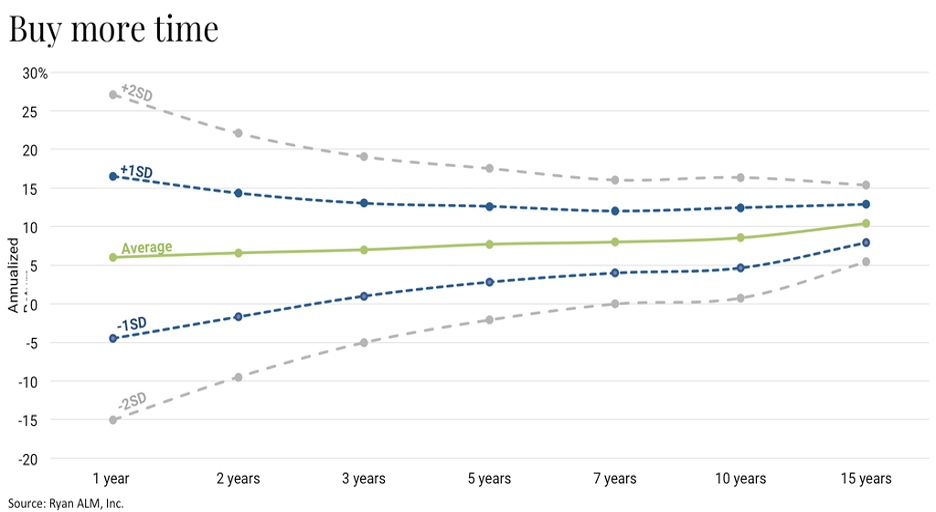
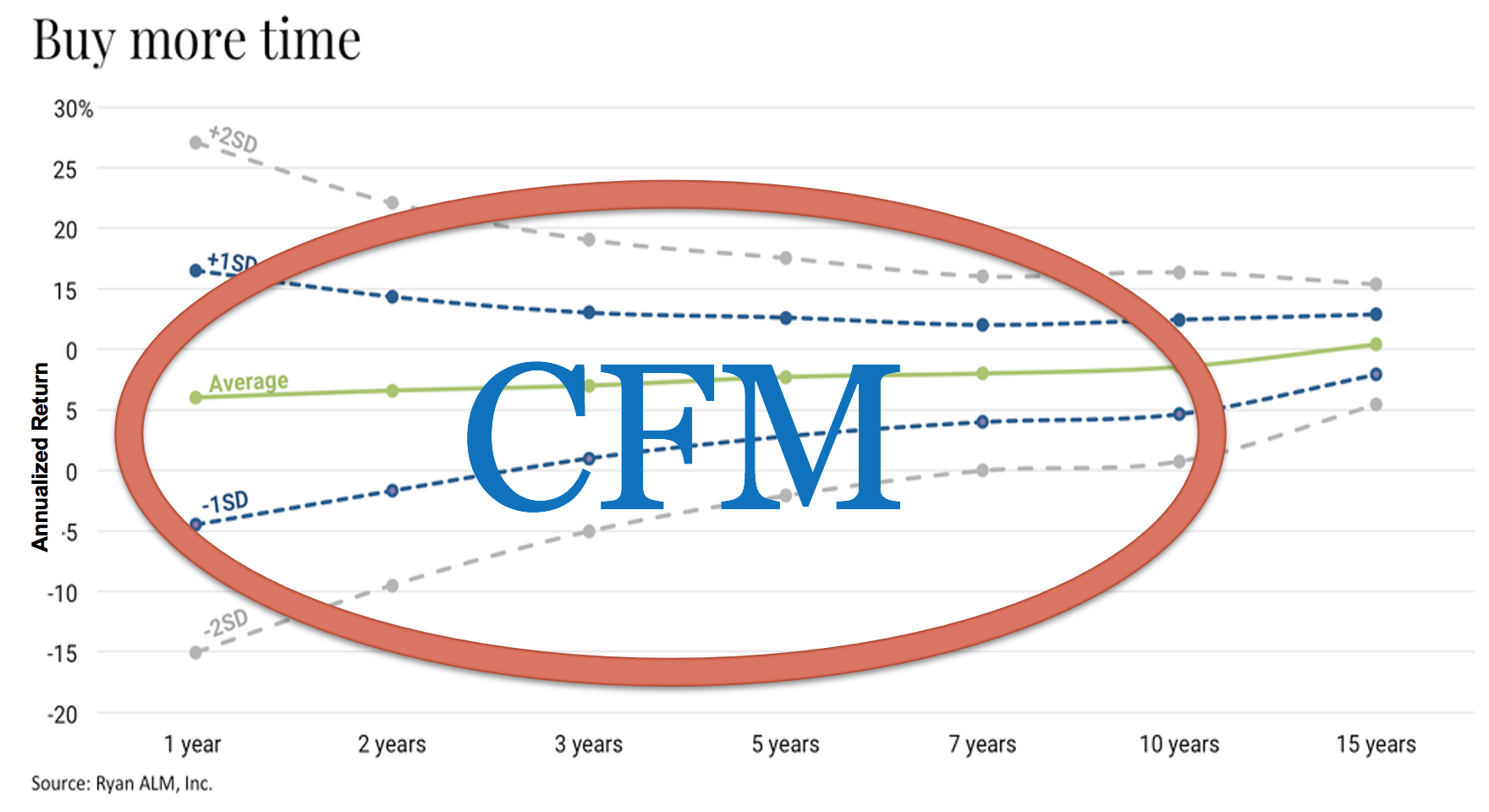
A traditional DB plan’s asset allocation comes with a lot of annual volatility (see the graph below). That volatility gets reduced as one extends the investing horizon, but it is still quite uncertain until you extend sufficiently, such as 10 or more years. However, as plan sponsors and investment managers, we have been living in a quarter-to-quarter measurement cycle for decades. In that environment, a 1 standard deviation (1 SD) measurement for a 1-year time frame (Ryan ALM asset allocation model since 1999) is +/- 10.5%. In the example below, 68% of the observations (1 SD) will fall between 16.5% and -4.5%. A 2 SD measurement would have the range for 95% of the observations between 27% and -15%. That gap, or should I say canyon, is a 1-year observation. Extend the measurement period to 5-years and the range of results is still wide but less so at +/- 9.8% for 2 SDs. It isn’t until you get beyond 10 years that the volatility associated with a fairly traditional asset allocation gets to a reasonable level.

Is there a way to bring more certainty to the asset allocation process that would allow for longer observation periods and less volatility? Absolutely! A plan sponsor and their advisors can adopt a bifurcated asset allocation in which a liquidity bucket is created that will fund and match the plan’s liability cash flows of benefits and expenses chronologically from the next month as far out as the allocation will cover (10+ years) allowing for the remainder of the alpha assets (all non-bond assets) to now grow unencumbered. The task for those assets is to meet future liabilities.

As the graph below highlights, a carefully constructed cash flow matching (CFM) portfolio can help plan sponsors wade through the volatility associated with shorter timeframes. The CFM portfolio will consist of investment grade bonds whose cash flows of interest and principal will be matched to the liability cash flows. This process now ensures (absent defaults) that the necessary liquidity is available when needed as those future promises have been SECURED. The remaining assets can now be managed as aggressively as the plan’s funded status dictates.

With this process, short-term market dislocations will no longer impact the plan’s ability to meet its obligations. There will be no forced selling to meet benefit payments. The alpha assets can now grow without fear of being sold at an unreasonable level. The CFM program takes care of your needs while establishing a buffer (longer investing horizon) from market corrections that happen on a fairly regular basis. This structure should also lead to less volatility related to contributions and the plan’s funded status.

Given the elevated US interest rate environment, now is the time to engage in this process. CFM will provide a level of certainty that doesn’t exist in a traditional asset allocation. This is a “sleep well at night” strategy that should become the core holding for DB pensions. As I mentioned in an earlier blog post today, bonds should only be used for the cash flows they produce. They should not be used as total return-seeking instruments. Leave that task to the alpha assets that will benefit from a longer investing period.

Housing Rental Expense killing DC contributions?

Despite the fact that inflation, as measured by the CPI, seems to be contained, rental expense for housing has jumped significantly in the US during the last decade.  As a country we are moving away from being a home ownership society to one that rents housing, as home ownership is now at its lowest since 1967! Furthermore, the only reason the home ownership rate is as “high” as it is, is due to homeowners in the 65 and over age group. For everyone else, home ownership rates are now the lowest recorded.

Compounding this problem is the fact that US household incomes are 7.2% less than they were in 1999. The lower incomes are being crushed by rising housing costs, medical expenses / insurance and education. Is it no wonder that folks don’t have any additional resources to fund their DC plans? What percentage of the US population really has discretionary income at this time?

According to the “State of the Nation’s Housing” report released by the Center for Housing Studies at Harvard, which showed that while inflation among most products and services may indeed be roughly as the Fed and BLS represent it, when it comes to rent things have never been worse.

According to the report, 2013 marked another year with a record-high number of cost burdened households – those paying more than 30 percent of income for housing. In the United States, 20.7 million renter households (49.0 percent) were cost burdened in 2013.  Alarmingly, 11.2 million (25%) all renter households, had “severe cost burdens, paying more than half of income for housing.” The median US renter household earned $32,700 in 2013 and spent $900 per month on housing costs.

So, do you still believe that the failure to fund defined contribution plans is because we have a population hellbent on consumption? The demise of the DB plan means that a significant percentage of our population will never be able to make adequate contributions (if any) into their retirement plan. The social and economic consequences for our country will be grave.

Future Contributions Into A DB Plan Should Be Considered An Asset Of The Fund

Recently, Mary Williams Walsh, NY Times, penned an article titled,

“Standards Board Struggles With Pension Quagmire”.

The gist of the article had to do with what role did the actuaries and actuarial accounting play in the current state of public pension funding. Many of the actuaries felt that they were pressed by politicians into reverse-engineering their calculations to achieve a predetermined result (contribution cost). “That can’t be good public policy,” said Bradley D. Belt, a former pension regulator, who is now the vice chairman of Orchard Global Capital Group.

According to Ms. Walsh, “he called for additional disclosures by states and cities, including the current value of all pensions promised, calculated with a so-called risk-free discount rate, which means translating the future benefits into today’s dollars with the rate paid on very safe investments, like Treasury bonds.”

Actuaries currently use higher discount rates, which complies with their professional standards but flies in the face of modern asset-pricing theory. Changing their practice to resolve this is one of the most hotly contested proposals in the world of public finance, because it would show the current market value of public pensions and probably make it clear that some places have promised more than they can deliver.

But, if we are going to require DB plans to mark-to-market their fund’s liabilities, inflating future promised benefits, we should also include future contributions as an asset of the plan. Since many, if not most plans, have a legal obligation to fund the plan at an actuarial determined level or through negotiations, these contributions are likely to be made (NJ is one of the exceptions).

When valuing liabilities at “market” without taking into consideration future contributions, plans are artificially lowering their funded ratio, while negatively exacerbating their funded status. Most individuals (tax payers) would not understand the “accounting”, but they would certainly comprehend the negative publicity of a < 50% funded plan.

Most public pension plans derive a healthy percent of their assets through contributions.  Not reflecting these future assets in the funded ratio creates the impression that these funds are not sustainable, which for most public plans is not close to reality.

We need DB plans to be the backbone of the US retirement industry. Only marking to market liabilities without giving a nod to future contributions doesn’t fairly depict the whole story. We can do better.

Rethink the Use of Fixed Income in a Defined Benefit Plan

With the closure of the first quarter, we’d like to remind you of a blog post that we first published in early January.  Our thoughts are still relevant, especially given the market action within fixed income during the quarter and what is transpiring in US fixed income today.  The 10-year Treasury has rallied 2% today, and we think that it may continue to move lower.  The following paragraphs are what we originally posted.

What I’d like to highlight today is a new use for a plan’s current fixed income exposure. In day two of the conference, I attended a panel discussion titled, “Opportunities in Fixed Income and Credit Markets”.  The panel was occupied by 4 senior investment pros (plan sponsor, consultant, and investment managers).  They generally discussed the likelihood that interest rates were going to rise (I’m beginning to wonder if there is anyone out their who doesn’t think that rates will rise), and the implications of that movement on traditional fixed income portfolios.  Most of the panelists talked about various sub-sectors (mortgages, asset backs, bank loans, etc) and which ones might hold up better. There was discussion about shortening duration, etc. They also talked about fixed income’s traditional role as an anchor to windward, a risk reducer, and a provider of liquidity.

However, only one individual mentioned taking a step back to truly contemplate the “role” of fixed income.  He didn’t provide any further perspective, which is why I’m addressing the issue here and today.  I believe (as do my partners at KCS) that a plan’s liabilities should be the focal point of any pension discussion.  As such, they need to be the primary objective for the plan, the driver of asset allocation decisions and investment / portfolio structure.  The asset class most similar in characteristic to liabilities is fixed income.  As such, fixed income needs to play a prominent role in a defined benefit plan.

Instead of worrying about the implications from a rising interest rate environment on an LDI strategy that currently consists of long duration corporates, change the emphasis to matching near-term liabilities, by converting your current fixed income portfolio into a Treasury STRIP portfolio that matches cash flows with projected benefits (Beta portfolio).  First, you are improving liquidity.  Second, duration is shortened in an environment that may not be conducive to long bonds.  Third, you are lengthening the investing time horizon for the balance of the corpus, which will allow asset classes / products with a liquidity premium a chance to capture that performance increment (Alpha portfolio). Finally, the funded status and contribution costs should begin to stabilize.  As the Alpha portfolio outperforms liability growth (hopefully), siphon excess profits and extend the beta portfolio.

This is a proactive move to restructure the fixed income portfolio in an environment of uncertainty.

Lastly, I am not of the general school of thought that interest rates are definitely going to rise, and soon.  I believe that we still have slack demand in our economy, brought on by underemployment, which will keep inflation in check and provide room for stable to slightly lower rates.