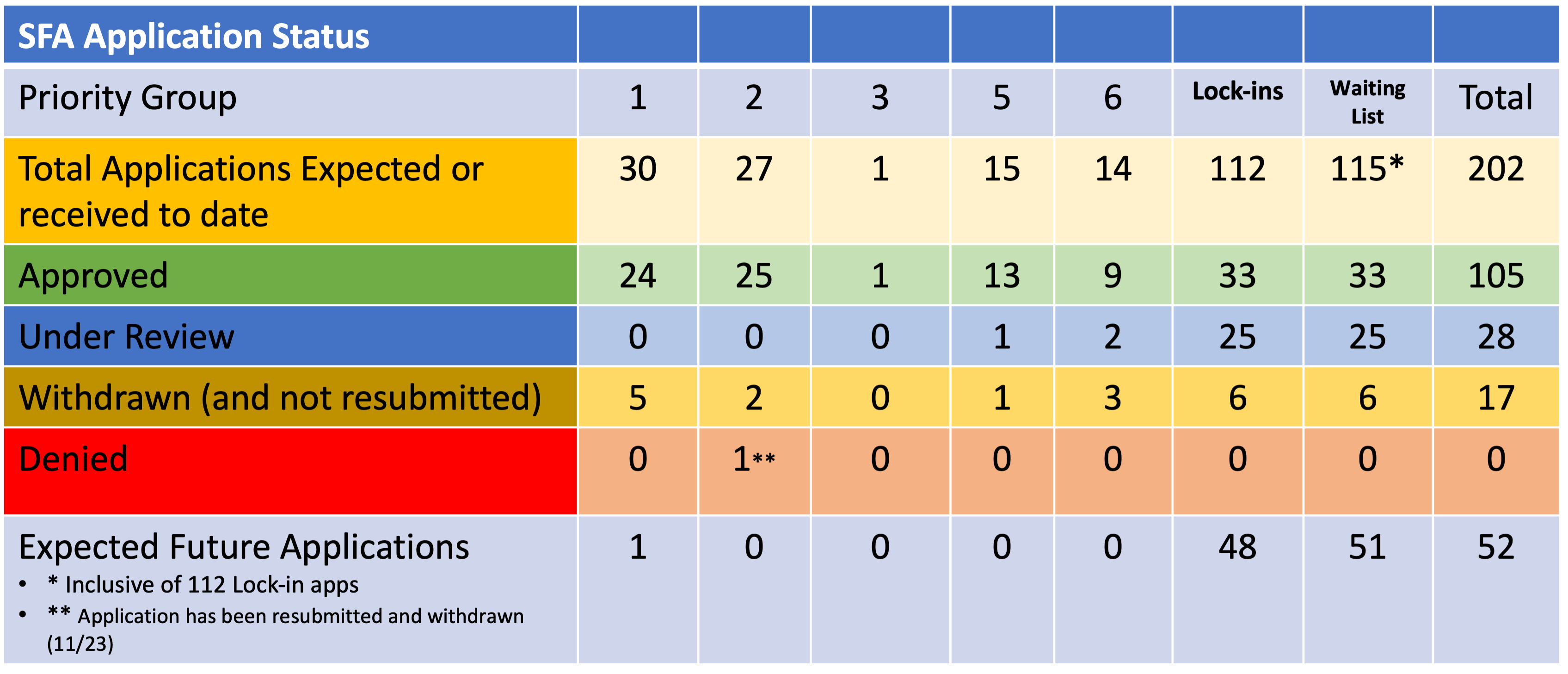
After a very hectic June, in which the PBGC approved nine applications for SFA, July has seen a replenishing of submitted applications seeking SFA grant money with 9 being filed in the first three weeks of the month. In the last week alone, we had Local 734 Pension Plan, Teamsters Local 210 Affiliated Pension Plan, Pension Plan of the Marine Carpenters Pension Fund, and the Pension Plan of the Automotive Machinists Pension Trust submit applications seeking nearly $411.5 million for the combined 20,111 plan participants.
There is really nothing else of note to those of us on the outside of this process. According to the PBGC’s website, there were no applications for SFA approved or denied in the previous week. No funds were asked to return excess payments, no multiemployer plans were added to the waitlist, and no applications were withdrawn.
There are still 16 funds with Priority Group standing (1-6) that are not currently under review, including 1 Priority Group 1 member that hasn’t filed an initial application, while all the others have withdrawn at least initial applications. In addition, there are still 71 waiting list applicants that have not yet submitted an initial application. Despite the successful implementation of ARPA to date, the PBGC still has a ton of work to do.
A friend of mine in the industry emailed me a copy of Howard Marks’ latest memo titled, “The Folly of Certainty”. As they normally are, this piece is excellent. As regular readers of this blog know, I’ve encouraged plan sponsors and their advisors to bring more certainty to defined benefit plans through a defeasement strategy known as cash flow matching. I paused when I read the title, thinking, “oh, boy”, I’m at odds with Mr. Marks and his thoughts. But I’m glad to say after reading the piece that I’m not.
What Howard is referring to are the forecasts, predictions, and/or estimates made with little to no doubt concerning the outcome. He cited a few examples of predictions that were given with 100% certainty. How silly. Forecasts always come with some degree of uncertainty (standard deviation around the observation), and it is the humble individual who should doubt, to some degree, those predictions. I’ve often said that hope isn’t an effective investment strategy, but that thought doesn’t seem to have resonated with a majority of the investment community.
Ryan ALM’s pursuit of greater certainty is brought about through our ability to create investment grade bond portfolios whose cash flows match with certainty (barring a default) the liability cash flows of benefits and expenses. We accomplish this objective through our highly sophisticated and trade-marked optimization model. We are not building our portfolios with interest rate forecasts, based on economic variables that come with a very high degree of uncertainty. No, we build our portfolios based on the client’s specific liability cash flows and implement them in chronological order. Importantly, once those portfolios are created, we’ve locked in a significant cost reduction that is a function of the rate environment and the length of the mandate.
As stated previously, I have a great appreciation for Howard Marks and what he’s accomplished. He is absolutely correct when he questions any forecast that has little expectation for being wrong. In most cases, the forecaster is not in control of the outcome, which should lend itself to being more cautious. In the case of the Ryan ALM cash flow matching strategy, we are in control. Having the ability to bring some certainty in our pursuit of securing the promised benefits should be greatly appreciated by the plan sponsor community. Because of the uncertain economic environment that we are currently living in, bringing some certainty should be an immediate goal. Care to learn more?
Given the improved funded status for most defined benefit pension plans, there is increased plan sponsor interest in reducing some of the risk from a traditional asset allocation. Asset Liability Management (LDI) is the process by which this objective can be implemented. We are pleased to provide you with an LDI checklist that provides you with some important questions that should be answered by prospective investment managers. We specifically discuss the two primary LDI strategies – cash flow matching and duration matching.
Hopefully these insights will prove most useful to you. There is also a plethora of additional research on how to de-risk a pension plan at https://www.ryanalm.com/white-papers. Lastly, don’t hesitate to reach out to us if we can be of any further assistance. Our experience in this space dates back to the 1970s.
Not only has the weather heated up, but so has the activity at the PBGC as it relates to the implementation of the ARPA pension legislation. During the past week two non-priority group plans submitted applications. In the case of the Carpenters Pension Trust Fund – Detroit & Vicinity, it was a revised application seeking nearly $600 million in Special Financial Assistance (SFA), while the Laborers’ Local No. 265 Pension Plan put forward its initial filing seeking $55.6 million. In total, more than 24,000 plan participants would enjoy a more secure retirement with the approval of these applications.
In other ARPA news, the American Federation of Musicians and Employers’ Pension Plan finally received approval. This fund had multiple filings throughout the process, which began on March 10, 2023 with the initial filing followed by two other applications. The wait was certainly worth it, as they will receive >$1.5 billion to reinforce the pensions of nearly 50,000 eligible participants.
There were no applications denied during the past week, but one fund, the United Food and Commercial Workers Union and Participating Food Industry Employers Tri-State Pension Plan, withdrew its application that had been seeking $638.3 million in SFA for 29+k members. There were no plans that were forced to repay excess SFA assets and no new plans added to the waitlist.
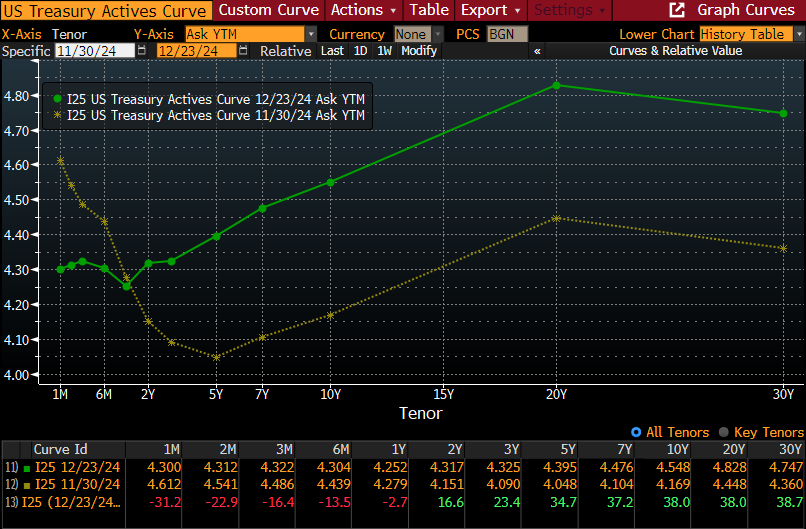
We’ve all heard the phrase with uncertainty comes opportunity, and that may very well be true, but the uncertainty comes with a certain level of risk, too. Given all of the uncertainty in the economic and political spheres at this time, is the opportunity greater than the risk? We would encourage plan sponsors of all plan types to look to reduce some of the risk in their funds, especially given the elevated multiples on which the equity markets are currently trading. The higher US interest rates are providing a unique opportunity not available to us in the past two decades. Secure some of the promises (benefits) by defeasing your liabilities through a cash flow matching strategy. We are happy to discuss this suggestion in far greater detail or you can go to RyanALM.com to read myriad research articles and blog posts on the subject.
Milliman has once again produced its monthly update of the Milliman 100 Pension Funding Index (PFI), which analyzes the 100 largest U.S. corporate pension plans. Thank goodness they can still find 100 corporate plans to evaluate. Despite my snarkiness, it is good to read that Milliman is reporting improved funding for the sixth consecutive month in 2024, with a slight increase in the funded ratio from 103.6 to 103.7. The surplus remained the same at $46 billion.
June’s investment return of 1.22% matched the $9 billion increase in liabilities as the discount rate fell 7 bps to 5.46%. “The first half of 2024 has seen nothing but funded ratio improvements,” said Zorast Wadia, author of the PFI. “However, with markets at all-time highs and concerns that discount rates may eventually fall, the forecast for the second half of 2024 may not be as sanguine, and liability-matching portfolios will continue to be prudent strategies for plan sponsors.”
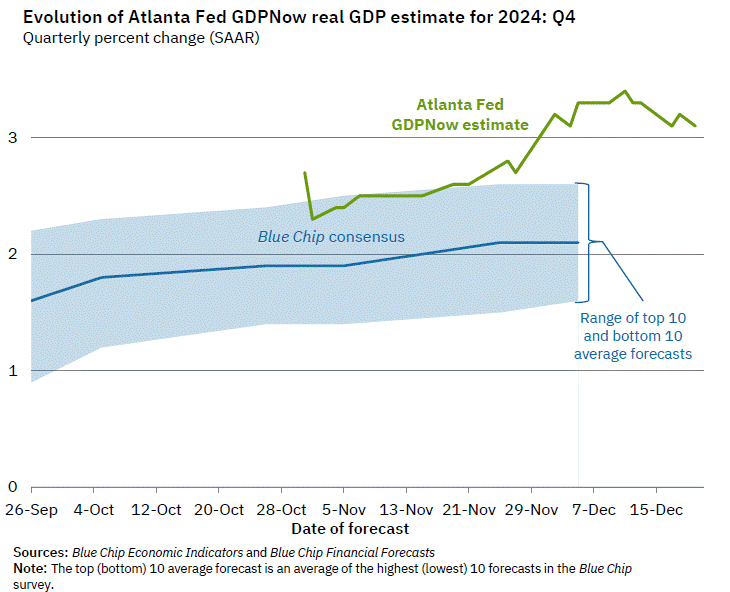
We absolutely agree with Zorast’s assessment of what may transpire in 2024’s second half. There has clearly been a slowing in economic activity as seen by the GDP in Q1’24 (1.4%) and Q2’24 is not looking much more robust, as the Atlanta Fed’s GDPNow model presently forecasts a 2.0% real GDP annualized return for the second quarter. If economic weakness were to develop, as a result of the Fed’s campaign to stem inflation by raising the Fed Fund’s rate (presently 5.25% – 5.5%), US interest rates could fall, while equities could also cool off as a result of the economic weakness. A combination such as this would be quite detrimental to pension funding.
In related news, FundFire has published an article highlighting the fact that “fixed income products now make up about 54% of defined-benefit portfolios, according to Mike Moran, senior pension strategist at Goldman Sachs Asset Management. He is obviously speaking about corporate plans, as both public and multiemployer exposures to fixed income are much more modest. Happy to see that Moran was quoted as saying that he “urges pension managers to act quickly to de-risk.” He went on to say, “This is a period of strength, a position of strength, for plan sponsors, and history shows us that the position of strength can sometimes be fleeting,” We absolutely agree.
We’ve been encouraging plan sponsors of all types to act to reduce risk and secure the promised benefits before the Fed or market participants reduce rates from these two-decade high levels.
Not sure why I used the title that I did, but I recently had pudding (vanilla) over the holiday weekend, so maybe that inspired me, and boy, was it good! That said, we, at Ryan ALM, Inc., are frequently challenged about the benefits of Cash Flow Matching (CFM) versus other LDI strategies, most notably duration matching. There seems to be singular focus on interest rate risk without any consideration for the need to create the necessary liquidity to meet monthly benefit payments. Given that objective, it isn’t surprising that duration matching strategies have been the dominant investment strategy for LDI mandates. But does that really make sense?
Are duration matching strategies that use an average duration or several key rate durations along the Treasury curve truly the best option for hedging interest rate risk? There are also consulting firms that espouse the use of several different fixed income managers with different duration objectives such as short-term, intermediate, and long-term duration mandates. Again, does this approach make sense? Will these strategies truly hedge a pension plan’s interest rate sensitivity? Remember, duration is a measure of the sensitivity of a bond’s price to changes in interest rates. Thus, the duration of a bond is constantly changing.
We, at Ryan ALM, Inc., believe that CFM provides the more precise interest rate hedge and duration matching, while also generating the liquidity necessary to meet ongoing benefits (and expenses (B&E)) when needed. How? In a CFM assignment, every month of the mandate is duration matched (term structure matched). If we are asked to manage the next 10-years of liabilities, we will match 120 durations, and not just an “average” or a few key rates. In the example below, we’ve been asked to fund and match the next 23+ years. In this case, we are funding 280 months of B&E chronologically from 8/1/24 to 12/31/47. As you can see, the modified duration of our portfolio is 6.02 years vs. 6.08 years for liabilities (priced at ASC 715 discount rates). This nearly precise match will remain intact as US interest rates move either up or down throughout the assignment.
Furthermore, CFM is providing monthly cash flows, so the pension plan’s liquidity profile is dramatically improved as it eliminates the need to do a cash sweep of interest, dividends, and capital distributions or worse, the liquidation of assets from a manager, the timing of which might not be beneficial. Please also note that the cost savings (difference between FV and PV) of nearly 31% is realized on the day that the portfolio is constructed. Lastly, the securing of benefits for an extended time dramatically improves the odds of success as the alpha/growth assets now have the benefit of an extended investing horizon. Give a manager 10+ years and they are likely to see a substantial jump in the probability of meeting their objectives.
In this US interest rate environment, where CFM portfolios are producing 5+% YTMs with little risk given that they are matched against the pension plan’s liabilities, why would you continue to use an aggressive asset allocation framework with all of the associated volatility, uncertainty, and lack of liquidity? The primary objective in managing a pension plan is to SECURE the promised benefits at a reasonable cost and with prudent risk. It is not an arms race designed on producing the highest return, which places most pension plans on the asset allocation rollercoaster of returns.
We hope that you had an enjoyable long holiday weekend. We once again provide you with an update on ARPA and the PBGC’s implementation of this key pension legislation. Following a busy June, in which nine multiemployer plans received Special Financial Assistance (SFA) approval for $6.4 billion for roughly 233k participants, the PBGC’s application portal has been reopened and three applications were filed during the past week. PA Local 47 Bricklayers and Allied Craftsmen Pension Plan, Local 111 Pension Plan, and Bricklayers Pension Fund of West Virginia have each filed its initial application seeking SFA. In total, these three smallish plans are requesting $25.7 million for 2,066 participants.
In other developments, there was little obvious activity during the holiday shortened week, as there were no plans receiving approval for SFA, no applications that were denied or withdrawn, and no plans agreed to repay excess SFA grant money. Finally, there were no additional plans added to the waitlist at this time. Currently, 37 non-priority plans, from a list of 114, have seen some action on their application – approved, submitted, or withdrawn.
There remains great uncertainty within the US economy. Is the US labor market weakening? Is inflation truly under control? With the recent fall in Q2’24 GDP growth estimates from 3.1% to 1.5% by the Atlanta Fed (GDPNow model), will the Fed finally have the information that they’ve been seeking to reduce US interest rates? Will these trends begin to weigh on US corporate profits? If so, elevated valuations for US stocks could begin to pressure US stock prices, which seem to have been immune to bad news in the last couple of years. It may be time to rebalance or reduce any exposure to stocks within the SFA bucket and lock in these higher US rates.
We are very pleased to provide you with the Ryan ALM, Inc. 2Q’24 Newsletter. We hope that you find our insights meaningful. One trend of note is the dramatic improvement in DB pension funding during the last couple of years despite tremendous economic uncertainty. This improvement should get plan sponsors looking to remove some risk from their plan’s asset allocation. Give us a call at (201)675-8797 if you have any questions on how you can accomplish that objective.
As we complete the first half of 2024 and get ready for the Fourth of July celebrations with family and friends, we believe that it is fitting to celebrate the success to date of the ARPA pension legislation and the PBGC’s implementation that has positively impacted so many Americans. Here are the highlights:
ARPA’s Special Financial Assistance has been awarded to 84 plans to date.
Those 84 pension plans are responsible for >1.2 million American Workers, who now have their promised retirement benefit secured.
The 84 multiemployer plans have received roughly $60.4 billion in SFA to date.
Furthermore, there are roughly another 115-120 pension plans that might be eligible to receive the SFA before the program comes to its end. Just think of all those hard-working Americans who might have lost a significant % of their benefit, if not the whole promise, through no fault of their own. Congratulations, to all involved in creating and implementing this incredible legislation.
Despite all of the success of this program to date, there is much still to be done. During the previous week, the PBGC allowed two pension plans to file applications for SFA grants, including I.B.E.W. Pacific Coast Pension Fund and Midwestern Teamsters Pension Plan, with each submitting its initial application. In total, these two funds are looking for about $91.7 million in SFA proceeds for just under 4,000 plan participants. The PBGC will now have 120 days to act on these requests.
In other ARPA news, the Kansas Construction Trades Open End Pension Trust Fund received approval of its revised application. They will receive $43.1 million for the 8,145 participants in their program. There were no applications denied or withdrawn, and no funds were forced to repay excess SFA grants. Lastly, no new funds have been added to the waitlist.
We wish for you a wonderful Fourth of July holiday. Please remember those that sacrificed so much so that we can celebrate the independence and freedom that we enjoy in this country. Stay safe.
In a recent article in Nakedcapitalism.com, titled “Private Equity Becomes Roach Motel as Public Pension Funds and Other Investors Borrow as Funds Remain Tied Up”, posted by Yves Smith, there was a reference to the Stone Ages. Smith wrote, “pension funds in particular have actuarially-estimated payout schedules to meet. In the stone ages, they used to buy bonds and match the maturity to expected obligations”.
In the stone ages that strategy of matching maturities was likely used (a laddered bond portfolio). Today, we have highly structured optimization models that can do a far more effective job of ensuring that the cash flow to meet benefit payments is available when needed (monthly) at low-cost and with prudent risk.
Given the elevated yields available to bond investors, why wouldn’t we want to once again explore a strategy that actually supports the primary objective in managing a DB pension which is to SECURE the promised benefits at low cost and with prudent risk? It doesn’t seem like the current approach is working any better. It seems as if the “norm” in asset allocation results in less transparency, higher costs, and little liquidity. That doesn’t seem like a winning formula, but what do I know?