A Contrarian Approach That is Becoming More Common?

By: Russ Kamp, Managing Director, Ryan ALM, Inc.

I suspect that some (perhaps) many folks in our industry are becoming a little tired of my constant drum beat requesting a change in how pension plans are managed. I’m sorry if that is the case, but I have a reason to speak out often, if not loudly. My goal/mission, and that of Ryan ALM, Inc., is to protect and preserve defined benefit plans for the masses. I believe wholeheartedly that DB plans are superior to any other retirement program since they provide the monthly promise with little involvement from the participant, who may have particularly wonderful skills used in their day-to-day lives, but investing isn’t likely one of them.

By espousing Cash Flow Matching (CFM) as an important investment strategy, particularly in this period of attractive interest rates, we are bringing pension management generally and asset allocation strategies specifically back to its roots. The SECURING of the pension promise must be the primary objective for plan fiduciaries. Better yet, it should be accomplished at a reasonable cost and with prudent risk. As I’ve discussed before, a CFM strategy brings an element of certainty to the management of pensions that have embraced uncertainty through asset allocation strategies that are subject to the whims of the markets.

The riding of the asset allocation rollercoaster in pursuit of a performance objective does little to secure the pension promise, but it certainly adds to annual volatility of both the funded status and contribution expenses. Is that the outcome that the sponsors of these plans and the participants want? Heck no! Are we at Ryan ALM tilting at or own windmills? I sure hope not.

I’ve been heartened recently to read several articles favoring a return to pension basics, including the focus on the pension promise to drive asset allocation through a CFM implementation. I’m not afraid to be a lone wolf, and nearly 1,400 blog posts support that claim, but it is comforting to have some company, as being a contrarian outside of the “herd” has been described as being as painful as chewing off one’s left arm – OUCH! In one specific instance, Stephen Campisi, recently posted his article on LinkedIn.com, in which he espoused a similar bifurcated approach – liquidity and growth buckets – to pension asset allocation. He also reminded everyone that “aiming” at the correct objective was essential. In this case, he correctly cited that the objective was the promise that had been given to the participant.

Nothing would please me more than to have the entire industry once again realize the significant importance of the defined benefit plan and its role in securing a dignified retirement. Eliminating the rollercoaster cycles of performance will go a long way to preserving their use. Adopting a CFM strategy that secures the monthly promises at a reasonable cost and with prudent risk is the first step in the process. I look forward to you jumping on our bandwagon.

ARPA Update as of March 1, 2024

By: Russ Kamp, Managing Director, Ryan ALM, Inc.

Welcome to March. It is said that the weather in the Northeast comes in like a lion and exits like a lamb. Is the same true for markets? Given a lot of the crosscurrents in the markets from geopolitical concerns, equity valuations, AI, interest rates, and Fed policy, who knows what is in store for us this month and beyond.

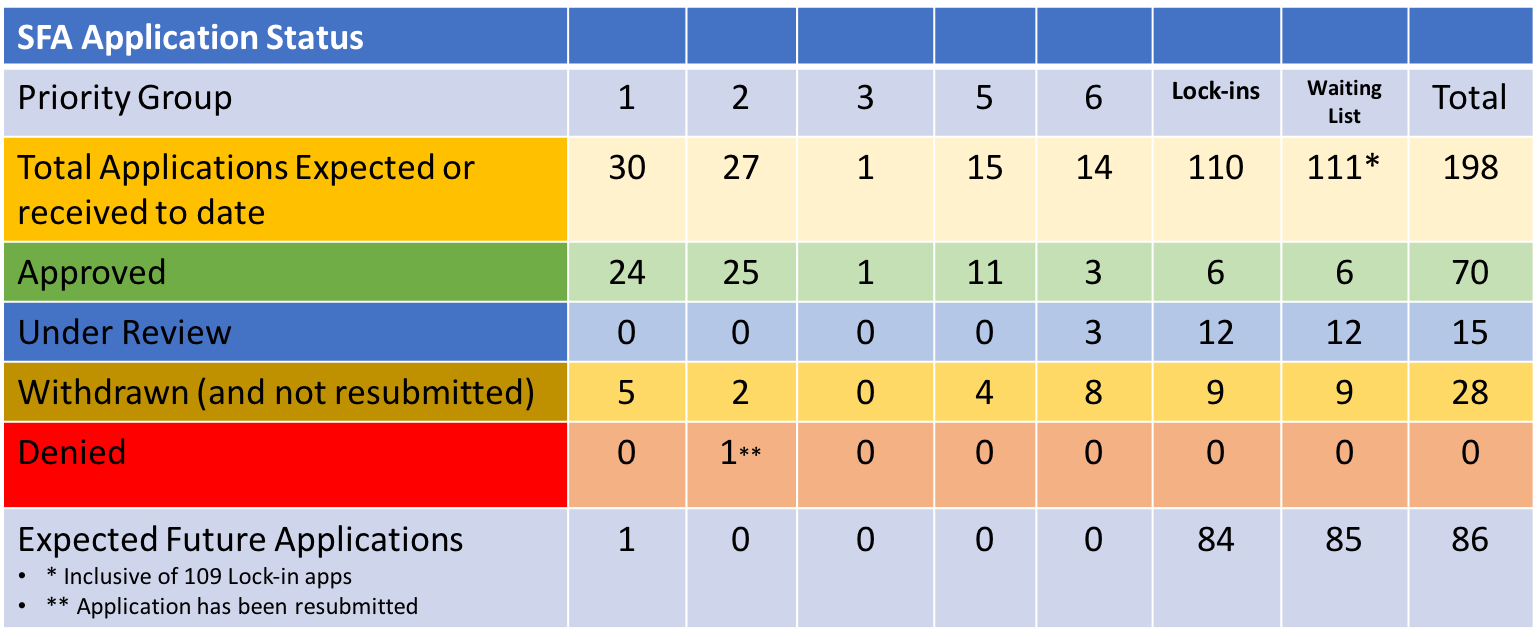
That said, we can with near certainty discuss what transpired during the last week as it relates to ARPA and the PBGC’s implementation of that critical legislation. I say with near certainty only because the weekly updated spreadsheet provided by the PBGC didn’t have a couple of actions from 2/23/24 that were only added in the March 1st update. Specifically, Union de Tronquistas de Puerto Rico Local 901 Pension Plan, a Priority Group 1 member, has once again withdrawn its application. They are seeking >$37 million for the 4,029 participants. In other delayed news, the American Federation of Musicians and Employers’ Pension Plan, a much larger fund and a Priority Group 6 member, has also withdrawn its revised application. They are in pursuit of an SFA grant that would provide the fund with $1.44 billion in SFA plus interest for more than 49k participants.

Now that we are caught up, this past week (ending 3/1/24) saw some activity, too. Two members from the waiting list entered their applications through the PBGC’s portal, including the Kansas Construction Trades Open End Pension Trust Fund and the Pacific Coast Shipyards Pension Plan. Both plans have submitted revised applications. Kansas Construction is seeking $40.7 million for its 8,145 participants, while the Shipyards plan is striving for $17.8 million for 507 participants, which is 35,108/participant compared to the roughly $5,000/participant for the Kansas plan.

In other ARPA news, there were no applications approved or denied during the previous week. There was one application withdrawn (2/26), but the Pacific Coast Shipyards quickly resubmitted the application by 3/1. In somewhat surprising news, there is a late arrival to the waitlist – # 113! Plasterers Local Union No. 1 Pension Plan joined the list on 2/26/24. They have also locked in the valuation date of November 30, 2023.

Have a great week. In the meantime, please don’t hesitate to reach out to us if we can be of any assistance to you as it relates to this legislation.

Bad Policy – AGAIN!

Further hikes in PBGC premiums will help pay for a federal budget bill agreed to by the White House and congressional leaders late Monday.

But, at what cost to our economy and employees?

According to P&I, the budget deal, which lays out a two-year budget and extends the federal debt limit until March 2017, raises per-person premiums paid to the Pension Benefit Guaranty Corp. from $64 in 2016 to $68 in 2017, $73 in 2018 and $78 in 2019. The 2015 rate is $57. Variable rate premiums would increase to $38 by 2019 from the current $24.

The proposal also calls for extending pension funding stabilization rules for two more years, until 2022, to allow sponsors to use higher interest rates when calculating contribution rates. Regrettably, this is nothing more than fuzzy math, and it continues to mask the true economics for DB plans.

“Once again the employer-sponsored system is being targeted for revenue,” said Annette Guarisco Fildes, president and CEO of the ERISA Industry Committee, who predicted that the premium hike will give defined benefit plan sponsors “more reasons to consider exit strategies.” We, at KCS, absolutely agree. DB plans need to be preserved. Punishing sponsors by raising PBGC premiums is not supportive.

“It’s an incredibly bad idea and it’s going to have, in the long run, devastating consequences for the (defined benefit) system,” said Deborah Forbes, executive director of the Committee on Investment of Employee Benefit Assets, in an interview.

According to P&I, PBGC officials had not called for additional premium increases in the single-employer program on top of ones already scheduled. “PBGC’s finances for the single-employer program have been improving steadily over the past few years, and there is really no reason to increase single-employer premiums at this time,” said Michael Kreps, a principal with Groom Law Group.

We’ve witnessed a precipitous decline in the use of DB plans during the last 30+ years. The elimination of DB plans as THE primary retirement vehicle and the move toward DC offerings to fill that gap is creating an environment in which there will be grave social and economic consequences. Enough already! Wake up Washington before the slope gets too slippery.

Single and Broke In Retirement?

We recently came across a news report that highlighted the fact that “singles” in the U.S. are more likely NOT to have a retirement account. In fact, only 51 percent of unattached people have a retirement savings account, according to a study released Wednesday by Mintel. (Mario Petitti / Chicago Tribune)

The population of single people is rising with almost half of adults today not living with a spouse, according to the U.S. Census. That’s up from about 30 percent in 1967.

“More Americans are staying single longer, and our data shows this trend will hold out for the foreseeable future,” Robyn Kaiserman, Mintel financial services analyst, said in the report.

Regrettably, the percentage of singles that have a retirement account is far less than people who are living with a partner or who are married, the research firm said.

Retirement savings accounts have been set up, in contrast, by 68% of people living with a partner and 84% of married adults.

We, at KCS, suggest that Americans overall need to take retirement more seriously, especially those not in a traditional DB plan.

For participants in defined contribution plans, just 27% contribute the maximum allowed to their plan, and 22% say they contribute only enough to get the employer match.

Whether you are single or not the key to funding a successful retirement is to start saving / investing early in life and be consistent (save with every paycheck). Taking advantage of a matching 401k plan should be a no brainer. Unfortunately, the power of compounding is lost on many people. But, why should that be a surprise? We provide so little financial literacy in our schools!

KCS August 2015 Fireside Chat – “Targeting Future Changes”

We are pleased to share with you the latest edition in the KCS Fireside Chat series.  This article touches on the burgeoning use of target date funds (TDFs).  However, all TDFs aren’t the same, and plan sponsors have an important responsibility to make sure that they stay on top of these funds from both an investment and fiduciary standpoint.  My colleague, Dave Murray, shares his expertise on these important investment vehicles.  Please don’t hesitate to reach out to us if we can provide any assistance.  Enjoy!

Click to access KCSFCAUG15.pdf

IMG_1237

Market Volatility Giving You The Woollies?

I’ve witnessed many market declines during my more than 33 years in the investment industry, and I would be lying if I told you that I called the beginning, end, and ultimate magnitude of any of the sell-offs.  Market declines are part of the investing game.  But just knowing that isn’t enough, as unfortunately, they can have a profound impact on retirement plans and retirement planning, both institutional and individual, as they impact the psyche of the investors.

It is well documented how individuals tend to buy high and sell low. The market crash of 2007 – 2009 drove many individuals out of equities at or near the bottom, and many of those “investors” have kept their allocations to equities below 2007 levels. It hasn’t been that much better for the average institutional investor either.  We are aware of a number of situations (NJ for one) that plowed into expensive, absolute-return product at the bottom of the equity market only to see that portfolio dramatically underperform very inexpensive beta, as the equity markets have rallied since March 2009.

In some cases, the selling “pressure” was the result of liquidity needs, which lead to the tremendous explosion in the secondary markets for private equity, real estate, etc. in 2009.  The E&F asset allocation model, made so famous by Yale, was the undoing for many retirement plans, as the failure to secure adequate liquidity exacerbated market losses. Who knows whether the turmoil in Greece will lead to their exit (expulsion) from the Euro, but there is certainly heightened fear and volatility in the global markets? Are you currently prepared to meet your liquidity needs?

As we’ve discussed within both the Fireside Chats and on the KCS blog, the development of a hybrid asset allocation model geared specifically to your plan’s liabilities, can begin to de-risk your plan, while dramatically improving liquidity.  The introduction of the beta / alpha concept will provide plan sponsors with an inexpensive cash matching strategy that meets near-term benefit needs, while extending the investing horizon for the less liquid investments in your portfolio. By not being forced to sell into the market correction, your investments have a greater chance of rebounding when the market settles.

Traditional asset allocation models subject the entire portfolio to market movements, while the beta / alpha approach only subjects the alpha assets to volatility.  But, since one doesn’t have to sell alpha assets to meet liquidity needs given that the beta portfolio is used for that purpose, the volatility doesn’t matter. Don’t fret about Greece and its potential implications for the global markets and your plan. Let us help you design an asset allocation that improves liquidity, extends the investment horizon for your alpha assets, and begins to de-risk your plan, as the funded ratio and status improve.

Pension America – Taking Control Of One’s Destiny

For pension plan participants defined benefit plans (DB) must remain the backbone of the US Retirement Industry

The true objective of a pension plan is to fund liabilities (monthly benefits) in a cost effective manner with reduced risk over time. Unfortunately, it has been nearly impossible to get a true understanding of a plan’s liabilities outside of the actuary’s report, which is received by sponsors and trustees only on an annual basis, at best, and usually many months delinquent.

Fortunately, a plan’s liabilities can now be monitored and reviewed on a monthly basis through a groundbreaking index developed by Ron Ryan and his firm, Ryan ALM – The Custom Liability Index (CLI). The CLI is similar to any index serving the asset side of the equation (S&P 500, Russell 1000, Barclays U.S. Aggregate, etc.), except that the CLI measures your plan’s specific liabilities and not some generic liability stream. This critically important tool calculates the present value, growth rate, term-structure, interest rate sensitivity of your plan’s liabilities, and other important statistics such as, average yield, duration, etc. With a more transparent view of liabilities, a plan can get a truer understanding of the funded ratio / funded status.

The use of the CLI enables plan sponsors, trustees, finance officials, and asset consultants to do a more effective job allocating assets and determining funding requirements (contributions). The return on asset assumption (ROA), which has been the primary objective for most DB plans, should become secondary to a plan’s specific liabilities. Importantly, as the plan’s funded status changes, the plan’s asset allocation should respond accordingly.

Importantly, the CLI is created using readily available information from the plan’s actuary (projected annual benefits and contributions), and it is updated as necessary to reflect plan design changes, COLAs, work force and salary changes, longevity forecasts, etc. In addition, the CLI is an incredibly flexible tool in which multiple views, based on various discount rates, can be created. These views may include the ROA, ASC 715, PPA, GASB 67/68, and market-based rates (risk-free), with and without the impact of contributions.

Why should a DB plan adopt the CLI? As mentioned above, DB plans only exist to fund a benefit that has been promised in the future. As a plan’s financial health changes the asset allocation should be adjusted accordingly (dynamic). Without having the greater transparency provided by the CLI, it is impossible to know when to begin de-risking the plan. You’ve witnessed through the last 15 years the onerous impact of market volatility on the funded status of DB plans and contribution costs. Ryan ALM and KCS can help you reduce the likelihood of a repeat, and very painful, performance.

Double DB® – The Answer to a DB Plan’s Funding Volatility and More

Level cost, as a percentage of payroll, is the preferred basis for financing any retirement plan obligation, which is why 401(k) type defined contribution systems have become the nation’s most prevalent retirement vehicle.

Aware of this development and concerned about pre-retirement spending of accumulating funds by participating employees (loans, premature withdrawals), a group of us have confronted the culprit issues: pension cost volatility and resultant perilous pension indebtedness due to prior underfunding (see Illinois, NJ, and a host of other plans).

We have developed an over-arching, patent pending answer to all of it – Double DB®, which;
(1) Provides pensions, not “employee accessible” cash.
(2) Is “percentage of payroll” financed.
(3) Easily “manages” debt from past underfunding.

While accomplishing the above tasks, Double DB also removes the individual from having to manage these retirement assets.

If you would like to have a conversation about how a conversion of a current defined benefit plan to a Double DB® plan might work, please ask and we can send illustrative language or provide contact with our attorney / actuary.

Finally, It may be of interest to note that Chief Counsel’s Office of IRS regards the Double DB® concept favorably.

Double DB presented on Fox Business today

Double DB presented on Fox Business today

I had the pleasure to represent the Double DB pension alliance on Fox Business today.  We introduced the Double DB plan in a conversation with Adam Shapiro.  We hope that you find our conversation enlightening.  Ed Friend, Ron Ryan, Barry Gillman and KCS are looking forward to fielding your questions.  Enjoy!

Where are the Economies of Scale?

Since its founding in August 2011, KCS has tried to highlight some of the issues facing the US retirement industry in the hopes that perhaps best practices could be identified and DB plans, as a result, SAVED.  I recently came across the “Status Report on Local Government Pension Plans” for Pennsylvania.  The report was released in December 2012, and it used information through calendar year 2011.

The following paragraph jumped out at me:

“Pennsylvania’s local government pension plans comprise more than 25 percent of the public employee
pension plans in the United States. There are now more than 3,200 local government pension plans in
Pennsylvania, and the number is continuing to grow. Seventy percent of the local government pension plans
are self-insured, defined benefit plans, and 30 percent are money purchase or other type plans. The pension
plans range in size from one to more than 18,000 active members, but more than 98 percent of the pension
plans can be characterized as small (less than 100 members). While 68 percent of the local government
pension plans have ten or fewer members, 32 percent have three or fewer active members.”

I find it hard to believe that anyone thinks that having more than 3,200 local government plans in PA is a good idea, especially when one considers that 98% of the plans have fewer than 100 employees. The local governments and their participants would be much better off pooling their resources into larger, more professionally managed DB plans that afford everyone the benefit or economies of scale. 

I suspect that there exist other states in the Union with a similar governance structure, but if we are to preserve the defined benefit plan as the retirement vehicle of choice, we need to reduce the cost of managing these plans.  Allowing thousands of defined benefit plans with fewer than 100 participants to exist is not sound governance.