ARPA Update as of November 1, 2024

By: Russ Kamp, Managing Director, Ryan ALM, Inc.

Welcome to November. I’m shocked by how quickly the year is flying by. I’m also thankful that the incessant political commercials will soon be behind us.

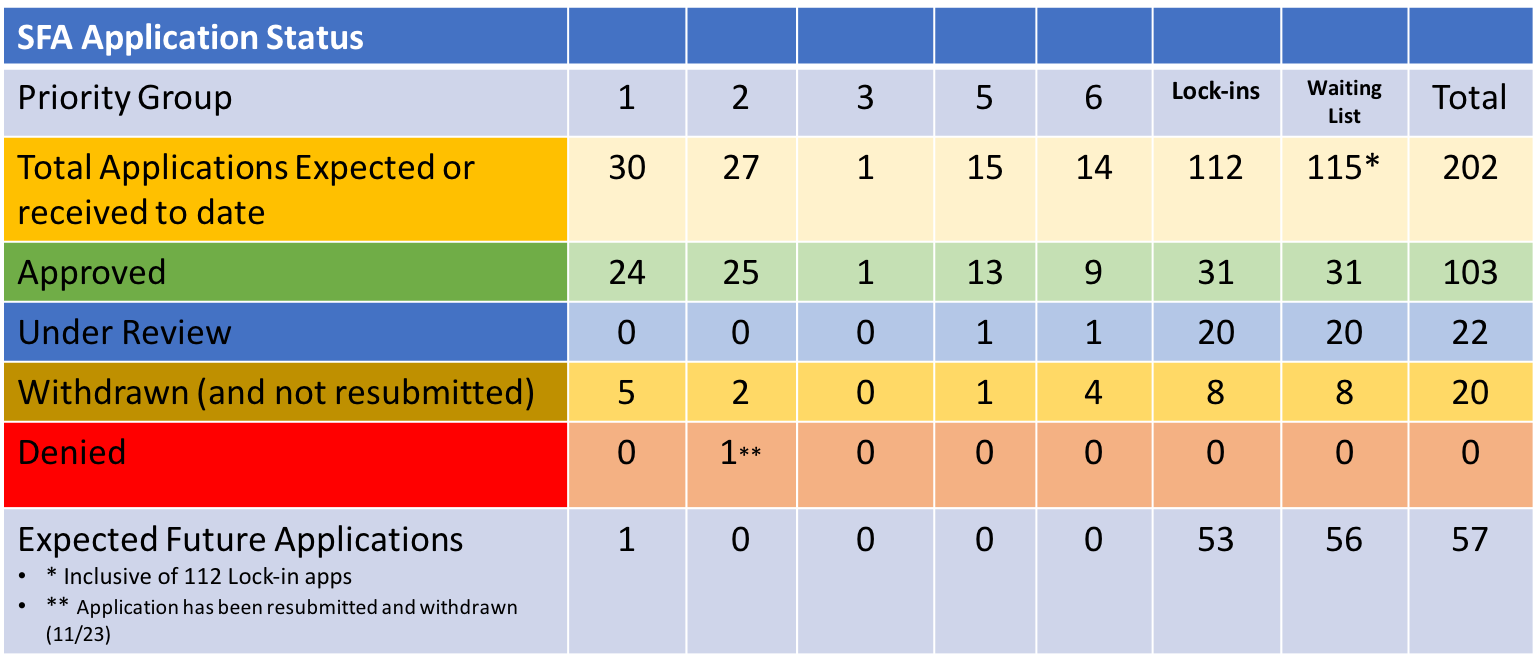
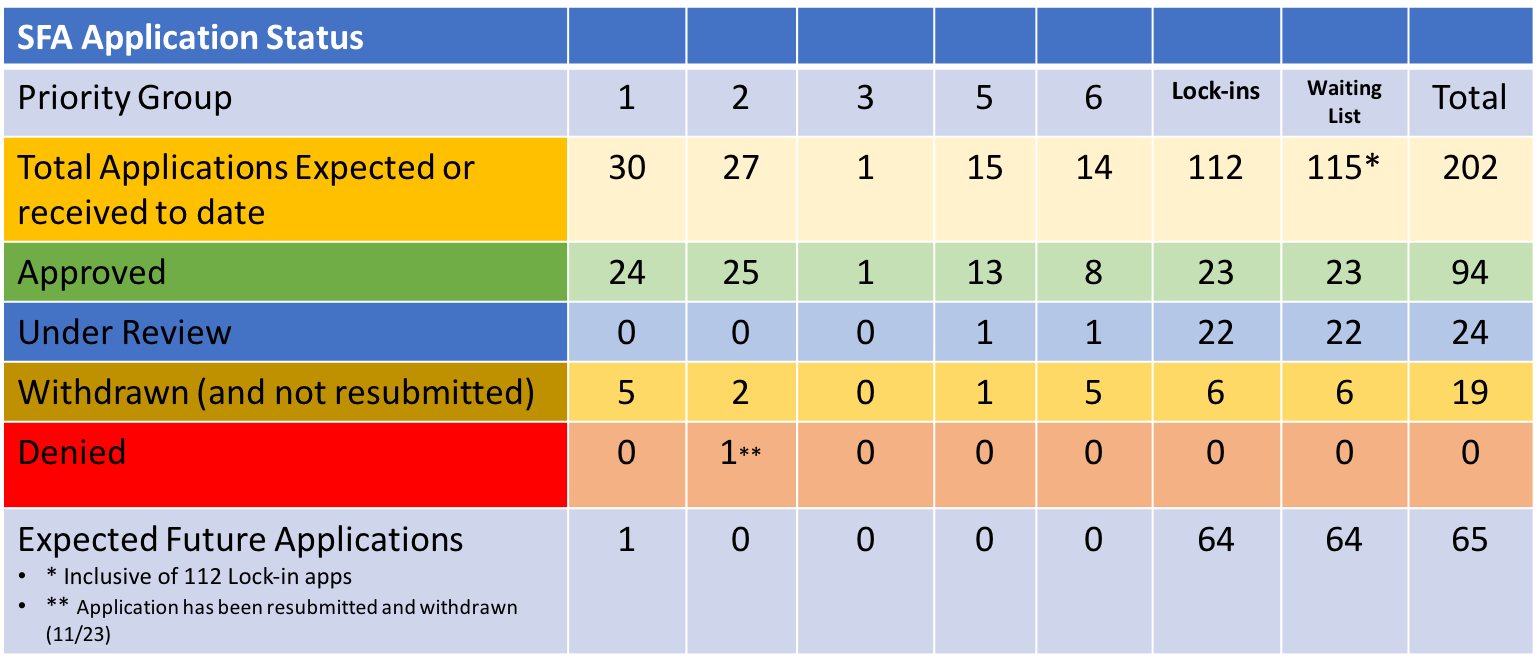
The PBGC had a very good and busy last week, as we witnessed quite a bit of activity in the implementation of the ARPA legislation. Always pleased to announce that three plans received approval for Special Financial Assistance, including the last member of the #6 priority group. Pension Plan of the Marine Carpenters Pension Fund (their initial application), United Food and Commercial Workers Union and Participating Food Industry Employers Tri-State Pension Plan (the Priority Group 6 member), and Local 111 Pension Plan were granted a total of $736.1 million for just over 32k participants.

In addition to the approvals, the eFiling portal was open to Lumber Industry Pension Plan and the Laborers’ Local No. 130 Pension Fund. In the case of the lumber Industry plan, it appears that they get to chop off some of the wait time for approval as their application indicates an expedited review. This plan is seeking $103.2 million for 5,834 members. Local No. 130 filed its initial application in which they are hoping to receive $32.1 million for 641 plan participants.

There were also four plans that withdrew initial applications for SFA. Alaska Plumbing and Pipefitting Industry Pension Plan, Lumber Industry Pension Plan, Upstate New York Engineers Pension Fund, and Pension Plan of the Automotive Machinists Pension Trust were collectively seeking $438.3 million for just under 22k participants. Each of these plans are non-priority funds. Only 15 of the original 87 Priority Group members have not received approval at this time.

Finally, there were no applications denied during the prior week and no funds rebated excess SFA on account of census errors. There were also no pension plans added to the waitlist which stands at 63 that haven’t seen any activity at this time. There hasn’t been a plan added to the waitlist since July 2024 with the addition of the Production Workers Pension Plan.

“More Needs To Be Done!” – Do You Think?

By: Russ Kamp, Managing Director, Ryan ALM, Inc.

This post is the 1,500th on this blog! I hope that you’ve found our insights useful. We’ve certainly appreciated the feedback – comments, questions, and likes – throughout the years. A lot of good debate has flowed from the ideas that we have expressed and we hope that it continues. The purpose of this blog is to provide education to those engaged in the pension/retirement industry. We have an incredible responsibility to millions of American workers who are counting on us to help provide a dignified retirement. A goal that is becoming more challenging every day.

As stated numerous times, doing the same-old-same-old is not working. How do we know? Just look at the surveys that regularly appear in our industry’s media outlets. Here is one from MissionSquare Research Institute done in collaboration with Greenwald Research. The survey reached a nationally representative sample of 1,009 state and local government workers between September 12 and October 4. What they found is upsetting, if not surprising. According to the research, “81% are concerned they won’t have enough money to last throughout retirement, and 78% doubt they’ll have enough to live comfortably during their golden years.”

Some of the other findings in the survey also tell a sad story. In fact, 73% of respondents are concerned they won’t be able to retire on time, while the same number are unsure whether they’ll have sufficient emergency savings. How terrible. The part about being able to retire “on time” is not often in the workers control wether because of health and the ability to continue to do the required task or as a result of other plans by their employer. Amazingly, public sector workers believe that their current retirement situation is better than those in the private sector. Wow, if that isn’t telling of the crisis unfolding in this country.

Given these results, it shouldn’t be shocking that unions are seeking a return of DB plans as the primary retirement vehicle. We know that asking untrained individuals to fund, manage, and then disburse a “benefit” through a defined contribution plan is poor policy. We’ve seen the results and they are horrid, with median balances for all age groups being significantly below the level needed to have any kind of retirement. Currently, the International Association of Machinists and Aerospace Workers are on strike at Boeing, and a major sticking point is the union’s desire to see a reopening of Boeing’s frozen DB plan.

We’ve also recently seen the UAW and ILA memberships seek access to DB plans. It shouldn’t be a shock given the ineffectiveness of DC plans that were once considered supplemental to pensions. Again, asking the American worker to fund a DC offering with little to no disposable income, investment acumen, or a crystal ball to help with longevity concerns is just foolish. Yes, there is more to do, much more! It is time to realize that DB plans are the only true retirement vehicle and one that helps retain and attract talented workers who aren’t easily replaced. Wake up before the crisis deepens and everyone suffers.

We Are # 29 – WOW!

By: Russ Kamp, Managing Director, Ryan ALM, Inc.

The  16th annual Mercer/CFA Institute Global Pension Index report was released on Oct. 15. I want to extend a big thank you to Mercer and the CFA for their collective effort to elevate retirement issues, while celebrating those countries who are getting it right. According to the survey, “the overall index value is based on three weighted sub-indices—adequacy (40%), sustainability (35%) and integrity (25%)—to measure each retirement income system. Adequacy looked at areas such as benefits, system design, savings and government support. Sustainability examined pension coverage, total assets, demography and other areas. Integrity encompassed regulation, governance and protection.” There are more than 50 indicators that support these three broad categories.

The United States was given a score of 60.4 (63 in 2023’s study), which placed our retirement readiness at 29 of 48 countries that were evaluated. That 29 is 7 spots lower than 2023’s rank. According to the Mercer CFA study, a score of 60.4 places us slightly below the average score (63.4) among those ranked and we were given a letter grade of C+. I don’t know about you but if I had scored a 60 (scale of 0-100) during my school days, my letter grade would have likely been an F. Based on how I feel that we are prepared as a nation, I think that an F is much more appropriate than a C+. What about you?

I’m not trying to pick on the U.S. retirement system, which scored 63.9 on adequacy, 58.4 on sustainability and 57.5 on integrity, with Integrity being the poorest ranking as it trailed the worldwide average score by >16 points at 74.1. Our retirement system was evaluated based on the Social Security system and voluntary private pensions, which may be job-related (DB or DC) or personal, such as an IRA. Other systems with comparable overall index values to the U.S. (60-65) included Colombia (63), Saudi Arabia (60.5) and Kazakhstan (64.0). I don’t know about you but being ranked among those countries doesn’t make me feel warm and fuzzy about our effort or achievement. Systems scoring the highest were the Netherlands (84.8), Iceland (83.4), Denmark (81.6), and Israel (80.2) – they were given an ‘A’ grade.

Anyone participating in our industry knows that can AND MUST do better. The loss of DB pension plans within the private sector is a very harmful trend. Leakage within DC plans makes them more like glorified savings accounts rather than retirement vehicles, and Social Security provides small relief for a majority of recipients. As I’ve uttered on many occasions, asking untrained individuals to fund, manage, and then disburse a “retirement benefit” without the financial means, investment skill, and a crystal ball to forecast longevity is just silly policy.

Mercer and the CFA institute recommended a series of potential reforms to improve the long-term success of the US retirement system. I just loved this one:

Promoting higher labor force participation at older ages, which will increase the savings available for retirement and limit the continuing increase in the length of retirement;

A truly amazing suggestion – if you never retire then you don’t have to worry about whether or not your system will provide an adequate benefit! Problem solved! Many Americans would welcome the opportunity to extend their careers/employment opportunities, but some jobs require physical labor not easily done at more mature ages, while many American companies are anxious to rid themselves of higher priced and experienced talent in favor of younger workers (ageism?).

When I wrote about this survey last year, I’d hoped that the higher US interest rate environment would begin to improve outcomes for our workers whether their plans are a defined benefit or defined contribution offering. Unfortunately, current trends have US rates falling again. That just puts more pressure on DB plans and individual participants in DC plans and encourages (forces) everyone to take more risk. That development isn’t going to help next year’s score!

ARPA Update as of October 11, 2024

By: Russ Kamp, Ryan ALM, Inc.

I hope that you enjoyed a wonderful holiday weekend. Autumn’s beautiful colors are finally present in the Northeast – enjoy those, too. As you will soon read, the PBGC had a busy week according to its latest update, so the extra day of rest was likely necessary.

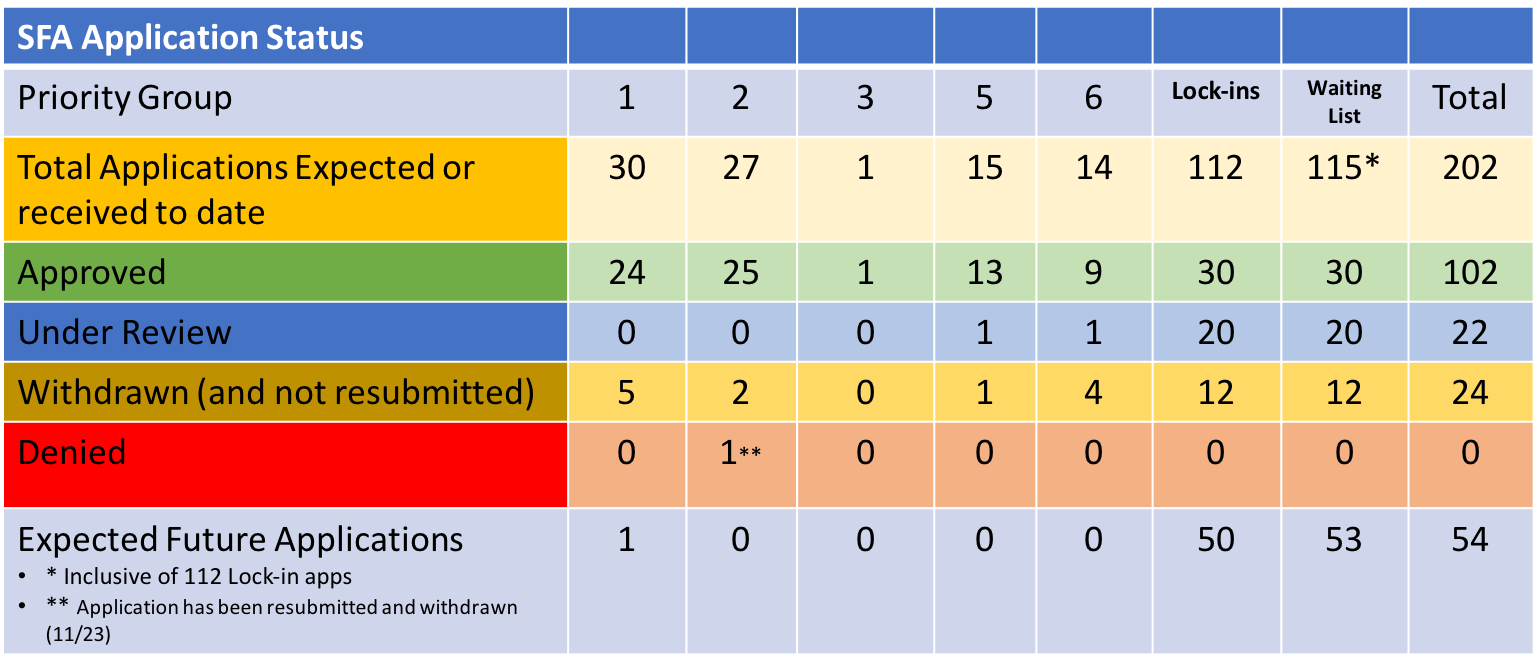
The PBGC’s effort implementing the ARPA legislation continues in full swing. During the prior week there were three new applications received, two approved, another 2 withdrawn, and finally there were two more plans rebating excess SFA as a result of census corrections. Thankfully, there were no applications rejected. Lastly, there were no multiemployer plans seeking to be added to the waitlist (non-Priority Group members).

The plans receiving approval included Midwestern Teamsters Pension Plan and the Carpenters Pension Trust Fund – Detroit & Vicinity. The Carpenters nailed a $635.0 million SFA grant for its 22,576 participants, while the much smaller Midwestern Teamsters plan received $23.6 for 615 members. The PBGC has now awarded $68.6 billion in SFA grants to 94 pension systems.

Sheet Metal Workers’ Local No. 40 Pension Plan, Warehouse Employees Union Local 169 and Employers Joint Pension Plan, and Local 111 Pension Plan were granted the opportunity to submit requests for SFA grants. In the case of Local 111, they submitted a revised application. They are collectively seeking $124,7 million for 6,193 plan members. Good luck! In other news, the Teamsters Local 210 Affiliated Pension Plan and Local 111 Pension Plan withdrew their initial applications. These two funds were seeking $137.3 million collectively.

Finally, Milk Industry Office Employees Pension Trust Fund and Local 805 Pension and Retirement Plan rebated excess SFA grant money as a result of a census audit that confirmed overpayment. The Milk Industry delivered $193k (2.4% of the SFA received) to the PBGC, while Local 805 forked over $3.2 million (1.8% of the grant). Both represented a larger percentage of the SFA received than the previous transactions. At this time, 21 plans have returned $147.5 million in SFA and interest representing 0.37% of the grants received.

I hope that you find these updates useful. I remain incredibly bullish regarding the ARPA legislation and the positive impact that it continues to have on the American worker that earned this pension promise. Please don’t hesitate to reach out to Ryan ALM with any questions related to the legislation and what should be done to secure the promised benefits with the SFA grant assets.

Welcome to National Retirement (in)Security Month!

By: Russ Kamp, Managing Director, Ryan ALM, Inc.

October isn’t just for leaf peepers, although it is a special time of year for those of us living in the Northeast. Importantly, October is also National Retirement Security Month. For those of you who regularly follow this blog, you know that we (at Ryan ALM, Inc.) are huge supporters of DB pension plans. Fortunately, we aren’t the only ones. In a wonderful post published by the National Public Pension Coalition, Ariel McConnell writes about the importance of supporting public pension plans, as well as those sponsored by private organizations.

Ms. McConnell highlights many concerns regarding the current state of retirement readiness among American workers. Frighteningly, she points out that 57% of Americans don’t have any retirement savings, and those with 401(k)s have a median balance of only $27,376. That will barely provide you with the financial resources to get you through one year let alone a retirement that could stretch well beyond 20 years. She also highlights how each of us can become more active in the fight to get every American ready for their retirement. We want each worker to have the chance to enjoy their “golden years”. Let’s not let poor policy decisions tarnish that dream.

Please join Ariel, the National Public Pension Coalition, Ryan ALM, Inc., and many more organizations in the fight to protect and preserve defined benefit plans for all. I can only begin to guess at the significant economic and social consequences if our Senior population is forced to live on a median balance as insignificant as the one mentioned in NPPC’s blog post.

Falling Rates – Not A Panacea For Pensions

By: Russ Kamp, Managing Director, Ryan ALM, Inc.

Milliman has reported that pension funding for Corporate plans declined in August. The Milliman 100 Pension Funding Index (PFI) recorded its most significant decline of 2024, as the funded ratio fell from 103.6% to 102.8% as of August 31, 2024. No, it wasn’t because markets behaved poorly, as the month’s investment gains of 1.81% lifted the combined plans’ market value by $17 billion, to $1.347 trillion at the end of the period. It was the result of falling US interest rates that impacted the liability discount rate on those future promises.

According to Milliman, the discount rate fell from 5.3% in July to 5.1% by the end of August. That 20 basis points move in rates increased the projected benefit obligations (PBO) for the index constituents by $27 billion. As a result, the $10 billion decline in funded status reduced the funded ratio by 0.8%. The index’s surplus is now at $36 billion.

Markets seem to be cheering the prospects of lower US interest rates that may be announced as early as September 18, 2024 following the next FOMC. Remember, falling rates may be good for consumers and businesses, but they aren’t necessarily good for defined benefit pension plans unless the fall in rates rallies markets to a greater extent than the drop in rates impacts the growth in pension liabilities.

“With markets falling from all-time highs and discount rates starting to show declines, pension funded status volatility is likely in the months ahead, underscoring the prudence of asset-liability matching strategies for plan sponsors”, said Zorast Wadia, author of the PFI. We couldn’t agree more with Zorast. As we’ve discussed many times, Pension America’s typical asset allocation places the funded status for DB pension on an uncomfortable rollercoaster. Prudent asset-liability strategies can significantly reduce the uncertainty tied to current asset allocation practices. Thanks, Milliman and Zorast, for continuing to remind the pension community of the impact that interest rates have on a plan’s funded status.

Pension Myth #1: Earn the ROA…All is Well!

By: Russ Kamp, Managing Director, Ryan ALM, Inc.

We are pleased to share with you a recent white paper produced by Ron Ryan, Ryan ALM’s CEO. In this excellent piece, Ron reminds us of the fallacy that achieving the ROA as an underfunded DB pension system will make everything good – it won’t! As he correctly points out, the funded ratio may remain the same, but the funded status will continue to deteriorate. If the pension plan is 60% funded, at a market value of $100, that system has a funded status deficit of $40. If that 60% funded plan achieves the 7% ROA, assets will grow by $4.20. However, liabilities at that same discount rate will grow at $7. After 5 years, the funded status will have deteriorated by >40% and the deficit will now be >$56.

DB Pension systems that are poorly funded need to work extra hard to keep pace with the growth in the promised benefits or contribute significantly more to close the funding gap. There aren’t many plan sponsors in a position to contribute whatever is necessary to keep the plan in good funded status. Ron also discusses the need for plan sponsors to produce an Asset Exhaustion Test (AET), which is a requirement under GASB 67/68. It is a test of solvency. Ryan ALM modifies the AET to accurately determine the required ROA to fully fund the liability cash flows. Has your actuary produced the AET for your plan? If not, would you like Ryan ALM to calculate the ROA needed to fully fund your plan?

Please don’t hesitate to reach out to us with any questions that you might have regarding this white paper. Also, don’t hesitate to go to RyanALM.com for all the research that we’ve produced throughout the years. We look forward to being a resource for you.

ARPA Update as of July 26, 2024

By: Russ Kamp, Managing Director, Ryan ALM, Inc.

The “dog days” of summer don’t seem to be impacting the activity level at the PBGC, as we had a plethora of activity last week. As mentioned on the PBGC website, the e-filing website is open, but limited. “The e-Filing Portal is open only to plans at the top of the waiting list that have been notified by PBGC that they may submit their applications. Applications from any other plans will not be accepted at this time.” That’s interesting, as there are still 16 pension plans in Priority Groups 1-6 that have potential applications that are not currently being reviewed. Are they excluded, too?

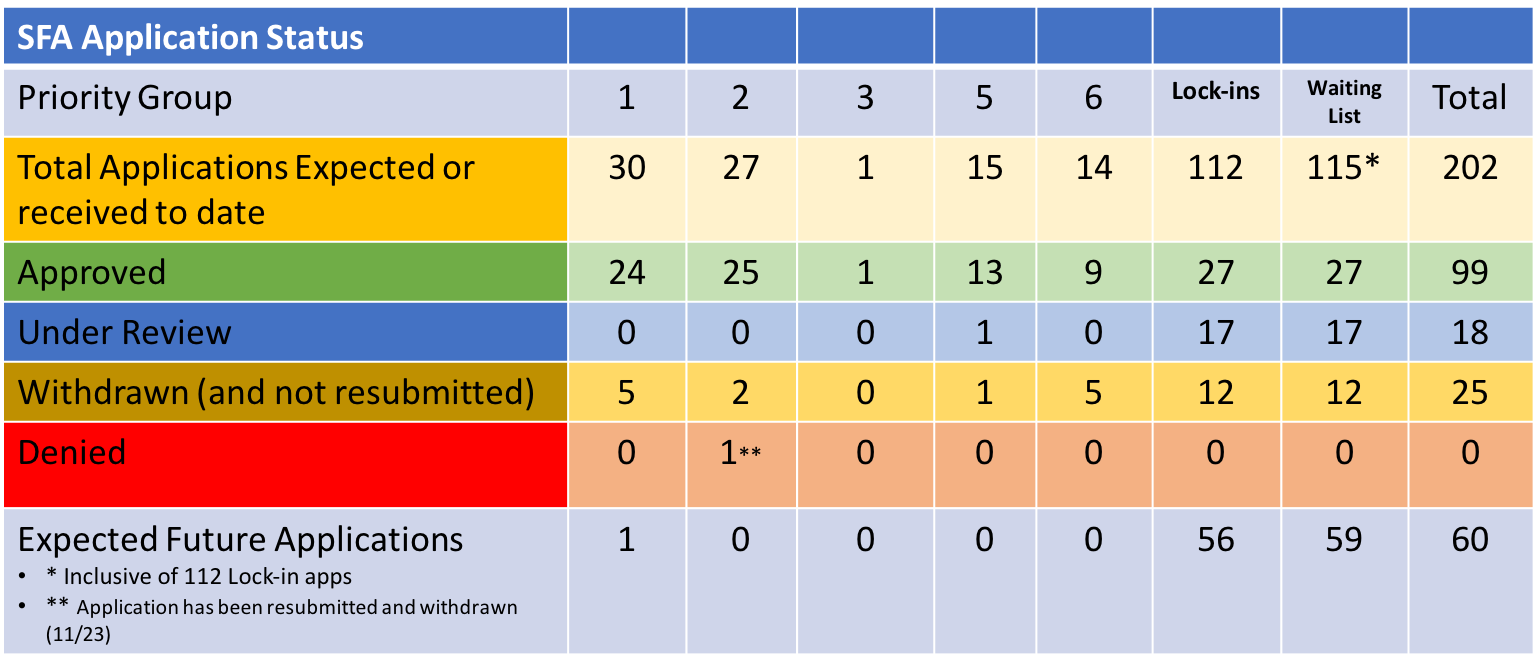
During the week, three funds that had been on the waitlist submitted applications, including, Local 810 Affiliated Pension Plan, the Upstate New York Engineers Pension Fund, and the Alaska Plumbing and Pipefitting Industry Pension Plan. They are seeking a total of $282.1 million for the 9,620 plan participants. This is each plan’s initial submission. As always, the PBGC has 120 from the filing date to conclude the review.

In other news, two plans received approval of their applications, including the Pension Plan of the Moving Picture Machine Operators Union Local 306, a Priority Group 5 member, and the New England Teamsters Pension Plan, that was a Priority Group 6 member. The Moving Picture machinists will receive $20.7 million to support its 542 members, while the NE Teamsters get a whopping $5.7 billion for just over 72k participants. With these latest approvals, the PBGC has now granted through ARPA $67.7 billion in Special Financial Assistance (SFA) that will support the financial futures of 1.34 million American retirees.

On July 23, the Production Workers Pension Plan was added to the waitlist, becoming the 115th member on that list, with 47 having seen some activity (approved, under review, or withdrawn) regarding their applications. In other news, there were no applications denied or withdrawn. Furthermore, none of the previous SFA recipients were asked to repay a portion of the grant due to overpayment. Have a great week, and don’t hesitate to reach out to us if we can provide any assistance to you as you think through your investment strategy as it relates to the SFA grant.

ARPA Update as of June 14, 2024

By: Russ Kamp, Managing Director, Ryan ALM, Inc.

We hope that you enjoyed a wonderful Father’s Day. I’m blessed to still have my Dad with us (95 years young). In addition, I have two sons and two sons-in-law who are wonderful fathers. It was a terrific day!

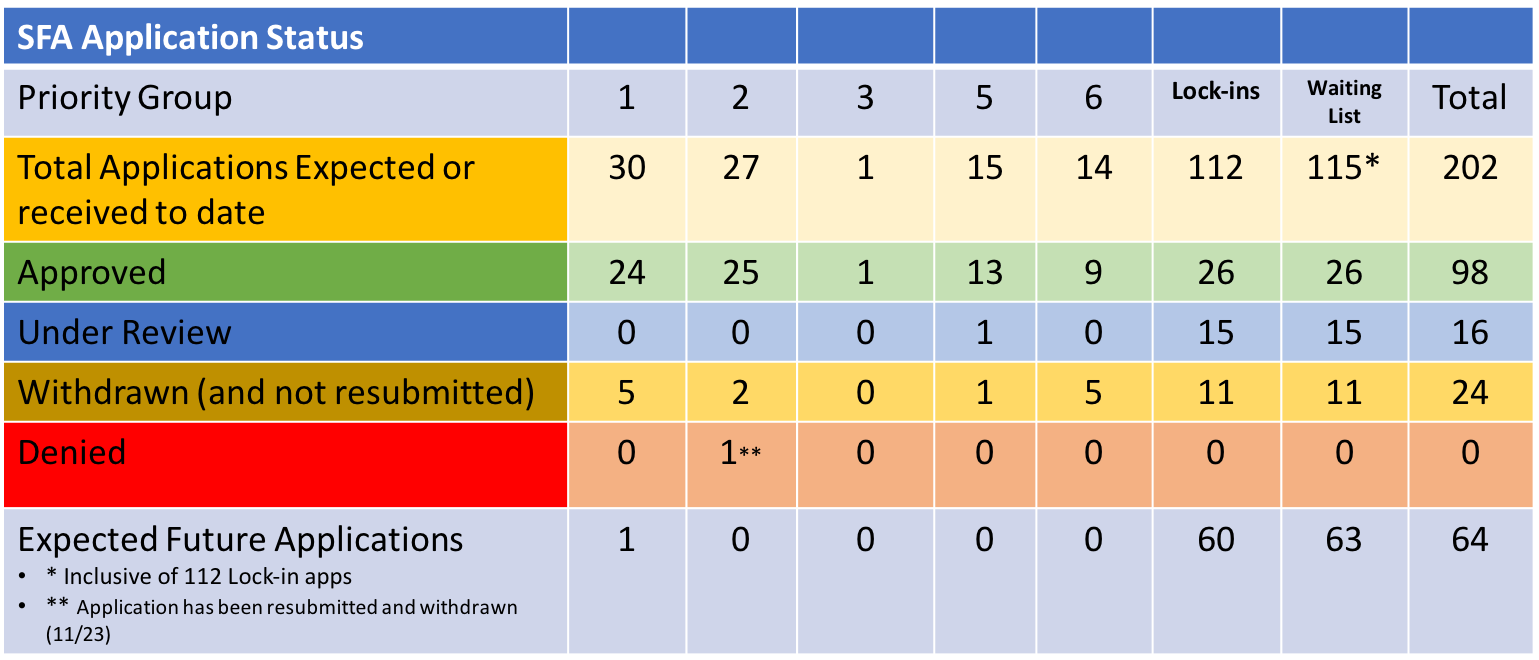
Regarding ARPA and the PBGC’s implementation of that critical pension legislation, there was some activity during the previous week. However, the filing portal remains temporarily closed for those plans still seeking relief through the SFA grants. That said, there are still 17 applications that are currently being reviewed with 6 of those nearing the 120 deadline for action. Those six plans are seeking nearly $5.5 billion in SFA. As a result, the rest of June is going to be busy for the PBGC.

The Pension Plan for the Arizona Bricklayers’ Pension Trust Fund received approval for its application. They will receive $10.7 million to protect the pensions for the 666 members of the plan. This non-priority plan received approval on their initial application. In other news, there were no applications either denied or withdrawn. However, the Graphic Communications Conference of the International Brotherhood of Teamsters National Pension Fund joined Central States as the only other plan to repay excess SFA as a result of a death audit. In this case, they are repaying just over $8 million.

Have a great week. Don’t hesitate to reach out to us if you like to learn more about cash flow matching and how it can be used to extend and protect the SFA grant assets so vital to ensuring that the pension promises are met for your participants.

Money Managers Recaptured 1/2 the 2022 losses – Should We Be Pleased?

By: Russ Kamp, Managing Director, Ryan ALM, Inc.

P&I has produced an article highlighting the fact that money managers recaptured nearly half of the institutional assets lost (-$9 trillion) in 2022’s market correction. They mention that this was accomplished despite “lingering economic and political uncertainties that kept a lot of money sidelined, including a record $6 trillion parked in money market funds alone.”

According to Pensions & Investments’ 2023 survey of the largest money managers, institutional assets for 411 managers around the globe rose 9.7%, or $4.89 trillion, to $55.23 trillion as of Dec. 31, 2023 for a recovery rate of 52.5%. This recapture of assets was primarily driven by equities, both US (+26%) and global X US (+18%), while bonds were up 5.6% domestically and abroad.

Obviously, it was great to see the “rally” despite wide-spread uncertainty related to the economy, inflation, interest rates, and the labor market. Issues that are still impacting perceptions today. But the real question one should ask has to do with the cyclical nature of markets and what plan sponsors and their advisors can do to mitigate the peaks and valleys. As I reported earlier this week, since 2000, public pension plans have seen a tripling (or more) in contribution expenses as a % of pay, while the funded status of Piscataqua research’s universe of 127 state and local plans has fallen by 25%.

Isn’t it time to get off the asset allocation rollercoaster? The nearly singular focus on return (ROA) by pension plan sponsors has placed pension funding on a ride that does little to guarantee success, but has certainly exacerbated volatility. In the process, contributions into these critically important retirement systems have skyrocketed. Let’s stop thinking that the only way to fund pensions is through outsized market returns. Today’s interest rate environment is providing plan sponsors with a wonderful opportunity to SECURE a portion of their future promises by carefully constructing a defeased bond portfolio that matches and funds asset cash flows of principal and interest with liability cash flows of benefits and expenses.

By doing so, you eliminate the impact of drawdowns, as the assets and liabilities will now move in tandem. How refreshing! Because you are defeasing a future benefit, you are also eliminating interest rate risk, as future values are not interest rate sensitive. Furthermore, you have now created a liquidity profile that is enhanced, as the bond portfolio now pays all of the benefits and expenses chronologically as far into the future as the allocation to the cash flow matching program lasts. Lastly, the growth or alpha assets can now grow unencumbered, as they are no longer a source of funding. The need for a cash sweep has been replaced by cash flow matching with bonds.

Let’s stop having to celebrate recovery rates of roughly 50%, when we can institute investment programs that eliminate these massive and harmful drawdowns. They aren’t helpful to the sustainability of DB pension plans, which we so desperately need if we are to provide a dignified retirement to the American worker. Let’s get back to the fundamentals, as the true objective of a pension is to fund benefits in a cost-efficient manner with prudent risk. It isn’t a performance arms race!