Taking From Peter to Pay Paul

By: Russ Kamp, CEO, Ryan ALM, Inc.

Do you, or would you, consider yourself a “high earner” with a salary of $145k/year?

Try asking a family of four in NYC that question, when you consider the expenses from taxes (federal, state, city, sales, and property), the housing costs associated with an apartment, childcare, healthcare, food, clothing, etc. Yet, those at the IRS certainly do. In case you didn’t realize it, SECURE 2.0 is eliminating the tax deductibility of “make up” contributions for those 50 and up after they have maxed out their $23,500 annual contribution beginning in 2027. As a reminder, for those that 50-years old and up one can contribute another $7,500. For those between the ages of 60-and 63-years-old there is a super catch up contribution of $11,500. Why a 64- or 65-year-old can’t contribute more is beyond me. Perhaps it will blow out the U.S. federal budget deficit!

Unfortunately, if you are so lucky to earn a whopping $145k from a single employer in a calendar year, you will be forced to use a Roth 401(k) for those make up contributions. As stated previously, you lose the tax deductibility for those additional contributions. So, if you earn $200k and you contribute the additional $7,500 or the $11,500, instead of seeing your gross income fall by those figures, you will be taxed at the $200k level, increasing your tax burden for that year. Yes, the earnings within the account grow tax free, but the growth in the account balance is subject to a lot of risk factors.

We should be incentivizing all American workers to save as much as possible. Let’s stop with all these different gimmicks. Do we really want a significant percentage of our older population no longer participating in our economy? Those 65-years and older represent about 17% of today’s population, but they are expected to be 23% by 2050. Do we really want them depending on the U.S government for social services? No, and they don’t want that either. We want folks to be able to retire with dignity and remain active members of our economic community.

The demise of the traditional DB pensions has placed a significant burden on most American workers who are now tasked with funding, managing, and then disbursing a “retirement” benefit with little disposable income, no investment acumen, and a crystal ball to determine longevity as foggy as many San Francisco summer days. Again, with the burdens associated with all of the expenses mentioned above and more, it really is a moot point for many Americans to even consider catch up contributions, but for those lucky few, why penalize them?
Today is National 401(k) Day. Where is National DB Pension Plan Day?

By: Russ Kamp, CEO, Ryan ALM, Inc.

I suspect that most of us have no idea that today, September 5, 2025, is National 401(k) Day. This day is recognized every year on the Friday following Labor Day. The day is supposed to be an opportunity for retirement savings education and for companies to inform their employees about their ability to invest in company sponsored 401(k)s. Did you get your update today? Unfortunately, like many small company employees, I don’t have access to one or a DB plan.

For the uninformed, 401(k) plans are defined contribution plans (DC). This plan type was created in the late 1970s (Revenue Act of 1978) as a “supplemental” benefit. Corporate America liked the idea of a DC offering because it helped them recruit middle and senior management types who wouldn’t accrue enough time in the company’s traditional pension plan. Again, the benefit was supplemental to the traditional monthly pension payment and not in lieu of it!

I think that defined contribution plans are fine as long as they remain supplemental to a DB plan. Asking untrained individuals to fund, manage, and then disburse a retirement benefit is a ridiculous exercise, especially given their lack of disposable income, investment acumen, and NO crystal ball to help with longevity issues. In fact, why do we think that 99.9% of Americans have this ability? Regrettably, we have a significant percentage (estimated at 28%) of our population living within 200% of the poverty line. Do you think that they have any discretionary income that would permit them to fund a retirement benefit when housing, health insurance, food, education, childcare, and transportation costs eat up most, if not all, of an individual’s take home pay? Remember, these plans are only “successful” based on what is contributed. Sure, there may be a company match of some kind, but we witnessed what can happen during difficult economic times, when the employer contribution suddenly vanishes.

Defined benefit plans are the gold standard of retirement vehicles. They once covered more than 40% of the private sector workforce, most union employees, and roughly 85% of public sector workers. What happened? Did we lose focus on the primary objective in managing a DB plan which is to SECURE the promised benefits in a cost-effective manner with prudent risk? Did our industry’s focus on the return on asset assumption (ROA) create an untenable environment? Yes, we got more volatility and less liquidity! Did we did we get the commensurate return? Not consistently. It was this volatility of the funded ratio/status that impacted the financial statements and led to the decision to freeze and terminate a significant percentage of private DB plans. It is a tragic outcome!

What we have today is a growing economic divide among the haves and haves-not. This schism continues to grow, and the lack of retirement security is only making matters worse. DB plans can be managed effectively where excess volatility is not tolerated, where the focus is on the promised benefit and not some made up ROA, and where decisions that are made relative to investment structure and asset allocation are predicated on the financial health of the plan: mainly the funded status. We need DB plans more than ever and ONLY a return to pension basics will help us in this quest. Forget about all the newfangled investment products being sold. Replacing one strategy for another is no better than shifting deck chairs on the Titanic. We need improved governance and a renewed focus on why pensions were provided in the first place.

The Intrinsic Value of Bonds

Ronald J. Ryan, CFA, Chairman

The true value of bonds is the certainty of their cash flows (interest + principal payments). I don’t believe there is another asset class with such attributes. This is why bonds have traditionally been the asset choice for LDI strategies in general and, defeasement specifically. Given that the true objective of a pension is to secure benefits in a cost-efficient manner with prudent risk then cash flow matching with bonds is a best fit. In the 1970s and 1980s cash flow matching was called Dedication and was the main pension strategy at that time.

Today we live in a volatile and uncertain financial world. Volatility of a pension’s funded status is not a good thing and leads to volatility in contribution costs which are calculated annually based on the present value of assets versus the present value of liabilities. Since 2000 contribution costs have spiked and for many pension plans are 5 to 10x higher than 1999. One would think that a prudent plan sponsor would install a strategy to derisk their pension and reduce or even eliminate this volatility. Cash flow matching (CFM) is the answer. CFM fully funds and matches the monthly liability cash flows (future values) thereby eliminating the present value volatility that plaques most pensions.

As our name implies, Ryan ALM is an Asset Liability Manager specializing in CFM. As the founder of Ryan ALM, my experience with CFM goes back to the 1970s when I was the Director of Fixed Income research at Lehman Bros. Our current CFM model (Liability Beta Portfolio™ or LBP) is a cost optimization model that will fully fund monthly liability cash flows at the lowest cost to the plan sponsor. Our model will reduce funding costs by about 2% per year (1-10 years of liability cash flows = 20% cost reduction). Moreover, there are several other significant benefits to our LBP:

  • LBP de-risks the plan by cash flow matching benefit payments with certainty
  • LBP provides liquidity to fully fund liabilities so no need for a cash sweep
  • Mitigates interest rate risk since it is funding benefits (future values)
  • LBP reduces asset management costs (Ryan ALM fee = 15 bps)
  • Enhances ROA by out-yielding active bond management 
  • Reduces volatility of the funded ratio + contributions
  • Buys time for Alpha assets to grow unencumbered

  “Where is the knowledge we have lost in information” T.S. Eliot

DC Participants: “Just Say No”

By: Russ Kamp, CEO, Ryan ALM, Inc.

Most everyone who lived through the ’80s will remember the slogan “Just Say No”. The slogan was created and championed by Nancy Reagan during her husband’s presidency. As you’ll recall, the slogan was part of the U.S.-led war on drugs.

I’d like to reuse the slogan of JUST SAY NO as it relates to using alternatives, especially private equity and credit in defined contribution (DC) plans. DC plans are proving to be a failed model for the vast majority of participants given the anemic median balances, as asking untrained individuals to fund, manage, and then disburse a “retirement” benefit with little to no disposable income, investment acumen, or a crystal ball to help with longevity is just silly policy. Trying to push alternatives onto these folks is maddening! They don’t need more offerings providing complicated structures, little transparency, high fees, and poor liquidity.

Importantly, what happened to being a “qualified or accredited” investor? As you may recall, private investments are restricted in most cases to individuals who meet certain financial thresholds that have been established by regulatory authorities. These considerations included minimum income levels (>$200k for some period of time and sustainable), net worth considerations at >$1 million not including your primary residence, and finally, investment knowledge, in which individuals need to demonstrate sufficient knowledge and experience in financial and business matters to evaluate the risks and merits of a prospective investment. Do you honestly think that the average 401(k) participant qualifies under any of these considerations?

The alternative suite of product offerings is proving to be challenging for many institutional investors/boards, often requiring the retention of a specialist consultant to support the plan’s generalist advisor. Given that reality, does it really make sense that an untrained individual will truly understand the potential risk and reward characteristics? Furthermore, these investments are NOT the magic elixir that they are made out to be. Performance results range far and wide and liquidity (capital distributions) is proving illusive. Do providers of these products really believe that more assets are needed at this time given how difficult it is to invest the current dry powder?

I put a similar comment to this post on LinkedIn.com earlier today. Somebody commented that a simple NO without exploration perhaps would violate my fiduciary responsibility. My answer: Someone needs to be the grown up in the room trying to keep our industry’s greedy hands off DC plans. I believe that I am acting very much in a fiduciary capacity.

I could apply the “Just Say No” slogan to so many practices within our pension industry, but for now I’ll restrict it to this one area of concern. This one rant!

A Retirement is Out of the Question for Many – Unfortunately!

By: Russ Kamp, CEO, Ryan ALM, Inc.

Is there such a thing as a retirement anymore? According to Fidelity’s Q4 2024 Retirement Analysis, 41% of “retirees” are working, have worked, or are currently seeking work. I would guess that the need to work is strongly correlated to the demise of the DB pension plan.

In other Fidelity news, a big deal was made out of the fact that 527k participants had account balances >$1 million (2.2% of their account holders), but despite those attractive balances, the “average” balance was still only 131k at year-end following two incredible years of growth for the S&P 500 specifically, and equities generally, especially if you rode the tech sector.

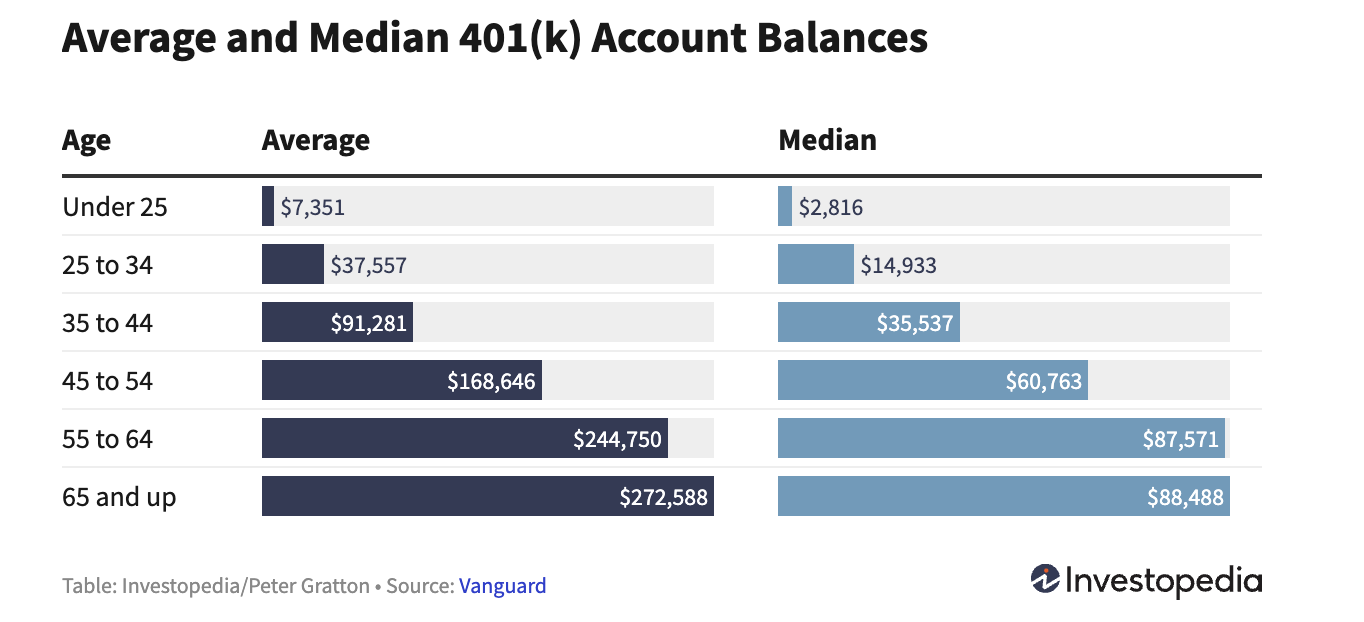
Regrettably, there was once again NO mention of the median account balance, which we know is rather anemic. Can the providers of 401(k)s, IRAs, and 403(b)s, please stop highlighting average accounts which are clearly skewed by the much larger balances of a few participants? According to an analysis provided earlier this year by Investopedia, median account balances at Vanguard were dramatically lower than average accounts. As the chart below highlights, there was not a median balance within 40% of the average balance. In fact, those 65-years-old and up had an account balance at 32% of the average balance. I can’t imagine that this ratio would be much different at Fidelity or any other provider of defined contribution accounts.

It is truly unfortunate that a significant percentage of the American workforce will never enjoy the rewards of a dignified retirement. My Dad, who just recently passed at age 95, enjoyed a 34-year retirement as a result of receiving a modest DB pension benefit. That monthly payment coupled with my parents Social Security enabled them to enjoy their golden years. Providing this opportunity for everyone needs to be the goal of our retirement industry.


Note: Fidelity’s 401(k) analysis covers 26,700 corporate DC plans and 24.5 million participants.