Markets Hate Uncertainty

By: Russ Kamp, CEO, Ryan ALM, Inc.

I’ve published many posts on the impact of uncertainty on the well-being of individuals and our capital markets. In neither case are the outcomes positive.

What we are witnessing in the last several trading days is the direct result of policy flip-flopping that is creating abundant uncertainty. As a result, the business environment is deteriorating. One can argue the merits of tariffs, but it is the flip-flopping of these policy decisions that is wreaking havoc. How can a business react to these policies when they change daily, if not hourly.

The impact so far has been to create an environment in which both investment and employment have suffered. Economic uncertainty is currently at record levels only witness during the pandemic. Rarely have we witnessed an environment in which capital expenditures are falling while prices are increasing, but that is exactly what we have today. Regrettably, we are now witnessing expectations for rising input prices, which track consumer goods inflation. It has been more than four decades since we were impacted by stagflation, but we are on the cusp of a repeat last seen in the ’70s. How comfortable are you?

We just got a glimpse of how bad things might become for our economy when the Atlanta Fed published a series of updates driving GDP growth expectations down from a high of +3.9% earlier in the quarter to the current -2.4% published today. The key drivers of this recalibration were trade and consumer spending. The uncertainty isn’t just impacting the economy. As mentioned above, our capital markets don’t like uncertainty either.

I had the opportunity to speak on a panel last week at Opal/LATEC discussing Risk On or Risk Off. At that point I concluded that little had been done to reduce risk within public pension plans, as traditional asset allocation frameworks had not been adjusted in any meaningful way. It isn’t too late to start the process today. Action should be taken to reconfigure the plan’s asset allocation into two buckets – liquidity and growth. The liquidity bucket will provide the necessary cash flow in the near future, while buying time for the growth assets to wade through these troubled waters. Doing nothing subjects the entire asset base to the whims of the markets, and we know how that can turn out.

Is Now The Time To Act?

By: Russ Kamp, Managing Director, Ryan ALM, Inc.

Equity market participants were recently reminded of the fact that markets can fall, and unfortunately they usually don’t decline with any kind of notice. The impetus behind the markets’ most recent challenging day was the Fed’s relatively tame forecast for likely interest rate moves in 2025. There is no question in my mind that the nearly 4-decade decline in rates from lofty heights achieved in the early ’80s, when the Fed Funds Rate eclipsed 20%, to the covid-fueled bottom reached in early 2020, when the yield on the 10-year Treasury Note was at 0.5%, made bond returns a lot stronger than anyone’s forecast.

It certainly seemed that the US Federal Reserve provided the security blanket any time there was a wobble in the markets. This action allowed “investors” to keep their collective foot on the gas with little fear. Sure, there were major corrections during that lengthy period, but the Fed was always there to lend a hand and a ton of stimulus that propped up the economy and markets, and ultimately the investment community. As we saw in 2022, the Fed had run out of dry powder and ultimately had to raise US interest rates to stem a vicious inflationary spike. Rates rose rather dramatically, and the result was an equity market, as measured by the S&P 500, that declined 18% for the calendar year. Bonds faired only marginally better as rising rates impacted bond principals creating a collective -12.1% return for the BB Aggregate Index.

As we enter 2025, do we once again have a situation in which the Fed’s ability to reduce rates has been curtailed due to a stronger economy than anticipated? Will the continued strength and massive government stimulus drive inflation and rates higher? According to a blog post from Apollo’c CIO, here are his list of the potential risks and the probabilities:

Risks to global markets in 2025

Interesting that he feels, like we do at Ryan ALM, Inc., that the economy is likely to be stronger than most suspect (#6) leading to higher inflation, rising rates (#7), and a 10-year Treasury Note yield in excess of 5% (#8). That yield is currently at 4.6% (as of 3:06 pm).

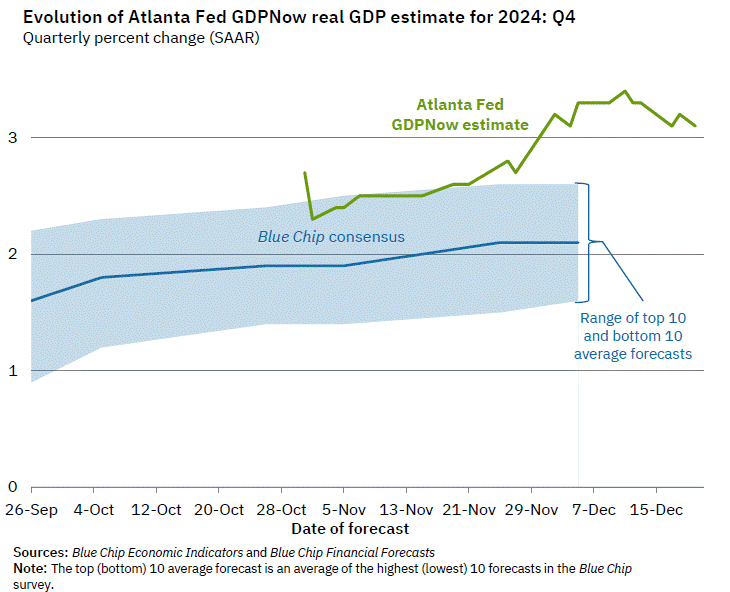
For those that might be skeptical, the Atlanta Fed’s GDPNow model is currently forecasting GDP growth for Q4’24 at 3.1% annualized. They have done a wonderful job forecasting quarterly growth rates. Their forecasts have consistently been above the “street’s” and as a result, much more accurate.

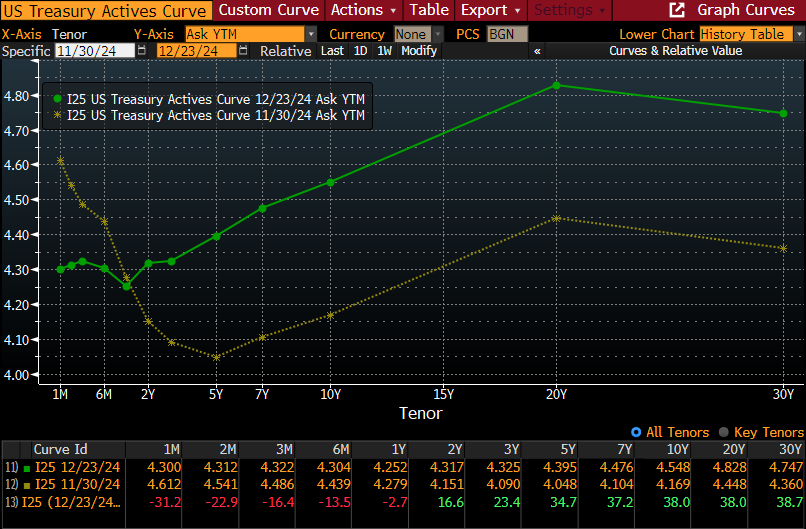
In addition, despite the third rate cut by the Federal Reserve at the most recent FOMC meeting of their benchmark Fed Funds Rate (-1.0% since the easing began), interest rates on longer dated maturities have risen quite significantly, as reflected below.

Rising US rates, stronger growth, and greater inflation may just be the formula for a significant contraction in equity valuations, especially given the current level. Be proactive. Reduce risk. Secure the promised benefits. Under no circumstance should you just let your “winnings” ride.

A Little History Lesson is in Order

By: Russ Kamp, Managing Director, Ryan ALM, Inc.

I continue to be surprised by the constant droning that US interest rates are too high and financial conditions are too tight. Compared to what? If the reference point is Covid-19 induced levels then you are probably right, but if the comparison is to almost any other timeframe then those proclaiming that the sky is about to fall should refer to one of the greatest decades for equities in my lifetime – the 1990s. I think most investors would agree that the 1990s provided a nearly unprecedented investing environment. One in which the S&P 500 produced an 18.02% annualized performance.

Was the economic environment of the 1990s so much better than today’s? Heck no, but let’s take a closer look. The average 10-year Treasury note yield was 6.52% ranging from a peak of 8.06% at the end of 1990 to a low of 4.65% in 1998. Given that the current yield for the US 10-year Treasury note is 4.56%, I’d suggest that the present environment isn’t too constraining. Furthermore, let’s look at the employment picture from the ’90s. If US rates aren’t high by 1990 standards, unemployment must have been very low. You’d be wrong if that was your guess. In fact, unemployment in the US ranged from 7.5% at the end of 1992 to a low of 4.2% in 1999. For the decade, we had to deal with an average of 5.75% unemployment. Today, we sit with a 3.9% unemployment rate. That level doesn’t seem too constraining, and initial unemployment claims remain quite modest.

So, current US interest rates and unemployment look attractive versus what we experienced during the ’90s. It must be that economic growth was incredibly robust to support such strong equity markets. Well, again you’d be wrong. Sure economic growth averaged 3.2% during the decade, but the Atlanta Fed’s GDPNow model is forecasting a 3.5% growth rate currently for Q2’24. This comes on the heels of a rather surprising 2023 growth rate. What else could have contributed to the 1990’s successful equity market performance that isn’t evident today? How about fiscal deficits? Perhaps the US annual deficit during the ’90s contributed significant stimulus which would have led to enhanced demand for goods and services?

I don’t think that was the case either, as the cumulative US fiscal deficit of $1.336 trillion during the 1990s, including surpluses in 1998 and 1999, is roughly $400 billion less than that which occurred in fiscal 2023 and what is predicted for 2024. Oh, my. The largest fiscal deficit during the 1990s was only $290 billion. That’s equivalent to about 2 months-worth today.

I’m confused, the 1990s produced an incredible equity market despite higher rates, higher unemployment, lower GDP growth, and little to no fiscal stimulus provided by deficit spending, yet today’s environment is constraining? Come, on. Inflation remains sticky. The American worker is enjoying (finally) some real wage growth and is gainfully employed. Rates are not too high by almost any reasonable comparison. US GDP growth is forecasted to be >3%. Where is the recession? Fiscal stimulus continues to be in direct conflict with the Fed’s monetary policy. Something that those investing during the 1990s didn’t need to worry about. Taken all together, is 2024’s environment something to be concerned about, especially relative to what transpired in the 1990s? Should the Fed be looking to reduce rates? I’ll be quite surprised if they come to that conclusion anytime soon.