Corporate Pension Funding – UP!

By: Russ Kamp, CEO, Ryan ALM, Inc.

I was out of the office last week, and as a result I am trying to play catch-up on some of the stories that I think you’d be interested in. Happy to report that Milliman released its monthly Milliman 100 Pension Funding Index (PFI), which, as you know, analyzes the 100 largest U.S. corporate pension plans. Importantly, the news continues to be good for corporate pension funding.

For July, a discount rate increase of 3 bps helped stabilize corporate pension funding, lowering the Milliman PFI projected benefit obligation (PBO) by $6 billion to $1.213 trillion as of July 31. Anticipated investment returns were marginally subpar at 0.38%. After taking into consideration a higher discount rate, marginal investment gains, and net outflows, overall corporate pension funding increased by $4 billion for the month.

The Milliman 100 PFI funded ratio now stands at 105.3% up from June’s 105.7%. For the last 12-months, the funded ratio has improved by 2.8%, as the collective funded status position improved by $32 billion. “July marks four straight months of funding improvement, with levels not seen since late 2007, before the global financial crisis,” said Zorast Wadia, author of the PFI. “In order to preserve funded status gains, plan sponsors should be thinking about asset-liability management strategies to help mitigate potential discount rate declines in the future.” We couldn’t agree more with you, Zorast!

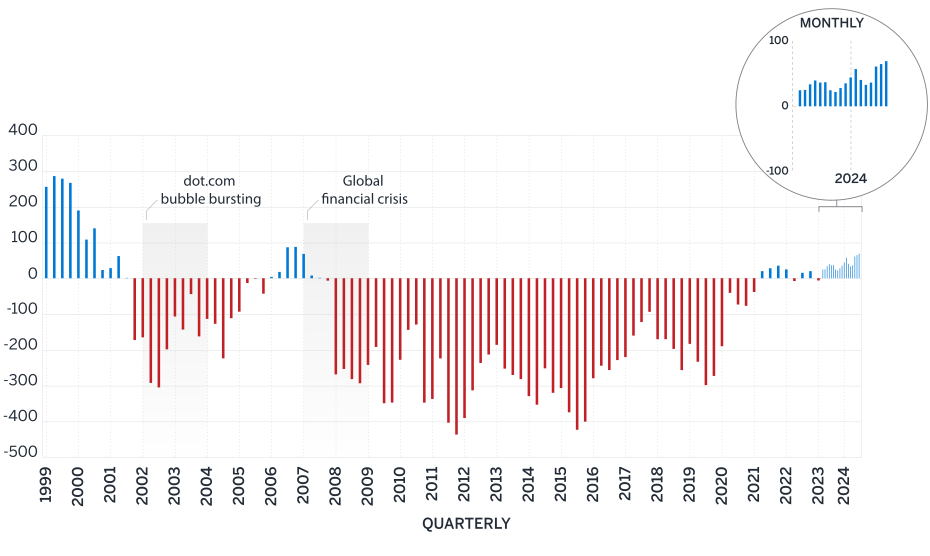
As highlighted below, overall corporate pension funding has improved dramatically. A significant contributor to this improvement has been the rise in U.S. interest rates which significantly lowered the present value of those future benefits. Let’s hope that the current funding will encourage plan sponsors to maintain their DB pension plans for the foreseeable future. You have to love pension earnings as opposed to pension expense!

Figure 1: Milliman 100 Pension Funding Index — Pension surplus/deficit

View the complete Pension Funding Index.

Have You Ever Wondered?

By: Russ Kamp, Managing Director, Ryan ALM, Inc.

Ever wonder why future pension contributions aren’t part of the funded ratio calculation, yet future benefit payments are? Ironically, under GASB 67/68, which requires an Asset Exhaustion Test (AET), which is a test of a pension plan’s solvency, future contributions are an instrumental part of the equation. Why the disconnect? 

Also, the fact that future contributions, which in many cases are mandated by legislation or through negotiations, are not in the funded ratio means that the average funded ratio is likely understated. Furthermore, given the fact that the funded ratio is likely understated, the asset allocation, which should reflect the funded status, is likely too aggressive placing the plan’s assets on a more uncertain path leading to bigger swings in the funded ratio/status of the plan as the capital markets do what they do.

As part of the Ryan ALM turnkey LDI solution, we provide an AET, which often highlights the fact that the annual target return on asset assumption (ROA) is too high. A more conservative ROA would likely lead to a much more conservative asset allocation resulting in far smaller swings and volatility associated with annual contributions and the plan’s funded status. As you will soon read, contributions are an important part of the AET for public pensions. When performing the test, you need to account for future contributions from both employees and employers. These contributions, along with investment returns, help to sustain the pension plan’s assets relative to liabilities over time.

Here’s a quick summary of how contributions fit into the asset exhaustion test:

  1. Current Assets: Start with the current market value of the plan’s assets.
  2. Benefit Payments: Forecast the actuarial projections for future benefit payments
  3. Administrative Expenses: Add in the actuarial projections for administrative expenses
  4. Future Contributions: Subtract the actuarial projections for future contributions from employees and employers to get a net liability cash flow.
  5. Investment Returns: Grow the current market value of plan’s assets at the expected investment return on the plan’s assets (ROA) plus a matrix of lower ROAs to create an annual asset cash flow
  6. Year-by-Year Projection: Perform a year-by-year projection to see if the asset cash flows will fully fund the net liability cash flows. Choose the lowest ROA that will fully fund net liability cash flows as the new target ROA for asset allocation

By including contributions in the test, you get a more accurate picture of the plan’s long-term sustainability. So, I ask again, why aren’t future contributions included in the Funded Ratio calculation? Isn’t it amazing how one factor (not including those contributions) can lead to so many issues? With less volatility in funded status and contributions, DB plans would likely have many more supporters among sponsors and the general public (aka taxpayer) . It is clearly time to rethink this issue.

“The Truth Will Set You Free”

I continue to be perplexed, befuddled, mystified, and perhaps stumped by the reticence shown by plan sponsors and their consultants in wanting to know the value of the liabilities in their defined benefit plan on an on-going basis!

As a reminder, the defined benefit plan solely exists to provide a predefined benefit to past, present and future employees of the system in a cost effective manner such that contribution costs remain low and stable. Again, the plan exists to meet a liability.  It doesn’t exist to meet a return on asset assumption. Yet, plan sponsors spend 95% of their time worried about the assets in their plan and very little time on how liabilities are being impacted by market forces.

If two pension plans have widely differing fund ratios, say 100% and 60%, should they have the same asset allocation? No, they shouldn’t. They certainly shouldn’t have the same ROA objectives. Why would a plan sponsor of a well funded plan want to live with the volatility associated with an asset allocation designed to support a 60% funded plan?  Plan sponsors should adjust their asset allocation based on the plan’s funded ratio.

A more fully funded plan should have a much more conservative asset allocation than a poorly funded program. However, in order to know what the funded ratio is, one needs a more accurate and current understanding of the value of the plan’s liabilities.  Currently, the only visibility on a plan’s liabilities is through the annual actuarial report, which tends to be provided 4-6 months delinquent. For many plans, they may still only have a view on year-end 2013 liabilities. We can assure you that liability growth has swung wildly in the last 17-18 months, as interest rates fell significantly in 2014, before backing up so far this year.

In a previous blog posting we discussed 2014’s performance for the average pension plan. We highlighted the fact that the average plan slightly underperformed the average ROA, and that based on that performance most sponsors likely felt that it was an okay year.  Unfortunately, that perception would be incorrect as liability growth easily outpaced asset growth in 2014.

In addition, had sponsors taken risk off the table in 1999 when most DB plans were over-funded, they would have adjusted their asset allocations toward fixed income and away from equities. Regrettably, more risk was put into the plans when fixed income allocations were dramatically reduced for fear that the lower yielding environment would reduce a plan’s ability to meet the ROA objective.  As you know, DB plans have missed the last 15 years of a bond bull market, while subjecting those plans to greater equity risk and two major market declines.

Clearly, liabilities and assets have different growth rates. Yet, the industry continues to believe that by achieving the Holy Grail ROA annually that everything will be fine. Unfortunately, that perception is false.

Would you be comfortable playing a football game in which you only knew your score (assets), but had no clue as to what your opponent was doing (liabilities)? How would you adjust your play calling or defense? I suspect that you wouldn’t play any game in which this scenario existed. Then why as an industry are we playing the pension game by only focusing on the assets with no understanding as to how your liabilities are doing?

We can win the pension game, WE NEED TO WIN THE PENSION GAME, but in order to do so we must utilize tools that provide us with all the information that we need to manage these plans more effectively.  Having greater clarity on the liabilities doesn’t have to be a bad thing!  What are you afraid of?

Pension America – Taking Control Of One’s Destiny

For pension plan participants defined benefit plans (DB) must remain the backbone of the US Retirement Industry

The true objective of a pension plan is to fund liabilities (monthly benefits) in a cost effective manner with reduced risk over time. Unfortunately, it has been nearly impossible to get a true understanding of a plan’s liabilities outside of the actuary’s report, which is received by sponsors and trustees only on an annual basis, at best, and usually many months delinquent.

Fortunately, a plan’s liabilities can now be monitored and reviewed on a monthly basis through a groundbreaking index developed by Ron Ryan and his firm, Ryan ALM – The Custom Liability Index (CLI). The CLI is similar to any index serving the asset side of the equation (S&P 500, Russell 1000, Barclays U.S. Aggregate, etc.), except that the CLI measures your plan’s specific liabilities and not some generic liability stream. This critically important tool calculates the present value, growth rate, term-structure, interest rate sensitivity of your plan’s liabilities, and other important statistics such as, average yield, duration, etc. With a more transparent view of liabilities, a plan can get a truer understanding of the funded ratio / funded status.

The use of the CLI enables plan sponsors, trustees, finance officials, and asset consultants to do a more effective job allocating assets and determining funding requirements (contributions). The return on asset assumption (ROA), which has been the primary objective for most DB plans, should become secondary to a plan’s specific liabilities. Importantly, as the plan’s funded status changes, the plan’s asset allocation should respond accordingly.

Importantly, the CLI is created using readily available information from the plan’s actuary (projected annual benefits and contributions), and it is updated as necessary to reflect plan design changes, COLAs, work force and salary changes, longevity forecasts, etc. In addition, the CLI is an incredibly flexible tool in which multiple views, based on various discount rates, can be created. These views may include the ROA, ASC 715, PPA, GASB 67/68, and market-based rates (risk-free), with and without the impact of contributions.

Why should a DB plan adopt the CLI? As mentioned above, DB plans only exist to fund a benefit that has been promised in the future. As a plan’s financial health changes the asset allocation should be adjusted accordingly (dynamic). Without having the greater transparency provided by the CLI, it is impossible to know when to begin de-risking the plan. You’ve witnessed through the last 15 years the onerous impact of market volatility on the funded status of DB plans and contribution costs. Ryan ALM and KCS can help you reduce the likelihood of a repeat, and very painful, performance.