What Are the Stats Telling Us?

By: Russ Kamp, Managing Director, Ryan ALM, Inc.

Mark Twain quoted Benjamin Disraeli in his 1907 autobiography, when he stated “Lies, damned lies, and statistics” as a phrase used to describe the persuasive power of statistics to support weak arguments. Folks who regularly read my posts know that I am a frequent user of statistics to support my arguments, whether they are strong or weak. As a young man, I would study the sports section box scores and the backs of my baseball cards for every possible stat. It is just who I am. I love #s!

The investment management industry is inundated with statistics. You can’t go a day without a meaningful insight being shared in reference to our industry, the economy, interest rates, politics, companies, commodities, etc. I try to absorb as many of these stats as possible. However, it is easy to fall prey to confirmation bias, which humans are prone. Putting a series of statistics together and building an investment case is never easy. That said, we at Ryan ALM, Inc. have been saying since the onset of higher rates that the US Federal Reserve would likely be forced to keep rates higher for longer, as inflation would remain stickier than originally forecast.

We also didn’t see a recession on the horizon due to an incredibly strong US labor market, which continues to witness near historic lows for unemployment. Despite the retiring of the Baby Boomer generation, the labor participation rate is up marginally during this period of higher rates, indicating that more folks are looking for employment opportunities at this time. They are being supported by the fact that job openings remain quite elevated relative to pre-Covid-19 levels at roughly 880k. When people work, they spend! Wage growth recently surprised to the upside. Will demand for goods and services follow? It usually does.

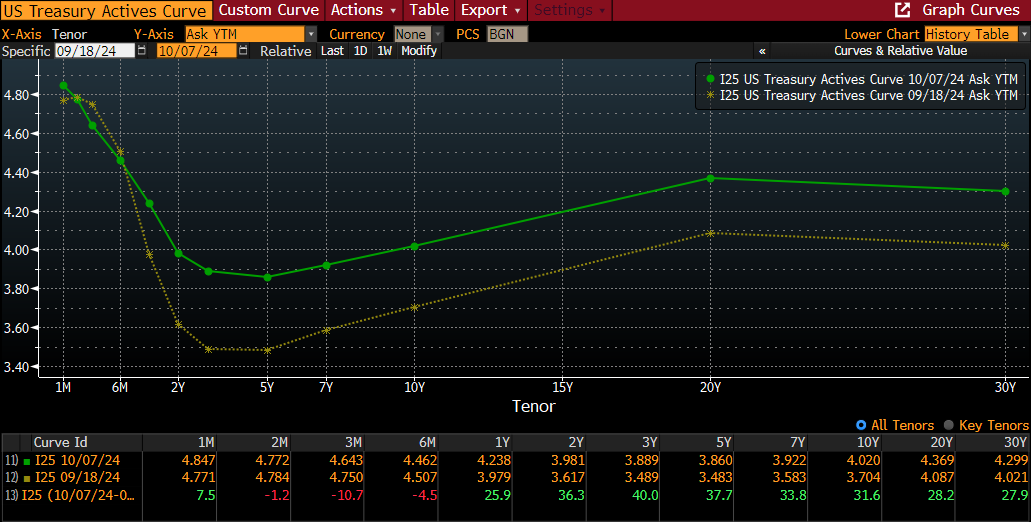
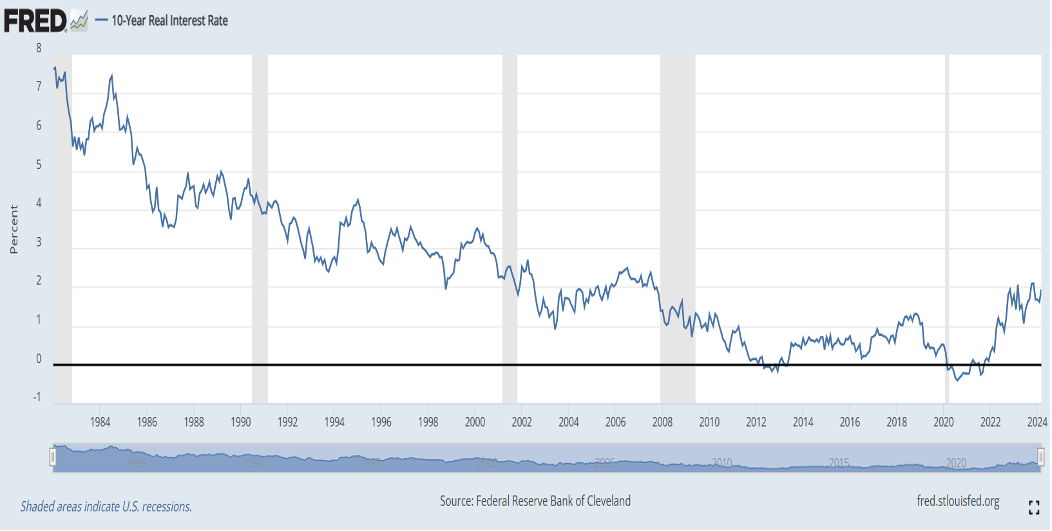
Furthermore, as we’ve disclosed on many occasions, financial conditions are NOT tight despite the rapid rise in US interest rates from the depths induced by the pandemic. Long-term US rates remain below the 50-year average, and in the case of the US 10-year Treasury note, the yield difference is roughly -2.1%. Does that give the Fed some room to possibly increase rates should inflation remain elusive?

In just the past week, we’ve had oil touch $85/barrel, the Atlanta Fed’s GDPNow model increase its forecast for Q1’24 growth from 2.3% to 2.8%, a Baltimore bridge collapse that will impact shipping and create additional expense and delays, housing that once again exceeded expectations, Fed (Powell) announcements that a recession wasn’t on the horizon, job growth (ADP) that was the highest in 8 months, manufacturing that stopped contracting for the first time since 2022 (17 months), and on and on and… Am I kidding myself that our case for higher for longer is the right call? Am I only using certain stats to “confirm” the Ryan ALM argument?

We don’t know. But here is the good news. Our investment strategy doesn’t care. As cash flow matching experts, we are agnostic as to the direction of rates. Yes, higher rates mean lower costs to defease those future benefit promises, so higher rates are good. However, once we match asset cashflows of interest and principal to the liability cash flows (benefit payments and expenses), the direction of rates becomes irrelevant, as future values are not interest rate sensitive. Building an investment case for cash flow matching was challenging when rates were at historic lows. It is much easier today, as one can invest in high quality investment-grade corporate bonds and get yields in the range of 5%-5.5%, which is a significant percent of the average return on asset assumption (ROA) with much less risk and volatility of investing in equities and other alternatives.

I don’t personally see a case for the Fed to cut rates in the near future. I think that it would be a huge mistake to once again ease monetary policy before the Fed’s objective has been achieved. I lived through the ’70s and witnessed first-hand the impact on the economy when the Fed took its collective foot off the brake. As a result, I entered this industry in 1981 when the 10-year Treasury yield was at 14.9%. The Fed can’t afford to repeat the sins of the past. I believe that they know that and as a result, they won’t act impulsively this time.

Are We Witnessing a Heavy Weight Fight?

By: Russ Kamp, Managing Director, Ryan ALM, Inc.

Most everyone is aware that monetary policy has gotten much tighter than we’ve witnessed in multiple decades, especially on the heels of the Fed’s zero interest rate policy (ZIRP). As a reminder, the Federal Reserve began raising the Fed Funds Rate (FFR) on March 17, 2022. After 2 years of their tightening action designed to combat inflation, the Fed Funds Rate sits at 5.25%-5.5%, where it has been for the last 1/2 year. Has the Fed’s action achieved its primary objective of price stability? No, but they’ve certainly made strides toward that quest seeing inflation fall from a high of 8.4% in July 2022 to February’s 3.2% reading. Furthermore, neither the economy nor the labor force have collapsed.

I recall when the Fed first began raising the FFR, they anticipated that both the economy and labor force would be impacted. In fact, I remember seeing estimates that the unemployment rate would likely elevate to between 4.5% and 5% as a result of this action, and the economy would most likely fall into recession. Thankfully, neither event has occurred. Why? Despite the aggressive Fed action to raise interest rates, financial conditions are not that tight. In fact, as I wrote in yesterday’s post, by some measures, financial conditions are actually easier than they were before the first rate increase.

Could it be that the Federal government’s budget is the reason behind the economy and labor market’s strength despite “aggressive” monetary policy? The Office of Management and Budget (OMB) estimates that the Federal budget for fiscal year 2024 will ultimately produce a deficit of roughly $1.6 trillion. Furthermore, 2025’s budget is forecast to create a deficit of $1.8 trillion. This is incredible stimulus that is being provided to the US economy. It is in direct conflict to what the Fed is trying to accomplish. First, I don’t believe that the current level of interest rates is that high, especially by historical standards, but they definitely aren’t high enough to combat the government’s deficit spending at this time.

As a reminder, when the government deficit spends, those $s flow into the private sector in the form of income which leads to greater spending and corporate profits, which we are witnessing at this time. This conflict between monetary policy and fiscal policy is what I’m defining as the heavyweight battle. Which policy action will ultimately prevail? Back in the 1970’s monetary policy became quite aggressive leading to double digit interest rates that bled into the early 1980s. There were many factors that created the excessive inflation that ultimately had to be curtailed with unprecedented Fed action. What the Fed didn’t have to do was fight the Federal government budget.

During the 1970s, the average budget deficit was only $35 billion. Yes, that is correct. The peak deficit occurred in 1976 at $74.7 billion , while 1970’s deficit of $2.8 billion was the lowest. In case you are wondering, the $35 billion average deficit would equate to roughly $153 billion in today’s $s or <1/10th of 2024’s expected deficit. Clearly, there was little excess spending/stimulus created by the Federal government at that time for which monetary policy had to combat. So, again, the US doesn’t have a debt problem. It has an income problem! The excess stimulus is elevating economic activity, keeping workers employed and spending, while corporate America produces the goods and services that are being demanded, leading to excess profit growth that continue to fuel the stock market.

As you can see, this tug of war or heavy weight battle is far from decided. I don’t believe that US interest rates are high enough to truly impact economic activity and the labor force, which continues to enjoy sub 4% unemployment rates. We either need rates to rise more, government deficits to shrink, or a combination of both before we see the Fed achieve its goal of a 2% sustained inflation rate. Let’s pray that our very uncertain geopolitical environment doesn’t take a turn for the worse with further escalation of the Ukraine/Russia war or worse yet, conflict in Southeast Asia between China and Taiwan. Our inflation story could get much worse under those scenarios.

KCS told you this 15 months ago

KCS told you this 15 months ago

Mr. Bernanke said recent government spending cuts and tax increases have worked against the Fed’s efforts to encourage more spending, investment and hiring.
“With fiscal and monetary policy working in opposite directions, the recovery is weaker than it otherwise would be,” Mr. Bernanke said, stepping up arguments he has made about recent government efforts to reduce near-term budget deficits.

These comments were taken from the attached WSJ article from January 3, 2014

This article was brought to my attention by my son, Ryan, who also reminded me that KCS had reported nearly 15 months ago that the fiscal drag created by both deficit reduction and tax increases would combine to damp economic activity and the recovery from the great recession.  Economists estimate that the US economy grew in 2013 at roughly 2.1%, which is very modest given this many years into the “recovery”. 

As a reminder, KCS produces a monthly investment article on a variety of topics.  In addition, we occasionally produce a piece titled “Burning Issues”.  In the October 2012 Fireside Chat, and again in the January 2013 Burning Issue, we highlighted the potential drag from fiscal tightening.  Both articles are available on the KCS website at http://www.kampconsultingsolutions.com.

GDP= C+I+G+(X-M), where C=consumption, I=Investment, G=government spend (deficit) and X-M=net exports

The consumer has been, until recently, reworking their balance sheets, and have reduced debt to roughly 92% of earnings. Corporate investment has been tame, but appears to be growing at a faster pace, and this should continue through 2014.  Net exports remain a large drag on GDP, but trade imbalances have improved.  The fiscal deficit has been cut nearly in half through spending cuts and tax increases.  We are unlikely to see greater fiscal cuts in 2014, so the drag on GDP may be lessened.

We, at KCS, are expecting GDP growth to be slightly greater than current forecasts (2.7%).  In fact, it would not surprise us to see GDP growth exceed 3% – 3.5% in 2014. Our hope is that greater investment will continue to strengthen the US labor market, increasing wage growth and spurring demand for goods and services. If this scenario materializes, our GDP forecast may be understated.

KCS Fireside Chat – 403 (b) Plans: Oldies but Goodies!

KCSThis month’s Fireside Chat was crafted by our partner, Dave Murray, the former plan sponsor for Conrail’s DB and DC plans.  Dave has become a real expert in all things DC.  Dave’s focus this month is on the 403(B) space, and specifically those plan’s dealing with non-profits.  Many of our colleagues, friends and associates volunteer at non-profits, with many holding board or finance positions.  With this great responsibility comes the need to stay on top of legislative changes.  We hope that you find this piece educational.

Washington’s Folly

I have to be careful!  I find myself shaking my head so frequently at what is transpiring in Washington DC, that I might suffer permanent nerve damage.  It is scary how uninformed our politicians are regarding economics, and specifically the role of federal deficits in generating economic activity.

There are four primary sources of profits at the macro level of the US economy including, consumption (consumer spending), corporate investment (plant, equipment and inventory), net exports (exports minus imports) and net government spending (deficit spending minus tax receipts).  Since the great recession, it has really only been the federal spending that has kept corporate profits at all-time highs (averaging > 10% of GDP).  The consumer and corporations have kept spending and investment below normal historical levels, and our net exports are nearly -$500 billion. If it weren’t for the fact that the US fiscal deficit was as great as it has been, the economic recovery would have been far more muted, especially in 2010 and 2011.

Remember, the Federal deficit = private savings! Cut back too much on the federal deficit spending without a commensurate pick up in investment and consumption, and we could teeter on the brink of another recession.  With employment remaining weak, we need corporations to pick up the slack.  We may also benefit by becoming a bigger energy exporter, reducing the negative consequence of being a net importer nation, but that might take years.  Until then, we need Washington to stop focusing on the debt ceiling and expend their energy on creating an economic environment that creates jobs and stimulates demand for goods and services.

Youth unemployment’s second derivative effect

Much has been written about the growing unemployment crisis for those under 30 in the US, with <50% of that cohort working a full-time job, but there is a secondary effect that hasn’t gotten much notice.  With the demise of defined benefit plans as the primary source of retirement income, defined contribution plans are rapidly becoming the only retirement game in town.  However, for DC plans to be effective, employees need to fund as much as they can, as early as they can, in order to build a nest egg that will accumulate the necessary assets for a 20-25 year retirement.  With the younger workers not entering the workforce until they are in their late 20s, they are missing out on several years of contributions and compounding.  Unfortunately, managing a DC plan has proven difficult enough for most of us.  We certainly don’t need further impediments exacerbating an already tough situation.