ARPA Update as of October 10, 2025

By: Russ Kamp, CEO, Ryan ALM, Inc.

Welcome to Columbus and Indigenous Peoples’ Day. Bond markets are closed and the equity markets remain open. Columbus Day remains a federal holiday, but with most federal employees already furloughed, it will not be a day to celebrate for many.

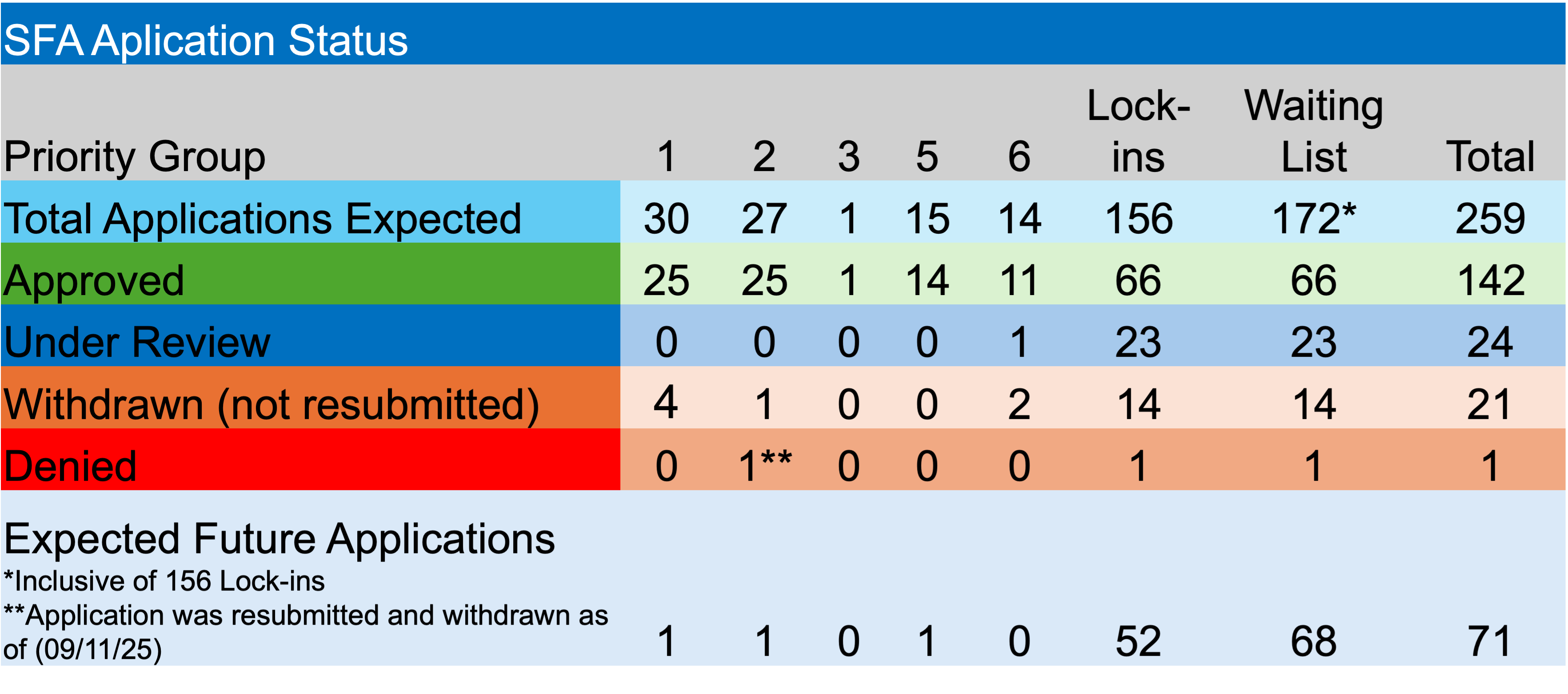
Regarding ARPA and the PBGC’s activity implementing this critical legislation, last week proved a busy one as there were three new applications received, two approved, and one withdrawn. There was also a plan added to the burgeoning waitlist. Happy to report that there were no applications denied or required to rebate a portion of the SFA as a result of census errors.

Now for the details. Ironworkers’ Local 340 Retirement Income Plan, Operative Plasterers & Cement Masons Local No. 109 Pension Plan, and Dairy Employees Union Local #17 Pension Plan, each a non-priority group member, filed their initial applications seeking a combined $60.4 million in SFA for nearly 3k plan participants. The PBGC has 120-days to act on these applications.

Pleased to report that two plans, Local 734 Pension Fund and the Retirement Plan of the Millmen’s Retirement Trust of Washington received approval for their initial applications, and they will receive $89.5 and $7.2 million, respectively for their combined 2,597 members. The PBGC has now awarded $74.3 billion in SFA grants to support the pensions for 1.828 million workers.

In other ARPA news, Pension Plan of the Pension Fund for Hospital and Health Care Employees – Philadelphia and Vicinity has withdrawn its initial application seeking $229.8 million in SFA that would support 11,084 members. Finally, the Buffalo Carpenters Pension Fund has added their name to the waitlist. They immediately secured the valuation date as July 31, 2025. Good luck to them as there are 67 plans currently on the waitlist that have yet to submit an application.
I’ve mentioned on several occasions the approaching deadline to file an initial application seeking SFA approval. I do hope that an extension of the filing deadline is approved. There are a lot of American workers who should be provided the full benefits that they have been promised and could secure through the ARPA legislation. This should be a bi-partisan effort.
ARPA Update as of August 15, 2025

By: Russ Kamp, CEO, Ryan ALM, Inc.

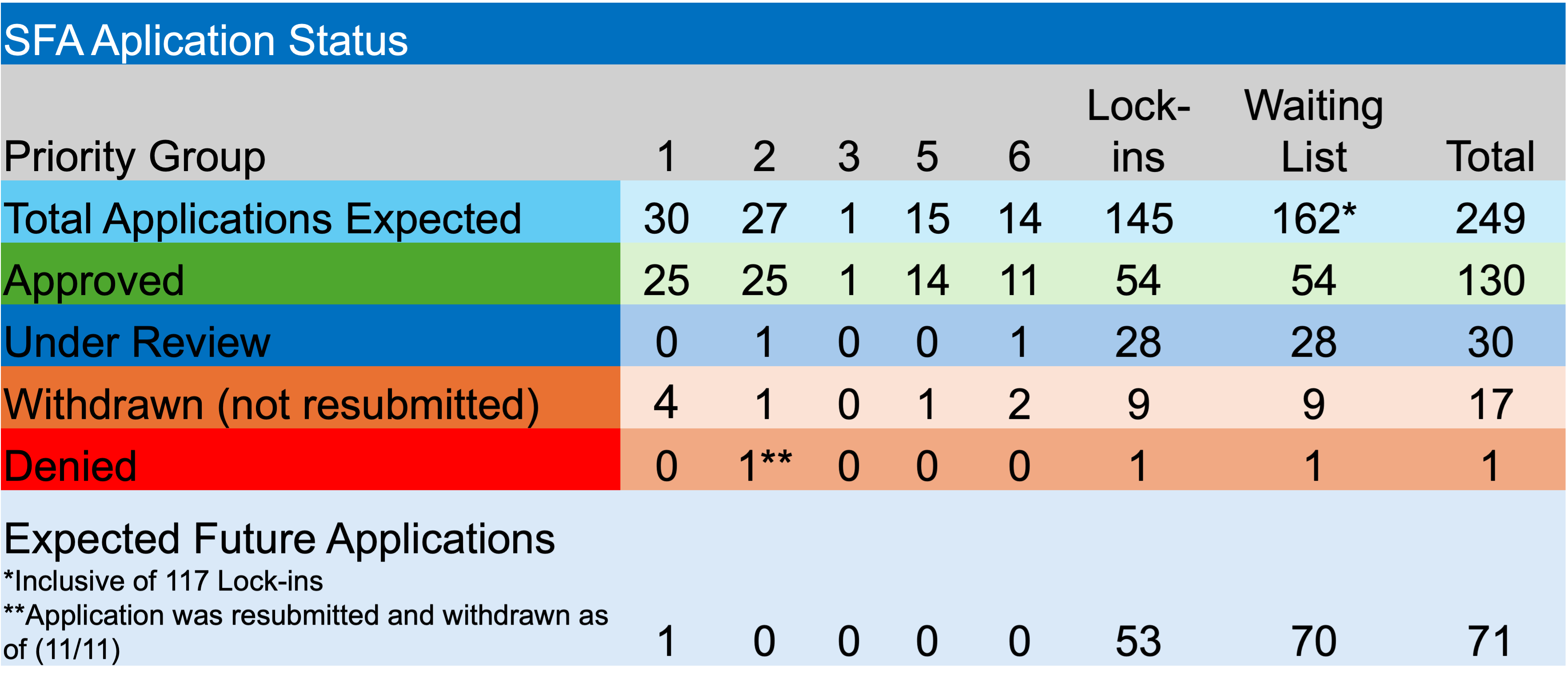
Hard to believe that we are nearly 2/3rds of the way through 2025. I suspect that the PBGC is having a hard time with that reality given the workload that remains with 119 multiemployer plans still seeking a successful review of their SFA application. Seventy-one applications have yet to be submitted through the PBGC’s e-Filing portal.

As for last week, there were no applications approved and none have been since July 29, when Laborers’ Local No. 130 Pension Fund received $33.3 million in SFA to support its 641 plan participants. However, there were 3 applications submitted for review. These applications were from none-priority group members submitting revised applications. There are currently 30 applications before the PBGC, which has 120-days to act on each or they are automatically approved.

I’m pleased to report that no applications were denied or withdrawn during the previous week. There were also no pension funds required to repay a portion of the SFA deemed excessive due to census errors. It has been since August 1, 2025, that we’ve had a fund repay a portion of the SFA. There was one new fund added to the waitlist, which now stands at 162 members. Chicago Foundry Workers Pension Plan added its name to the list on August 11th. As reported above, there are still 71 multiemployer plans that have not submitted applications at this time.

As you may recall, when the Butch Lewis Act was first contemplated, the folks at Cheiron initially defined the potential universe of SFA recipients as 114 funds. Today there are 249 funds seeking SFA support, of which 130 have already been approved. As a reminder, eligible plans must apply for SFA by December 31, 2025. Those filing revised applications have until December 31, 2026. Any distribution of SFA must be completed by September 30, 2030, due to legislative sunset rules.

The PBGC is averaging about 6-7 submissions per month. Based on that pace, it doesn’t seem possible that many of the 71 members on the waitlist that haven’t submitted applications will be able to meet that 2025 deadline. More to come.

Delayed Gratification – Just How Important Is It?

The following Tweet was posted by Vanguard this morning – “Delaying gratification, avoiding debt, & saving are all central to a financial literacy program for student”. We all know that we are more responsible for funding our retirement than at any time in the last 60 years, but just because we know doesn’t mean we have the ability to do so.

Defined Contribution plans are the vehicles of choice for most private sector employers, if not their employees. However, funding these plans, even to meet the company match, is not easy for many (most) low to middle income households. At KCS, we’ve discussed the benefits of participating in a DB plan versus a DC plan since our founding.

But, if you have a job, don’t have substantial student loan our housing debt, and can afford to make sizable contributions into your retirement program, it is better to delay gratification and make those contributions as early and often as possible. Why? Because the math of compounding truly works.

For instance, if a 22 year old can make a monthly contribution of $833 for 10 years, the $99,960 in contributions growing at 4% / year will become $438,393.12 upon reaching age 65. Again, that is with making contributions for only the first 10 years. At that point, you’ve basically funded your retirement and now you can begin acquire some of the other assets that you’ve been deferring.

However, if you can’t fund your retirement upfront with sizable monthly contributions, but can only put in $194 / month for the next 43 years growing at 4% until age 65, your balance upon retirement would only be $256,648.87, or roughly $182,000 less in total assets. WOW!

Finally, just think about how little you’ll be able to accumulate in your account if you delay making contributions until the age of 32. For instance, if you can only make that $194 / month for the next 33 years your account balance at age 65 is only $154,500, more than $100,000 less than you would have had if you began contributing the $194 / mo for the prior 10 years.

So, DC plans need funding often and early to be successful, but having the financial wherewithal is not a given, and having the discipline is not easy.