Not Quite Ripken-like, but it is over!

By: Russ Kamp, CEO, Ryan ALM, Inc.

Like clockwork, Milliman has released its monthly Milliman 100 Pension Funding Index (PFI), that analyzes the 100 largest U.S. corporate pension plans, and for the first time in 11-months, the collective funded ratio for this cohort failed to advance.

Investment returns for the constituents in this index fell -3.33% causing assets for PFI members to collectively fall to $1.3 trillion. Unfortunately, a 32-basis-point increasein the discount rate was not enough to offset asset depreciation. The discount rate at 5.65% caused the present value of liabilities to fall to $1.2 trillion. As a result, the funded ratio marginally declined from 109.3% as of February 28, to 108.9%, as of March 31, 2026.

Despite the recent setback, the index showed a 0.7% improvement in the funded ratio which began 2026 at 108.2%. The 0.7% improvement resulted in a $6 billion funding improvement for the first quarter, as a 19-basis-point rise in the discount rate offset quarterly returns for the index constituents of -0.21%.

“March was the first month of funding level declines in almost a year,” said Zorast Wadia, PFI author. “While funding levels improved overall during the first quarter, it is uncertain how long these gains will last, given current volatility. Surplus management strategies focused on both sides of the balance sheet continue to be prudent.” We, at Ryan ALM, Inc., couldn’t agree more. A cash flow matching (CFM) strategy, designed to carefully match asset cash flows (bond interest and principal) with liability cash flows (benefits and expenses) would bring an element of certainty to the management of defined benefit plans. CFM provides all the liquidity to meet ongoing monthly obligations, while extending the investing horizon for the non-bonds. It also eliminates interest rate risk for that portion of the portfolio using CFM.
View this month’s complete Pension Funding Index.

ARPA Update as of April 3, 2026

By: Russ Kamp, CEO, Ryan ALM, Inc.

Good morning. We hope that you had a good holiday weekend.

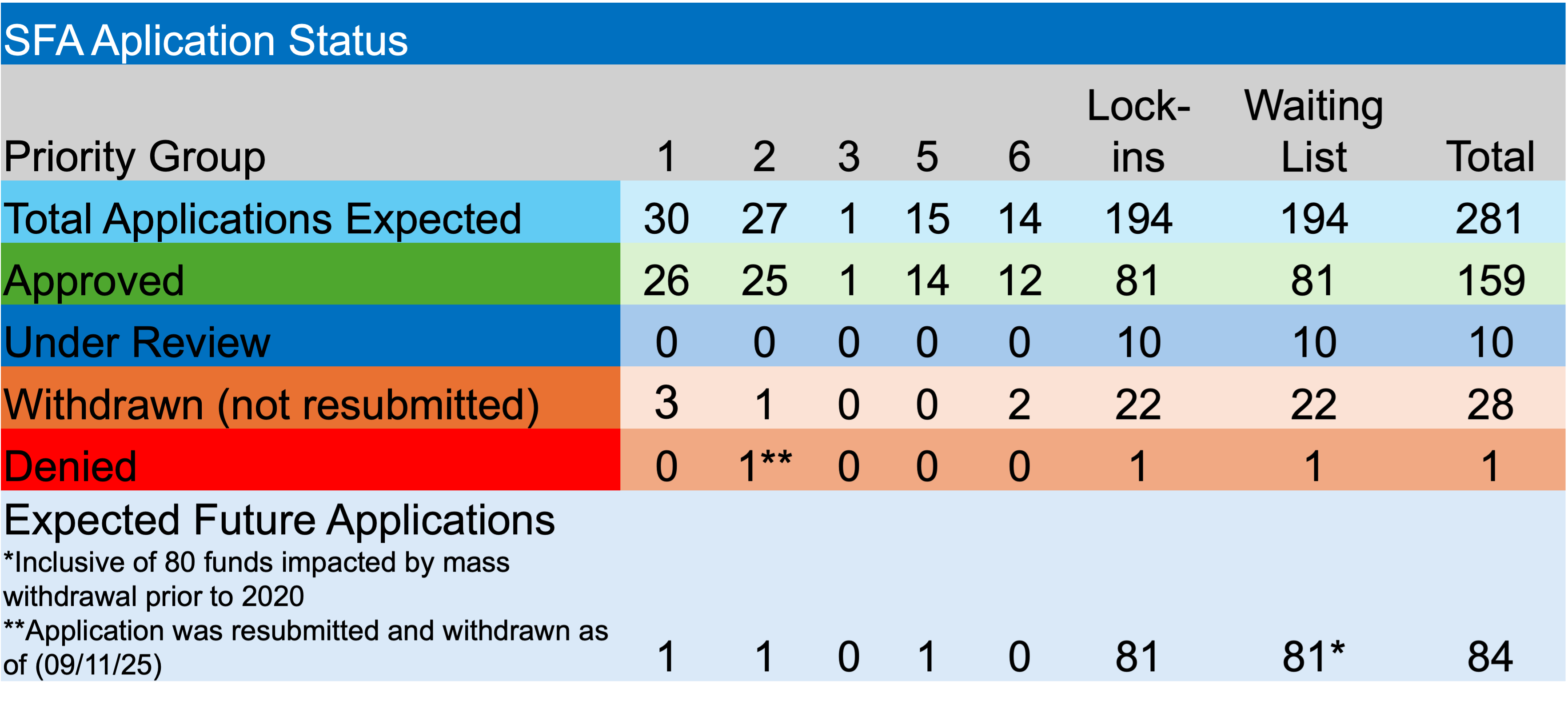
ARPA is now more than 5-years old (March 11, 2021), and the PBGC continues to plug along implementing this critical pension legislation. We are still waiting to hear how the 80 multiemployer plans on the waitlist that were terminated by Mass Withdrawal before 2020 Plan Year will be treated.

As far as those that are currently going through the process, this week saw one plan added to the waitlist, one plan receive approval for their revised application, and three funds that withdrew initial applications.

Pension Plan of the Automotive Machinists Pension Trust, a non-Priority Group member, is seeking $139 million in SFA through a revised application for their nearly 7,500 plan participants. While the Machinists wait for an answer on their application, the members of the UFCW – Northern California Employers Joint Pension Plan are celebrating the announcement that its revised application has been approved. They will receive nearly $2.6 billion in SFA and interest for their >138k members.

Lastly, Bricklayers and Stonemasons Local Union #2 Pension Plan, Communications Workers Local 1109 Pension Plan, and Local 1430 I.B.E.W. Pension Plan have each withdrawn an initial application seeking SFA. Collectively they are trying to secure $50.2 million for 1,690 pensioners.

Since the PBGC began implementing the ARPA pension legislation in July 2021, more than 18% of the roughly 11 million participants in multiemployer plans have had their promised pension benefits secured. Of the nearly 1,350 multiemployer plans, more than 20% have or will go through the application process to help fund those pension promises. It has been an extraordinary legislative effort.

March Proves Challenging for Core Fixed Income

By: Russ Kamp, CEO, Ryan ALM, Inc.

March was a difficult month for active core fixed income managers, as the Bloomberg U.S. Aggregate Index fell -1.8%. Uncertainty related to the impact of the Iran War on oil prices and subsequently inflation, pushed rates higher across the Treasury yield curve. The U.S. 10-year Treasury note saw yields rise 38 bps to 4.31%.

Agencies fell -1.7% in line with Treasuries, while the Corporate sector declined -2.0%. Corporate spreads ended March with an option adjusted spread (OAS) of 88.6 bps. The best performing Corporate sector was Financials (-1.7%), while Utilities performed worst at -2.2%.

The greatest risk managing bonds is interest rate risk. Given both geopolitical (Iran, Taiwan, Ukraine) and economic risks (oil, inflation, interest rates), now is the time to significantly reduce risk within your fund, whether that be a DB pension or E&F. Why continue to ride active fixed income through these uncertain markets? One can use a cash flow matching (CFM) strategy to SECURE and fund net liabilities chronologically well into the future. In the process, interest rate risk is eliminated as future benefits and expenses are not interest rate sensitive.

Furthermore, by securing near-term liabilities, the non-bond assets can now grow unencumbered providing more time to wade through these challenging times. I have no idea how long this conflict will last. I also don’t know how much damage has occurred and that which might still happen to oil production in the Middle East. Implementing a strategy that doesn’t rely on forecasting U.S. interest rates should be a high priority today.

Making the switch is easy. Rotate your current core fixed income assets from an active investment strategy to a CFM portfolio. There isn’t a need to revisit the fund’s asset allocation. We’ll even look for opportunities to take-in-kind some of your existing holdings. You’ll appreciate not having to search each month for the liquidity to meet the monthly promises that have been made to your participants, as the CFM strategy will provide all the liquidity that you need. Moreover, the Ryan ALM CFM model is skewed to A/BBB+ corporate bonds which should outyield most generic bond indexes that are skewed to Treasuries (e.g. the AGG).