ARPA Update as of February 6, 2026

By: Russ Kamp, CEO, Ryan ALM, Inc.

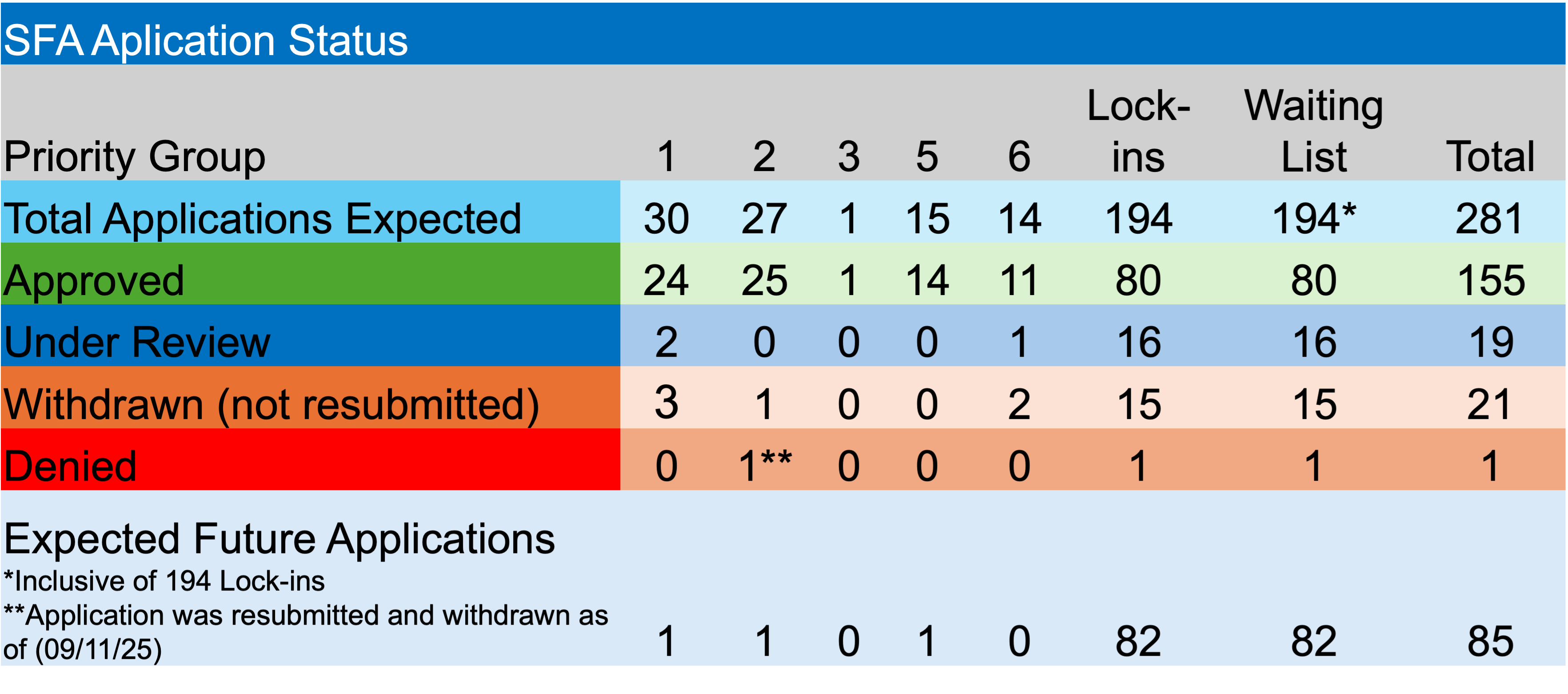
It looks like those of us in the Northeast will finally get some respite from the bitter cold, as temps will moderate this week and actually hit the 30s. However, those multiemployer pension plans currently sitting on the waitlist and classified as a Plan Terminated by Mass Withdrawal before 2020 Plan Year, continue to be frozen in place. According to the PBGC’s latest update, there are 80 plans that fall under the Mass Withdrawal classification. I’ll share more info on this subject later in this post.

Regarding last week’s activity, the PBGC is reporting that one fund, Operative Plasterers & Cement Masons Local No. 109 Pension Plan, a Troy, MI, construction union, will receive $13.7 million for the 1,439 plan members. In addition to the one approval, there was another fund that withdrew its initial application. Norfolk, VA-based International Association of Bridge, Structural, Ornamental and Reinforcing Ironworkers Local No. 79 Pension Fund was seeking $14.6 million in SFA for 462 participants in the plan.

There were no applications submitted for review. It appears that only one non-mass withdrawal plan, Plasterers Local 79 Pension Plan, remains on the waitlist. Fortunately, there were no plans asked to rebate a portion of the SFA grant due to census errors or any funds deemed no eligible.

Regarding the 80 mass withdrawal funds currently sitting on the waitlist, MEPs terminated by mass withdrawal under ERISA §4041A(a)(2) are explicitly ineligible for SFA under ARP/IRA rules, regardless of application timing. Furthermore:

No “initial application” option exists post-termination date.

Mass withdrawal means that all/substantially all employers completely withdraw leading to a plan termination.

PBGC SFA statute excludes §4041A(a)(2) terminated plans.

For the 80 funds sitting on the waitlist, it seems like a long shot that the APRA legislation will be amended to accommodate these funds seeking SFA. I’ll continue to monitor this situation in future posts.

Continued Steepening

By: Russ Kamp, CEO, Ryan ALM, Inc.

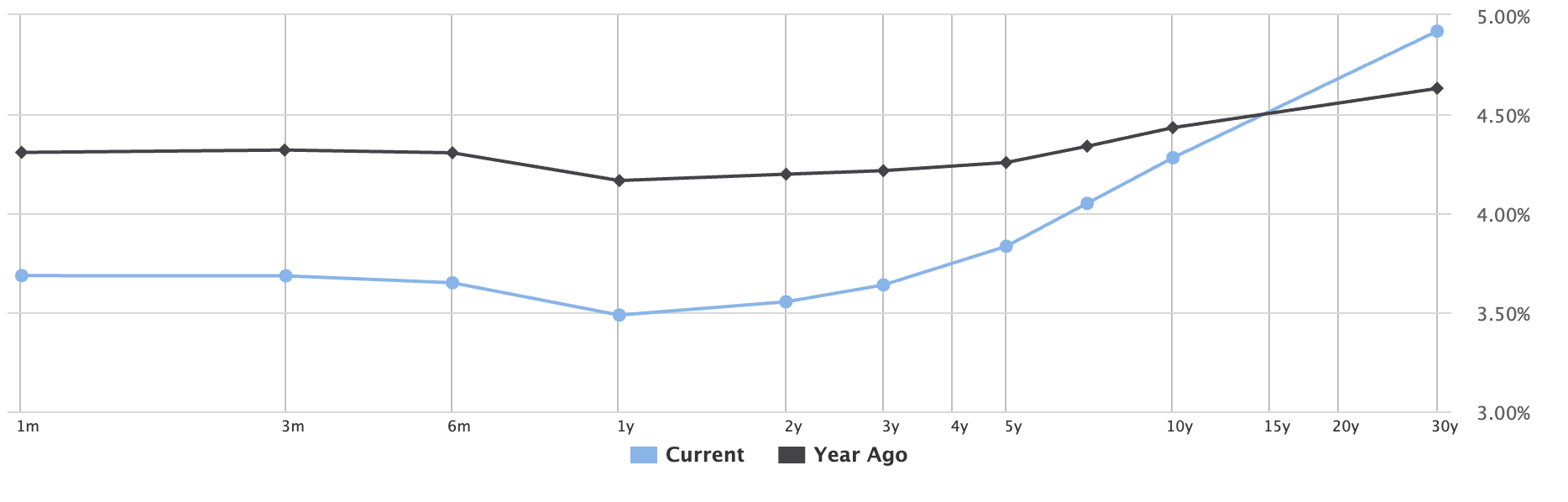
Given today’s headline news related to initial jobless claims and layoffs for January, which were at the highest level since 2009, risk assets are once again selling off (Bitcoin -7% and Nasdaq -1.5%), while short-term Treasury notes are rallying. As a result, the U.S. Treasury yield curve is continuing to steepen, as reflected in the WSJ graph below.

The spread between 2-year notes and 30-year bonds was only 43 bps 12-months ago. The spread today is 1.37%. As we’ve mentioned, bond math is straightforward. The higher the yield (30-year Treasury bonds are 29 bps higher today than last year) and the longer the maturity, the greater the cost reduction in the future value of promised benefits.

Let us produce a free analysis that will highlight the potential cost reduction in those future promises either through a 100% cash flow matching assignment or a vertical slice of a portion of those liabilities. You’ll be positively surprised by the potential cost reduction.

How Do You Know?

By: Russ Kamp, CEO, Ryan ALM, Inc.

I’m on my way home from another terrific FPPTA conference. The only issue I have is with the weather Gods. How is it that Orlando had weather similar to what New Jersey experiences during January? Yes, I was in a conference room from dawn to dusk, but it still wasn’t fair, especially since temps are set to hit 70+ today, while I’m now sitting at the airport. 

Okay, enough of my complaining. As mentioned, I just attended FPPTA’s Winter Trustee meeting in Orlando. They continue to do an excellent job providing critical education for trustees of all experience levels. As I’ve written, they have also developed a higher-level program for a select group of pension trustees that truly want to roll up their sleeves and like Dorothy and her friends, get behind the curtain. I’ve been fortunate to be a part of the first two TLC classes. As the FPPTA continues to develop their use of AI and the self-contained bot currently under construction, Florida public pension trustees will have critical information at their fingertips that few other states, if any, can provide. Great job!

Despite the robust curriculum, there is still much more that needs to be covered and comprehended by the trustees. For instance, there was a lot of discussion surrounding hiring and firing of managers during a particular case study. As I’ve observed over the years, the fortunate investment manager that gets hired usually has the best performance and a reasonable fee that doesn’t offset the performance advantage. Do pension trustees truly understand what they are buying? Often the manager selected is large and likely growing in terms of AUM. But are those advantages?

Worse, when a manager underperforms, which they will eventually do, whether that underperformance is related to a style rotation or something specific to that manager’s process, a decision must be made as to that manager’s fate. Do you keep the manager or let them go? On what basis are you making that decision? Again, you hired a manager because they had good performance. Did you understand their security selection process (insights) and how those insights were working? Did recent strong AUM growth fuel a positive response in the stocks that they owned? As we know, cycles in the investment industry are driven by cash flows, both positive and negative. More money chasing a few ideas drives up returns, while an exodus from those same ideas can tank an investment manager’s performance.

During one exchange of ideas, I asked the TLC participants if any of their funds were using performance fees for their long-only assignments. Only one trustee said that they had – too bad. We’ll discuss that issue in another post. Regarding the one affirmative response, they initiated a performance fee after an extended period of underperformance. Was that action correct? Paying asset-based fees with no promise of delivery on forecasted alpha is wrong, but retaining an underperforming manager may be just as bad whether they are on a performance fee or not. How did this trustee and his fellow board members know whether the manager had skill or if they once did, were their insights still robust?

Investment managers choose their portfolio holdings based on certain insights, and those insights can be measured as to their predictive ability (information coefficient or IC). An information coefficient is the correlation between predicted returns (or rankings of one stock versus another) and the subsequent results (realized returns). If an advisor is a growth manager, they likely swim in a subset of the U.S. equity universe. They then apply their insights to that subset of equity stocks. Each month they can array their portfolio holdings with the balance of the names in the universe that they did not select to see how their ideas stacked up.

You might be surprised to read that a monthly IC above 0.05% is considered fairly strong. An IC from 0.05% to 0.15% would be very strong and likely lead to consistent alpha generation. However, even the best investment ideas can go through challenging times when market dynamics are just out of whack with historic observations and relationships. But there are also times when ideas can get arbitraged away either by that managers growth or the broader investment community latching onto the same insight rendering it less effective or in some cases a negative forecaster/predictor.

So, I ask, when your manager is underperforming, do you know whether it is a market dynamic that is rendering the insight temporarily weak or has that manager’s forecasting ability been diminished? In the case of the manager who maintains strong forecasting ability, but the insight is just out of favor, you would likely want to retain them after a period of underperformance and maybe give them more assets to manage, but I would not recommend putting them on a performance fee (regression to the mean tendencies). However, if after your careful analysis you identify that the manager in question has seen their insights arbitraged away, that should lead you to terminate the manager, whether you like them or not! Let me know if you’d like to discuss his concept in greater detail.

Financial Leverage – A Double-edged Sword

By: Russ Kamp, CEO, Ryan ALM, Inc.

As I recently reported in a blog post titled “Another Cockroach!”,  BlackRock TCP Capital, a business-development company (BDC), reported that it would be slashing the net asset value of its shares by 19% for the Q4’25. I wrote this post because I’ve been concerned about the incredible growth in AUM committed to this asset class. Adding to my concerns is the use of financial leverage to “boost” returns, but as we all know, the impact of leverage can be a double-edged sword.

Recently, Eric Jacobson, Morningstar, wrote an article highlighting the recent travails of the BlackRock BDC with an emphasis on financial leverage. He pointed out that as of September 2025, borrowing within the BDC had increased the market exposure of TCPC’s portfolio to more than 230% of what it would have been without leverage. By Eric’s calculations, the leverage translated into roughly $740 million of net assets alongside nearly $1 billion of borrowed money—a practice that turns uncomfortable valuation adjustments into a painful net asset value drop. According to Jacobson, had the same portfolio been unlevered, its NAV write-down might have a more modest 8% loss. Not great but not nearly as damaging.

Importantly, Jacobson highlights that private direct lending is not a natural substitute for a conventional bond portfolio. We couldn’t agree more. Use investment-grade bonds for their cash flows, as managing a pension plan is all about cash flows. The careful matching of asset cash flows (principal and interest) with benefits and expenses (liability cash flows) SECURES the promised benefits for the period that the allocated assets cover. How comforting!

ARPA Update as of January 30, 2026

By: Russ Kamp, CEO, Ryan ALM, Inc.

So much for escaping the bitter cold in New Jersey by flying to Orlando, FL. The reality is that Orlando is sitting at 25 degrees this morning (Sunday 2/1). Someone is playing a nasty trick on all those snowbirds. It is a good thing for me that I’ll be spending most of my time in a conference room until Wednesday (FPPTA). I hope that you have a great week.

Regarding ARPA and the PBGC’s continuing implementation of this critical legislation, there was activity last week, and some of it was surprising. As I’ve mentioned on several occasions, the ARPA legislation specifically states that all initial applications seeking special financial assistance (SFA) needed to be submitted to the PBGC by 12/31/25. Revised applications could be resubmitted after that date and until 12/31/26. That said, there were three initial applications filed with the PBGC during the week ending January 30th. What gives?

In other news, Cincinnati-based Asbestos Workers Local No. 8 Retirement Trust Plan received approval for SFA. They will get $40.1 million to support their 451 plan participants. In other news, Local 1814 Riggers Pension Plan, withdrew its initial application which had been filed through the PBGC’s e-Filing portal last October. They are hoping to secure a $2.5 million SFA grant for their 65 members.

Fortunately, there were no previous recipients of SFA asked to repay a portion of the grant due to census errors nor were any applications denied due to eligibility issues. Lastly, no new pension plans asked to be added to the waitlist which currently numbers more than 80 systems.

The U.S. Treasury yield curve remains steep, with 30-year bond yields exceeding the yield on the 2-year note by 1.34% as of Friday’s closing prices. This steepening provides plan sponsors and grant recipients with attractive yields on longer maturity cash flow matching programs used to secure the promised benefits.