Public Pension Funding Improves – Milliman

By: Russ Kamp, Managing Director, Ryan ALM, Inc.

Milliman is reporting that funding for public pensions improved in February. According to Milliman’s Public Pension Funding Index (PPFI), which analyzes data from the nation’s 100 largest public defined benefit plans, the average funded ratio improved from 77.7% at the end of January to 78.6% as of February 29, 2024. This represents the highest funded status since May 2022, which was just after the Fed (March) started raising US interest rates.

The PPFI plans returned an estimated 1.7% in aggregate for February. “Individual plan returns ranged from an estimated 0.0% to 3.2% for the month, while the plans gained around $79 billion in total market value”, according to the report. The current deficit between assets and liabilities now stands at $1.33 trillion following an improvement of $56 billion in the past month.

According to Becky Sielman, co-author of Milliman’s PPFI, by the end of February “we’re holding on to the gains we saw in Q4 of last year, with 21 plans above 90% funded, and 15 plans below 60% funded.” Please note that accounting rules for public pensions allow for the discounting of liabilities at the plan’s return on asset assumption (ROA). The median rate stood at 7% in this study. US interest rates have backed up nicely during the first 2+ months of calendar year 2024. The actual improvement in the average funded status may be understated.

ARPA Update as of March 22, 2024

By: Russ Kamp, Managing Director, Ryan ALM, Inc.

“March Madness” is upon us. How’s your bracket doing? I still have my champion in the running, but not much more than that.

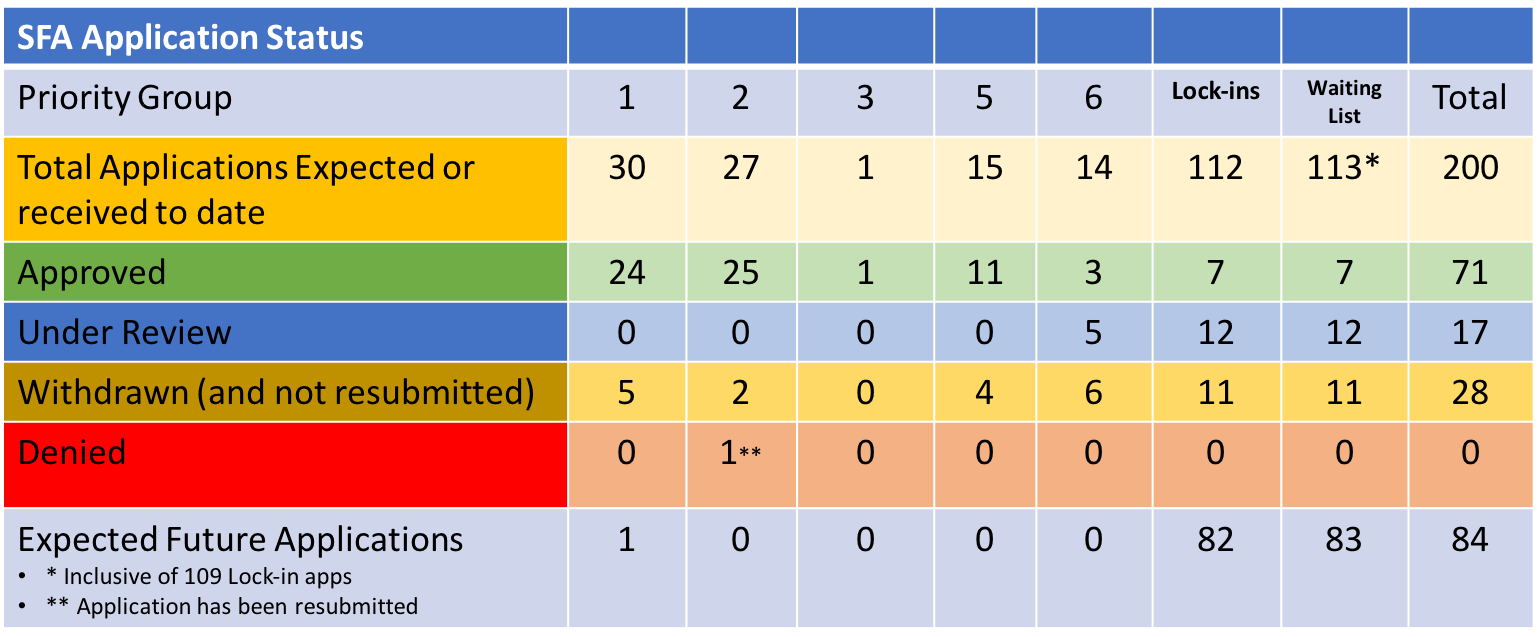
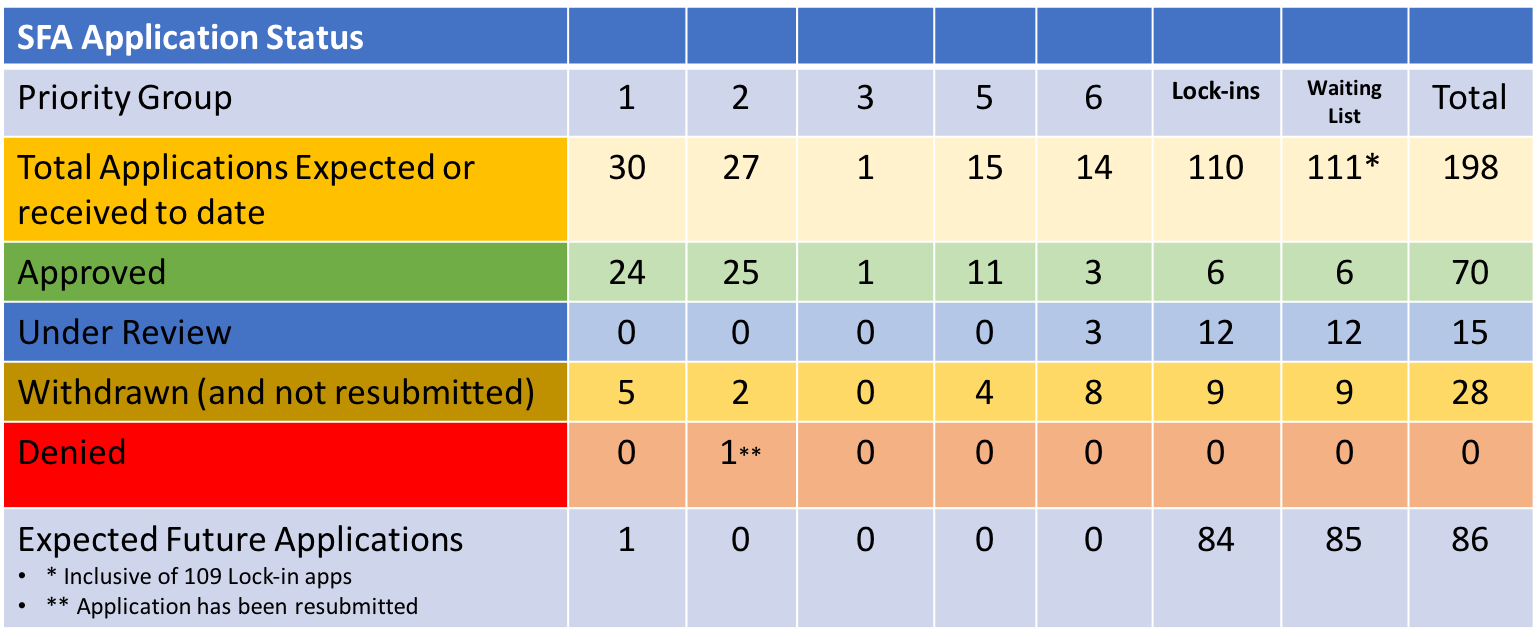
The past week was very quiet with regard to the ARPA legislation and activity associated with its implementation. We did have one fund submit an application for Special Financial Assistance (SFA). United Food and Commercial Workers Union and Participating Food Industry Employers Tri-State Pension Plan, a Priority Group 6 member, submitted a revised application on March 16th. This fund is seeking SFA in the amount of $638.3 million for the fund’s 29,233 members. The PBGC will now have until July 14, 2024 to act on the application.

Besides the filing by the UFCW, there was little to show last week, as there were no applications approved, denied, or withdrawn. Furthermore, unlike the prior week, there were no additions to the waitlist which continues to have 113 funds listed of which 27 have been invited to submit an application. To-date, 71 funds have received SFA in the amount of $53.6 billion. These proceeds include the grant, interest, and any FA loan repayments.

Like the picking of the NCAA tournament bracket, for which there are no perfect submissions remaining, the capital markets are highly uncertain. Yes, the US equity market has enjoyed a robust 5-6 months period, but how predictive is that for the next six months or longer? Those yet to receive the SFA should seriously consider an investment strategy that takes the uncertainty of the markets out of the equation. I am specifically referring to the use of investment grade bonds to defease the promised benefit payments as far into the future that the SFA allocation will cover. Once the matching of asset cash flows to the plan’s liability cash flows is done, that relationship is locked in no matter what transpires in the capital markets. Any risk taken by recipients of these assets should be done in the legacy portfolio where a longer investing horizon has been created. Fortunately, US interest rates remain elevated significantly from when the ARPA program began in 2021. The timing couldn’t have been better.

Corporate Pension Funding Continues to Improve

By: Russ Kamp, Managing Director, Ryan ALM, Inc.

The Milliman organization does a terrific of providing frequent and very useful updates through their Milliman 100 Pension Funding Index (PFI). They are reporting that the funded status improved by $26 billion in February for the largest 100 corporate defined benefit pension plans. The funded status at the end of February sat at 104.9% up from 102.8% at the end of January 2024.

All of the improvement in the funded status is the result of a higher discount rate that reduced the present value of those future pension promises. Unlike public pension plans, corporate accounting uses a AA corporate rate to value liabilities and not the ROA. Assets don’t need to rise in order for pension funds to show improvement in the funded status. In fact, during the month, Milliman estimates that liabilities fell in value by $30 billion. The current funding surplus for the members of this index stands at $63 billion at month end.

What’s next for these companies? Much of Corporate America has already begun to de-risk their plans. For those that haven’t the time is now to consider taking some risk out of the asset allocation. We certainly don’t want to see a repeat from 1999, when pensions were well over-funded on to see that funded status deteriorate rapidly with the advent of two major equity market declines. Importantly, de-risking doesn’t mean getting out of the pension game. it does mean that you, as the sponsor, don’t want to continue to ride the asset allocation rollercoaster up and down which can impact contribution expenses.

Migrate your fixed income from a return-seeking mandate to one that is now going to use bond cash flows of interest and principal to match the liability benefit payments. In an uncertain environment as to the direction of US interest rates, utilizing a cash flow matching (CFM) strategy will lock up the relationship with those pesky liabilities and eliminate interest rate risk for that portion of the portfolio. How comforting is that?

A Contrarian Approach That is Becoming More Common?

By: Russ Kamp, Managing Director, Ryan ALM, Inc.

I suspect that some (perhaps) many folks in our industry are becoming a little tired of my constant drum beat requesting a change in how pension plans are managed. I’m sorry if that is the case, but I have a reason to speak out often, if not loudly. My goal/mission, and that of Ryan ALM, Inc., is to protect and preserve defined benefit plans for the masses. I believe wholeheartedly that DB plans are superior to any other retirement program since they provide the monthly promise with little involvement from the participant, who may have particularly wonderful skills used in their day-to-day lives, but investing isn’t likely one of them.

By espousing Cash Flow Matching (CFM) as an important investment strategy, particularly in this period of attractive interest rates, we are bringing pension management generally and asset allocation strategies specifically back to its roots. The SECURING of the pension promise must be the primary objective for plan fiduciaries. Better yet, it should be accomplished at a reasonable cost and with prudent risk. As I’ve discussed before, a CFM strategy brings an element of certainty to the management of pensions that have embraced uncertainty through asset allocation strategies that are subject to the whims of the markets.

The riding of the asset allocation rollercoaster in pursuit of a performance objective does little to secure the pension promise, but it certainly adds to annual volatility of both the funded status and contribution expenses. Is that the outcome that the sponsors of these plans and the participants want? Heck no! Are we at Ryan ALM tilting at or own windmills? I sure hope not.

I’ve been heartened recently to read several articles favoring a return to pension basics, including the focus on the pension promise to drive asset allocation through a CFM implementation. I’m not afraid to be a lone wolf, and nearly 1,400 blog posts support that claim, but it is comforting to have some company, as being a contrarian outside of the “herd” has been described as being as painful as chewing off one’s left arm – OUCH! In one specific instance, Stephen Campisi, recently posted his article on LinkedIn.com, in which he espoused a similar bifurcated approach – liquidity and growth buckets – to pension asset allocation. He also reminded everyone that “aiming” at the correct objective was essential. In this case, he correctly cited that the objective was the promise that had been given to the participant.

Nothing would please me more than to have the entire industry once again realize the significant importance of the defined benefit plan and its role in securing a dignified retirement. Eliminating the rollercoaster cycles of performance will go a long way to preserving their use. Adopting a CFM strategy that secures the monthly promises at a reasonable cost and with prudent risk is the first step in the process. I look forward to you jumping on our bandwagon.

ARPA Update as of March 1, 2024

By: Russ Kamp, Managing Director, Ryan ALM, Inc.

Welcome to March. It is said that the weather in the Northeast comes in like a lion and exits like a lamb. Is the same true for markets? Given a lot of the crosscurrents in the markets from geopolitical concerns, equity valuations, AI, interest rates, and Fed policy, who knows what is in store for us this month and beyond.

That said, we can with near certainty discuss what transpired during the last week as it relates to ARPA and the PBGC’s implementation of that critical legislation. I say with near certainty only because the weekly updated spreadsheet provided by the PBGC didn’t have a couple of actions from 2/23/24 that were only added in the March 1st update. Specifically, Union de Tronquistas de Puerto Rico Local 901 Pension Plan, a Priority Group 1 member, has once again withdrawn its application. They are seeking >$37 million for the 4,029 participants. In other delayed news, the American Federation of Musicians and Employers’ Pension Plan, a much larger fund and a Priority Group 6 member, has also withdrawn its revised application. They are in pursuit of an SFA grant that would provide the fund with $1.44 billion in SFA plus interest for more than 49k participants.

Now that we are caught up, this past week (ending 3/1/24) saw some activity, too. Two members from the waiting list entered their applications through the PBGC’s portal, including the Kansas Construction Trades Open End Pension Trust Fund and the Pacific Coast Shipyards Pension Plan. Both plans have submitted revised applications. Kansas Construction is seeking $40.7 million for its 8,145 participants, while the Shipyards plan is striving for $17.8 million for 507 participants, which is 35,108/participant compared to the roughly $5,000/participant for the Kansas plan.

In other ARPA news, there were no applications approved or denied during the previous week. There was one application withdrawn (2/26), but the Pacific Coast Shipyards quickly resubmitted the application by 3/1. In somewhat surprising news, there is a late arrival to the waitlist – # 113! Plasterers Local Union No. 1 Pension Plan joined the list on 2/26/24. They have also locked in the valuation date of November 30, 2023.

Have a great week. In the meantime, please don’t hesitate to reach out to us if we can be of any assistance to you as it relates to this legislation.

Tsipras Fiddles While Greece Burns!

Unfortunately in this age of the 30 second soundbite we have a tendency to get bored with stories and events, often long before there has been resolution. This seems to be the case with Greece and it’s inclusion in the the Euro / Eurozone.

Most news reports these days are reporting that there is a “DEAL” already signed and sealed as it pertains to a third bail out for Greece when in fact, negotiations on a potential resolution only began last week.  Furthermore, key players, most notably the IMF, aren’t at the negotiating table, and they likely will stay away unless considerable debt relief is negotiated – not a very likely outcome.

While the negotiations begin, Greece’s economy is plunging further into depression. As reported earlier today, the seasonally adjusted purchasing managers’ index (PMI), fell to 30.2 in July from 46.9 in June. Any reading below 50 suggests contraction in the sector. Furthermore, new business decreased sharply in July, surpassing the previous record set in February 2012, while employment dropped for the fourth straight month in July, and at the steepest pace ever recorded during the 16-plus years of data collection. In addition, production dropped for the seventh straight month in July due to diminished output requirements as new orders plummeted and firms had difficulty in sourcing materials and semi-finished goods for use in the output process.

As if that isn’t bad enough, a quick recalculation of necessary funding for Greece raises the number from $92 billion to around $120 billion, which includes re-capitalizing the Greek banks. According to Mark Grant, the number for the banks is now about $43 billion, and it could be far worse as it appears that loans in default are growing at an alarming rate. Clearly, this will not sit well in Brussels and Berlin, and could bring about even more stringent demands than had been previously thought.

Given the plethora of depressing economic news, it isn’t surprising that the Greek stock market got destroyed today after reopening for the first time in five weeks since the beginning of the country’s capital controls and the announcement of the bailout referendum. The overall Athens Stock Exchange (ASE) index plunged by 22.87% as it opened. That leaves the market at a low not recorded since the middle of 2012.

According to an article in the LA Times, several key participants in the negotiations don’t hold out much hope for Greece’s economy even if a deal is finally completed.  Greece’s own prime minister, Alexis Tsipras, says he doesn’t really “believe in” the new bailout deal he’s hoping to secure for his country. Germany’s top finance official thinks a Greek exit from the euro currency would be better than another costly rescue package. As mentioned previously, even the International Monetary Fund (IMF) doubts a bailout will work without major debt relief from Athens’ creditors, few of which appear willing to offer any.

To hear these key players tell it, the rescue plan they’re currently concocting to save Greece from bankruptcy is either a bad idea or doomed to fail. Yet they’re pressing ahead anyway, despite the questions that their own public statements raise about their commitment to keeping Greece solvent, helping its economy grow and preserving its membership in the Eurozone.

KCS August 2015 Fireside Chat – “Targeting Future Changes”

We are pleased to share with you the latest edition in the KCS Fireside Chat series.  This article touches on the burgeoning use of target date funds (TDFs).  However, all TDFs aren’t the same, and plan sponsors have an important responsibility to make sure that they stay on top of these funds from both an investment and fiduciary standpoint.  My colleague, Dave Murray, shares his expertise on these important investment vehicles.  Please don’t hesitate to reach out to us if we can provide any assistance.  Enjoy!

Click to access KCSFCAUG15.pdf

IMG_1237

KCS Second Quarter 2015 Update

We are pleased to share with you the KCS Second Quarter Update.  As we previously reported through this blog, 2015 has been a better year for pension funding than 2014 was despite the lower market returns, as interest rates have backed up creating a negative growth rate for plan liabilities.  We hope that you find our update insightful. Have a wonderful day.

Click to access KCS2Q15.pdf

Pension America – Taking Control Of One’s Destiny

For pension plan participants defined benefit plans (DB) must remain the backbone of the US Retirement Industry

The true objective of a pension plan is to fund liabilities (monthly benefits) in a cost effective manner with reduced risk over time. Unfortunately, it has been nearly impossible to get a true understanding of a plan’s liabilities outside of the actuary’s report, which is received by sponsors and trustees only on an annual basis, at best, and usually many months delinquent.

Fortunately, a plan’s liabilities can now be monitored and reviewed on a monthly basis through a groundbreaking index developed by Ron Ryan and his firm, Ryan ALM – The Custom Liability Index (CLI). The CLI is similar to any index serving the asset side of the equation (S&P 500, Russell 1000, Barclays U.S. Aggregate, etc.), except that the CLI measures your plan’s specific liabilities and not some generic liability stream. This critically important tool calculates the present value, growth rate, term-structure, interest rate sensitivity of your plan’s liabilities, and other important statistics such as, average yield, duration, etc. With a more transparent view of liabilities, a plan can get a truer understanding of the funded ratio / funded status.

The use of the CLI enables plan sponsors, trustees, finance officials, and asset consultants to do a more effective job allocating assets and determining funding requirements (contributions). The return on asset assumption (ROA), which has been the primary objective for most DB plans, should become secondary to a plan’s specific liabilities. Importantly, as the plan’s funded status changes, the plan’s asset allocation should respond accordingly.

Importantly, the CLI is created using readily available information from the plan’s actuary (projected annual benefits and contributions), and it is updated as necessary to reflect plan design changes, COLAs, work force and salary changes, longevity forecasts, etc. In addition, the CLI is an incredibly flexible tool in which multiple views, based on various discount rates, can be created. These views may include the ROA, ASC 715, PPA, GASB 67/68, and market-based rates (risk-free), with and without the impact of contributions.

Why should a DB plan adopt the CLI? As mentioned above, DB plans only exist to fund a benefit that has been promised in the future. As a plan’s financial health changes the asset allocation should be adjusted accordingly (dynamic). Without having the greater transparency provided by the CLI, it is impossible to know when to begin de-risking the plan. You’ve witnessed through the last 15 years the onerous impact of market volatility on the funded status of DB plans and contribution costs. Ryan ALM and KCS can help you reduce the likelihood of a repeat, and very painful, performance.

Double DB® – Answers To Your Questions

Earlier this week we shared with you the virtues of Double DB® and encouraged you to reach out with any questions.  I am very pleased with the response that we’ve gotten.

As a reminder, a group of us have confronted two important pension issues: pension cost volatility and resultant perilous pension indebtedness due to prior underfunding (see Illinois, NJ, and a host of other plans).

We have developed an over-arching, patent pending answer to all of it – Double DB®, which;
(1) Provides pensions, not “employee accessible” cash.
(2) Is “percentage of payroll” financed.
(3) Easily “manages” debt from past underfunding.

Here are some of your questions.

Q: How do you manage debt from past underfunding of a traditional DB plan?

Have the plan actuary determine the percentage of payroll expected to finance the plan debt in 30 years based on the actuary’s estimate of the rate of growth in the underlying payroll and the estimate of the rate of growth of the debt. Plan to allocate this percentage of payroll to debt financing every year. If it turns out that more or less than 30 years is required, simply accept the longer or shorter term or adjust the allocated percentage of payroll along the way.

Q: How do you fund and manage Double DB®?

Have the actuary determine the percentage of payroll needed to finance future service benefits of the plan. Plan to pay this percentage of payroll in every future year. In the first year, plan to place one half into a trust fund identified as DB1 and the other half into a trust fund identified as DB2. In the second and each future year, place the then actuarial cost of half of the future service benefit cost into DB1 and the remainder into DB2. Accordingly, one half of the future costs of the plan will always be financed on an actuarially sound basis within DB1, while DB2 will have assets reflecting the extent that experience is more favorable or less favorable than expected at the outset.

Q: What benefit can the employee expect to receive?

In each year of retirement a pensioner will receive one half the scheduled plan benefit from DB1 and an experience modified variation of the scheduled plan benefit from DB2. If an entering plan participant would prefer to have a level benefit rather than the two-part benefit as described, he/she may elect an option to receive, say, 90% of DB1 benefits from DB2 and thereby receiving 95% of the benefit value to which he/she is entitled in retirement. Accordingly, the DB2 component of the plan will be provided a 10% “fee” for taking the risk of paying a larger benefit than the benefit to which the pensioner was entitled over the years of retirement. The 90% component can be more than 90% if the actuary for the plan is satisfied that a higher percentage is justified based on his/her appraisal of the risk.

We thank you for your continued interest.  Please don’t hesitate to bring additional questions to our attention.