By: Russ Kamp, Managing Director, Ryan ALM, Inc.
Most everyone is aware that monetary policy has gotten much tighter than we’ve witnessed in multiple decades, especially on the heels of the Fed’s zero interest rate policy (ZIRP). As a reminder, the Federal Reserve began raising the Fed Funds Rate (FFR) on March 17, 2022. After 2 years of their tightening action designed to combat inflation, the Fed Funds Rate sits at 5.25%-5.5%, where it has been for the last 1/2 year. Has the Fed’s action achieved its primary objective of price stability? No, but they’ve certainly made strides toward that quest seeing inflation fall from a high of 8.4% in July 2022 to February’s 3.2% reading. Furthermore, neither the economy nor the labor force have collapsed.
I recall when the Fed first began raising the FFR, they anticipated that both the economy and labor force would be impacted. In fact, I remember seeing estimates that the unemployment rate would likely elevate to between 4.5% and 5% as a result of this action, and the economy would most likely fall into recession. Thankfully, neither event has occurred. Why? Despite the aggressive Fed action to raise interest rates, financial conditions are not that tight. In fact, as I wrote in yesterday’s post, by some measures, financial conditions are actually easier than they were before the first rate increase.
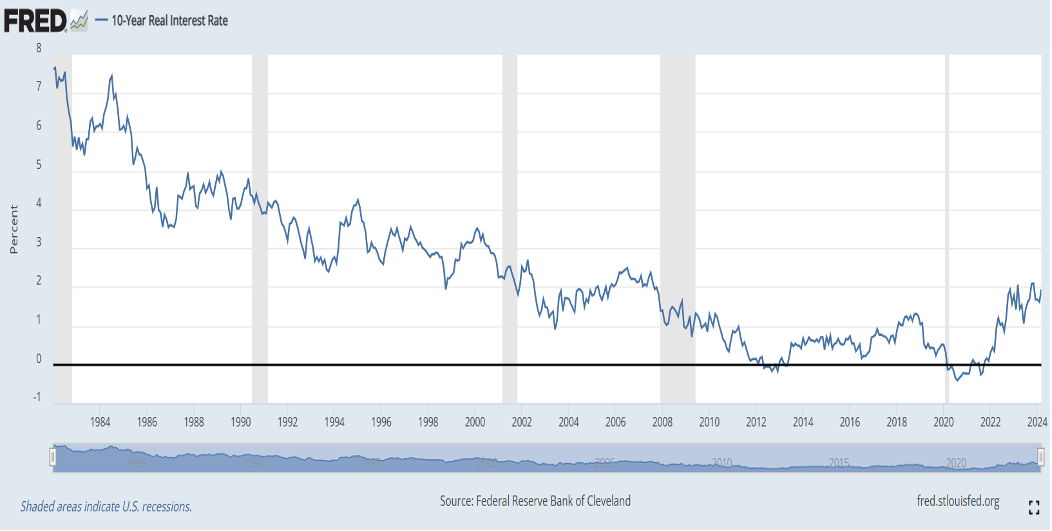
Could it be that the Federal government’s budget is the reason behind the economy and labor market’s strength despite “aggressive” monetary policy? The Office of Management and Budget (OMB) estimates that the Federal budget for fiscal year 2024 will ultimately produce a deficit of roughly $1.6 trillion. Furthermore, 2025’s budget is forecast to create a deficit of $1.8 trillion. This is incredible stimulus that is being provided to the US economy. It is in direct conflict to what the Fed is trying to accomplish. First, I don’t believe that the current level of interest rates is that high, especially by historical standards, but they definitely aren’t high enough to combat the government’s deficit spending at this time.
As a reminder, when the government deficit spends, those $s flow into the private sector in the form of income which leads to greater spending and corporate profits, which we are witnessing at this time. This conflict between monetary policy and fiscal policy is what I’m defining as the heavyweight battle. Which policy action will ultimately prevail? Back in the 1970’s monetary policy became quite aggressive leading to double digit interest rates that bled into the early 1980s. There were many factors that created the excessive inflation that ultimately had to be curtailed with unprecedented Fed action. What the Fed didn’t have to do was fight the Federal government budget.
During the 1970s, the average budget deficit was only $35 billion. Yes, that is correct. The peak deficit occurred in 1976 at $74.7 billion , while 1970’s deficit of $2.8 billion was the lowest. In case you are wondering, the $35 billion average deficit would equate to roughly $153 billion in today’s $s or <1/10th of 2024’s expected deficit. Clearly, there was little excess spending/stimulus created by the Federal government at that time for which monetary policy had to combat. So, again, the US doesn’t have a debt problem. It has an income problem! The excess stimulus is elevating economic activity, keeping workers employed and spending, while corporate America produces the goods and services that are being demanded, leading to excess profit growth that continue to fuel the stock market.
As you can see, this tug of war or heavy weight battle is far from decided. I don’t believe that US interest rates are high enough to truly impact economic activity and the labor force, which continues to enjoy sub 4% unemployment rates. We either need rates to rise more, government deficits to shrink, or a combination of both before we see the Fed achieve its goal of a 2% sustained inflation rate. Let’s pray that our very uncertain geopolitical environment doesn’t take a turn for the worse with further escalation of the Ukraine/Russia war or worse yet, conflict in Southeast Asia between China and Taiwan. Our inflation story could get much worse under those scenarios.

 Ryan ALM Blog