The Thawing Out of Corporate Frozen Pension Plans

By: Ronald Ryan, CEO, and Russ Kamp, Managing Director, Ryan ALM, Inc.

Milliman recently published an article that explains in detail what they called a “Goldilocks” moment for corporations to reopen their frozen DB pension plans. The article identifies and answers 10 frequently asked questions. Ryan ALM applauds Milliman for their very insightful review of this opportunity at this moment in time. We encourage all sponsors of corporate DB plans to read this timely article.

We would like to add our thoughts on this evolution, too. As corporate DB plan sponsors have learned, you do not want to have a volatile funded status that leads to higher contribution costs, PBGC variable premiums, and pension expense noted on their income statements. One way to address this potential volatility is through de-risking strategies. Fortunately, the time is right given higher US interest rates to defease pension liabilities in a cost-efficient manner with prudent risk. We believe that the most effective way to de-risk is through a strategy known as Dedication or Cash Flow Matching (CFM). Given that US interest rates are at their highest in 20+ years, CFM provides the certainty of funding liability cash flows in a very cost-efficient manner.

The Ryan ALM CFM product (Liability Beta Portfolio™ or LBP) will fully fund liability cash flows (benefits and expenses) at a cost savings of about 2% per year (50% – 60% on a 1-30 year liability cash flow assignment). Such cost savings is realized upon the implementation of our LBP so the plan sponsor realizes immediately the enormous benefit. Importantly, the LBP portfolio is 100% investment grade bonds and in harmony with each client’s investment policy statement (IPS). Since our LBP matches and fully funds monthly liability cash flows, we will provide a more precise duration match of the plan’s liabilities, and immunize interest rate risk since we are defeasing benefits that are future values. Given our emphasis on using IG corporate bonds (BBB+ or better), the LBP portfolio should outyield the ASC 715 discount rate (AA corporates) thereby enhancing pension income or reducing pension expense. As you can see, there are so many benefits to using CFM.

Ryan ALM’s experience with CFM goes back to the 1970s when Ron Ryan was the Director of Fixed Income Research at Lehman Bros. As a result, we believe that we have one of the most experienced CFM teams in the fixed income industry today with over 160 years of fixed income experience. We offer any corporate DB plan the opportunity to evaluate our value added capability by offering a FREE analysis, including the production of a Custom Liability Index and an LBP. All we need to receive from the sponsor and/or their actuary are the liability cash flow projections of benefits, expenses, and contributions. Through this free snap shot you will come to appreciate the many benefits of our turnkey asset/liability management capability. What’s the downside?

A Liquidity Crunch?

By: Russ Kamp, Managing Director, Ryan ALM, Inc.

Interesting article in FundFire today addressing the issue of a “liquidity crunch” as the over-commitment to private equity and the lack of distributions is forcing pension plan sponsors to seek their own liquidity through transactions in the secondary market. This isn’t a new issue, but one that is getting more press today. That said, we’ve seen this scenario play out many times before in our industry which has a tendency to overwhelm good ideas with too much money.

What I found most interesting is the fact that so much money is now chasing secondary opportunities (estimated at $70 billion in Q1’24), as if this opportunity were immune to also being overwhelmed. In fact, according to the FundFire article, “Secondaries took up a larger chunk of fundraising in the first quarter of this year than any other year going back to 2008.” What’s interesting about that time frame, we were dealing with a major repricing of all assets at that time. It made sense to be a provider of liquidity at deep discounts to previous valuations. However, that isn’t the case right now. Sellers (pension plans) have over committed and private equity portfolios aren’t returning capital at the same level that they’d previously done.

In addition, the article went on to say that a “potential rate decrease on the horizon, has created a greater confidence on secondary buyers putting forth a strong price for sellers.” Really? A strong price for sellers would mean to me the potential to overpay for the opportunities in the secondary market. If that is the case, future returns will be negatively impacted. Where’s the opportunity?

For plan sponsors needing liquidity, don’t be a forced seller of assets that in many cases don’t have natural liquidity. Bifurcate your plan’s asset allocation into two buckets: liquidity and growth. The liquidity bucket should be built using investment grade corporate bonds that defease near-term liabilities (next 10-years) allowing for the growth assets, including your private equity, to now grow unencumbered. Bonds are the only asset class with a known terminal value and contractual semi-annual payouts. Use that information to construct a portfolio that ensures (barring defaults) the necessary liquidity to meet the promises that have been made to your participants. With regard to the growth assets, extending the investing horizon will dramatically enhance the probability that the strategy will meet its long-term return objectives. Regrettably, most pension systems live in a quarter-to-quarter cycle of evaluation.

Lastly, before allocating to an asset class or making additional allocations, understand the natural capacity of that strategy. As mentioned earlier, we have a tendency to overwhelm good ideas. Don’t be the last one on the boat that is about to go over the falls! You want to be the seller to all those still trying to get on the boat.

Would You Call This Result a Success?

By: Russ Kamp, Managing Director, Ryan ALM, Inc.

Let me start off by stating unambiguously that I’m a huge supporter of defined benefit (DB) plans. Despite many recent improvements in defined contribution (DC) plans, such as auto-enrollment, auto-escalation, etc., I believe that DC plans should not be anyone’s primary retirement vehicle and that they should maintain their role as a supplemental to traditional pension plans. I maintain that asking untrained individuals to fund, manage, and then disburse a “benefit” with little to no disposable income, investment acumen, or a crystal ball to help with longevity and drawdown issues is an incredibly difficult task.

Given that we’ve had four plus decades of DC usage, how are we doing? According to the following information from Fidelity that runs through March 31, 2024, I’d say not very well. Would you disagree?

Importantly, there is a fairly significant subset of the American workforce that doesn’t have access to any employer sponsored plan – DB or DC. This is particularly troubling since most people don’t save outside of an employer sponsored plan. That reality makes the above information that much worse. That said, the fact that those in their 50s have a median balance (can we please stop using average balances) of only $64,300, how dignified will their golden years be? According to the St. Louis Federal Reserve’s data base (FRED), longevity for the average American is about 77.4 years. If one retires at 65-years-old and lives an average life that $64k will have to cover roughly 13 years which translates into almost $5,000/year ($416/month) before any investment gains or losses throughout the coverage period.

Given this reality, we need to double-down on our effort to protect and preserve DB pension plans. Refocusing on the true pension objective of SECURING the promised benefits at both a reasonable cost and with prudent risk would go a long way to reducing the volatility associated with funding these critically important funds. The current US interest rate environment is providing plan sponsors with the opportunity to reduce risk within a traditional asset allocation framework. As the funded status improves, more risk can be withdrawn from the asset allocation further stabilizing the funded ratio and contribution expenses. Given the information provided by Fidelity, we truly can’t rely on DC offerings as anyone’s primary retirement vehicle. It is time to act.

ARPA Update as of August 9, 2024

By: Russ Kamp, Managing Director, Ryan ALM, Inc.

Congrats to USA medal winners at the recently concluded Paris summer games. I’m still in awe of so many of the performances. Speaking of performances and medals, the PBGC deserves a medal at this time for their performance in implementing the ARPA legislation. Sure, there have been some fits and starts along the way, but the for the most part, their performance has been stellar. At the conclusion of this legislative effort, there may be more than 200 multiemployer plans receiving SFA. The significance to these funds and more importantly, the plan participants should not be minimized. Let’s not forget Carol, and the tens of thousands like her.

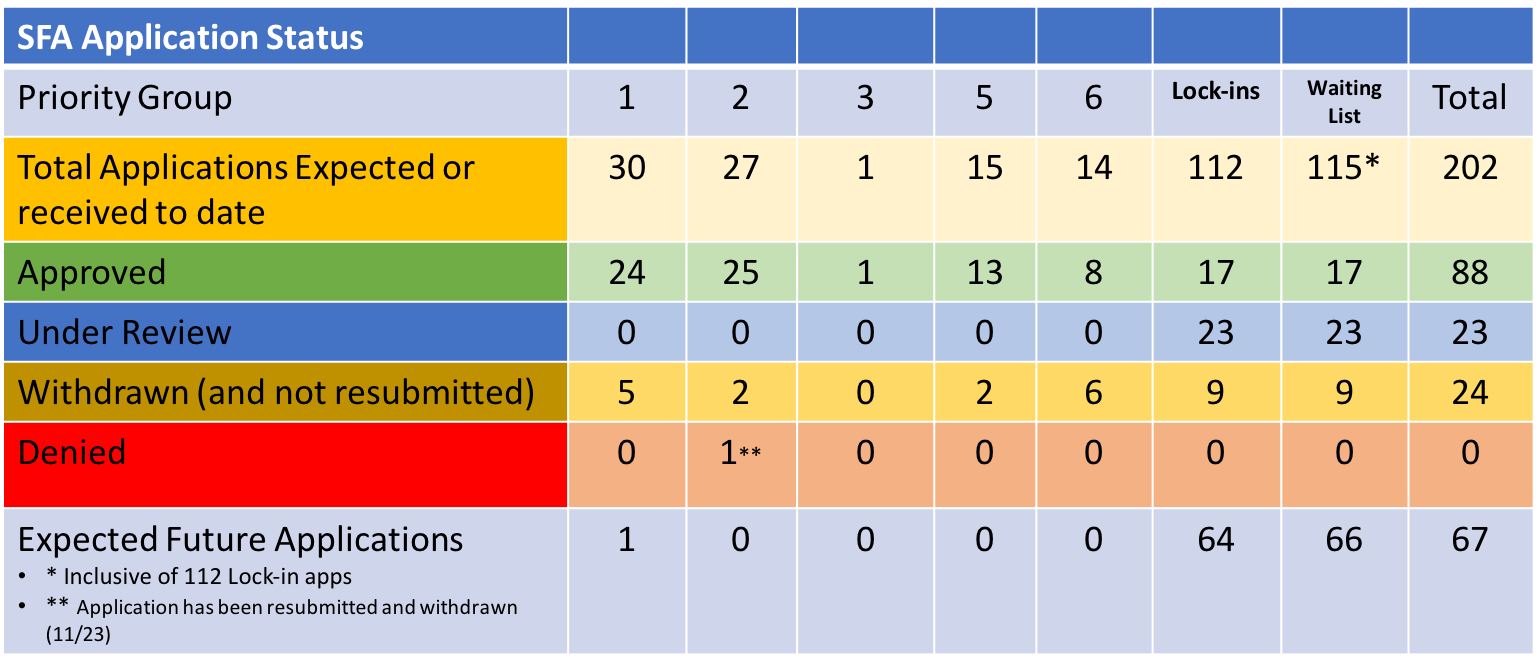
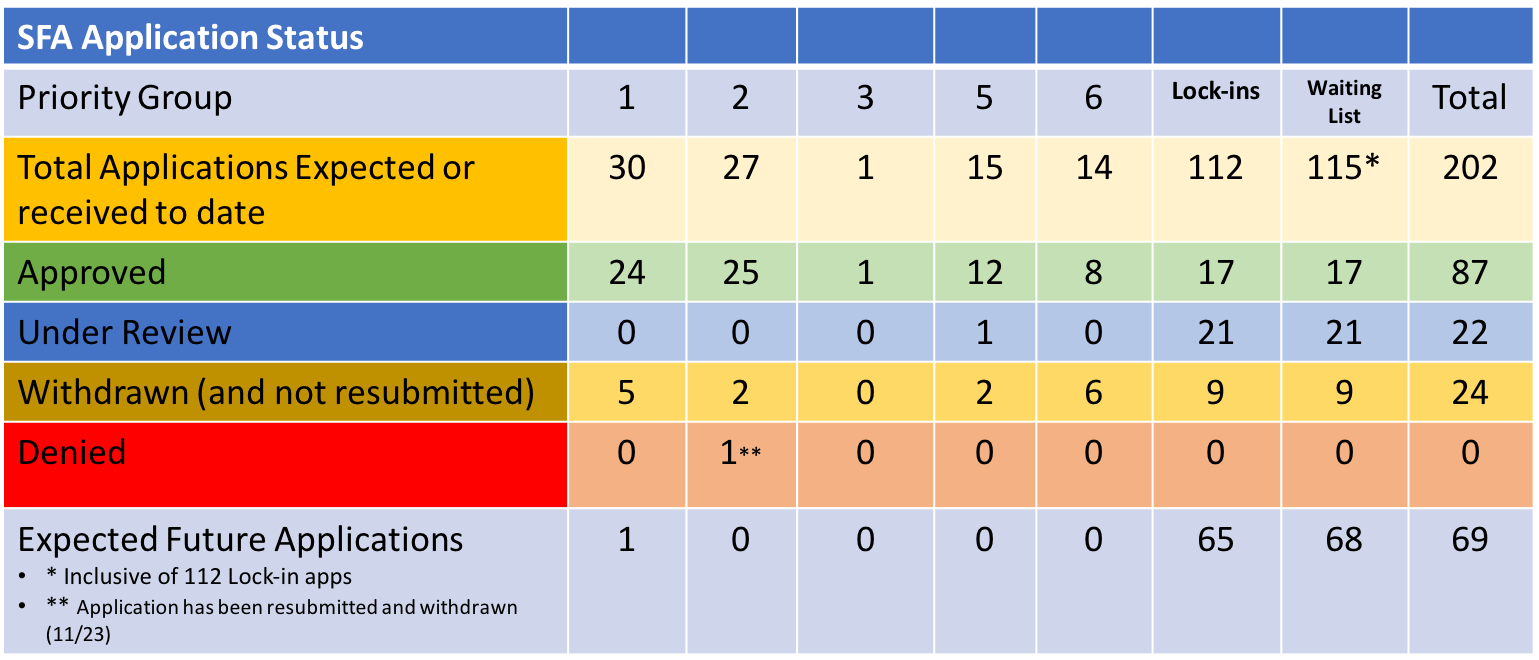
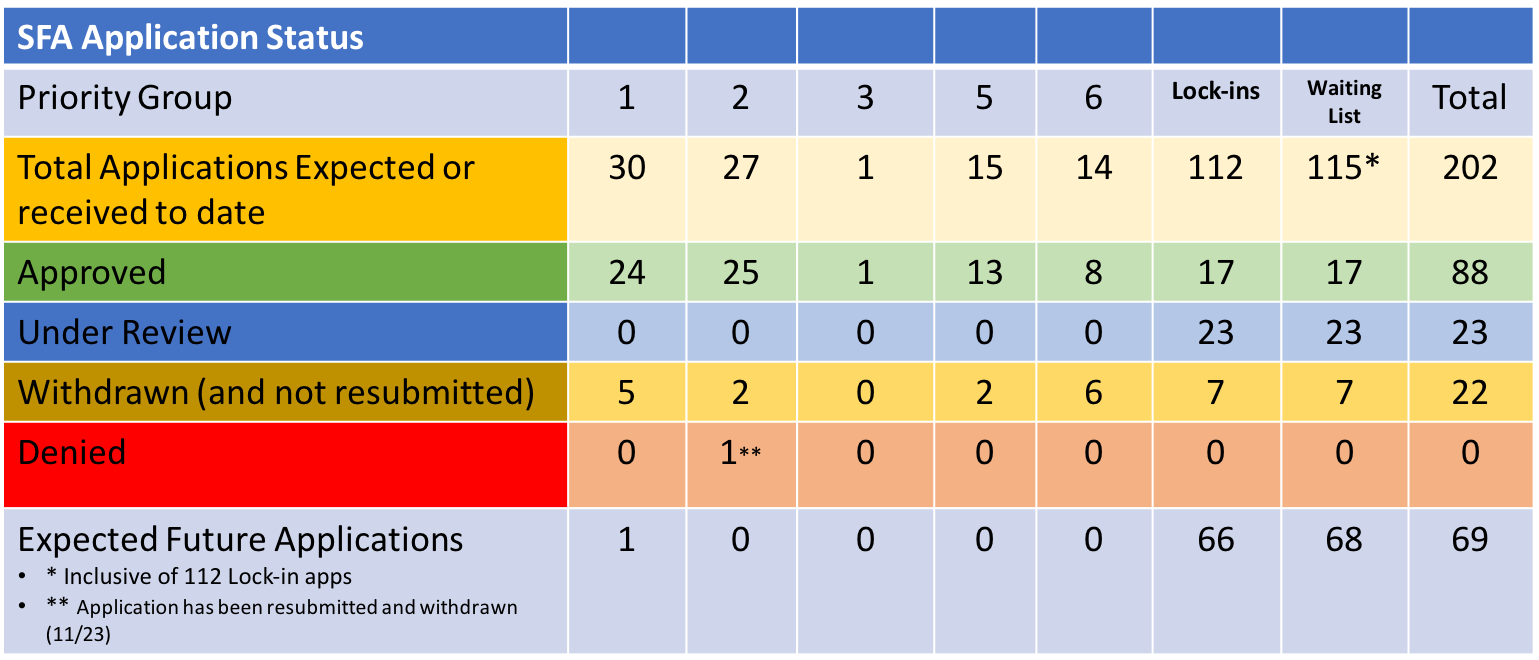
Last week saw a little reported action, with only one fund filing an application and another withdrawing one. It was the Employers’ – Warehousemen’s Pension Plan, which filed a revised application seeking $38.5 million for 1,821 plan participants. The Pressroom Unions’ Pension Plan has withdrawn its initial application which sought $59.3 million in SFA for the 1,344 members of that pension plan.

As the chart above highlights, there are still potentially 69 applications seeking SFA to be filed. In addition, there are 23 applications presently under review (all non-priority group members) and another 7 that submitted applications that have not yet been revised and resubmitted. As mentioned previously, there is still much work to be done by the PBGC.

US Treasury interest rates which fell rapidly last Monday in the wake of the Japanese carry trade unwinding, have bounced back rather impressively since then providing plan sponsors with the ability to secure the promised benefits at lower cost with the help of the SFA proceeds.

Yields Haven’t Moved As Much As You Think

By: Russ Kamp, Managing Director, Ryan ALM, Inc.

Uncertainty related to the Fed and the US economy has begun to impact equity markets during the past couple of weeks. Will the Fed cut rates? Is the US plunging toward a recession? Is the Fed too late? These and many other questions are being asked by the investment community. Expectations for a rate cut in September have become nearly unanimous. As a result, investors have been positioning portfolios in anticipation of future Fed action.

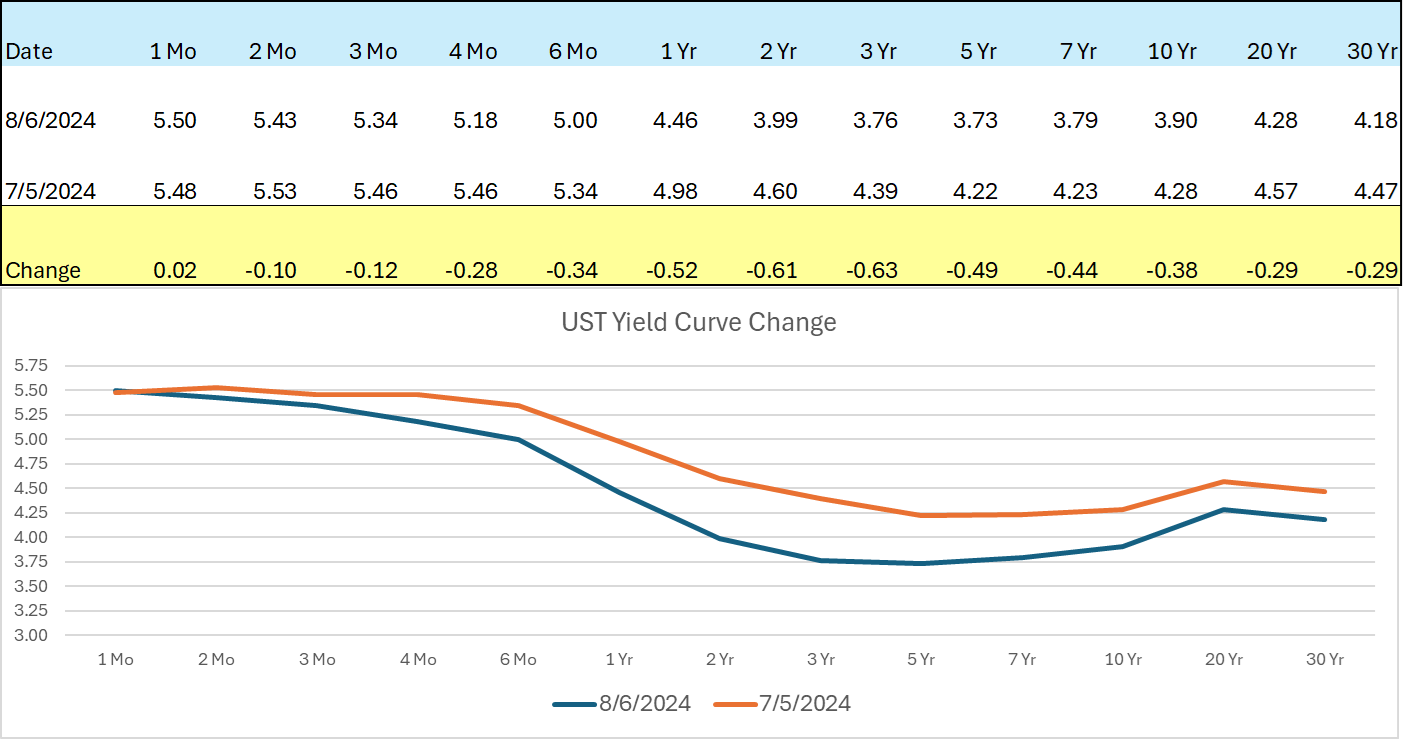
The US bond market has been extremely active with significant flows moving into bonds. In particular, US Treasuries of varying maturities. This has resulted in a significant move down in yields across the yield curve, but primarily in Treasury Notes with maturities 1-5 years, where rates have declined from 49 to 63 bps.

Information provided by Steve DeVito, Ryan ALM’s Head Trader

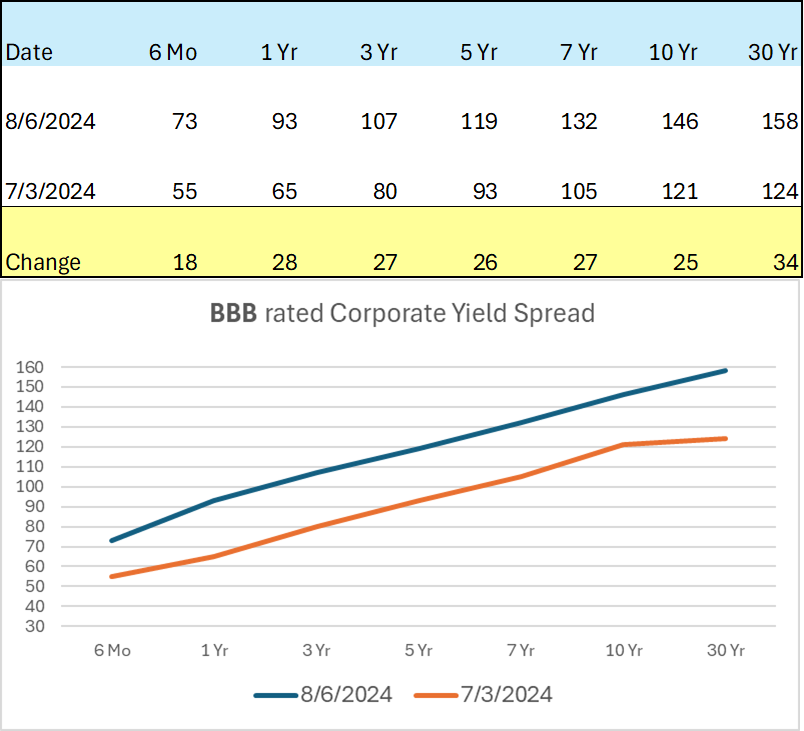
Has this move in rates also been witnessed in investment grade corporate bonds? If so, will the lower yields negatively impact cash flow matching (CFM) portfolios yet to be funded? Lower yielding bonds do reduce the potential cost savings that can be achieved in a CFM mandate, but there is good news on that front. Corporate bond yields, which had been incredibly tight to the equivalent Treasury bond, have widened considerably during the last month. Ryan ALM, Inc. prefers using IG corporate bonds in our CFM portfolios given the higher yields that can be accessed providing our clients with greater funding cost savings.

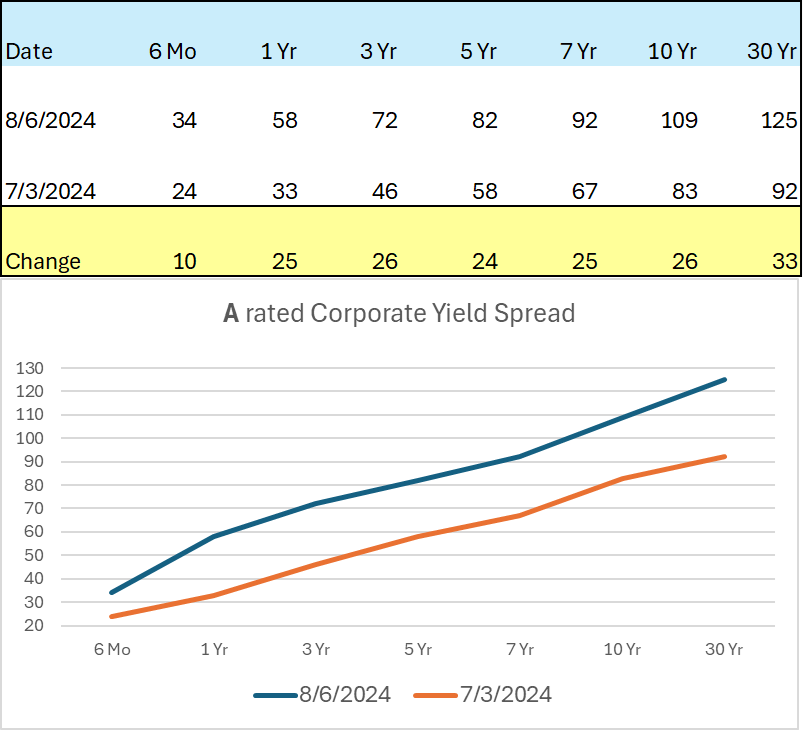
As the data above reveals, corporate spreads have widened quite a bit relative to Treasuries. For a BBB rated corporate with a 10-year maturity, the current yield spread would be about 146 basis points above the 10-year Treasury or about 5.4% based on today’s market action. That remains a very attractive rate for a pension plan looking to take risk off the table by securing future benefit payments through our defeasement strategy. Fortunately, the widening of yield spreads hasn’t been only found in BBBs, as yields for both A and AA bonds have also expanded relative to the comparable Treasury.

The widening that we’ve witnessed in A-rated corporates is indeed similar to that which has occurred in BBB. So, an A-rated corporate bond would yield about 5.05% today, given the 109 bps spread over the 10-year Treasury. Given the uncertainty in the economy, the capital markets, and with the Fed, why subject 100% of the pension plans assets to a traditional asset allocation framework? Bifurcate your plan’s assets into two buckets – liquidity and growth. The liquidity bucket will use IG corporate bonds with the attractive rates cited above to secure the promised benefits chronologically as far out as the allocation will go. While the liquidity portfolio is being used to make the monthly benefit payments, the remaining assets (non-bonds) will be growing unencumbered, as they are no longer a source of liquidity. Importantly, the liquidity bucket is the bridge that spans all of the potential uncertainty. Growth assets that have an extended investing horizon will see an enhanced probability of meeting their objectives.

Despite the fact that yield spreads have widened, there is no guarantee that those relationships will be maintained. Don’t let market events diminish your opportunity to reduce risk by securing your promises. We’ve witnessed too many occurrences where a delayed response has meant that a wonderful opportunity has been lost. Act today.

Say It Ain’t So?

By: Russ Kamp, Managing Director, Ryan ALM, Inc.

I’ve been fortunate to have participated in the investment/pension industry for more than four decades. I’ve seen the business from several perspectives, including as an asset/liability consultant and an investment manager. I’ve been involved in shops focused on equities, fixed income, and alternatives. I’ve also benefited from seeing the business through the lens of both fundamental and quantitative approaches. Lastly, I’ve worked at both large and small firms. As a student of our industry, I’ve learned a few things.

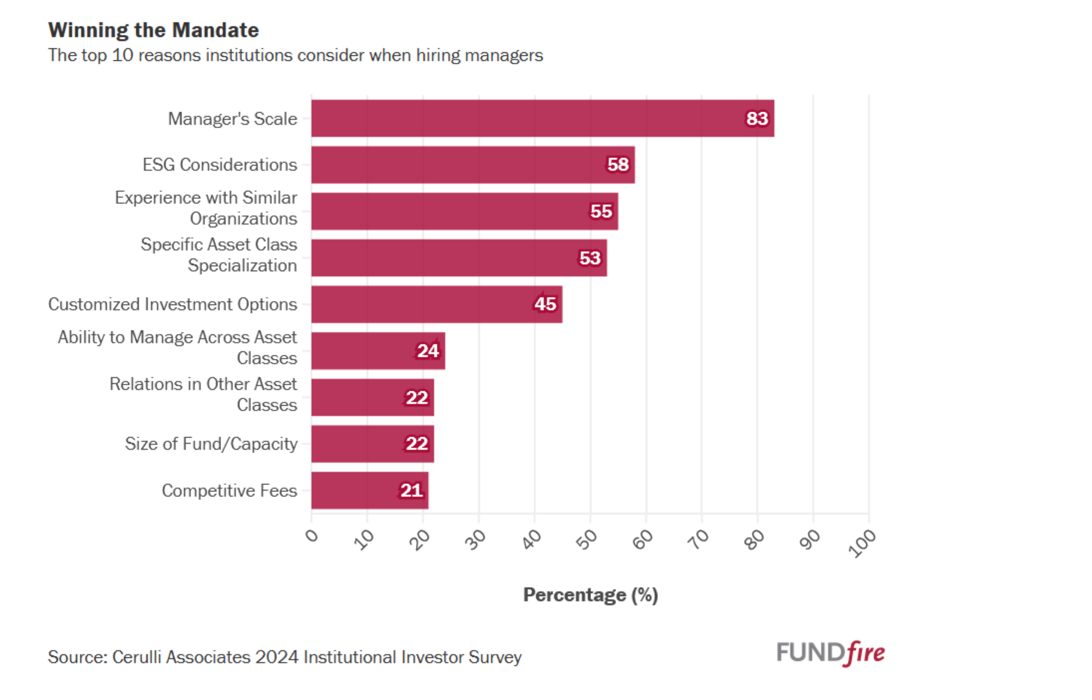
Based on my experience, having expertise in a particular investment discipline has always been the key to success. Another important data point in producing the desired outcomes is knowing when your AUMs have exceeded the natural capacity of that strategy. Yet, there seems to be this belief that size matters (scale). According to a recent article in FundFire, participants in the survey overwhelmingly indicated that scale was the most important characteristic in their hiring decision. Incredibly, specific asset class specialization was down at #4 with only 53% of respondents believing that was an important attribute. Seriously?

Our industry continues to “reward” larger firms, whether they be equity, fixed income, and/or alternative related with new mandates whether those firms actually add value or not. Importantly, there is only so much capacity within a single investment discipline, and our industry tends to overwhelm those capacity limits and the insights that are used. The quant crash in 2007 was brought about by having too much money chasing a few ideas. Those ideas got run over by the growth in the space. Insights can and did get arbitraged away by that AUM growth. This cycle of boom and bust is constantly being repeated, as we are seeing today with the loading up on products “investing” in anything AI-related. Yet, capacity is only a consideration for 22% of the participants.

Want to know why the average “active” investment manager isn’t adding any value? That firm has likely far exceeded the natural capacity in their strategy. Having the discipline to say “NO” to new mandates is not easy, but in the long run it is essential. Why potentially engage in an activity that might risk the entire franchise for the chance to bring in a few more $s? I recall limiting individual position size based on the percentage of a day’s trading volume. We constrained our exposure to <25% of the daily volume. At the same time, a larger competitor of ours had 34 days volume in the same stock. Try getting out of that stock without moving the market.

If I’m sitting in the plan sponsor’s chair, I am focused on three critical investment management attributes, and size (large) isn’t one of them. I would want to work with a firm that constantly evaluates the insights that they bring to their product to make sure that those insights are still adding value. If not, it is time to cast that idea aside and bring new insights to the table. I’d want to work with a firm that doesn’t push off the shelf product but can design a unique solution that meets my specific needs. Finally, I’d want to work with an investment management organization and not a sales shop. The true investment firm will understand just how much capacity there is in the strategy and they will do everything that they can to work within that restriction.

ARPA Update as of August 2, 2024

By: Russ Kamp, Managing Director, Ryan ALM, Inc.

The old adage of selling in May and going away is looking as if it were once again prophetic. We’ll see where markets close today, but the last couple of weeks should be a reminder that markets do go down, too.

That said, let’s focus on the task at hand: ARPA and the pension legislation that has been so powerful in rescuing 1+ million promised retirements. The latest week didn’t see a tremendous activity level, but progress was still made by the PBGC. Two new applications seeking SFA were received, including those from Oregon Processors Seasonal Employees Pension Plan and the Lumber Industry Pension Plan. Both non-priority group members filed their initial application. The Oregon processors are seeking $19.1 million in SFA for its 7,279 participants, while the Lumber plan is requesting $103.3 million for its 5,834 plan members.

In other news, Printing Local 72 Industry Pension Plan, was awarded $39.4 million in SFA and interest that will go to supporting the retirement benefits for 787 plan participants. The Printers were a Priority Group 5 member and their application had been withdrawn twice before in December 2022 and September 2023 before resubmitting a successful application in April 2024.

Fortunately, no plans were denied SFA and no applications were withdrawn. There were no plans agreeing to return a portion of the SFA as overpayment due to faulty population numbers. Lastly, there were no additions to the waitlist and no members on the waitlist that hadn’t locked in their discount rate did so in the latest week.

The tremendous move down in US interest rates will hurt plans that have locked in the discount rate at higher levels, as less SFA will be received. They will also be buying into a bond market that is now more expensive reducing the coverage period for those plans utilizing fixed income for a significant percentage of their forecasted benefits. As mentioned previously, we are happy to model different investment scenarios for plans that will soon be receiving SFA.

Hey, Ryan ALM – “What’s Your Benchmark?”

By: Russ Kamp, Managing Director, Ryan ALM, Inc.

Twice in the last two days, I’ve been asked by very knowledgeable industry professionals to define for them our benchmark. Knowing that we are a fixed income manager focused on defeasing (securing) pension liabilities through our cash flow matching (CFM) capability, they correctly assumed that it wasn’t the Lehman (now Bloomberg Barclay’s) Aggregate Index (homage to Ron Ryan who designed the AGG as Director of Fixed Income Research at Lehman), as no generic index can adequately replicate the unique liabilities of a plan sponsor’s liability cash flows. The answer is… in order to successfully manage a CFM mandate, one has to build a Custom Liability Index (CLI) so that the assets know what they have to fund and when the assets need to be available, especially given that benefit payments are needed on a monthly basis and actuarial reports provide annual forecasts.

The use of a CLI seems fairly obvious although it is not yet a standard practice. However, there is a second “benchmark”, too. Not all CFM managers are created equal. There are tremendous skills necessary to create an optimization framework that minimizes excess cash reserves while maximizing the cost reduction created through the construction of the CFM portfolio. It isn’t always easy to evaluate one investment firm or investment product versus another. Often, the size (defined as AUM) of the manager is a differentiator. Other factors might include fees, number of professionals assigned to a product, years implementing the strategy, etc. But rarely do consultants and their clients get to see under the hood. I’m speaking specifically of the efficiency of the model.

We at Ryan ALM, Inc. take great pride in our Models. The Models are the system! We treat our Models (discount rates, CLI, and CFM) as assets of the firm and not just products. We are particularly proud of the fact that all of the development has occurred in-house over decades. When we produce a cash flow matching portfolio, we also highlight the Model’s efficiency as it relates to that specific portfolio/mandate. We often produce a free analysis of what a potential mandate will look like for the consultant, plan sponsor, or both, which provides them with that look “under the hood”. If they are looking at multiple managers for a potential assignment, they should be getting this free look from the other firms, as well. They should be demanding to see how efficient the other offerings are. Why? Greater Model efficiency results in lower cost for the program, which should be the determining factor in whether one manager gets chosen over another, and not the other factors that often play a role.

Managing a cash flow matching assignment is not the same as building a laddered bond portfolio. Bond math is very straightforward. The higher the yield and the longer the maturity, the lower the cost. You want your CFM portfolio producing abundant cash flows that will cascade throughout the years of the mandate, but you don’t want excess cashflows given the potential negative impact of reinvestment risk. Having the most efficient model will reduce the negative impact of excess reserves building throughout the program. It will maximize the yield advantage from longer maturities and the cash flow that is produced from those longer maturities that will be used to meet near-term benefits and expenses. Let us know if you are interested in CFM. As stated above, we are always willing to produce a free analysis that will help guide you in your decision making. You’ll learn quickly just how efficient our system and models are.

ARPA Update as of July 26, 2024

By: Russ Kamp, Managing Director, Ryan ALM, Inc.

The “dog days” of summer don’t seem to be impacting the activity level at the PBGC, as we had a plethora of activity last week. As mentioned on the PBGC website, the e-filing website is open, but limited. “The e-Filing Portal is open only to plans at the top of the waiting list that have been notified by PBGC that they may submit their applications. Applications from any other plans will not be accepted at this time.” That’s interesting, as there are still 16 pension plans in Priority Groups 1-6 that have potential applications that are not currently being reviewed. Are they excluded, too?

During the week, three funds that had been on the waitlist submitted applications, including, Local 810 Affiliated Pension Plan, the Upstate New York Engineers Pension Fund, and the Alaska Plumbing and Pipefitting Industry Pension Plan. They are seeking a total of $282.1 million for the 9,620 plan participants. This is each plan’s initial submission. As always, the PBGC has 120 from the filing date to conclude the review.

In other news, two plans received approval of their applications, including the Pension Plan of the Moving Picture Machine Operators Union Local 306, a Priority Group 5 member, and the New England Teamsters Pension Plan, that was a Priority Group 6 member. The Moving Picture machinists will receive $20.7 million to support its 542 members, while the NE Teamsters get a whopping $5.7 billion for just over 72k participants. With these latest approvals, the PBGC has now granted through ARPA $67.7 billion in Special Financial Assistance (SFA) that will support the financial futures of 1.34 million American retirees.

On July 23, the Production Workers Pension Plan was added to the waitlist, becoming the 115th member on that list, with 47 having seen some activity (approved, under review, or withdrawn) regarding their applications. In other news, there were no applications denied or withdrawn. Furthermore, none of the previous SFA recipients were asked to repay a portion of the grant due to overpayment. Have a great week, and don’t hesitate to reach out to us if we can provide any assistance to you as you think through your investment strategy as it relates to the SFA grant.

Sometimes You Just Have To Shake Your Head

By: Russ Kamp, Managing Director, Ryan ALM, Inc.

CIO Magazine recently published an article chronicling the trials and tribulations of the Dallas Police and Fire and Dallas Employees pension systems. This is not the first time that these systems have been highlighted given the current funded status of both entities, especially the F&P plan currently funded at 39%. The article was based on a “commissioned” study by investment adviser Commerce Street Investment Management, that compiled and in June presented its report to the city’s ad hoc committee on pensions. According to the CIO Magazine article, they were “tasked with assessing the pension funds’ structure and portfolio allocation; reviewing the portfolios’ performance and rate of return; and evaluating the effectiveness of the pension funds’ asset allocation strategy.” That’s quite the task. What did they find?

Well, for one thing, they were comparing the asset allocation strategies of these two plans with similarly sized Texas public fund plans, including three Houston-based systems: the Houston Firefighters’ Relief and Retirement Fund, the Houston Police Officers’ Pension System, and the Houston Municipal Employees Pension System. The practice of identifying “peers” is a very silly concept given that each system’s characteristics, especially the pension liabilities, are as unique as snowflakes. The Dallas plans should have been viewed through a very different lens, one that looked at the current assets relative to the plan’s liabilities.

Unfortunately, they didn’t engage in a review of assets vs. liabilities, but they did perform an asset allocation review that indicated that the two Dallas plans did not have enough private equity which contributed to the significant underfunding. Really? Commerce Street highlighted the fact that “Houston MEPS’ private equity allocation is 28.2%, and the average private equity allocation among the peer group is 21.3%, compared with the DPFP and Dallas ERF’s allocations of 12.2% and 10.5%, respectively.” How has private equity performed during the measurement period? According to the report, Dallas P&F’s plan performed woefully during the 5-years, producing only a 4.8% return, which paled in comparison to peers. Was it really a bad thing that Dallas didn’t have more PE based on the returns that its program produced?

Why would the recommendation be to increase PE when it comes with higher fees, less liquidity, little transparency, and the potential for significant crowding out due to excess migration of assets into the asset class? During the same time that Dallas P&F was producing a 4.8% 5-year PE return, US public equities, as measured by the S&P 500, was producing a 15.7% (ending 12/31/23) or 15.1% 5-year return ending 3/31/24. It seems to me that having less in PE might have been the way to go.

The Commerce report recommended that “to improve the pension funds’ returns and funded ratios, the city should: analyze what top performing peers have done; collaborate to find new investment strategies; improve governance policies and procedures; and provide recommendations for raising the funds’ investment performance.” Well, there you have it. How about returning to pension basics? Dallas is going to have to contribute significantly more in order to close the funding gap. They are not going to be able to create an asset allocation that will dramatically outperform the ROA target. Remember: if a plan is only 50% funded, achieving the ROA will result in the funded status deteriorating even more. They need to beat the ROA target by 100% in order to JUST maintain the deficit.

I’ve railed about pension systems needing to get off the asset allocation rollercoaster to ruin. This recommendation places the Dallas systems on a much more precarious path. So much for bringing some certainty to the management of pension plans. No one wins with this strategy. Not the participant, sponsor, or the taxpayers.