Ryan ALM, Inc. 3Q’24 Newsletter

By: Russ Kamp, Managing Director, Ryan ALM, Inc.

We are pleased to share with you Ryan ALM Inc.’s 3Q’24 Newsletter. As you will read, the third quarter saw asset values continue to grow, while liabilities also increased due to falling US interest rates. However, asset growth has far exceeded liability growth in 2024 leading to improved funded ratios for all DB plan types. In addition, the current level of US rates is supportive of derisking strategies. Given elevated valuations, it makes sense to reduce risk before the markets impact the improved funded status.

As always, we encourage you to reach out to us with your questions. We want to be your source for anything liability-related. Please don’t hesitate.

You Have An Obligation – Fund it!

By: Russ Kamp, Managing Director, Ryan ALM, Inc.

I recently participated in a new program put on by the Florida Public Pension Trustees Association (FPPTA). They’ve introduced a higher-level program for trustees that really want to dive more deeply into pension issues. I’m thankful to have the opportunity to participate both as a speaker and a coach. At the inaugural event, the FPPTA leadership invited Von M. Hughes, the author of the book, U.S. Public Pension handbook”, which he described as a comprehensive guide for trustees and investment staff. During the Q&A session, Von was asked what differentiates a good fund from one that is performing poorly. His response was simple and direct. The pension systems that are best in class make the annual required contributions (ARC).

His response didn’t suggest anything about plans with internal staff versus those that outsource all investment functions. It had nothing to do with how complex the overall asset allocation was or the percentage allocated to alternatives. Furthermore, it didn’t matter about the size of the fund. It was simply, are you funding to a level required each and every year. Brilliant!

We all know which public funds are struggling and which are near full funding. There are enough entities reporting on the key metrics annual, if not more frequently. A closer look at these funds does support Von’s claim. But it isn’t just the lack of discipline in providing the necessary funding to secure the promises that have been met. There are also issues with regard to actuarial practices and legislative constraints. There is an interesting article in P&I with Brian Grinnell, former Chief Actuary, for the Ohio State Teachers’ Retirement System. Grinnell left the pension fund in May after more than 10 years, as the Chief actuary. According to Grinnell, he left the system because he “was not comfortable with the direction the plan was headed, and I didn’t feel like my continued participation would be positive.”

Grinnell discussed several issue, but the two that jumped out at me were the open amortization period and fixed contributions. In the case of the open amortization, Grinnell mentioned that “the amortization period for the retirement system’s unfunded pension liabilities under the STRS defined benefit plan had become infinite — meaning that it would never become fully funded.” Can you imagine having a mortgage with such a feature? With respect to the fixed-rate structure of both contributions and benefits, Grinnell mentioned that following a poor performance year the normal practice would be to increase contributions, which in the case of the Ohio plans is not possible without legislative action.

If creating a strong public pension system is predicated on the entity’s ability to meet the ARC, why would our industry agree to accounting and actuarial practices that restrict prudent action? Amortization periods should be fixed and contributions should be a function of how the plan is performing. As we’ve stated many times, DB pension plans are too critically important to millions of American workers. Investing is not easy. Forecasting the longevity of the participants is not easy. Let’s at least get the easy stuff right! Fund what is required!

Welcome to National Retirement (in)Security Month!

By: Russ Kamp, Managing Director, Ryan ALM, Inc.

October isn’t just for leaf peepers, although it is a special time of year for those of us living in the Northeast. Importantly, October is also National Retirement Security Month. For those of you who regularly follow this blog, you know that we (at Ryan ALM, Inc.) are huge supporters of DB pension plans. Fortunately, we aren’t the only ones. In a wonderful post published by the National Public Pension Coalition, Ariel McConnell writes about the importance of supporting public pension plans, as well as those sponsored by private organizations.

Ms. McConnell highlights many concerns regarding the current state of retirement readiness among American workers. Frighteningly, she points out that 57% of Americans don’t have any retirement savings, and those with 401(k)s have a median balance of only $27,376. That will barely provide you with the financial resources to get you through one year let alone a retirement that could stretch well beyond 20 years. She also highlights how each of us can become more active in the fight to get every American ready for their retirement. We want each worker to have the chance to enjoy their “golden years”. Let’s not let poor policy decisions tarnish that dream.

Please join Ariel, the National Public Pension Coalition, Ryan ALM, Inc., and many more organizations in the fight to protect and preserve defined benefit plans for all. I can only begin to guess at the significant economic and social consequences if our Senior population is forced to live on a median balance as insignificant as the one mentioned in NPPC’s blog post.

Pension Myth # 2: Contributions are NOT an Asset (in the Funded Ratio)

By: Russ Kamp, Managing Director, Ryan ALM, Inc.

We are pleased to share with you the second installment in the Ryan ALM, Inc. Pension Myth series. How many we produce has yet to be determined, but we can tell you that there are enough myths to keep us busy for a while. This one is focused on the critical role that contributions play. Given that benefits and expenses are paid net of contributions, we believe that future contributions are an asset of the fund and should be included in the pension plan’s Funded Ratio.

We hope that you find our thoughts useful as they challenge the industry’s “common wisdom”. We’d welcome the opportunity to discuss these concepts with you. Please don’t hesitate to reach out.

ARPA Update as of September 27, 2024

By: Russ Kamp, Managing Director, Ryan ALM, Inc.

Welcome to the last update for September 2024. Let’s hope that today brings at least one Mets’ win in Atlanta. It would mark quite the turnaround from where this team was on June 1st.

With regard to the PBGC’s implementation of the ARPA legislation, the efiling portal still remains temporarily closed. As a result, new applications have not been forthcoming. There are presently 22 applications with the PBGC. Sixteen of those must be acted on by November 30th.

Activity was fairly limited during the past week. There were no applications approved or denied. There was one application withdrawn. Bricklayers Pension Fund of West Virginia withdrew the initial application seeking $1.2 million for the 170 plan participants. In addition, 3 funds repaid a portion of the SFA grant received. Mid-Jersey Trucking Industry and Teamsters Local 701 Pension and Annuity Fund, the Pension Plan of the Bakery Drivers and Salesmen Local 194 and Industry Pension Fund, and the Building Material Drivers Local 436 Pension Plan each returned a portion of the overfunding due to incorrect census data. In total, the three plans returned $2.7 million from the $348.3 million received in SFA or 0.78%. To date, 17 plans have returned $142.3 million or 0.36% of the grant monies received. Lastly, there were no additional plans seeking to be added to the waitlist, which remains at 68.

Please don’t hesitate to reach out to us with any questions that you might have regarding investment strategies for the SFA assets. We are always willing to model your plan’s forecasted cash flows so that various implementations can be reviewed.

Pension Conundrum – Liquidity Risk

By: Ron Ryan, CEO, Ryan ALM, Inc.

Ryan ALM, Inc. is pleased to raise awareness about a challenging and ongoing pension fund activity – liquidity management. The payment of benefits and expenses is a critical function. Liquidity needs to be available when needed. However, frequently plan sponsors or their advisors are scurrying to find liquidity anywhere it presents, such as equity dividends, fixed income interest, and capital distributions. This practice of “sweeping cash” can lead to a negative impact on growth assets. The changing interest rate environment may also weigh heavily on cash balances. These issues and more are discussed in the brief research piece.

Please don’t hesitate to reach out to us with any questions or if we can assist you in any way.

Defined Benefit Pension Plan: “Absolute Truths”

By: Russ Kamp, Managing Director, Ryan ALM, Inc.

The four senior team members at Ryan ALM, Inc. have collectively more than 160 years of pension/investment experience. We’ve lived through an incredible array of markets during our tenures. We have also witnessed many attempts on the part of Pension America to try various strategies (schemes) to meet the promises that have been made to the pension plan participants. Regrettably, defined benefit (DB) pension plans continue to be tossed aside by corporate America in favor of defined contribution (DC) plans. Both public and multiemployer plan sponsors would be wise to adopt a strategy that seeks more certainty in order to protect and preserve these critically important retirement vehicles before they are subject to a similar fate.

We’ve compiled a list of DB pension “Absolute Truths” that we believe return the management of pension plans back to its roots when “SECURING the promised benefits at a reasonable cost and with prudent risk” was the primary objective. The dramatic move away from the securing of benefits to today’s arms race focus on the return on asset assumption (ROA) has eliminated any notion of certainty in favor of far greater variability in likely outcomes.

Here are the Ryan ALM DB Truths:

  • Defined Benefit (DB) plans are the best retirement vehicles!
  • They exist to fulfill a financial promise that has been made to the plan participant upon retirement.
  • The primary objective in managing a DB plan is to SECURE the promised benefits at a reasonable cost and with prudent risk.
  • The promised benefit payments are liabilities of the pension plan sponsor.
  • Liabilities need to be measured, monitored, and managed more than just once per year.
  • Liabilities are future value (FV) obligations – a $1,000 monthly benefit is $1,000 no matter what interest rates do. As a result, they are not interest rate sensitive.
  • Plan assets (stocks, bonds, real estate, etc.) are Present Value (PV) or market value (MV) calculations. We do not know the FV of assets except for bonds cash flows (interest and principal at maturity)
  • In order to measure and monitor the funded status, liabilities need to be converted from FV to PV – a Custom Liability Index (CLI) is absolutely needed.
  • A discount rate is used to create a PV for liabilities – ROA (publics), ASC 715 (corps), STRIPS, etc.
  • Liabilities are bond-like in nature. The PV of future liabilities rises and falls with changes in the discount rate (interest rates).
  • The nearly 40-year decline in US interest rates beginning in 1982 crushed pension funding, as the growth rate for future liabilities far exceeded the growth rate of the PV of assets.
  • The allocation of plan assets should be separated into two buckets – Liquidity (beta) and Growth (alpha).
  • The liquidity assets should consist of a bond portfolio that matches (defeases) asset cash flows with the plan’s liability cash flows (benefits and expenses (B&E)).
  • This task is best accomplished through a Cash Flow Matching (CFM) investment process.
  • The liquidity assets should be used to meet B&E chronologically buying time for the alpha assets to grow unencumbered in their quest to meet future liabilities.
  • The Growth assets will consist of all non-bonds, which can now grow unencumbered, as they are no longer a source of liquidity. Growth assets will fund future liabilities.
  • The Return on asset (ROA) assumption should be a calculated # derived through an Asset Exhaustion Test (AET)
  • The pension plan’s asset allocation should be responsive to the plan’s funded status and not the ROA.
  • As the funded status improves, port alpha (profits) from the Growth portfolio into the Liquidity bucket (de-risk) extending the cash flow matching assignment and securing more promises.
  • This de-risking ensures that plans don’t continue to ride the asset allocation rollercoaster leading to volatile contribution costs.
  • DB plans are a great recruiting and retention tool for managing a sponsor’s labor force.
  • DB plans need to be protected and preserved, as asking untrained individuals to fund, manage, and then disburse a “benefit” through a Defined Contribution plan is poor policy.
  • Unfortunately, doing the same thing over and over and… is not working. A return to pension basics is critical.

You’ve made a promise: measure it – monitor it – manage it – and SECURE it…   

Get off the pension funding rollercoaster – sleep well!

Must We Continue to Just Shift Deck Chairs on the Titanic?

By: Russ Kamp, Managing Director, Ryan ALM, Inc.

You may not have been following Ryan ALM’s blog through the many years that I have been producing posts in which I’ve touched on this subject. We at Ryan ALM continue to question the logic of focusing on the return on asset assumption (ROA) as the pension plan’s primary objective.  We especially challenge the notion that shifting a couple of percent from one asset class to another produces meaningful results for the pension system’s asset allocation and long-term funding success.

Day after day, I read, as I’m sure that you do, articles, blogs, emails, etc. highlighting a new product or twist to an existing one that will just “rock your world” and assist you on the road to achieving the return on asset (ROA) assumption. It doesn’t matter whether your plan is a public fund, multiemployer pension, or a private plan, the continued focus on the ROA as the primary objective for both plan sponsors and their asset consultants is leading everyone down the wrong path. You see, most of the retirement community has been sold a bag of rotten goods claiming that a plan needs to generate the ROA, or it will not meet its funding goals. I say, “Hogwash”! I’d actually like to say something else, but you get my drift.

So, when valuations for most asset classes seem to be stretched, as they do today, where does a pension plan go to allocate their plan’s assets? Well, this “issue” has plan sponsors once again scratching their collective heads and doing the Curly shuffle.  You see, they have once again through the presumed support of their consultants, begun to approach asset allocation as nothing more than rearranging the deck chairs on the Titanic.

Despite tremendous gains from both equity and fixed income bull markets, these plans are willing to “let it ride” instead of altering their approach to possibly reduce risk, stabilize the funded status, and moderate contribution expense. Can you believe that one of the country’s largest public plans has recently decided (I’m sure that it took a long time, too) to roll back fixed income exposure by 2% and equity exposure by 1% from 55% to 54%?  Are you kidding me? Is that truly meaningful or heroic?

Please note that generating a return commensurate with the ROA is not going to guarantee success. Furthermore, since most public pension plans are currently underfunded on an actuarial basis (let alone one based on market values) meeting this ROA objective will only further exacerbate the UAAL, as the funded status continues to slip. You see, if your plan is 80% funded, and that is the “average” funded ratio based on Milliman’s latest work, you need to outperform your plan’s 7% ROA objective by 1.75% in order to maintain the current funded status. Here’s a simple example as a proof statement:

Assets = $80   Liabilities = $100   ROA = 7.00%   Asset growth = $5.60   Liability growth = $7.00

In order for asset growth = $7.00, assets would need a 8.75% ROA

Given that reality, these plans don’t need the status quo approach that has been tried for decades. Real pension reform must be implemented before these plans are no longer sustainable, despite the claim that they are perpetual.  As an industry, we have an obligation to ensure the promised benefits are there when needed. Doing the same old, same old places our ability to meet this responsibility in jeopardy. If valuations are truly stretched, don’t leave your allocations basically stagnant. Take the opportunity to try something truly unique.

It is time to approach asset allocation with a renewed focus. Instead of having all of your plan’s assets tied to achieving the ROA, divide them into two buckets – liquidity and growth. The liquidity bucket will utilize a cash flow matching (CFM) strategy to ensure that monthly payments of benefits and expenses (B+E) are available, as needed, chronologically. The asset cash flows from the CFM strategy will be carefully matched against the liability cash flows of B+E providing the necessary liquidity. This provides the growth bucket (all non-bond assets) with an extended investing horizon, and we all know how important a long time horizon is for investing. Importantly, the growth assets will be used down the road to meet future pension liabilities and not in the short-term to meet liquidity needs. The practice of a cash sweep to meet ongoing liquidity has negatively impacted long-term returns for many pension systems.  Let bonds fund B+E so the growth assets can grow unencumbered.

Focusing on products and minor asset class shifts will waste a lot of your time and not produce the results that our pension plans need. Ensuring the appropriate funding to meet the promises given to the plan participant takes real reform. It starts with eliminating the single focus on the ROA. Pension plan liabilities need to be invited to the asset allocation dance, since paying a benefit is the only reason that the fund exists in the first place.

Liquidity Management Needs to be a Focus!

By: Russ Kamp, Managing Director, Ryan ALM, Inc.

I’ve produced several posts addressing the important issue of liquidity for pension plans. You may recall my 8/14/24 post titled “A Liquidity Crunch?” that referenced issues within private equity as a result of the lack of distributions or the March 28, 2024 post titled, “The Importance of Liquidity”, which referred to a terrific article penned by Jack Boyce. There have been several others, but the issue isn’t being addressed with the appropriate urgency, so I’ll continue to elevate our concerns. As we’ve stated many times, the only reason that a pension plan exists is because of promised benefits that have been made to the plan participant. It is that promise that must be met each and every month upon retirement. There are costs associated with meeting this commitment, so both the benefit and those expenses must be funded effectively and efficiently. At present, they are not!

Is the above picture representative of the available liquidity in your plan? Has the significant movement into alternatives reduced for you the number of investment strategies within your asset allocation framework that can provide liquidity when called upon? Is the changing shape (steepening) of the US Treasury yield curve reducing the return available on cash thus making the holding of cash reserves less palatable? Has your practice of doing a “cash sweep” of dividends, interest, and capital distributions each and every month created headaches for you?

We’d like to speak with you about a strategy – cash flow matching (CFM) – that can dramatically improve your liquidity, while enhancing the return associated with “cash reserves” thus reducing the potential negative impact on your pursuit of the required ROA. Wouldn’t you like liquidity to be abundant similar to the picture below? How comforting would it be to know that each and every month your plan has the necessary asset cashflows to meet the liability cashflows of benefits and expenses without having to liquidate assets that may be transacted at less than opportune times?

Cash flow matching (CFM) has been around for decades. CFM is often how insurance companies and lottery systems meet their future obligations. They take a present value calculation of that future promise and they fund an investment grade bond program that will carefully match asset cash flows with the liability cash flows so that your required liquidity is available monthly. There is no need to do a cash sweep! If you aren’t familiar with Guinness Global Investors (UK), they have determined through their research that the practice of sweeping dividends is harmful (very) to long-term equity returns. In fact, they found that on a 10-year rolling basis going back to 1940, that dividends contributed 47% of the total return. More starkly, on a 20-year rolling basis, that contribution escalates to 57% – wow! The ability to reinvest those dividends into potentially higher returning equities is quite powerful. A CFM strategy will enable your plan to eliminate the ill effects of the cash sweeping practice and allow growth assets to grow unencumbered.

At Ryan ALM, Inc., liquidity management has always been a focus of ours since all we do is provide asset cash flows through our CFM product to meet those pesky monthly obligations. Let us help you craft a “liquidity policy” that makes sense. Furthermore, through our Custom Liability Index (CLI) we will map for you the needed liquidity as far into the future as you want to fund. Lastly, we’ll construct an investment grade bond portfolio that will ensure the necessary asset cash flows are available monthly (barring any defaults, which are incredibly rare within the IG universe). This portfolio should be the core holding within your plan. All other assets now have seen the investing horizon extended since they are no longer a source of liquidity. As you know, time is a critical variable in the success or failure of an investment program. The more time that one has to invest, the higher the probability of success. We stand ready to assist you.

ARPA Update as of September 20, 2024

By: Russ Kamp, Managing Director, Ryan ALM, Inc.

Welcome to Autumn! It has always been my favorite season since I was a young boy. I would often listen to NY Giants football on the radio as I spent Sunday afternoons outside in the crisp fall air while raking leaves or lying in a freshly created pile. Unfortunately, the Giants weren’t very good in the ’60s and ’70s. I guess what goes around comes around.

I knew that this day would come since I publish an update on the weekly activity associated with the ARPA pension legislation. There was no obvious activity by the PBGC last week. In their latest update, the PBGC is not reporting any new applications received (the efiling portal remains temporarily closed), no applications were approved, denied, or withdrawn, no plans repaid a portion of the SFA due to census errors, and finally, no multiemployer plans sought inclusion on the waiting list. Oh, well. Even the PBGC needs a rest once in a while.

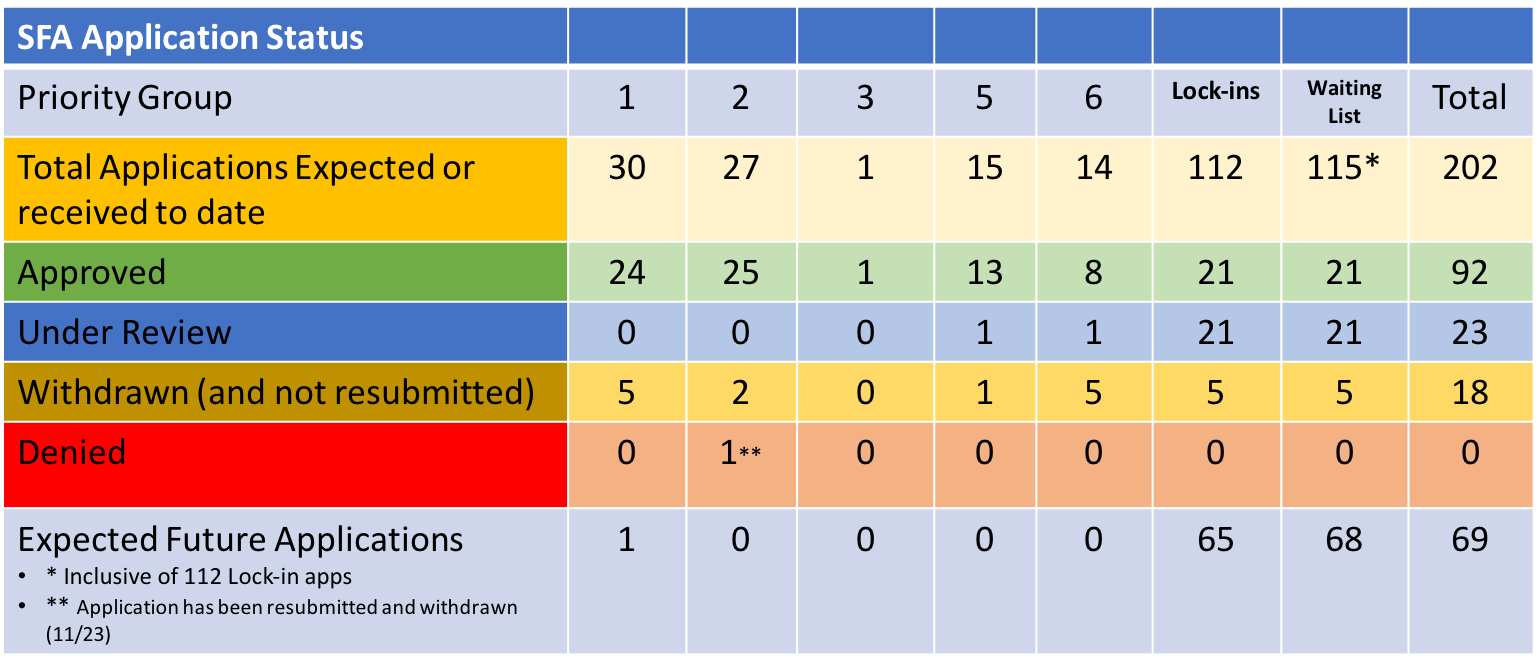
Perhaps the PBGC was focused on the Fed’s interest rate policy decision like the rest of us. So, I’ll take advantage of the clean slate and use my weekly update to summarize where we are at this stage of the PBGC’s implementation of the ARPA pension legislation which began in July 2021. To date, 92 multiemployer plans have received Special Financial Assistance totaling $68.0 billion in grants (inclusive of supplemental awards, interest, and FA Loan Repayments). Of the 92 approved applications, 38 (41.3%) were the initial application attempt. There has been only one plan that had its application denied for ineligibility. Bakery Drivers Local 550 and Industry Pension Fund had its initial application denied in January 2023. A subsequent application was withdrawn in July 2023.

There are currently 23 applications before the PBGC. Five of those 23 will have the 120-day review period elapse in October. There is still one Priority Group 1 member that hasn’t filed an application out of the 30 funds identified as Priority Group 1 eligible. In addition, there are currently 18 applications that were withdrawn that have yet to refile. As I’ve previously reported, 14 funds have repaid a portion of the SFA received because of overpayment due to incorrect census data. There may be more to come.

The Waitlist had 115 multiemployer plans at one time. Twenty-one of those plans have received SFA grants, another 21 are presently under review, while five applications were withdrawn and not refiled. That leaves 69 plans that have yet to get PBGC approval to submit the initial application. While last week may have been “quiet” for the PBGC from an external point of view, a tremendous effort has been put forth to get to this point with potentially lots more to go.