The Truth Will Set You Free!

By: Russ Kamp, Managing Director, Ryan ALM, Inc.

Managing a pension plan should be all about securing the promised benefits at a reasonable cost and with prudent risk. I believe that most plan sponsors would agree, yet that is not how plans are managed, especially public and multiemployer plans that continue to pursue the return on asset assumption (ROA) as if it were the Holy Grail. I’ve written quite a bit on this subject, including discussing asset consulting reports that should have the relationship of plan assets to plan liabilities on page one of the quarterly performance reports.

We know that pension liabilities are like snowflakes, as there are no two pension liability streams that are the same given the unique characteristics of each labor force. Furthermore, most pension actuaries only produce an annual update making more frequent (monthly/quarterly) updates more challenging. Would plan sponsors want a more frequent view of the liabilities if they were available? I think that they would. Again, if securing the promised benefits are the primary objective when it comes to managing a pension plan, then plan sponsors need a more frequent view of the relationship between assets and liabilities.

Why is this important? First and foremost, the capital markets are constantly moving, and the changes impact the value of the plan’s assets all the time. But it isn’t just the asset-side that is being impacted, as liabilities are bond-like in nature and they change as interest rates change. We’ve highlighted this activity in both the Ryan ALM Pension Monitor and the Ryan ALM Quarterly Newsletter. However, accounting rules for both multiemployer and public plans allow a static discount rate equivalent to the plan’s ROA to be used that hides the impact of those changing interest rates on the value of a plan’s liabilities and funded status.

What if a more frequent analysis was available at a modest cost. Would plan sponsors want to see how the funded status was behaving? Would they want that comparison available to help with asset allocation changes, especially if it meant reducing risk as funding improved? I suspect that they would. Well, there is good news. Ryan ALM, Inc. created a Custom Liability Index (CLI) in 1991. The CLI is designed to be the proper benchmark for liability driven objectives. The CLI calculates the present value of liabilities based on numerous discount rates (ASC 715 (FAS 158), PPA – MAP 21, PPA – Spot Rates, GASB 67, Treasury STRIPS and the ROA). The CLI calculates the growth rate, summary statistics, and interest rate sensitivity as a series of monthly or quarterly reports depending on the client’s desired frequency.
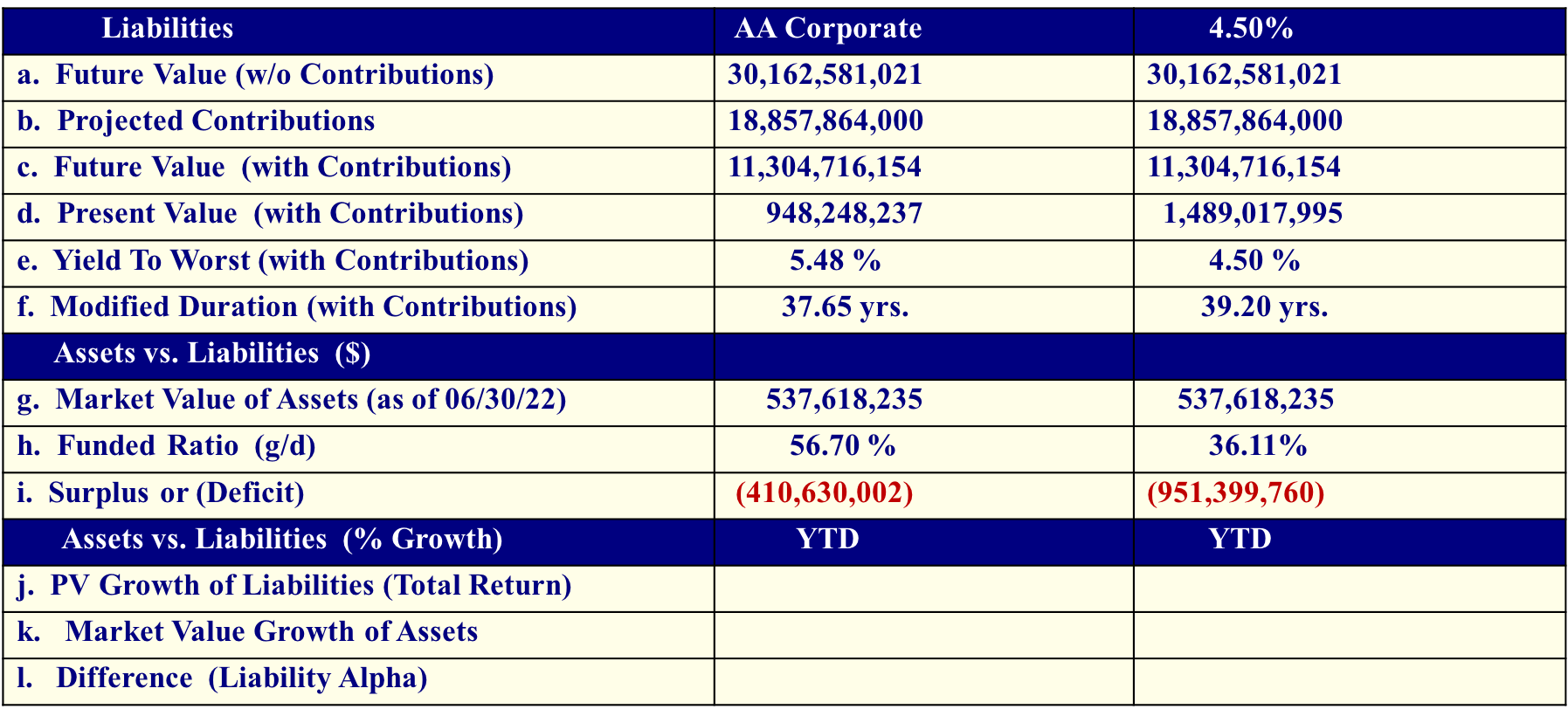
The above information is for an actual client, who we’ve been providing a CLI for 15+ years. This client has elected to receive quarterly reviews. They’ve also chosen to see the impact on liabilities for multiple discount rates, including a constant 4.5% ROA, which could easily be a pension plan’s ROA of say 7%. As you will note, the present value (PV) of those future value (FV) liabilities are different, and they could be dramatic, depending on the interest rate used. In this case, the AA Corporate rate (5.48% YTW) produces a funded ratio of 56.7%, while the flat 4.5% rate increases the PV liabilities thus reducing the funded status by more than 20%.
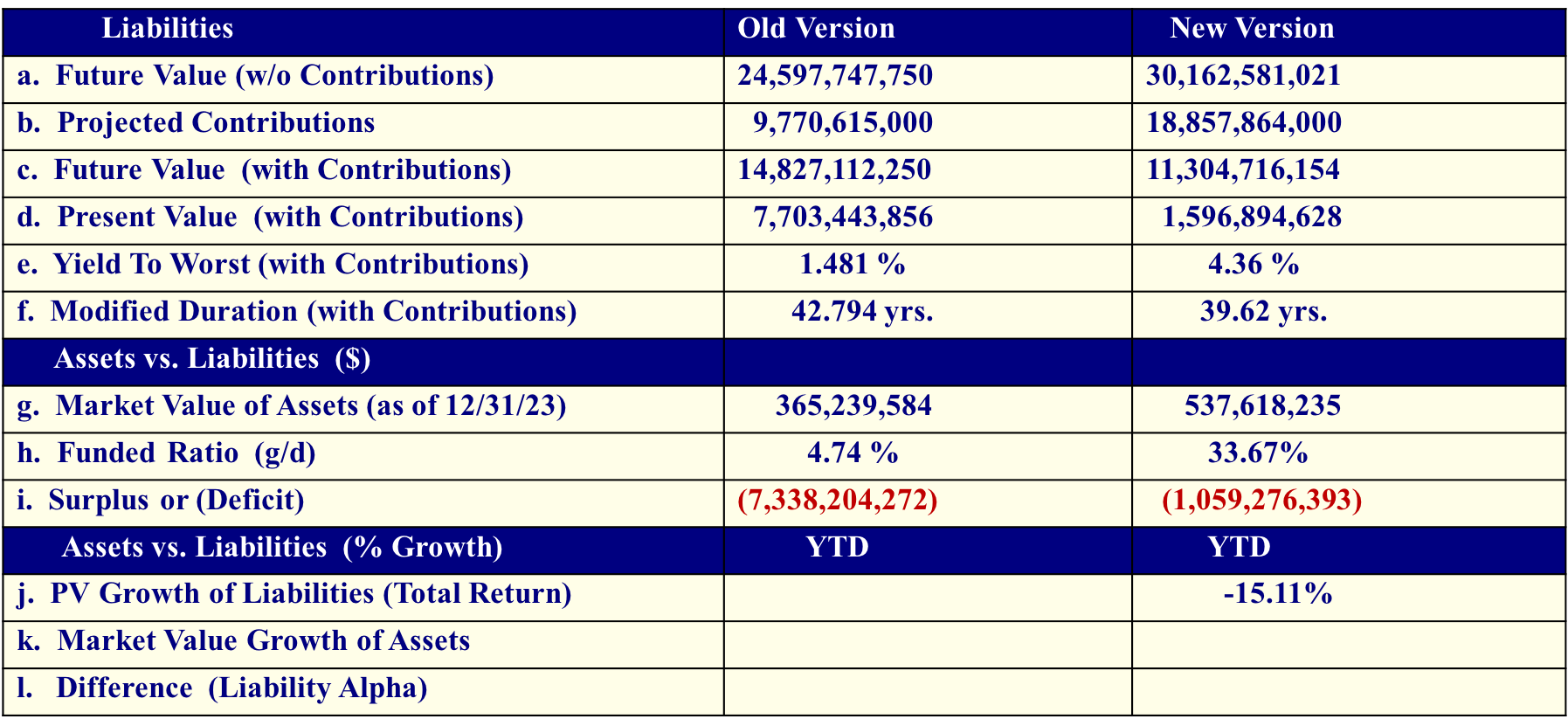
Using Treasury STRIPS as the discount rate produces the lowest funded ratio of 33.7% or 23% lower than using the AA Corporate discount rate.

With this information, plan sponsors and their advisors (consultants and actuaries) can make informed decisions related to contributions and asset allocation. Most plan sponsors are currently blind to these facts. As a result, decisions may be taken without having all of the necessary facts. Pension plans need to be protected and preserved (Ryan ALM’s mission). Having a complete understanding of what those future promises look like is essential.

You’ve made a promise: measure it – monitor it – manage it – and SECURE it…   

Get off the pension funding rollercoaster – sleep well!

Corporate Funding Improves in March – Milliman

By: Russ Kamp, Managing Director, Ryan ALM, Inc.

Milliman released the results of its latest Milliman 100 Pension Funding Index (PFI), which analyzes the 100 largest U.S. corporate pension plans. Pension funding improved for the third consecutive month to start the year, which now stands at 105.6% from 105.3% at the end of February. March was a bit different, however, as the discount rate declined 11 basis points increasing the collective liabilities by $14 billion to $1.299 trillion at the end of the quarter. Despite the increase in liabilities, investment performance was once again strong leading to a gain of $19 billion. Total assets now stand at $1.373 trillion.

Zorast Wadia, author of the PFI, stated, “the funded status gains may dissipate unless plan sponsors adhere to liability-matching investment strategies. Zorast’s observation is outstanding. Should rates fall from these levels, the cost to defease pension liabilities will grow. Now is the time to take risk off the table. Create certainty by getting off the asset allocation rollercoaster. Engaging in Cash Flow Matching (CFM) does not necessitate being an all or nothing strategy. Start your cash flow matching mandate and extend it as the funded status improves.

Return-seeking bond strategies will lose in an environment of rising rates. However, once a plan engages in CFM, the relationship between plan assets and liabilities is locked. Done correctly, assets and liabilities will move in tandem. It doesn’t matter what interest rates do, as benefit payments are future values that are not interest rate sensitive.

Act now to create some certainty! You’ll appreciate the great night’s sleep that you’ll start to have.

What are you paying for?

A reflection:

I was very fortunate to be hired into the investment industry in 1981. Two gentlemen, Larry Zielinski and Ted Swedock, took a huge leap hiring a not very qualified candidate out of undergraduate business school to fill a role as an analyst in a small consulting group.  I was the first-non consultant or assistant to be hired.  The role’s responsibilities were vast, and the experience that I gained was immeasurable.

But, the most important knowledge that was shared with me was a comment that Larry made on the first day that I began working at Janney Montgomery Scott’s Investment Management Controls division.  Larry told me that anyone or any company can produce vast quantities of paper and/or fancy reports.  A consultant is only worth their salt if they have the ability to interpret the information that they are passing on and at the same time are willing to make recommendations based on their interpretation.

As I sit back today and reflect on my nearly 33 years in this business, I can’t help but remember how important those words were that Larry uttered to me in October 1981.  I’ve tried to follow his lead since day one.  Initially, I didn’t have a clue about how most things truly worked in the investment industry. Today, as we build KCS, we continue to live by Larry’s example.  We can produce all the fancy reports in the world, but they aren’t worth the paper they are printed on if we also don’t share with our clients and prospects our recommendations as to a course that they should follow.  We are Fiduciaries, and we take that responsibility seriously.

As you may know, every month we produce at least one article on an investment subject. We don’t pull any punches.  If you want to know how we feel on a subject, just go to our website and look under the heading “Publications.”  Everything that we’ve produced is there.  I don’t know how many other consultants/consulting firms are regularly producing articles, but they should at least be willing to take a stand on those subjects most important to their clients.

At KCS, we are concerned about retirement security for most Americans.  We do believe that the demise of the defined benefit plan will produce negative economic and social consequences for a large segment of our population.   We don’t think that the status quo approach to managing DB plans is working.  We believe that our clients and their beneficiaries need new thinking and approaches on a variety of retirement subjects.  We’ve articulated those.  Has your consultant? So, I ask again, are you getting what you are paying for?

Europe isn’t wittnessing a great recovery!

As readers of the KCS Blog know, we have been and remain negative on the Euro-zone for a variety of reasons, but specifically because the Euro is a failed model. Without the ability of the Euro-zone constituents to devalue their currency when needed, and they can’t because it isn’t a Fiat currency, these economies / countries will continue to stagger.

Here is some perspective brought to us by Mark Grant:

“Let us peer specifically at Europe. Real inflation in Europe, adjusted for
austerity taxes, has been running at -1.5% for the past five months according to
London’s Telegraph. They are experiencing a very real bout of Deflation. Prices
are down -5.6% in Italy, -4.7% in Spain, -4.0% in Portugal and even -2.0% in
Holland. According to Bloomberg the EU is missing its Inflation target by more
than 150 bps on the downside. Bank of America has opined that the current
stagflation could cause a rise in France’s official debt to GDP to 105%, 148% in
Italy and 118% in Spain. The ECB has said that it is discussing some type of
Quantitative Easing though what it might be has yet to be seen. Yields are down
across Europe but the economies are no better.”

As we’ve discussed, austerity hasn’t worked. Debt to GDP is rising in most Euro-zone countries, employment remains incredibly high, and growth and inflation are non-existent. Clearly this isn’t a great formula for success.

Only time will tell, but don’t be shocked if one or more constituents are no longer sharing the Euro in the next 2-3 years.

Retirement Confidence Slips Again, according to the IRI

The Insured Retirement Institute (IRI) today released a new report showing that Baby Boomers’ confidence in their retirement plans continues to decline, a trend dating back to 2011, when IRI first began tracking Boomers’ retirement expectations. During that time, the percentage of Boomers showing high levels of confidence in their financial preparations for retirement dropped from 44 percent to 35 percent. But while confidence continues to slip, IRI found slight improvements in several important measures, including the percentage of Boomers (51-67) with retirement savings, their total savings, as well as the number of Boomers with a retirement savings goal and a planned retirement age.

While Boomers’ current economic outlook has also soured, they are beginning to show optimism that their financial situation will improve, with 42 percent of Boomers expecting things to improve in five years, compared to 33 percent of Boomers who shared this view in 2013.

Other key findings from the report:

  • A quarter of Boomers postponed their plans to retire during the past year.
  • 28 percent of Boomers plan to retire at age 70 or later.
  • One in 10 Boomers prematurely withdrew savings from a retirement plan during the past year.
  • 80 percent of Boomers have retirement savings.
  • About one-half of Boomers with retirement savings have $250,000 or more saved for retirement.
  • 55 percent of Boomers have calculated a retirement savings goal, up from 50 percent in 2013.
  • Of those calculating a retirement savings goal, 76 percent are factoring in the cost of health care.
  • Three in four Boomers say tax deferral is an important feature of a retirement investment.
  • Nearly 40 percent of Boomers would be less likely to save for retirement if tax incentives for retirement savings, such as tax deferral, were reduced or eliminated.
  • Boomers planning for retirement with the help of a financial advisor are more than twice as likely to be highly confident in their retirement plans compared to those planning for retirement on their own. 

The IRI study is based on a survey of 800 Americans aged 51 to 67.