Taking From Peter to Pay Paul

By: Russ Kamp, CEO, Ryan ALM, Inc.

Do you, or would you, consider yourself a “high earner” with a salary of $145k/year?

Try asking a family of four in NYC that question, when you consider the expenses from taxes (federal, state, city, sales, and property), the housing costs associated with an apartment, childcare, healthcare, food, clothing, etc. Yet, those at the IRS certainly do. In case you didn’t realize it, SECURE 2.0 is eliminating the tax deductibility of “make up” contributions for those 50 and up after they have maxed out their $23,500 annual contribution beginning in 2027. As a reminder, for those that 50-years old and up one can contribute another $7,500. For those between the ages of 60-and 63-years-old there is a super catch up contribution of $11,500. Why a 64- or 65-year-old can’t contribute more is beyond me. Perhaps it will blow out the U.S. federal budget deficit!

Unfortunately, if you are so lucky to earn a whopping $145k from a single employer in a calendar year, you will be forced to use a Roth 401(k) for those make up contributions. As stated previously, you lose the tax deductibility for those additional contributions. So, if you earn $200k and you contribute the additional $7,500 or the $11,500, instead of seeing your gross income fall by those figures, you will be taxed at the $200k level, increasing your tax burden for that year. Yes, the earnings within the account grow tax free, but the growth in the account balance is subject to a lot of risk factors.

We should be incentivizing all American workers to save as much as possible. Let’s stop with all these different gimmicks. Do we really want a significant percentage of our older population no longer participating in our economy? Those 65-years and older represent about 17% of today’s population, but they are expected to be 23% by 2050. Do we really want them depending on the U.S government for social services? No, and they don’t want that either. We want folks to be able to retire with dignity and remain active members of our economic community.

The demise of the traditional DB pensions has placed a significant burden on most American workers who are now tasked with funding, managing, and then disbursing a “retirement” benefit with little disposable income, no investment acumen, and a crystal ball to determine longevity as foggy as many San Francisco summer days. Again, with the burdens associated with all of the expenses mentioned above and more, it really is a moot point for many Americans to even consider catch up contributions, but for those lucky few, why penalize them?
Today is National 401(k) Day. Where is National DB Pension Plan Day?

By: Russ Kamp, CEO, Ryan ALM, Inc.

I suspect that most of us have no idea that today, September 5, 2025, is National 401(k) Day. This day is recognized every year on the Friday following Labor Day. The day is supposed to be an opportunity for retirement savings education and for companies to inform their employees about their ability to invest in company sponsored 401(k)s. Did you get your update today? Unfortunately, like many small company employees, I don’t have access to one or a DB plan.

For the uninformed, 401(k) plans are defined contribution plans (DC). This plan type was created in the late 1970s (Revenue Act of 1978) as a “supplemental” benefit. Corporate America liked the idea of a DC offering because it helped them recruit middle and senior management types who wouldn’t accrue enough time in the company’s traditional pension plan. Again, the benefit was supplemental to the traditional monthly pension payment and not in lieu of it!

I think that defined contribution plans are fine as long as they remain supplemental to a DB plan. Asking untrained individuals to fund, manage, and then disburse a retirement benefit is a ridiculous exercise, especially given their lack of disposable income, investment acumen, and NO crystal ball to help with longevity issues. In fact, why do we think that 99.9% of Americans have this ability? Regrettably, we have a significant percentage (estimated at 28%) of our population living within 200% of the poverty line. Do you think that they have any discretionary income that would permit them to fund a retirement benefit when housing, health insurance, food, education, childcare, and transportation costs eat up most, if not all, of an individual’s take home pay? Remember, these plans are only “successful” based on what is contributed. Sure, there may be a company match of some kind, but we witnessed what can happen during difficult economic times, when the employer contribution suddenly vanishes.

Defined benefit plans are the gold standard of retirement vehicles. They once covered more than 40% of the private sector workforce, most union employees, and roughly 85% of public sector workers. What happened? Did we lose focus on the primary objective in managing a DB plan which is to SECURE the promised benefits in a cost-effective manner with prudent risk? Did our industry’s focus on the return on asset assumption (ROA) create an untenable environment? Yes, we got more volatility and less liquidity! Did we did we get the commensurate return? Not consistently. It was this volatility of the funded ratio/status that impacted the financial statements and led to the decision to freeze and terminate a significant percentage of private DB plans. It is a tragic outcome!

What we have today is a growing economic divide among the haves and haves-not. This schism continues to grow, and the lack of retirement security is only making matters worse. DB plans can be managed effectively where excess volatility is not tolerated, where the focus is on the promised benefit and not some made up ROA, and where decisions that are made relative to investment structure and asset allocation are predicated on the financial health of the plan: mainly the funded status. We need DB plans more than ever and ONLY a return to pension basics will help us in this quest. Forget about all the newfangled investment products being sold. Replacing one strategy for another is no better than shifting deck chairs on the Titanic. We need improved governance and a renewed focus on why pensions were provided in the first place.

How Comforting is $1,305.54/year?

By: Russ Kamp, Managing Director, Ryan ALM, Inc.

One doesn’t have to spend much time on LinkedIn.com these days without seeing a discussion about the pros and cons of Defined Benefit (DB) vs. Defined Contribution (DC) aka 401(k) plans. Anyone who has read just a few of the >1,500+ posts on this blog know that I and Ryan ALM, Inc. are huge supporters of DB plans. Based on the following, it becomes apparent why that is the case.

One topic frequently mentioned among our peers is financial literacy. As a former member of two boards of education (11 years in total), I have witnessed first-hand how little financial literacy is shared with our high school students, especially as it relates to saving and investing. That said, as important as education is, the greatest issue for me is the lack of disposable income for the average American worker.

Frequently we read about the spending habits of younger generations, including being the “avocado toast” crowd. Examples often used include the daily purchase of a Starbucks drink or two, the use of Uber Eats, and similar examples of perceived wasteful spending. They fail to mention that even “well-paid” workers (>$100k) are burdened by a mortgage or rent payment, they likely have student loan debt, they have to buy insurance in order to use their car, which is also a very expensive purchase, they are required to have health insurance, homeowners or rental insurance, and God forbid that they have a spouse and a couple of kids. Childcare expenses have gotten to be insane. Is there any wonder that funding one’s own retirement has proven to be incredibly challenging?

So how are we doing? Unfortunately, most of the literature on the subject uses average balances to represent 401(k) savings. This practice needs to stop. According to Vanguard the average balance in 2024 is $134,128, but the median balance is $35,285. In addition, Morningstar has just published an article stating that retirees should use only a 3.7% withdrawal rate (no longer 4%) to safely use a 401(k) retirement balance given the recent performance of equity markets and the current interest rate environment. Let’s see: 3.7% * $35,285 = $1,305.54. That is an annual withdrawal, although it looks like it should be a monthly payout! What kind of retirement will that level of annual withdrawals provide? For comparison purposes, the average DB payout in the private sector is $11k and nearly $25k in public pensions.

As a reminder, DC plans were intended to be supplemental to DB plans. It is highly regrettable that they have morphed into most everyone’s primary means of “accumulating” retirement resources. This migration in proving to be an unmitigated failure and the consequences will be untenable. The American worker needs access to a DB plan. Let’s work together to protect and preserve those that remain, while encouraging former sponsors of these plans to rethink the decision to freeze or terminate. There are also state sponsored entities that afford employees in smaller companies access to a DB-like plan. That said, please manage them with a focus on the pension promise (securing benefits). Don’t rely on markets and all the volatility that comes with that exposure to “fund” these essential programs. That strategy hasn’t worked!

Does This Look Like Success?

By: Russ Kamp, Managing Director, Ryan ALM, Inc.

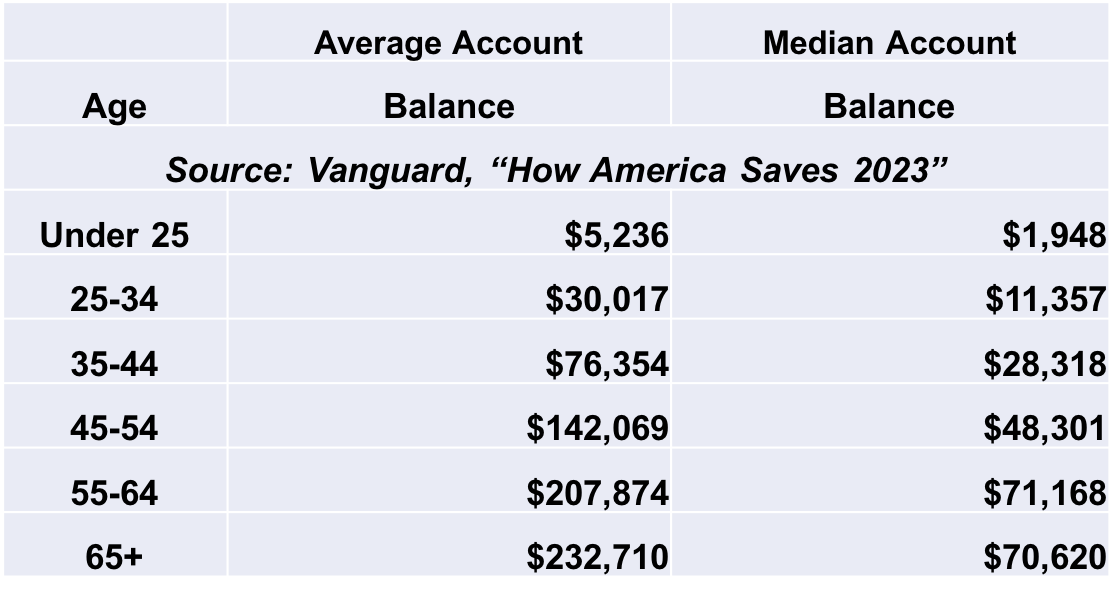
The following was a headline for a MarketWatch.com article, “The 401(k)’s success has been overlooked and will help even more Americans”, which I saw on a LinkedIn.com post earlier today. Sure, some American workers have benefited from their ability to fund a DC account, but the vast majority of Americans are struggling.

Does This look like success?

Perhaps the level of savings would be okay if DC plans were actually supplemental retirement vehicles, but since they have morphed into the primary retirement program for most workers, this is a disaster. I’m tired of the fact that we only ever see “average” balances reported. Of course, a few well-funded balances will drive the average up. Let’s focus on the MEDIAN account balances. Does a $70,620 account balance for a 65+ year-old participant look like a successful outcome? How much would that balance provide on a monthly basis for a roughly 20-year retirement?

If I were fortunate to have a defined benefit plan that provided $2,000/month (which isn’t a lot) for 20-years, I would receive $480K in retirement which is 6.8Xs what the 65+ year-old with the median account balance has today. It is a far cry when compared to the view that $1.4 million is the balance needed to have a dignified retirement today. It is silly to believe that the average American has the disposable income, investment acumen, and predictive ability to gauge how long they will live in order to allocate this meager balance to ensure that the recipient doesn’t outlive their savings.

The investment industry can celebrate all they want as it relates to the total accumulated wealth in defined contribution plans, but for the “median” American, it just isn’t close to being enough. Defined benefit plans should be the backbone of our retirement system, while DC plans occupy the supplemental role for which they were designed. As someone in that LinkedIn.com post stated, “the numbers don’t lie”. I would certainly agree, but that doesn’t mean that the #s are revealing success!

Delayed Gratification – Just How Important Is It?

The following Tweet was posted by Vanguard this morning – “Delaying gratification, avoiding debt, & saving are all central to a financial literacy program for student”. We all know that we are more responsible for funding our retirement than at any time in the last 60 years, but just because we know doesn’t mean we have the ability to do so.

Defined Contribution plans are the vehicles of choice for most private sector employers, if not their employees. However, funding these plans, even to meet the company match, is not easy for many (most) low to middle income households. At KCS, we’ve discussed the benefits of participating in a DB plan versus a DC plan since our founding.

But, if you have a job, don’t have substantial student loan our housing debt, and can afford to make sizable contributions into your retirement program, it is better to delay gratification and make those contributions as early and often as possible. Why? Because the math of compounding truly works.

For instance, if a 22 year old can make a monthly contribution of $833 for 10 years, the $99,960 in contributions growing at 4% / year will become $438,393.12 upon reaching age 65. Again, that is with making contributions for only the first 10 years. At that point, you’ve basically funded your retirement and now you can begin acquire some of the other assets that you’ve been deferring.

However, if you can’t fund your retirement upfront with sizable monthly contributions, but can only put in $194 / month for the next 43 years growing at 4% until age 65, your balance upon retirement would only be $256,648.87, or roughly $182,000 less in total assets. WOW!

Finally, just think about how little you’ll be able to accumulate in your account if you delay making contributions until the age of 32. For instance, if you can only make that $194 / month for the next 33 years your account balance at age 65 is only $154,500, more than $100,000 less than you would have had if you began contributing the $194 / mo for the prior 10 years.

So, DC plans need funding often and early to be successful, but having the financial wherewithal is not a given, and having the discipline is not easy.