Ron Ryan – Pension Expert Webinar – October 21st at 11:15 am (EDT)

Ron Ryan is an expert in pension matters as they relate to the liability side of the equation. Ron will be participating in a webinar tomorrow.  It is a great opportunity to invest a small amount of time to potentially gather tremendous value add.  I would encourage you to participate. If you can’t, I will be happy to get you his presentation upon request.

The details on how to register follow:

U.SPension copy

Convergex Plan Sponsor Services is committed to helping clients stay informed on important industry issues while building relationships with key industry contacts. In that regard, we’d like to you invite you to attend an upcoming webinar with Ronald Ryan, founder of Ryan ALM, an asset and liability management firm.

Join Our Twenty Minute Webinar with
Pension Expert and Ryan ALM Founder
Ronald Ryan

Host: Ronald Ryan, Founder of Ryan ALM
Date: Wednesday, October 21st
Time: 11:30am ET

REGISTER NOW
Convergex understands the critical importance for pension plan clients to be able to fund liabilities at stable and lower contribution costs. We also know that many of our clients are interested in de-risking their plans. This webinar will highlight how Ryan ALM’s offerings can help with these and other challenges.

About the Host
Ronald Ryan, founder of Ryan ALM, is an award winning pension expert who has been working with pension clients since 1977. His new book “The U.S. Pension Crisis” won the 2014 Independent Publisher Book Award Gold Medal in the Finance, Investments, and Economics category. Ryan designed the bond index benchmark, currently known as the Barclays Aggregate Index, while he was Director of Fixed Income Research at Lehman Brothers. His career efforts also won him the William F. Sharpe Indexing Lifetime Achievement Award.

Ryan ALM Offering
Ryan ALM offers the following products and services to pension plan clients:
For Public and Taft-Hartley Plans – Ryan ALM provides its proprietary Custom Liability Index (CLI), designed to be the proper pension benchmark for liability driven objectives, and its Liability Beta Portfolio (LBP), designed to de-risk a plan through a proprietary method of cash flow matching liabilities. According to Ryan/OMNI, this creates an opportunity to de-risk a plan while reducing costs by as much as 10%.
For Corporate Plans, in addition to the CLI and LBP, Ryan ALM provides a set of discount rates that conforms to ASC 715 and is used by a ‘Big 4’ accounting firm, according to Ryan ALM.

REGISTER HERE

The NUMBers Are In – And They Aren’t Pretty!

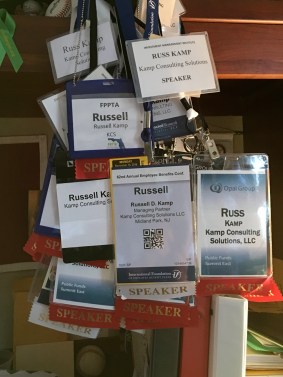
I was very fortunate to spend the last three days at the Florida Public Pension Trustees Association’s (FPPTA) educational conference listening to many bright, passionate presenters. If you’ve attended one of these before you wouldn’t be surprised to read that there were roughly 90 presentations on various investment strategies, actuarial related sessions, fiduciary standards, communication, healthcare, performance measurement, and even a couple on a DB plan’s liabilities (amen). But, the most common theme was related to the plan’s ROA or return on asset assumption, that is used to both discount liabilities and as a target for the plan’s assets. Through our research and based on what was shared at the conference, it appears that 7.5% is the most common target for the plan’s ROA.

Given recent volatility in and poor performance of the global markets, the performance for the most common indexes is flat to negative for the 12 months ending September 30, 2015. In fact, one would have to be making a meaningful style overweight favoring growth versus value (in all capitalization ranges) to see reasonably positive numbers of 2% or more or an over-weighting in fixed income relative to equities to accomplish the same objective (Barclays U.S. Aggregate is up 2.94% for the last 12 months). But, we know that public DB plans have been reducing fixed income exposure with the anticipation of rising interest rates.

It is doubtful that a “traditional” 60 / 40 (equity / fixed income) allocation is representative of today’s asset allocation, but if it were, it would show a 0.81% return for the 12 months, falling substantially behind the average ROA. If we used an equity allocation that included non-US equities at a 10% allocation, the 12-month return falls to 0.21%. However, it certainly seems to us that many plans have taken their international allocation up, while also diversifying into emerging markets. If the plan allocated only 5% of the domestic equity to emerging markets, so that the new allocation was 45% US equity, 10% Int’l – developed, 5% Int’l – emerging and 40% fixed Income, the return falls to -3% for the year, as emerging markets have gotten destroyed, a full 10.5% behind the “average” ROA.

Unfortunately, as yields on bonds fell below the ROA in the late ‘90s and early 2000s, asset consultants began reducing allocations to fixed income, fearing that any allocation would prove to be a drag on the plan’s ability to achieve the ROA. As a result, most public fund DB plans have substantially less in domestic fixed income than they should or historically have had. Once again, it appears to us that most plans have less than 25% allocated to traditional U.S. fixed income. If this is correct, it is likely that the performance numbers highlighted above would be weaker.

Compounding the fact that most plans will have a total fund performance that falls substantially below their ROA objective during this period, is liability growth, which during the last 12 months has increased by 9.6% (according to Ryan ALM). As we discussed at the conference, a plan’s specific liabilities should be the primary objective for performance reviews, but regrettably that hasn’t proven to be the case. Comparing your assets to your plan’s liabilities in 2015 would reveal a nearly 12.6% underperformance in the last 12 months.

DB Plan sponsors have been very pleased with returns relative to their stated ROA objective since the great financial crisis concluded in March 2009, but the reality is that liability growth has outpaced most plans’ asset growth during the same period. However, this fact is mostly unknown since most plans don’t get regular updates on their fund’s liabilities.  Unless a fund sponsor has access to a custom liability index (CLI) measuring the performance of the plan’s specific liabilities there is no way to know that fact.

Asset Allocation should be driven by your plan’s liabilities and funded ratio, and not the ROA. Asset allocation should also be responsive to changes in both, but in order to implement a responsive asset allocation, one needs greater transparency on the liabilities. Let us help you understand the true economics of your plan.

How to Derisk A Defined Benefit Plan

I had the great pleasure to attend Ron Ryan’s presentation yesterday at the Florida Public Pension Trustees Association (FPPTA) Conference in Naples, FL.  As many of you know, Ron is a pioneer in indexing dating back to his days when he was the Head of Research for Lehman, and he and his team created the Lehman Aggregate index and its component pieces (sub indexes).

Ron’s firm today, Ryan ALM, is focused on securing the promises made (liabilities) within defined benefit plans.  Both he and I are trying to refocus the industry on why paying greater attention to a plan’s liabilities helps plan sponsors do a better job of creating a more sound investment structure and asset allocation.

Getting a better feel for the liabilities doesn’t mean spending more time understanding the output from one’s annual actuarial report.  It does mean using a tool, such as a custom liability index (CLI) to measure the interest rate sensitivity, growth rate and term structure of the plan’s liabilities.  With this information, plan sponsors can begin to take risk off when it is appropriate to do so, and conversely, become more aggressive when the need arises.

As an industry we have spent an inordinate amount of time focused exclusively on the return on asset assumption (ROA), and not nearly enough time, if any, on the liabilities, which is the only reason that the plan exists in the first place. Asset allocation should reflect the funded ratio and funded status of the DB plan. A 90% funded plan should have a very different asset allocation and risk profile from that of a 50% funded plan.  How are your liabilities performing in this environment?

How To DeRisk A Pension 151004U.SPension copy

Weakening Jobs Growth To Further Pressure DB Plans

Given the news from this morning regarding US job growth (only 142,000 jobs added and revisions down in the previous two months), it would not surprise us to see US interest rates continue to fall.  If in fact this happens, DB plans’ funded ratios and funded status will continue to weaken. As we’ve reported on numerous occasions, plan liabilities, although discounted at the ROA, do not grow at the same rate as assets.

Liability growth has far outpaced asset growth in the last 15 years, and the asset allocation mismatch that exists between a plan’s assets and liabilities continues to be dramatic.  With most everyone expecting interest rates to rise, fixed income exposures have been reduced and bond durations shortened. A combination that continues to weigh on plan performance.

We continue to believe that weak global growth will keep interest rates low for the foreseeable future, and as such, fixed income exposures should be increased and reconfigured to meet near-term liabilities.  I will be discussing this concept / strategy at the upcoming FPPTA conference on Tuesday in Naples, FL.

Plans continue to focus almost exclusively on their fund’s ROA, but the liability side of the equation needs some attention, too, especially given the prospects for continuing global economic weakness.  In this environment, a plan will not close it’s funding gap through outperformance relative to its ROA.

October 2015 KCS Fireside Chat – Are ETFs as liquid as we assumed?

We are pleased to share with you the latest article in the KCS Fireside Chat series. In this article we once again explore the burgeoning ETF business, but with a particular focus on the trading activity that occurred on August 24th.  As you may recall, the market plummeted at the open (Dow down roughly 1,100 in first five minutes), and the impact on several ETFs was incredible.  We hope that you find the article helpful.  Please don’t hesitate to reach out to us if we can provide any assistance.

Click to access KCSFCOct15.pdf

IMG_1237

Housing Rental Expense killing DC contributions?

Despite the fact that inflation, as measured by the CPI, seems to be contained, rental expense for housing has jumped significantly in the US during the last decade.  As a country we are moving away from being a home ownership society to one that rents housing, as home ownership is now at its lowest since 1967! Furthermore, the only reason the home ownership rate is as “high” as it is, is due to homeowners in the 65 and over age group. For everyone else, home ownership rates are now the lowest recorded.

Compounding this problem is the fact that US household incomes are 7.2% less than they were in 1999. The lower incomes are being crushed by rising housing costs, medical expenses / insurance and education. Is it no wonder that folks don’t have any additional resources to fund their DC plans? What percentage of the US population really has discretionary income at this time?

According to the “State of the Nation’s Housing” report released by the Center for Housing Studies at Harvard, which showed that while inflation among most products and services may indeed be roughly as the Fed and BLS represent it, when it comes to rent things have never been worse.

According to the report, 2013 marked another year with a record-high number of cost burdened households – those paying more than 30 percent of income for housing. In the United States, 20.7 million renter households (49.0 percent) were cost burdened in 2013.  Alarmingly, 11.2 million (25%) all renter households, had “severe cost burdens, paying more than half of income for housing.” The median US renter household earned $32,700 in 2013 and spent $900 per month on housing costs.

So, do you still believe that the failure to fund defined contribution plans is because we have a population hellbent on consumption? The demise of the DB plan means that a significant percentage of our population will never be able to make adequate contributions (if any) into their retirement plan. The social and economic consequences for our country will be grave.

Single and Broke In Retirement?

We recently came across a news report that highlighted the fact that “singles” in the U.S. are more likely NOT to have a retirement account. In fact, only 51 percent of unattached people have a retirement savings account, according to a study released Wednesday by Mintel. (Mario Petitti / Chicago Tribune)

The population of single people is rising with almost half of adults today not living with a spouse, according to the U.S. Census. That’s up from about 30 percent in 1967.

“More Americans are staying single longer, and our data shows this trend will hold out for the foreseeable future,” Robyn Kaiserman, Mintel financial services analyst, said in the report.

Regrettably, the percentage of singles that have a retirement account is far less than people who are living with a partner or who are married, the research firm said.

Retirement savings accounts have been set up, in contrast, by 68% of people living with a partner and 84% of married adults.

We, at KCS, suggest that Americans overall need to take retirement more seriously, especially those not in a traditional DB plan.

For participants in defined contribution plans, just 27% contribute the maximum allowed to their plan, and 22% say they contribute only enough to get the employer match.

Whether you are single or not the key to funding a successful retirement is to start saving / investing early in life and be consistent (save with every paycheck). Taking advantage of a matching 401k plan should be a no brainer. Unfortunately, the power of compounding is lost on many people. But, why should that be a surprise? We provide so little financial literacy in our schools!

KCS September 2015 Fireside Chat – “Happy 80th Birthday”

We are pleased to share with you the latest KCS Fireside Chat article. Social Security has just turned 80, and in this article we explore its origins, operating practices, and importantly, its future. We hope that you find this subject interesting.

Click to access KCSFCSep15.pdf

As a nation we cannot afford to have our seniors living on the precipice of financial ruin. A return to the poor houses of the 20’s and 30’s is absolutely unacceptable. Ideally, we would once again provide a strong pension system that would strengthen the three-legged stool, but until we can resurrect defined benefit pensions for the masses, we better figure out a way to continue to provide, and even enhance, the current Social Security system.

Please don’t hesitate to reach out to us if we can be of any assistance to you. Have a great Labor Day weekend!

IMG_1237

Markets Giving You The Woolies – UPDATE!

The following is a re-introduction of a concept that we shared with you in June.

I’ve witnessed many market declines during my more than 33 years in the investment industry, and I would be lying if I told you that I called the beginning, end, and ultimate magnitude of any of the sell-offs.  Market declines are part of the investing game.  But just knowing that isn’t enough, as unfortunately, they can have a profound impact on retirement plans and retirement planning, both institutional and individual, as they impact the psyche of the investors.

It is well documented how individuals tend to buy high and sell low. The market crash of 2007 – 2009 drove many individuals out of equities at or near the bottom, and many of those “investors” have kept their allocations to equities below 2007 levels. It hasn’t been that much better for the average institutional investor either.  We are aware of a number of situations (NJ for one) that plowed into expensive, absolute-return product at the bottom of the equity market only to see that portfolio dramatically underperform very inexpensive beta, as the equity markets rallied from the bottom in March 2009.

In some cases, the selling “pressure” was the result of liquidity needs, which lead to the tremendous explosion in the secondary markets for private equity, real estate, etc. in 2009.  The E&F asset allocation model, made so famous by Yale, was the undoing for many retirement plans, as the failure to secure adequate liquidity exacerbated market losses.  Given the heightened fear and volatility in the global markets, are you currently prepared to meet your liquidity needs?

As we’ve discussed within both the Fireside Chats and on the KCS blog, the development of a hybrid asset allocation model geared specifically to your plan’s liabilities, can begin to de-risk your plan, while dramatically improving liquidity.  The introduction of the beta / alpha concept will provide plan sponsors with an inexpensive cash matching strategy that meets near-term benefit needs, while extending the investing horizon for the less liquid investments in your portfolio. By not being forced to sell into the market correction, your investments have a greater chance of rebounding when the market settles.

Traditional asset allocation models subject the entire portfolio to market movements, while the beta / alpha approach only subjects the alpha assets to volatility.  But, since one doesn’t have to sell alpha assets to meet liquidity needs given that the beta portfolio is used for that purpose, the volatility doesn’t matter. Don’t fret about China, Oil and / or emerging markets and the potential implications for the global markets and your plan. Let us help you design an asset allocation that improves liquidity, extends the investment horizon for your alpha assets, and begins to de-risk your plan, as the funded ratio and status improve.

U.S. $ Strength – An Unwelcomed Guest For U.S. Multinationals

Readers of this blog may recall that in the KCS First Quarter 2015 commentary we wrote;
With regard to the strengthening U.S. dollar versus major currencies, particularly the Euro, we think that U.S. large cap, multi nationals will be particularly challenged as the cost of their exports ratchet up, and competitors import prices make sales domestically more competitive. Could the U.S. dollar reach parity with the Euro? We certainly believe that can happen, as Europe continues its own QE initiative to jump-start economic growth and inflation.
Well, the impact of a strengthening US $ is beginning to be quantified, and as we speculated, corporate earnings are being dinged. In an FT article from August 2nd, it is estimated that the impact on earnings of US multinationals could be significant in 2015.
http://www.ft.com/cms/s/0/ab30e1d4-37c2-11e5-b05b-b01debd57852.html#ixzz3hmoRs0US

“The sharp rise in the US dollar may slice more than $100bn off dollar-denominated revenues at some of America’s largest multinationals this year, a sum larger than the sales of Nike, McDonald’s and Goldman Sachs combined, according to a Financial Times analysis.”

As mentioned in the article, in the first half of the year, 10 of the largest American multinationals have had their sales reduced by a combined $31bn — including blue-chip companies like Apple, General Motors, IBM, Johnson & Johnson, Amazon and General Electric — and concerns have mounted that a move by the Federal Reserve to lift interest rates later this year will push the dollar higher.
Given our concerns earlier this year about the impact of a strong US $, we began to trim equity positions among large cap domestic holdings, favoring instead small to mid cap companies whose earnings would not be impacted. Furthermore, if the dollar continues to rise versus other currencies, we would suggest that cap weighted, passive portfolios (index funds) will also be stressed in this environment.
Is it the time for active management?