
By: Russ Kamp, CEO, Ryan ALM, Inc.
You are not likely to know about Florida Statute §112.661(6) unless you reside in Florida and sit on a pension board, and even then, you still might not have heard or read about this statute. It became effective October 1, 2000, as part of Chapter 2000-264, Laws of Florida, enacted through CS/SB 372, “Investment of Public Funds”, which Governor Jeb Bush approved on June 14, 2000,
This provision is the only one of its type among the 50 U.S. states. Florida should be commended for its inclusion in the management of public pension plans. The subsection for this statute is titled “Maturity and Liquidity Requirements.”
It provides: “The investment policy shall require that the investment portfolio be structured in such manner as to provide sufficient liquidity to pay obligations as they come due.”
It then goes a meaningful step further: “To that end, the investment policy should direct that, to the extent possible, an attempt will be made to MATCH (the statute’s word, not mine) investment maturities (that says bonds to me) with known cash needs and anticipated cash-flow requirements.” As Phil Rizzuto would say, “Holy Cow”! If given the opportunity, I couldn’t have written this requirement any more clearly.
Again, the Investment Policy Statement (IPS) should direct that an attempt will be made to match investment maturities through bonds with known cash needs and anticipated cash-flow requirements. That sounds a lot like Cash Flow Matching (CFM) to me.
So, I ask, within your (IPS) do you have an explicit Liquidity Policy? If so, does it consider Florida Statute 112.661? At the most recent FPPTA conference in Orlando, I was asked to speak to liquidity management practices currently used in Florida. What I discovered is the there are two fundamentally different philosophies:
Asset-driven liquidity
“When we need cash, where can we get it?”
Liability-driven liquidity
“We know when benefits must be paid, so why don’t we arrange the assets today to produce the cash when those payments occur?”
Here are the seven strategies that I was able to identify that are currently being utilized. I’d be interested to hear from those of you that might have adopted some other means to secure liquidity.
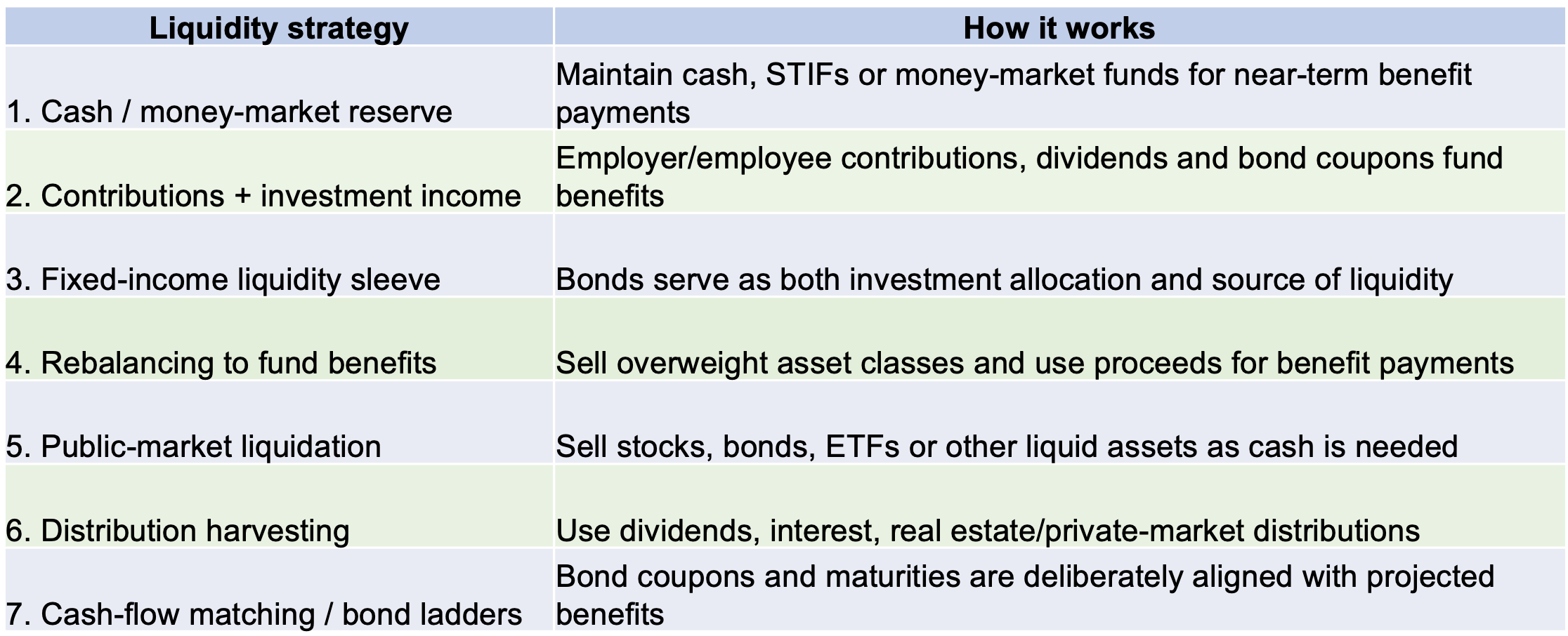
Only #7 falls under the category of liability-driven liquidity, which comes closest to adhering to statute 112:661. Given the rapid rise in U.S. interest rates, creating a cash flow matching portfolio for some period of time (10-years) not only SECURES the necessary liquidity, it extends the investing horizon for the plan’s residual assets, while dramatically reducing the cost to fund those future benefits. We are always happy to provide a free analysis on what CFM could accomplish for you and your fund. Don’t let this wonderful rate environment pass you by.

