ARPA Update as of April 5, 2024

By: Russ Kamp, Managing Director, Ryan ALM, Inc.

Welcome to ECLIPSE DAY. Good luck found me in Dallas today for the TexPERS conference, as it is in the path of totality (complete darkness). Bad luck has it heavily overcast today following a Sunday that had beautiful blue skies. Oh, well. Perhaps we’ll get lucky.

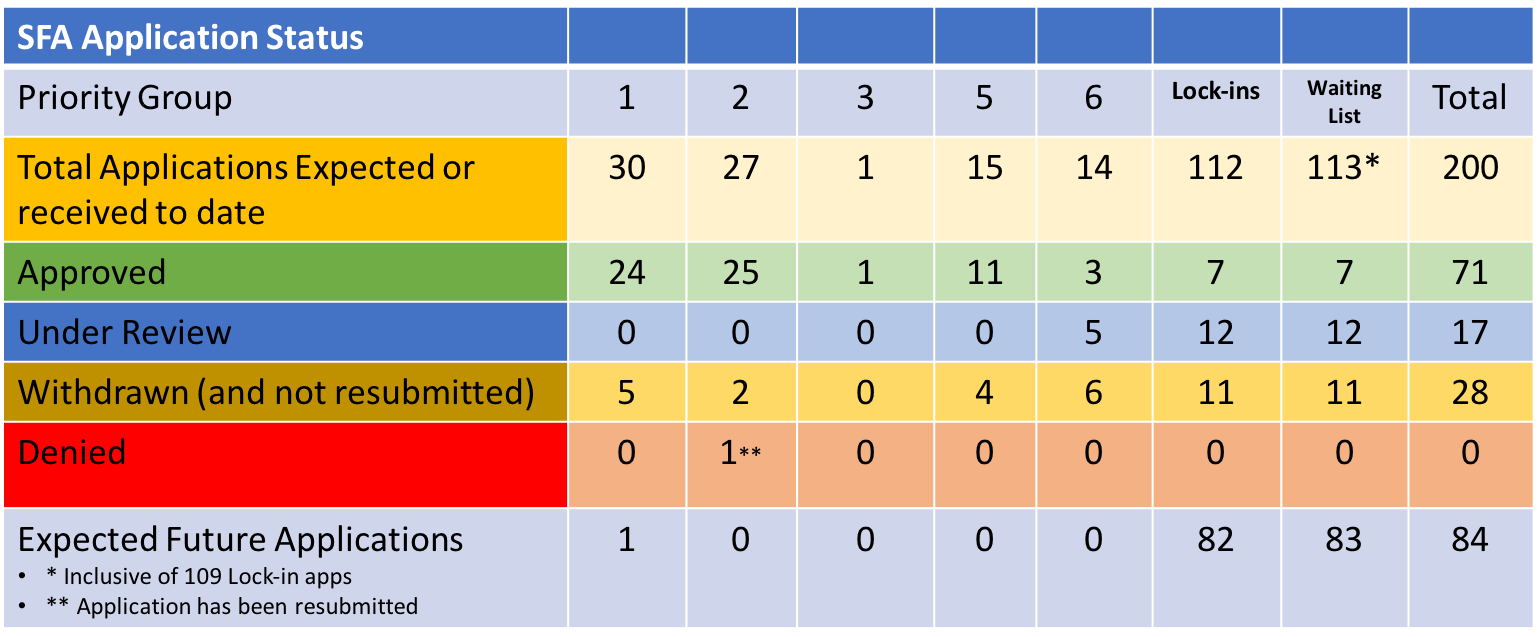
APRA’s implementation by the PBGC has slowed, and we don’t have earthquakes (NJ residents are still shaking their heads), eclipses, or any other natural event to blame. That is not to say that nothing has been done, as there was one new application received during the week. Printing Local 72 Industry Pension Plan, a Priority Group 5 member, submitted its revised application seeking $37 million in SFA for the 787 plan participants. Beyond that, I suspect that they are busy reviewing the 19 applications that have been submitted that are currently waiting on approval. Only 5 of those applications are the initial version.

As we’ve discussed in previous updates, census data used to determine SFA grant payments has had to be checked and rechecked following the announcement that Central States received more SFA grant $ than they were eligible to receive since some of the participants were no longer alive. That revelation and the corrective measures taken to ensure that SFA monies are only being allocated for eligible participants has really slowed an already cumbersome review. Despite some of these impediments, it is great that 72 plans have gotten the SFA awards totaling nearly $54 billion.

We might not have great visibility as it pertains to the eclipse, but with US interest rates tending higher, inflation remaining more “sticky” than hoped, and a Fed that may just not cut in 2024, visibility is clearer that cash flow matching the SFA is the way to secure the benefits and expenses well into the future. As a reminder, as rates rise, the cost to defease those promised benefits falls. Higher rates aren’t only good for savers. They are particularly good for SFA recipients and all plan sponsors of DB plans.

As an example of how that math works, when I entered this industry on October 13, 1981, the 10-year Treasury was yielding 14.9%. It would have only cost you $17.82 to defease a $1,000 30-year liability. On August 4, 2020, when the 10-year Treasury yield dipped to 0.52%, it would have cost you an extraordinary $860.40 to defease the same $1,000 30-year liability. As of April 5, 2024, the 10-year Treasury is yielding 4.41% and the cost to defease that 30-year liability is much more manageable at $301.00. You should be cheering for a higher for longer scenario.
The Importance of Liquidity

By: Russ Kamp, Managing Director, Ryan ALM, Inc.

I recently came across an article written by a friend of mine in the industry. Jack Boyce, former Head of Distribution for Insight, penned a terrific article for Treasury and Risk in July 2020. The title of Jack’s article was “We Need to Talk About the Armadillo in the Room”. It isn’t just a funny title, but an incredible simile for the two primary stages of a pension plan, notably the accumulation and decumulation stages of pension cash flows. The move from a positive cash flow environment to a negative cash flow environment creates a hump that is reminiscent of the shape of an armadillo.

I stumbled on an armadillo at TexPERS last summer and truthfully didn’t think at that time that I was looking at a pension funding cycle, but I’ll never look at an armadillo again without thinking about Jack’s comparison. But the most important aspect of Jack’s writing wasn’t that he correctly associated the funding cycle with a less than cuddly animal, it was the fact that he highlighted a critically important need for pension plan sponsors of all types – liquidity! I’ve seen far too often the negative impact on pension plans and endowments and foundations when appropriate and necessary liquidity is not available to meet the promises, whether they be a monthly benefit, grant, or support of operations.

The last thing that you want to have happen when cash is needed is to be forced to raise liquidity when natural liquidity is absent from the market. There have been many times when even something as liquid as a Treasury note can’t be sold. Just harken back to 2008, if you want a prime example of not being able to transact in even the most liquid of instruments. Bid/ask spreads all of a sudden resemble the Grand Canyon. As we, at Ryan ALM have been saying, sponsors of these funds should bring certainty to a process that has become anything but certain. Jack correctly points out that “a typical LDI approach focuses on making sure the market value of a plan’s assets and the present value of its liabilities move in lockstep.” However, too often “these calculations fail to factor in the timing of cash flows.” We couldn’t agree more. Where is the certainty?

His recommendation mirrors ours, in that cash flow matching should be a cornerstone of any LDI program. Using the cash flow of interest and principal from investment grade bonds to carefully match (defease) the liability cash flows secures the necessary liquidity chronologically for as long as the allocation is sustained. By creating a liquidity bucket, one buys time for the remaining assets in the corpus to now grow unencumbered. As we all know, time is an extremely important attribute when investing. I wouldn’t feel comfortable counting on a certain return over a day, week, month, year, or even 5 years. But give me 10-years or more and I’m fairly confident that the expected return profile will be achieved.

Jack wrote, “pension plan sponsors need thoughtful solutions”. We couldn’t agree more and have been bringing ideas such as this to the marketplace for decades. Like Jack, “we believe a CDI approach can simultaneously improve a plan’s overall efficiency and the certainty of reaching its long-term outcome.” Certainty is safety! We should all be striving for this attribute.

ARPA Update as of March 22, 2024

By: Russ Kamp, Managing Director, Ryan ALM, Inc.

“March Madness” is upon us. How’s your bracket doing? I still have my champion in the running, but not much more than that.

The past week was very quiet with regard to the ARPA legislation and activity associated with its implementation. We did have one fund submit an application for Special Financial Assistance (SFA). United Food and Commercial Workers Union and Participating Food Industry Employers Tri-State Pension Plan, a Priority Group 6 member, submitted a revised application on March 16th. This fund is seeking SFA in the amount of $638.3 million for the fund’s 29,233 members. The PBGC will now have until July 14, 2024 to act on the application.

Besides the filing by the UFCW, there was little to show last week, as there were no applications approved, denied, or withdrawn. Furthermore, unlike the prior week, there were no additions to the waitlist which continues to have 113 funds listed of which 27 have been invited to submit an application. To-date, 71 funds have received SFA in the amount of $53.6 billion. These proceeds include the grant, interest, and any FA loan repayments.

Like the picking of the NCAA tournament bracket, for which there are no perfect submissions remaining, the capital markets are highly uncertain. Yes, the US equity market has enjoyed a robust 5-6 months period, but how predictive is that for the next six months or longer? Those yet to receive the SFA should seriously consider an investment strategy that takes the uncertainty of the markets out of the equation. I am specifically referring to the use of investment grade bonds to defease the promised benefit payments as far into the future that the SFA allocation will cover. Once the matching of asset cash flows to the plan’s liability cash flows is done, that relationship is locked in no matter what transpires in the capital markets. Any risk taken by recipients of these assets should be done in the legacy portfolio where a longer investing horizon has been created. Fortunately, US interest rates remain elevated significantly from when the ARPA program began in 2021. The timing couldn’t have been better.