Another CPI Posting and Another Strange Reaction

By: Russ Kamp, Managing Director, Ryan ALM, Inc.

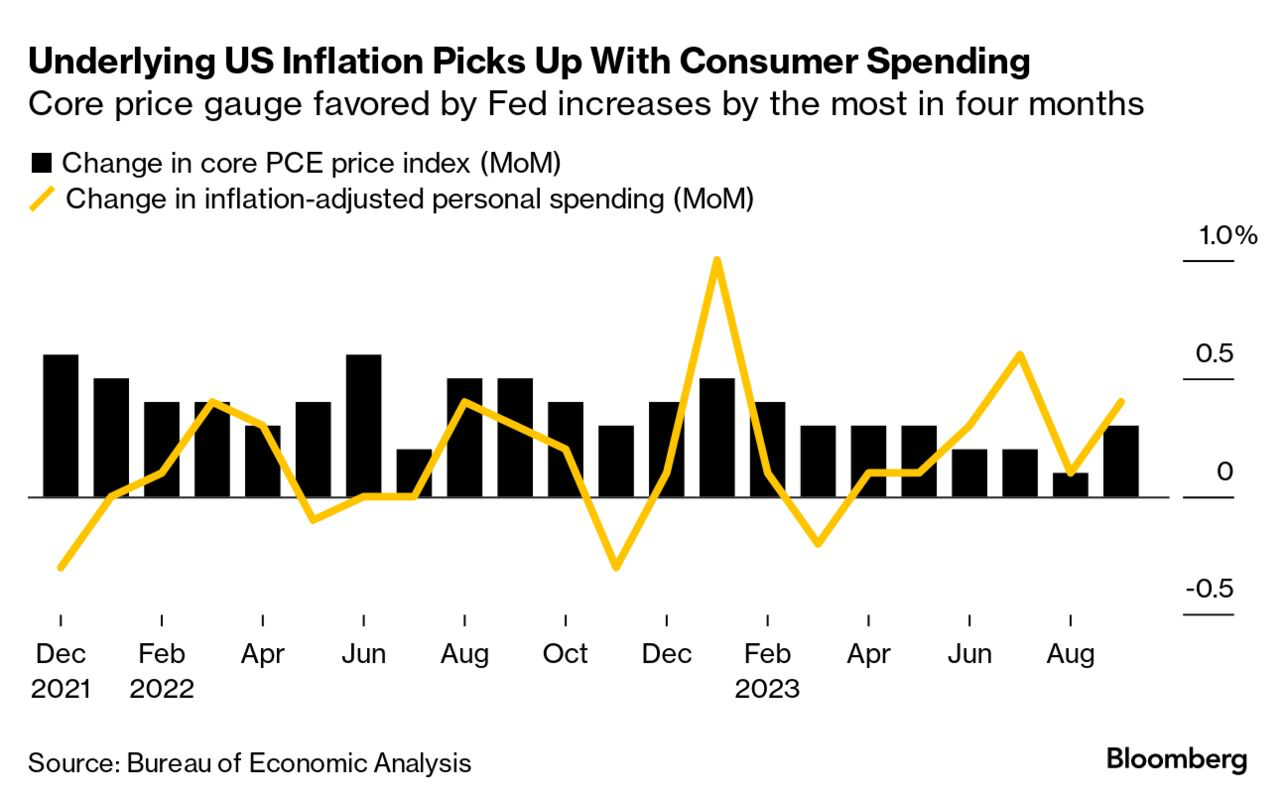
Well, Wednesday, April 12th marked another release of a CPI data point. As predicted, headline inflation as measured by the CPI showed a reduction in the annual rate that was slightly better than forecast. As a result, both equity and fixed-income markets rallied rather dramatically at the open. If the headline was all you read, your response to the news would have been understandable, but if you took the time to dig a little deeper, it wouldn’t have taken long to read that the “core” inflation reading had actually risen to 5.6%. I’m not sure that I could do the “new math” being taught to fourth graders, but I do appreciate the fact that 5.6% is well above the Fed’s 2% target inflation rate.

You see, the US Federal Reserve continues to promote the idea that they are focused (singularly) on creating price stability. Furthermore, they have announced that they will NOT pause the increases in the Fed Fund’s Rate (FFR) until it is clear that inflation is on a meaningful path to that 2% level. So far, that evidence hasn’t presented itself. How long that takes is anyone’s guess?

I recently attended the TexPERS conference in Austin. I had the pleasure of listening to Richard Bernstein, CEO/CIO, of Richard Bernstein Advisors, discuss the current economic environment. I think that Richard does a great job getting behind the numbers. The chart below was shown during his session. It is published by the Federal Reserve Bank of Atlanta. I found the information to be both dramatic and compelling. Again, if you are only focused on the headline CPI then this data is likely new to you. Most meaningful to me is the fact that 6 of 9 important inflation indicators are now higher than they were one year ago just before or concurrent with the FOMC’s first increase in the FFR. As you know, there have been an additional 8 increases bringing to 4.75%-5.0% the current level for the FFR.

Despite these facts, there was a euphoric response to the announcement of today’s CPI. Do market participants really think that they know more than the Fed? Do they think that the US Federal Reserve is kidding when they say that they don’t see an easing in rates this year? Have the last forty years of easy money and Fed support anytime there was a wobble in the markets really clouded judgment today? Fortunately, I am not in the game of forecasting interest rates. Our focus at Ryan ALM is taking the guessing risk out of investing by carefully matching asset cash flows through investment-grade bonds with a pension’s liability cash flows. Not having to guess how markets react is so comforting. Being able to tell your plan participants that their benefits are SECURE is equally, if not more, comforting. I highly recommend adopting a Cash Flow Matching strategy that gets you out of the game of guessing not only actions that are outside of your control but the market’s reaction to those events, which aren’t always logical.

The Ryan ALM Pension Monitor for Q1’23

By: Russ Kamp, Managing Director, Ryan ALM, Inc.

We are pleased to provide you with the Ryan ALM, Inc Pension Monitor for the first quarter of 2023. As you will note, Q1’23 witnessed positive market performance for nearly all asset classes, which was a significant departure from last year’s challenging environment. That said, declining US interest rates, especially following the banking crisis that saw several banks fail and Credit Suisse acquired, produced strong liability growth under FASB accounting rules. Liability growth was 7.2% for corporates, while public and multiemployer plans using GASB accounting saw liability growth of only 1.8% based on an annual ROA of 7.5%. As you may recall, the Federal Reserve’s action to raise rates beginning in March 2022, led to significant declines in pension liabilities for Corporate America in 2022. While it is unlikely that we will see a dramatic increase in US interest rates in 2023, the Fed has indicated that it doesn’t intend to begin easing monetary policy in 2023.

The history of Ryan ALM Pension Monitors and many other research items can be found at Ryan ALM, Inc. We hope that our insights provide a useful perspective related to asset/liability management.

ARPA Update as of April 7, 2023

By: Russ Kamp, Managing Director, Ryan ALM, Inc.

It is about to get wild! The PBGC’s e-filing portal is now open and four non-priority plans have submitted applications. The PBGC has stated that they will allow enough applications to be filed that allows for an orderly review and a decision within the legislation’s mandated 120-day window. The four funds that filed applications are the IUE-CWA Pension Plan, Laborers’ International Union of North America Local Union No. 1822 Pension Fund, Teamsters Local 11 Pension Plan, and The Newspaper Guild International Pension Plan. In total, they are seeking $370 million for the roughly 21,000 plan participants. Again, the PBGC has 120 days to take action on these applications.

In other news, the PBGC announced that four pension funds received approval, effective March 31st, for the supplemental applications. These plans include the New York State Teamsters Conference Pension and Retirement Fund, Teamsters Local Union No. 52 Pension Fund, the Cement Masons Local 783 Pension Plan, and the Cement Masons Local Union #681 Pension Plan. Collectively, they were awarded $450 million for just under 35,000 plan participants. The majority of this allocation was awarded to the New York State Teamsters Conference Pension and Retirement Fund, which will receive $438 million for its 33,643 members. Congrats to all of the grant recipients.

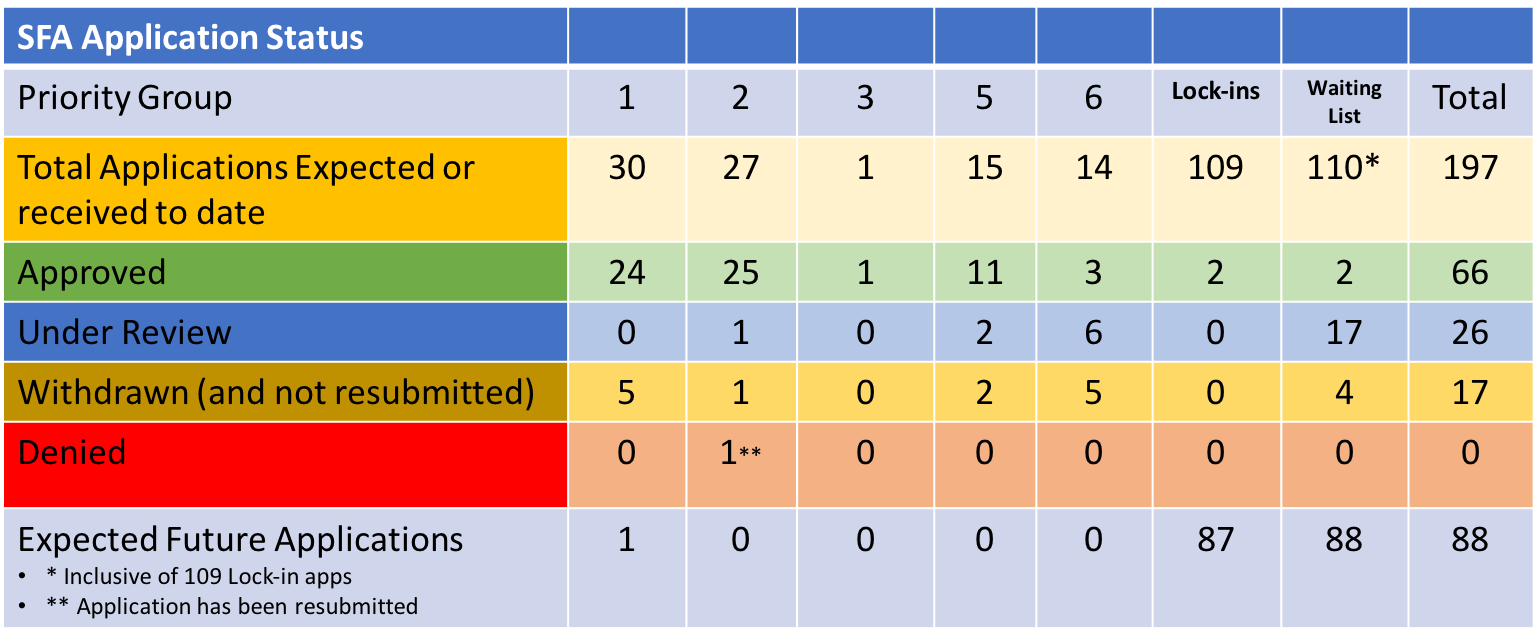
There were no applications denied or withdrawn during the prior week. However, there was some activity regarding the SFA lock-ins and waiting lists. The Pension Plan for Bricklayers and Stonemasons Union No. 2 of Norfolk, VA has locked in its valuation date for 1/31/23. They are the only fund of the more than 100 plans that have locked in a valuation date of January 31, 2023. There were no additional plans that were added to the waitlist, which remains at 104.

As a reminder, the numbers displayed above represent the initial or revised applications and do not include supplemental filings. As of today (04/10/23), the number of plans receiving SFA grants from the PBGC remains at 41. There is clearly a lot yet to be done given that 191 plans have been or will be filed, and there may be more than those.

Plummeting Rates – an Inflation Fight Challenger?

By: Russ Kamp, Managing Director, Ryan ALM, Inc.

Federal Reserve Bank of St. Louis President James Bullard spoke today at the Arkansas Bankers Association. Before I knew that this was happening, I produced the following graph:

I’ve been wondering how the massive shift down in the Treasury Yield Curve would impact the Fed’s action in its battle to control stubborn inflation. As you can see, despite massive “tightening” since March 17, 2022, long rates haven’t budged much. They had peaked at higher levels prior to Silicon Valley’s implosion and fear of a greater banking crisis drove market participants to seek a flight to safety. Incidentally, Bullard addressed this very issue in today’s talk. He stated that “financial stress can be harrowing, but one corresponding effect of note is that it tends to reduce the level of interest rates”. He continued, “Lower rates, in turn, tend to be a bullish factor for the macroeconomy”. In the four weeks since SVB’s demise, the 10-year US Treasury yield has declined by 50 bps, while the 2-year Treasury yield has declined by more than 100 bps.

Bullard also spoke about the macroprudential policy response which he described as “swift and appropriate”. For those of you like me, who might not have understood what macroprudential meant, it is “of or pertaining to systemic prudence, especially to the strengths and vulnerabilities of financial systems.” Obviously! He wanted to reassure everyone that the financial metrics of today remain low compared to levels that were observed during the GFC or during the beginning stages of Covid-19. That’s comforting!

However, he did go on to say that the US economy produced a stronger GDP in the second half of 2022 than was forecast, while 2023 looks to be relatively strong with the GDPNow forecast for the first quarter at 1.7%. Furthermore, inflation remains too high. Core PCE and the Dallas Fed’s trimmed mean inflation measures have declined, but by less than the headline measures. It appears to us that the Federal Reserve still has plenty to do to stabilize prices. The banking system may have scared many of us, but a strong labor force, decent wage growth, and falling US interest rates may just be keeping the current inflation environment stickier than the Fed wants to see.

ARPA Update as of March 31, 2023

By: Russ Kamp, Managing Director, Ryan ALM, Inc.

The portal for PBGC application review is open. According to the PBGC’s website, “the e-Filing portal is open only to plans at the top of the waiting list that have been notified by PBGC that they may submit their applications. Applications from any other plans will not be accepted at this time.” Before we discuss the waiting list and lock-in applications, there is still some activity related to the initial 6 Priority Groups. That said, there were no applications approved or rejected or SFA funds paid, but there was one plan, the Southwest Ohio Regional Council of Carpenters Pension Plan, a Priority Group 2 plan (MPRA Suspension) that pulled its initial application that had been filed with the PBGC on 12/22/22. That application was seeking $240.6 million in SFA for its 5,399 plan participants. As we’ve discussed recently, Priority Group candidates do not get to jump to the head of the waitlist line at this point.

With regard to the waitlist, four additional plans have requested to be added to the waitlist, while 74 plans have lock-in the valuation date joining 25 other plans that had previously lock-in the valuation date of December 31, 2022. I clearly don’t know the reasons why each and every plan is locking in a valuation date of December 31, 2022, but some of the plans must be thinking that US interest rates will be rising which reduces the potential SFA payment.

The PBGC is/has notified a subset of the waitlist candidates to have them file the SFA application. They have 7 days to get those applications into the PBGC or they forfeit their current place on the list. We should have some knowledge of how many of these plans have been given instructions to submit. Much more to come.

Corporate Bonds and the Impact of Refinancing

By: Russ Kamp, Managing Director, Ryan ALM, Inc.

The recent banking crisis was driven in large part by the rapid rise in US interest rates that created losses for SVB’s investment portfolio (Treasury holdings) and other banks and drove depositors to seek higher yields available on short-term Treasuries (disintermediation). Fortunately, the intensity of the crisis has been moderated by the FDIC increase in insured deposits and the Fed Bank Term Funding Program, but are banks and the US markets in the clear? My crystal ball is no better than anyone else’s, but my guess is that the relative calm experienced in the last week or so may be premature.

The Federal Reserve has indicated that its objective has not been completed. As a result, US rates, or at least the Federal Funds Rate, will continue to rise as the Fed tries to tamp inflation toward the 2% level. Today’s release of the PCE inflation (the Fed’s preferred measure) indicator highlights the fact that the Fed still has some work to do, as the 0.3% reading and 4.6% YOY result are still well above the 2% annual objective.

As if concerns related to the Treasury market aren’t enough, US Corporate bonds, which were issued at record levels during the pandemic are on the cusp of being refinanced at record levels too. The issue, historically low-interest rates have been replaced by much higher rates as the Fed tightens. The impact on Corporate America’s profitability may be meaningful. Here are some facts:

Bond issuance in 2020 stood at a record $2.275 trillion – up 60.4% over 2019.

80.1% of the issuance was investment grade.

As of 2021, the outstanding debt of nonfinancial corporations in the US was $17.7 trillion.

American companies owe > $10.5 trillion just in bonds relative to $8.8 trillion prior to the pandemic.

88% of bonds issued in 2020 are callable – it was 40% of issuance in 2005

Debt to EBITDA ratios have risen from 2.2 to 2.5.

The total nonfinancial debt to mature could reach $968.5 billion by 2025, compared to $570 billion in 2022.

Therein lies the problem. Will corporate America be able to successfully refinance the mounds of debt accumulated during the pandemic when US interest rates were at historically low levels or will the need to issue more debt as substantially higher rates impact a company’s R&D, dividend policy, earnings, employees, etc?

As Cash Flow Matching (CFM) specialists, Ryan ALM has chosen to invest almost exclusively in US corporate bonds, as they provide a premium yield that further reduces the costs associated with defeasing pension liabilities through asset cash flows. It is incumbent on us to make sure that none of our portfolio holdings default, as a situation such as that could substantially impact the portfolio’s ability to produce the necessary cash when needed. I am extremely pleased to report that Ryan ALM has never experienced a default in its nearly 19-year history. Our proprietary Approved List system has numerous quantitative and qualitative filters in our research process that have helped us avoid any potential disaster.

ARPA Update as of March 24, 2023

By: Russ Kamp, Managing Director, Ryan ALM, Inc.

We are pleased to provide you with our weekly update on the PBGC’s activity as it relates to the processing of applications for Special Financial Assistance (SFA) under the ARPA legislation. As we discussed in last week’s update, this legislative effort has moved onto a new phase. That isn’t to say that the original Priority Groups (1-6) aren’t still occupying the PBGC’s time -they certainly are! To that point, there remain 36 initial or revised applications for SFA waiting to be approved. These 36 applications will all have to be reviewed and decisions rendered within the next 3 1/2 months (by July 8th). In addition, there are 100 multiemployer plans that currently sit on a waitlist to have their applications submitted and reviewed. They will have 7 days to file once they are notified that the application portal is open.

Last week we mentioned that there were 15 plans that had indicated that they wanted to “lock in” a valuation date once their application window was opened. We need to add 9 more to that list. Each of these new lock-in candidates chose 12/31/22 as the valuation date for determining eligibility and potential grants. There were no new names added to the waitlist which is somewhat surprising as early indications were that 218 plans might qualify for SFA that weren’t part of the initial Priority Groupings.

With regard to the original Priority Group filings, 4 plans received their supplemental SFA payouts. In total, these four plans received an additional $26.7 million for just under 6,700 plan participants. Pleased to report that there were no applications denied or withdrawn. Clearly, there is much more to report on and we will continue to provide weekly updates until the ARPA/PBGC process has run its course.

There’s a Disconnect

By: Russ Kamp, Managing Director, Ryan ALM, Inc.

The flight to quality that occurred as the banking system teetered drove US Treasury yields down dramatically. However, in the process, did it create a situation in which Treasuries were overbought? Given that the US Federal Reserve has indicated that US interest rates would continue to rise and that an easing in monetary policy was unlikely in 2023, where do you think that US rates, particularly on the short end, will be going?

As the graph above highlights, the US 2-year Treasury Note yield has historically moved in lockstep with the US Fed Funds Rate. That is, until recently. Today, the upper FFR bound is 5%, while the yield on the 2-year Treasury Note has fallen to 4.0% (1:46 pm). This recent shift in rates has created an incredible gap that rarely exists, especially since 1990. Are market participants right in assuming that economic conditions have deteriorated and warrant this move down in rates, or are they once again blind to the Fed’s objective of raising rates to combat inflation as they seek price stability?

My money has been on the Fed since they first elevated the FFR on St. Paddy’s day in 2022 (+25 bps). The peak in the 2-year Treasury Note’s yield touched 5.07% just prior to SVB’s collapse and the subsequent rally in Treasuries. The Note’s yield bottomed last week at 3.78% before beginning its recent climb to today’s 4.0%. What’s the next move? Will the US 2-year note’s yield once again be a proxy for the FFR or will the Fed realize the “error of their way” and surprise the market with easing that drives the FFR down? I think that you know where I stand.

Investing To Lose

By: Russ Kamp, Managing Director, Ryan ALM, Inc.

The recent banking “crisis” has once again highlighted the willingness on the part of fixed-income “investors” to buy and hold bonds that are losing value to inflation every day. It makes little sense. During my tenure in asset consulting roles (about 20 years), we always talked about US core fixed income as having a roughly 2% inflation premium return whereas cash would command about a 1% inflation premium. But, in fact, the real return premium has averaged just over 3% per year since 1960. Those days seem long gone! Why the change in the investor’s mindset and approach? Why the willingness to use one’s resources in such a fashion? The Fed certainly has been guiding the investment community that rates would rise and rise they did, as we’ve witnessed nine consecutive FOMC meetings in which rates have been increased. Furthermore, they have indicated that there will be no cut in 2023. Yet, the Treasury yield curve has collapsed relative to where rates were just two weeks ago.

As the chart above highlights, we are in an extremely rare environment when it comes to fixed-income investing. One has to go way, way back to the mid-’70s when we last witnessed a sustained period of negative real rates. I was in high school at that time, and I suspect that many of our investors today weren’t even born – ouch! As you may recall from reading market history, there seemed to be an expectation that the Fed had accomplished its objectives by the mid-’70s (sound familiar), and as a result, bond investors were willing to jump into the market with both feet anticipating that inflation would soon fall. Well, that didn’t happen as we know, and the Fed had to keep raising US interest rates. They didn’t stop for a long time, eventually elevating the Fed Funds Rate to 20%!!

We are still in an inflationary environment with both the CPI and PCED well above the Fed’s desired level of 2%. Services inflation has remained sticky. Employment has remained firm. Despite some of our large tech companies announcing significant layoffs, initial unemployment claims remain below pre-covid-19 levels. This all seems to support the idea that the Fed must raise rates higher for longer, yet as previously stated, the Treasury yield curve has dramatically adjusted.

Do we have a banking crisis that will lead to a recession that will help the Fed achieve its objectives – the market certainly thinks so – or will the liquidity crisis be contained and banks will once again resume normal activity? We, at Ryan ALM, have been stating for 18 months that we thought that inflation would be more challenging to control as it wasn’t transitory. As a result, we’ve been writing a lot about not fighting the Fed and the upward trajectory of rates. We still believe that inflation is sticky. A premature easing of financial conditions may not result in a ’70’s-early ’80s shock, but it could nonetheless create a painful environment for both bond and equity investments.

I’ve mentioned on several occasions that most investment practitioners had never witnessed high inflation, high rates, and the onerous impact of both. A nearly 40-year bull market for bonds will do that to you. The Fed has an incredibly difficult task remaining. Fighting inflation and providing necessary liquidity for the banking system seem like incompatible objectives. Which one will they choose as their Alamo?

ARPA Update as of March 17, 2023

By: Russ Kamp, Managing Director, Ryan ALM, Inc.

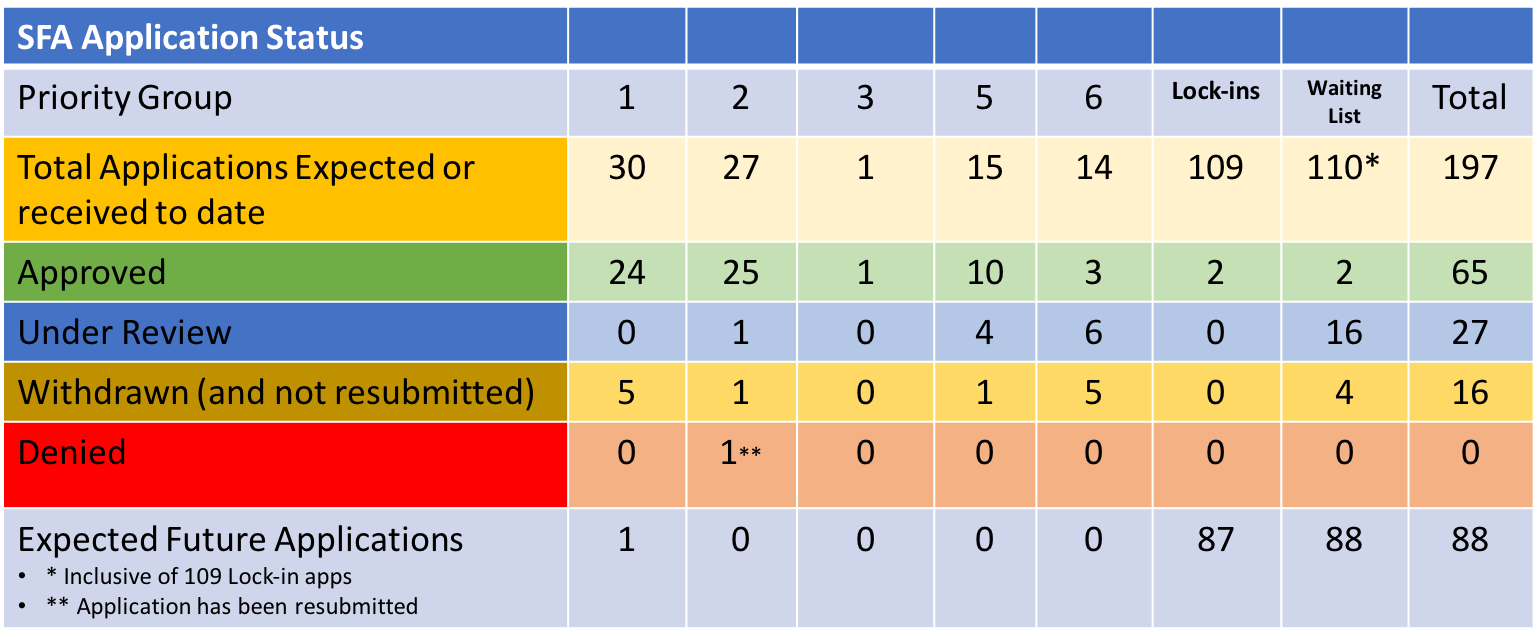
We’ve entered a new period for the ARPA/SFA process. As we mentioned previously, effective March 11, the non-Priority plans were permitted to either Lock-in an application’s details and/or place the plan’s name on the waiting list for submission once the PBGC e-filing portal is re-opened. As of last Friday, 14 plans have elected to Lock-in the valuation date (all chose December 31, 2022) and 12 of those are also on the waiting list to file an application. A plan that intends to submit a Lock-in application or intent to file a Lock-in application request isn’t automatically added to the waitlist. This action must be done by emailing the PBGC at SFA@PBGC.gov. There were 88 multiemployer plans that asked to be added to the waiting list in addition to the 12 plans that have intended to file a Lock-in application while also asking to be placed on the waiting list.

Plans that were among the Priority Groups (1-6, although there were no 4s) that haven’t filed yet are not given priority should they decide to file now. The only exception is if the application is filed as an emergency application. According to the PBGC, “Plans that are insolvent or expected to be insolvent within 1 year of an application and plans that have suspended benefits under MPRA as of March 11, 2021, retain the ability to submit emergency filings (see § 4262.10(f)).”

The PBGC “will provide updates of the intended date the e-Filing portal will be re-opened and will provide advance notice to the plans at the top of the waiting list that will be allowed to apply at that time. Once notified, a plan will have seven calendar days from the date the e-Filing portal is opened to submit a complete application. If the plan’s application is not submitted within this time, the plan’s spot on the waiting list will be forfeited and the plan will need to submit a new email request to SFA@pbgc.gov to be placed at the end of the waiting list.”

The chart above reflected the PBGC’s expectations of possible SFA applications. There may still be roughly 218 applications submitted by non-Priority Group plans, but I’ve updated the chart (see below) reflecting the actual number of plans currently on the waiting list as of March 17, 2023.

We’ll continue to provide our readers with weekly updates regarding ARPA/SFA. Importantly, plans that are at the end of the waitlist are not going to be disadvantaged. The following is from the PBGC’s Q&A on its website: “The statute and PBGC’s regulation define the amount of SFA each eligible plan may receive, but the law does not cap the overall amount of SFA that PBGC may pay.”