POBs Should Still Be On The Table for Discussion

By: Russ Kamp, Managing Director, Ryan ALM, Inc.

Pension Obligation Bonds (POBs) were all the rage in 2021 following the historic collapse in US interest rates during the initial market reaction to Covid-19. You may recall that I wrote and spoke quite often on the subject, especially in 2021 and into 2022. We published “POBs – All the Rage!” in early September 2021 and followed that up with “Why POBs? Reason #2 – Reversion to the Mean” later that same month. I was imploring plan sponsors and their advisors to take advantage of the historically low rates, but more importantly, as you’ll read in the second piece, I was concerned about the extraordinary performance results that had been generated by public equities, which I didn’t think were sustainable. As you know, 2022 produced a -18.1% return for the S&P 500, while the BB Aggregate Bond Index declined a historic -13.0%.

If plan sponsors had issued POBs to shore up the plan’s economics, they could have capitalized on an interest rate environment that we are not likely to witness again. According to S&P, there were 72 POBs issued in 2021, which significantly eclipsed the average annual issuance of 25, but given the 20,000+ defined benefit plans, the 72 didn’t register as even a rounding error. What a wasted opportunity! Well, all may not be lost. As the chart below reflects, US interest rates for maturities 5 years and out have seen little increase in the last 12 months despite very aggressive tightening by the Fed.

It is incredible to see just how little movement there has been in the longer-dated Treasury yields. Plan sponsors can still capture an impressive arbitrage opportunity by issuing POBs in this environment. Importantly, the proceeds can be invested in a cash flow matching (CFM) strategy that will secure the plan’s benefits and expenses as far into the future as the POB proceeds will permit. This CFM portfolio will invest in investment-grade corporate bonds that will currently provide a yield to worst (YTW) in the low 5% range. While the CFM portfolio’s assets are used to fund all of the benefits, the plan’s legacy assets can be invested more aggressively now that the plan has bought considerable time (extended the investing horizon). Given the market’s poor performance since the end of 2021, being able to invest at substantially lower valuation levels should be pursued with vigor.

POBs were panned by certain entities because of the uncertainty of investing the bond’s proceeds into a traditional asset allocation. We’ve removed that uncertainty by recommending that the proceeds be used to defease a plan’s liabilities. No reason to play the markets with all of the risk and uncertainty that accompanies that strategy. Please consider POBs again.

Doesn’t the Starting Point Matter?

By: Russ Kamp, Managing Director, Ryan ALM, Inc.

The US Federal Reserve didn’t disappoint anyone today, other than those who for some strange reason have been expecting the Fed to have eased by now and in some cases all the way back to last Summer. The Fed has now raised rates for 10 straight meetings bringing the Fed Fund’s Rate to 5% – 5.25%, which is up 500bps since they began elevating rates last March in an attempt to tamp down inflation.

Like you, I get tons of emails every day from one research firm after another proclaiming that this time has to be the last time of Fed hiking in this rate cycle. One firm stated just today that “in the past, cumulative hikes of more than 300bp or so have been enough to push the economy into recession.” But we’ve also never had a starting point of ZIRP (zero interest rate policy) and incredible stimulus in reaction to Covid-19 lockdowns. Doesn’t the starting point matter?

As a reminder, US interest rates bottomed in July 2020, with US Treasury Bills and Notes with maturities < 5 years posting yields below 0.3%, while the 10-year yield hit 0.55% and the 30-year had a yield of 1.2%. These were historic low rates. They were not sustainable and ultimately contributed to the inflation that we are still wading through today. But, even with the Fed’s increases, US Treasury yields are not much higher than they were 12 months ago for those with maturities of 5 years or more. In fact, the difference in yield for the 5-year Note 12 months ago versus today is ONLY 37 bps. Do you really believe that economic activity is going to be crushed with a yield differential of 37 bps? The spread for 7 years, 10 years, and 30 years today versus 12 months ago are not meaningfully different, too (32 bps, 41, bps, and 69 bps, respectively). Once again, do you really believe that these increases are crushing?

As I reported last week, the average 10-year Treasury yield for the last 70+ years has been 5.1%, a full 1.7% higher than the current environment. In order to combat inflation in the late ’70s and early ’80s, the Fed elevated the effective FFR to 22.29% or more than 4 times the current level. That was crushing!

You Gotta Love Charlie

Charlie, as in Charlie Munger, Warren Buffet’s right-hand man (last 45 years), and a 99-year-old billionaire, is not one to mince words. During the past weekend, he is quoted as saying “that the company’s success (Berkshire Hathaway) was by and large the result of low-interest rates, low equity values, ample opportunities,” suggesting that he lived during “a perfect period to be a common stock investor.” I’d add to that list investors of bonds, real estate, private equity, private debt, and any other financial instrument that was supported by a nearly 4-decade tailwind that often resembled a tornado!

Charlie also went on to say that “investment managers are nothing more than fortune tellers or astrologers who are dragging money out of their client’s accounts.” Harsh, but probably in many cases true. I’ve written on numerous occasions that the significant tailwind of falling rates and low inflation witnessed during the last 40 years has made us all appear smarter than we really were or are. This next rate cycle is going to help identify the real investors. Investors can hope all they want that the Fed will soon come to its collective senses, but in the meantime, employment remains firm and inflation sticky.

You can continue to ride the asset allocation rollercoaster to ruin or you can take substantial risk off the table by focusing on the promise that has been made to the plan participant. I know what I’d do.

ARPA Update as of April 28, 2023

By: Russ Kamp, Managing Director, Ryan ALM, Inc.

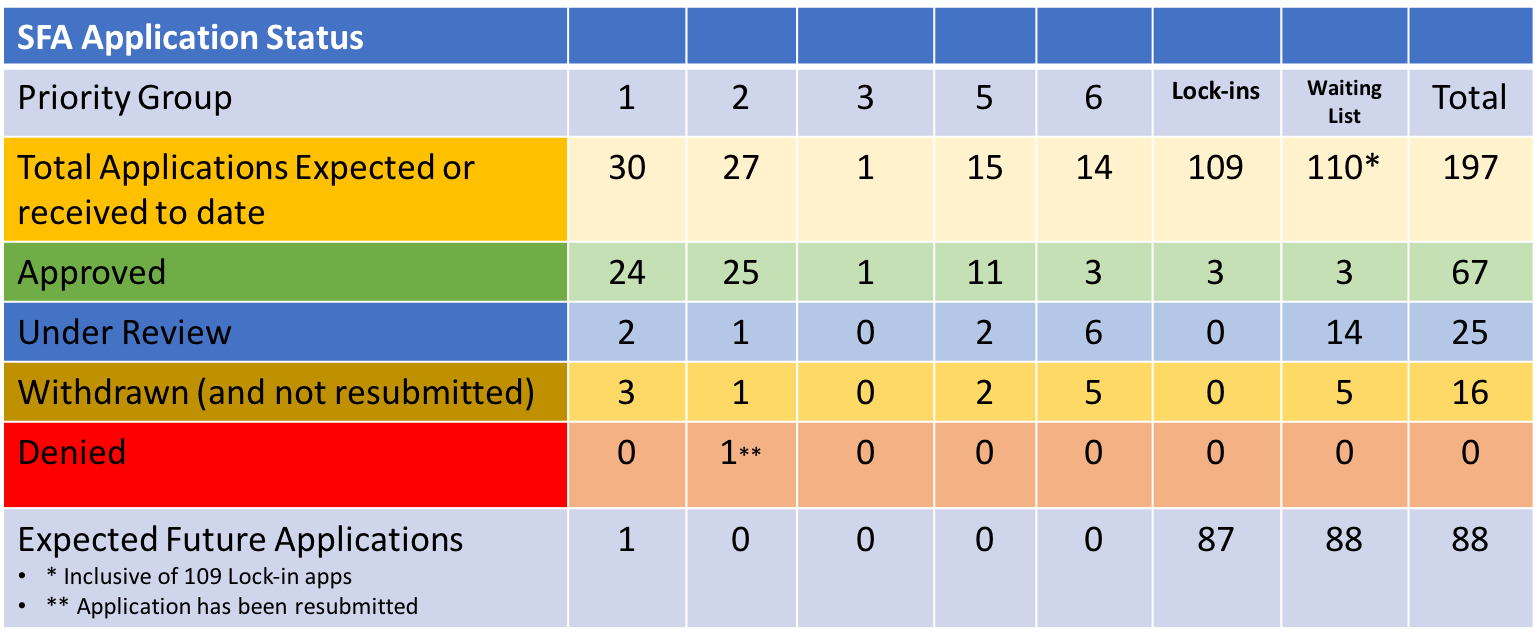
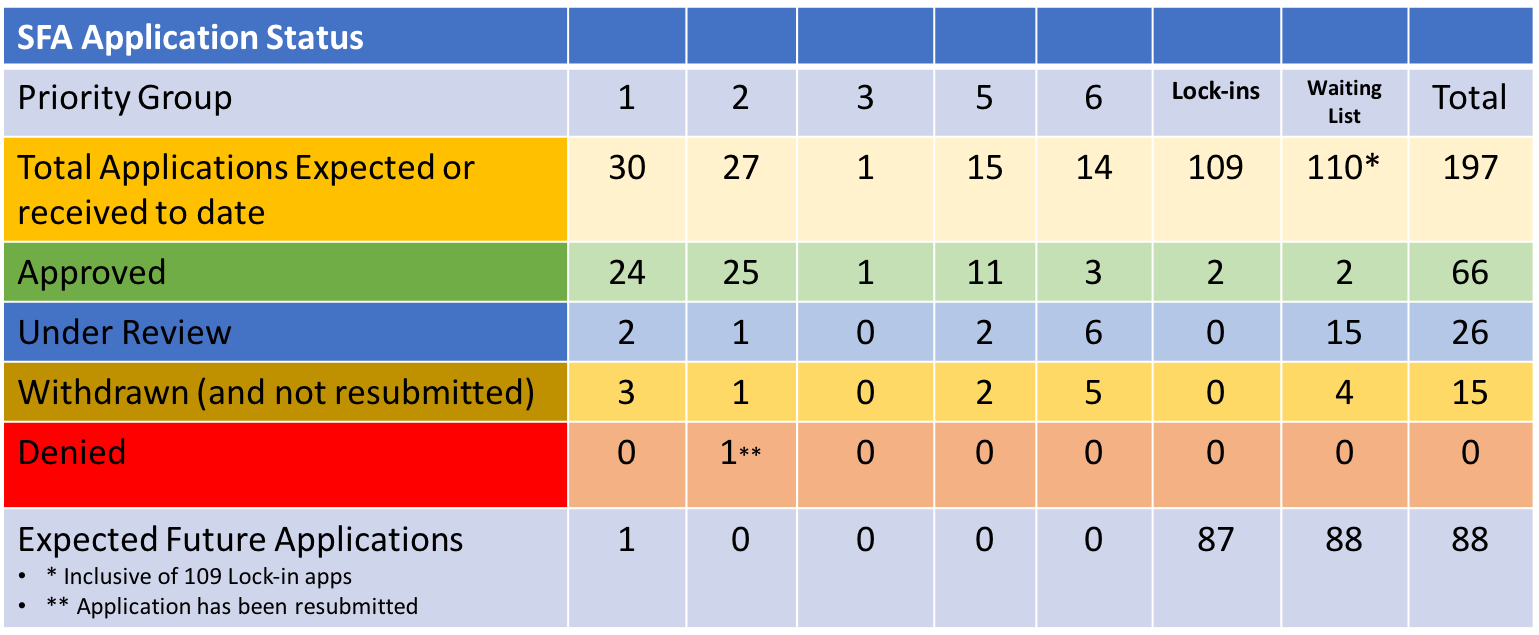
We are pleased to provide you with the weekly update on the PBGC’s progress in implementing the ARPA legislation. They’ve been diligently stewarding this process Since July 2021. There are still many more potential grants to be awarded, as reflected in the chart below.

May was brought in with a flurry of activity. It was reported that five multiemployer plans had the SFA applications approved last week. These plans, United Independent Union – Newspaper Guild of Greater Philadelphia Pension Plan, the Pension Plan of the Bakery Drivers and Salesmen Local 194 and Industry Pension Fund, the United Furniture Workers Pension Fund A, the Western States Office and Professional Employees Pension Fund, and the Building Material Drivers Local 436 Pension Plan will receive awards totaling $1.062 billion to help support the pensions of 20,846 participants. Four of the plans had their initial application approved, while the United Furniture Workers had its revised application approved. This brings the total approved applications to 46 as of last Friday, April 28th.

In addition to the 5 approved accounts, there were 3 applications withdrawn, no applications that were denied, and none of the nine approved applications received their wire transfers. There were no additions to the “waiting list”, while one of the plans on the waiting list elected to lock in its valuation date. G.C.U. Local No. 96B Pension Plan filed to have their valuation date be 1/31/23. They are the second plan to use that date, while 103 have chosen 12/31/22.

-61.1% Is Some Cost Reduction!

By: Russ Kamp, Managing Director, Ryan ALM, Inc.

Ryan ALM has just completed the production of a Custom Liability Index™  (CLI) for a pension system in which we mapped the plan’s net liabilities (benefits and expenses net of all contributions) using two discount rates (Tsy STRIPS and AA Corp). Once the CLI was completed, we were able to construct a Liability Beta Portfolio (cash flow matching (CFM) and cost optimization process). Using a conservative implementation in which we limited the investible universe to BBB+ or better, we were able to defease this plan’s entire liabilities, while producing a small surplus. In contrast, the plan’s actuary has the plan’s funded ratio at <50% in their last valuation.

The plan’s liabilities are roughly $11.034 billion going out to 2114. The net liabilities (after contributions) are $5.756 billion. Plan assets are only $2.4 billion as of 3/31/23, so how is it that a cash flow matching implementation can claim that this fund is fully invested? Simple. A present value (PV) calculation of the future value (FV) benefits and expenses reveals that we ONLY need $2.24 billion in assets to defease the $5.756 billion in liabilities. This reduction in the future cost to fund benefits amounts to a 61.1% cost savings versus a pay-as-you-go system, which is how many pension plans are managed.

Some will argue that all we are doing is highlighting the “time value of money” and that might be the case, but the day that our portfolio is constructed is the day that those “funding cost savings” are realized and booked! How much annual volatility is associated with a traditional pension asset allocation: 10%, 12%, or more? One could probably cobble together a collection of products and asset classes that might accomplish the same objective over time but that strategy comes without the cash flow certainty provided by CFM. Why subject the plan’s assets to market risk when a CFM implementation allows you and the participants to sleep well at night (SWAN strategy).

The US yield environment has changed dramatically in the last 13 months. Pension plans can now use the cash flows of principal and interest from bonds to engage in risk reduction strategies like CFM. Insurance companies and lottery systems don’t play games with the promises that they’ve made. They utilize CFM to SECURE those promises. Isn’t it about time that Pension America got off the asset allocation rollercoaster before it is too late?

Will Economic Growth Be Thwarted at These Rates?

By: Russ Kamp, Managing Director, Ryan ALM, Inc.

It is time for market participants to be real! I’m not referring to the social media app BeReal that has captured the attention of both young and old. I’m talking about the investment community that is lamenting the rise in US rates as if they are approaching historic levels. Be Real! The current yield on the US 10-year Treasury Note is ONLY 3.40% (10:57 am EST). This yield is certainly up from the historic depths experienced during the onset of Covid-19, but it is certainly nowhere near levels that would be economically crushing!

A bit of history is needed. Following the inflationary decade of the 1970s, the US Federal Reserve drove the FFR target to an unprecedented 22.36% on January 19, 1981. As a result, the 10-year Treasury reached a peak yield in excess of 15%. As I’ve mentioned previously, the yield was 14.9% on 10/13/81 which was the day I entered this industry. 14.90%!!! Now, that was economically crushing, and those higher rates led to a recession that ran through 1982.

For the nearly next four decades, US interest rates plummeted to historically low and unsustainable levels. The Fed’s “aggressive” action during the last 9 FOMC meetings has elevated the FFR all the way back to… 4.75%-5% as the target, or less than 25% of the peak yield reached in 1981. While the FFR sits at roughly 5%, the 10-year Treasury note’s yield has only moved up by 57 bps. That doesn’t seem like it would be significant enough to crush much economic activity. Yet, the hand-wringing by the investment community is incessant. It certainly appears to me that most of the market participants, who haven’t been in the industry for 40+ years or who haven’t experienced significantly higher rates are anchored on the idea that our economy can only function if real rates are around zero.

Again, a little history may be needed. The average nominal yield on the US 10-year treasury note since 1941 is 5.1% or 1.7% higher than what the 10-year is trading at today. During that roughly 70-year period of “higher” average yields, the US GDP annual growth rate was 3.1%! Higher rates and relatively strong growth. You would think that wasn’t possible given all of the whining.

US interest rates remain low relative to history. Employment remains full despite the announced layoffs. Economic activity continues to defy forecasts. Are we really going to see a Federal Reserve cave in a similar fashion to what they did in 1975? Hardly. Our economy is just fine at the present time. For plan sponsors of defined benefit plans, use this period of higher (not high) yielding bonds to improve your liquidity management while securing your promises to participants. Bonds are back and it is a wonderful thing!

ARPA Update as of April 21, 2023

By: Russ Kamp, Managing Director, Ryan ALM, Inc.

We are pleased to provide you with an update on the PBGC’s yeoman effort to implement the ARPA legislation. The process has been underway since July 2021, when the PBGC issued its interim final rules and began taking SFA applications. To date, 41 plans have received the SFA, and in some cases, supplemented awards. This represents a small subset of the plans still in the queue to receive these grants. This implementation will likely stretch well into 2024, if not beyond.

The current activity includes 5 applications from non-Priority Group members and 36 pension plans that were among the initial 6 priority groups. During the previous week, there were no applications approved or denied. No SFA grant money was wired out either. However, there was an application filed. Priority Group 5 member, UFCW Local One Pension Plan, filed a revised application seeking $764.4 million in SFA grant money for its 19,177 participants. The PBGC has until 8/16/23 to act on the application.

In addition to the activity above, Priority Group 2 member, Pension Plan for Employees of United Furniture Workers of America and Related Organizations, withdrew its application. They’d been seeking $8.8 million for its 95 members. Lastly, the Local 1814 Riggers Pension Fund became the most recent non-Priority Group member to be added to the waitlist. They have not chosen to lock in a valuation date at this time. There are currently 101 non-priority plans waiting to file SFA applications. The PBGC has indicated that they will open the e-filing portal in an orderly fashion so as not to overwhelm their ability to review and approve applications within the mandated 120-day window. There is much more to come.

ARPA Update as of April 14, 2023

By: Russ Kamp, Managing Director, Ryan ALM, Inc.

We are pleased to be able to provide you with this ARPA update through April 14, 2023. I am able to provide these summaries of the week’s activity for you thanks to the PBGC which continues to provide its weekly update. As we’ve recently reported, the general level of activity has slowed. To that point, there were no new applications accepted by the PBGC in the latest week. In addition, there were no applications for SFA (initial or supplemental) that were approved, denied, or paid out.

There was, however, one pension fund, the International Association of Bridge, Structural, Ornamental & Reinforcing Ironworkers L.U. No. 79 Pension Fund, which was placed on the waiting list. There are 105 non-priority plans (Groups 1-6) that made it to the waiting list. Of those 105, five applications are currently being reviewed by the PBGC. They’ve indicated that they will open the e-filing portal at a pace that allows for an orderly review to be completed on each application within the legislation’s 120-day window.

It will be interesting to see if the pace of activity can be increased given that more than 140 applications are left to review before other pension funds are possibly added to the waitlist. Remember, it was estimated by the PBGC that as many as 218 non-priority plans could potentially file. We’ve seen fewer than half of those get placed on the waiting list at this time. Lastly, of all the plans that have locked in a valuation date, there remains only one with a January 31, 2023 date. All of the others have chosen 12/31/22.

The Gap Is Narrowing

By: Russ Kamp, Managing Director, Ryan ALM, Inc.

US Treasury Yields mostly peaked during the fourth quarter of 2022. However, they did stage a brief rally in February, but in no case did they reach the peak yield established during this recent interest rate regime change. Following the collapse of SVB and Signature Bank and the take-over of CS by UBS, US Treasury yields plummeted, as the fear of a broad-based banking crisis drove investors to the safety of US Treasuries. Fortunately, the feared banking contagion didn’t materialize and as a result, Treasury yields are once again reflecting the economic environment. Rates have been rising modestly during the last couple of weeks.

As my chart above highlights, Treasury yields are still below the peak yields of last year, but they are closing the gap as uncertainty persists as to the interest rate path that the FOMC will take in May and beyond. Has inflation been contained? Do we have enough weakness in the US labor force to no longer be concerned about wage growth/pressures? The manufacturing sector activity seems to be collapsing. What about the US service sector since it is by far the largest contributor to US GDP growth?

Despite those many questions, members of the Fed still seem to feel that inflation is too high. In recent days, Federal Reserve Governor Christopher Waller commented that he favored more monetary tightening. “Because financial conditions have not significantly tightened, the labor market continues to be strong and quite tight, and inflation is far above target, so monetary policy needs to be tightened further,” Waller said Friday in a speech in San Antonio, Texas.

We, at Ryan ALM, Inc. have felt that US investors were too focused on the Fed easing, and as a result, artificially drove Treasury yields to unsustainably low levels. The Fed has been very consistent in its communications. Waller is no different, as he “would welcome signs of moderating demand, but until they appear and I see inflation moving meaningfully and persistently down toward our 2% target, I believe there is still work to do.” No ambiguity there!

Bond investors have been willing to hold US Treasuries with yields at significant negative real rates. That isn’t a good long-term strategy. Rates are likely to continue rising. At the very least, it doesn’t appear that the Fed has any appetite to begin easing. Will rates achieve a level across the curve that exceeds the previous peak in this interest rate cycle? In MHO, I think that they will. That result would not be good for total-return-focused fixed-income products, but higher rates and more interest income are great for Cash Flow Matching (CFM) strategies.

Ryan ALM, Inc. 1Q’23 Newsletter

By: Russ Kamp, Managing Director, Ryan ALM, Inc.

We are pleased to share with you the Ryan ALM, Inc. 1Q’23 Newsletter. We hope that you find our insights useful.

As you will see, first quarter asset performance was certainly a big improvement following 2022’s struggles. However, asset growth didn’t exceed liability growth during the quarter if you valued plan liabilities using FASB accounting, as the fall in US interest rates propelled liability growth. Plans operating under GASB that use the return on asset (ROA) assumption witnessed assets exceeding liabilities.

The newsletter also contains a number of research articles and blog posts that were produced during the first quarter. The article that was written by Ron Ryan discussing ASOP 4’s new guidance on valuing pension liabilities using more market-based discount rates is particularly timely given that these changes are in effect for actuarial valuations after February 2023.

As always, we welcome your feedback and questions. Please don’t hesitate to reach out to us. Have a wonderful day.

Not Much of a Brain Teaser

By: Russ Kamp, Managing Director, Ryan ALM, Inc.

Given this opportunity, what would you do? You can continue to strive to achieve a 7% annual return through a traditional asset allocation strategy that is accompanied by significant annual volatility of >10% or you could match a portion of the plan’s liabilities through a Cash Flow Matching (CFM) strategy that carefully matches asset cash flows to liability cash flows effectively ensuring that assets and liabilities move in lock-step with one another. Need more input?

The recent rise in US interest rates is providing Plan Sponsors of defined benefit pension plans with a unique opportunity that hasn’t occurred in decades. Working with their advisors, Plan Sponsors can now SECURE near-term benefits and expenses (meeting all of the liquidity needs) as far into the future as the allocation to a Cash Flow Matching (CFM) strategy will take them. In doing so, a pension fund may generate through an investment-grade corporate bond portfolio a YTM of roughly 5.5% to 6%.

We haven’t seen yields like this from IG corporate bonds since the early ’00s. Why is this an attractive option when the plan may be striving for 7%? First, the “return” as measured by the YTM is locked in on the day that the portfolio is built, since this is a mostly buy-and-hold endeavor. By defeasing pension liabilities through the cash flows of principal and interest from the bonds, the YTM becomes the portfolio’s expected return (barring a default). Furthermore, a carefully matched portfolio will insulate the bonds from interest rate risk as benefits owed are future values, which are not interest rate sensitive. That is a critical attribute given the great uncertainty surrounding Fed policy and the future direction of rates.

In addition, creating a liquidity bucket allows the alpha or growth assets not invested in the CFM portfolio an opportunity to grow unencumbered since they are no longer a source of liquidity. We know from previous studies (Guinness Asset Management) that sweeping cash dividends from equity accounts can dramatically reduce long-term returns, as dividends and dividends reinvested represent nearly 50% of the return of the S&P 500 over rolling 10-year periods dating back to 1940. It is even more beneficial for 20-year periods (57%). Do you still need more info? You are a tough one to convince!

The strategy that I’m highlighting is how most insurance companies and lottery systems are managed. Those entities know what that future promise looks like (as do pension plans). They take a present value (PV) calculation of what it would take to fund that future value (FV) commitment and they invest that sum of money in investment-grade corporate bonds through an optimization strategy – not a laddered bond portfolio. We refer to this implementation as a SWAN strategy (Sleep Well At Night). Wouldn’t it be great to announce to your plan participants that no matter what transpires in the markets the promised benefits have been secured?

So, I ask again, wouldn’t it be the prudent exercise to invest a portion of your plan’s assets into a liquidity bucket that secures the promised benefits at a reasonable cost and with prudent risk as opposed to hoping that the aggregate exposure to a variety of asset classes and products can produce a return close to the 7% return target on an annual basis? I’m not a gambler, so maybe it is just me, but I know what I would do if I was put in the position to manage a pension plan that is responsible for a group of participants planning on a dignified retirement.