The Fed’s Job Has Gotten More Challenging!

By: Russ Kamp, Managing Director, Ryan ALM, Inc.

Early last week, shortly after Fed Chairman Powell delivered his testimony to Congress, US Treasury yields moved skyward. There seemed to finally be a realization that US inflation, while down from its peak, was still stubbornly high and sticky. As a result, interest rates moved as one would expect, with the 2-year Treasury Note reaching a yield of 5.31%. Thus reaching its highest level since November 2000. What has transpired since last Wednesday (3/8) is nearly unparalleled.

The Bloomberg chart above reflects a massive shift in sentiment that is directly related to what transpired with Silicon Valley Bank and Signature Bank, and heightened fear that other regional banks would crumble as a result of the Fed’s massive interest rate push and the impact that effort has on a bank’s investments. As a result, Treasury yields have plummeted, with the 2-year yield being repriced by 118 basis points in 5 trading days. Monday’s 61 basis points decline was the most significant move since 1982 when the US interest rate environment was recovering from double-digit highs.

Does this significant repricing of US Treasury rates make the US Federal Reserve’s effort to control inflation more challenging? We, at Ryan ALM, Inc., believe that it does. The Fed’s objective in raising the Fed Fund’s Rate is to thwart economic activity by reducing demand for goods and services. Recent economic activity suggests that demand for goods has waned considerably as supply imbalances have been eradicated. However, service-related inflation remains sticky and elevated. Financial conditions certainly seem to have gotten easier with these lower rates. February’s housing activity suggests that economic activity isn’t collapsing, and these lower Treasury yields may inspire potential buyers of existing and new homes to get off the sidelines.

Most market participants believe that the Fed will focus its attention on the current banking crisis and as such, reduce the next FFR increase from 50 bps to 25 bps, with a large percentage now believing that the Fed will pause increasing rates. If so, inflation is not likely to continue its recent path lower, as we still have a robust labor market with decent wage growth and heightened demand for services. When was the last time that you were on a plane and had an open middle seat in your row?

Disintermediation? (The Flight to Yields)

By: Ronald J. Ryan, CFA, CEO, Ryan ALM, Inc.

The recent run-on-banks has several villains or reasons why this happened. Yes, there is a flight to big banks and quality. But the word that I do not hear is DISINTERMEDIATION. This is when clients decide they can get a higher yield on deposits considered safe by moving their deposits from banks to Treasuries… mainly, T-Bills. Given the inverse yield curve, depositors can port their funds from bank savings accounts to a Treasury investment and increase yield by hundreds of basis points with no cost from Treasury Direct. Such a transaction can be done quickly over a laptop or even a phone.

In the late 1970s and early 1980s, disintermediation was a significant trend given double-digit Treasury rates and an inverse yield curve. Disintermediation was a major cause of bank and S&L failures after 1980 as 1,617 commercial and savings banks failed. Many regulations followed including Dodd–Frank (enacted in July 2010).

What a Ride!

By: Russ Kamp, Managing Director, Ryan ALM, Inc.

The volatility witnessed in the capital markets during the last week or so has been incredible. As it relates to US fixed income, the interest rate moves have been nearly unprecedented. As you may recall, Fed Chairman Powell’s Congressional testimony sent US Treasury yields skyward on Monday and Tuesday, as it became more apparent that the Fed’s inflation fight would continue for longer. The trend to higher yields came to a screeching halt later in the week with the realization that Silicon Valley Bank (SVB) was quickly falling into insolvency only to be closed within about 24 hours of the first signs of weakness. This unanticipated situation was closely followed by the closure of Signature Bank on Sunday. What would come next?

Well, Monday did follow Sunday, as usual, but the interest rate environment and Treasury securities, particularly on the short end of the curve, produced a rally that has been eclipsed only a handful of times in our history. The yield on the 2-year Treasury note fell 61 bps on Monday (greatest move since 1982) eclipsing the move set following the stock market collapse of 1987 when yields fell 59 bps. The yield on this note peaked just last Wednesday at 5.07% and then plummeted to 3.985% by yesterday morning. Incredible!

Those moves of course coincided with the uncertainty surrounding our banking industry, particularly the regional banks. The action taken by the government to ensure that depositors would be taken care of has eased fears of a greater contagion, but what has really changed? The CPI data released this morning revealed a CPI for February that met consensus at 0.4% and 6% annually. However, core inflation came in above expectations at 0.5% and now sits at 5.5% for the last 12 months. Core inflation tends to be stickier, making the Fed’s job more challenging as we move forward.

There is a relief rally underway in the US equity markets today, with the major indices all up big (S&P 500 +2.02% at 11:50am), but is it warranted? The Fed is still focused on bringing inflation down to a 2% threshold. There seems to have been a significant shift in expectations from earlier last week when a majority of industry experts anticipated that the Fed would now elevate the Fed Funds Rate by 0.5% instead of a 0.25% increase which took place in early February. In a matter of days, and as a result of the banking “crisis”, expectations have shifted rather dramatically with most investors anticipating only a 25 bps increase and a number of market forecasters believing that no increase in the FFR is possible. I don’t see that happening given today’s economic news.

Well, I guess if you are a participant in our industry for less than 40 years, you’ve almost always seen the Federal Reserve step in at the first sign of trouble to ease concerns and stabilize the situation. Does that action help or hurt at this time? The dramatic fall in yields across the Treasury yield curve doesn’t help the Fed’s job. Yields are rising today, with the 2-year note currently trading with a yield of 4.36%, but that is still dramatically lower than where we were just 5 trading days ago. There once was a time when bond investors demanded a real return. Given the annual CPI at 6% and applying a normal 2-3% premium above inflation, it would seem to me that investors wouldn’t be accepting a 30-year YTM of 3.76%, but one more like 8%-9%.

A major reason given for SVB’s demise was disintermediation due to the rapid increase in US interest rates and the mismatch that existed between the bank’s holdings of longer-dated Treasuries and short-term rates. Well, if the Fed remains focused on price stability as its primary objective, rates need to continue to be elevated in order to tamp down economic activity and demand for goods and services. Won’t this scenario continue to put pressure on the US banking system? Pension plans should be concerned about this possible outcome as it will not be supportive of their asset bases. On the other hand, the present value of those benefits payments will look a lot more reasonable. Take advantage of higher US interest rates and reduce risk by defeasing your plan’s liabilities with bond cash flows of principal and interest. You’ll sleep a lot better than most industry participants did this past weekend!

ARPA Update as of March 10, 2023

By: Russ Kamp, Managing Director, Ryan ALM, Inc.

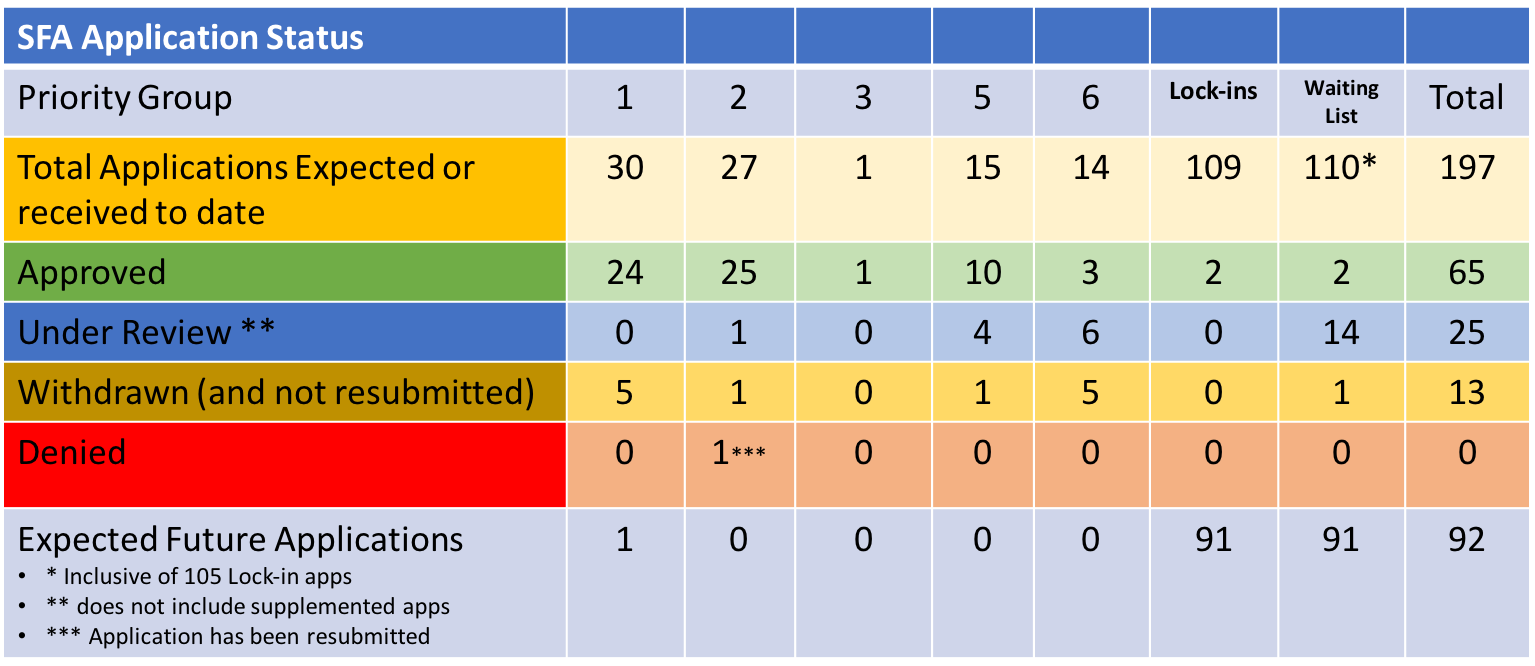
Despite the fact that most investors are either focused on the demise of Silicon Valley Bank (SIVB) or on filling out their NCAA tournament bracket, life goes on in the multiemployer world. In fact, last week was very busy as 9 applications for SFA funding were received by the PBGC. Of those applications submitted, one was a Priority Group 1 (PG) member, 2 were PG 2, 2 were PG 5, and 4 were PG 6. In all cases, but one, the applications for either the initial submission or a revised version. Only one of those applications was seeking supplemental funds.

Collectively, these plans are seeking >$3.9 billion in SFA for support of their nearly 339,000 participants. That equates to roughly $115,000 per participant. The Automotive Industries Pension Plan and the Southern California United Food and Commercial Workers Union and Food Employers Joint Pension Plan are each seeking more than $1 billion in SFA support. There were no applications approved or denied during the last week. There was one application withdrawn, but Local 210’s Pension Plan submitted a revised application within the same week.

As a reminder, effective March 11, 2023, more than 200 pension plans that were not placed in a priority grouping, but may still be eligible for SFA proceeds, were permitted to file. It will be quite interesting to see the pace of these submissions as we move through the upcoming weeks.

Bonds Are Beautiful!

By: Russ Kamp, Managing Director, Ryan ALM, Inc.

The US interest rate environment might be creating challenges for the investing community, but it is providing wonderful opportunities for pension plan sponsors who want to SECURE the promised benefits with little risk. Yes, that scenario is very possible. Why get caught up in all the market’s gyrations? Why sit on the edge of your desk chair trying to decipher every word of Fed Governor Powell’s utterances to Congress? We, at Ryan ALM, can remove so much uncertainty from managing a pension plan because bonds are once again beautiful!

Yesterday, we constructed a new portfolio for a prospective client that had a YTM of 6.03%! This analysis was for a 30-year cash flow-matching (CFM) portfolio that generated a YTM >6%. It wasn’t too long ago that the US 10-year Treasury note had a yield of < 0.6%! For pension plans, whether they be private, public, or union, striving to achieve a ROA of 6.75%-7.0%, we are able to get you most of the way to that objective through an optimization process that carefully matches asset cash flows with liability cash flows. Importantly, when you defease pension liabilities with bond cash flows you are eliminating interest rate risk for that portion of the portfolio since you are defeasing future values (FV) which are not interest rate sensitive.

Concerned about the Fed’s future action? Cash flow match today and sleep like a baby tonight! If you aren’t familiar with cash flow matching, it is a tried and true fixed-income strategy that has been used for decades in lottery systems and insurance companies. It was also used widely by pension plans around the globe until interest rates began to fall more than 4 decades ago. Please ask your consultant or reach out to us to provide you with the benefits of CFM. They are numerous and the current interest rate environment is wonderful, and it may get even better as Powell and his fellow FOMC board members ratchet rates higher!

ARPA Legislative Alert

By: Russ Kamp, Managing Director, Ryan ALM, Inc.

The PBGC has just announced the following: On Friday, March 10, 2023, the priority group application period (Groups 1-6) as specified in the SFA regulation will end, and on Saturday, March 11, 2023, the application period for all SFA-eligible plans (both priority group and non-priority group plans) will begin. As we’ve been reporting, the collection of non-priority group plans dwarfs the Priority Group plans in number (218 vs. 87), if not in potentially requested SFA.

Since December 21, 2021, when Local 138 Pension Trust Fund became the first plan to receive PBGC approval for Special Financial Assistance, the PBGC has approved 41 initial/revised applications and 28 supplemental applications. These approvals amounted to a distribution of $45.8 billion in ARPA grants covering the pensions of 686,540 American workers! There are still a number of Priority Group applications to be approved by the PBGC in addition to the more than 200 potential new applications. It is going to get quite busy at the PBGC, as if it hasn’t already been the case.

ARPA Update as of March 3, 2023

By: Russ Kamp, Managing Director, Ryan ALM, Inc.

We are pleased to provide our weekly update on the implementation of the ARPA legislation. The week ending March 3rd had plenty of activity, as there were 6 applications filed, including a supplemental application by Bricklayers and Allied Craftsmen Local 7 Pension Plan seeking an additional $9 million for its 397 participants. The Bindery Industry Employers GCC/IBT Pension Plan, a Priority Group 1 plan, finally joined the party. Not sure what the wait was all about, but this entity has 686 members that were probably wondering if they’d ever see this day, given that Priority Group 1 plans were first eligible to file on July 9, 2021. This pension system is seeking nearly $19 million in Special Financial Assistance. The remaining four plans are each a Priority 6 member. In total, these four plans are requesting $6.8 billion for their 270,000+ participants.

Fortunately, there were no applications denied, but there also weren’t any that were approved either. The PBGC is currently reviewing 26 applications. With the filing of the Priority Group 1 application, the PBGC is only expecting another two plans from that category to potentially file. There was one application withdrawn last week. The Pension Plan of the Moving Picture Machine Operators Union Local 306 withdrew its initial application. This Priority Group 5 plan is seeking $22.5 million in SFA for its 542 participants.

The ARPA program is an incredible lifeline for these once-struggling pension systems. As we’ve articulated on many occasions, this grant is a gift that is likely a once-in-a-generation award. The proceeds, which are a precious resource, need to be invested with great prudence, especially given all of the uncertainty in today’s markets.

What a Choice!

By: Russ Kamp, Managing Director, Ryan ALM, Inc.

The Millennial, Gen X, and Gen Z cohorts are facing a huge challenge, as it pertains to funding education, a home, and now a “retirement” account. They must make some very difficult decisions. First, do they go to college in order to potentially set themselves up with a good-paying job, but knowing that they will most likely incur significant debt in the process? A debt that most of my generation didn’t have to face – not even close. In fact, public college education today will cost you more than twice what it did during the ’70s. According to a GoBankingRates report, public education costs have rocketed from $39,780 to more than $91,000 in 2022.

The shift to the knowledge economy has simultaneously increased the necessity of a college degree while the rising costs of that degree have eroded the ROI. Classic “rock and a hard place”! Once they have that degree and hopefully find that decent-paying job they must decide if settling down is in the cards. Does settling down include buying a home? For most younger Americans, buying that first home is getting to be nearly impossible. According to a Bloomberg article, first-time homebuyers face the least affordable market on record (dating back to at least 1986). Yes, home price growth YoY has moderated, but it hasn’t fallen. Furthermore, US mortgage rates have skyrocketed. At present, a 30-year conventional mortgage will result in the buyer paying 7.16% up more than 300 basis points in the last 12 months – ouch!

Well, if you are fortunate to have a good job that affords you the opportunity to pay down your student loans and finance a huge mortgage (average home price according to the St. Louis Fed database was $535,800 as of 12/31/22), you are in rare company, as only 26% of home purchases in 2022 were by first-time homebuyers. But wait, now you have to figure out how to fund a retirement benefit because you most likely don’t work for a private sector organization that provides you with access to a defined benefit plan. That “retirement” benefit, in the form of a defined contribution (DC) offering, requires you to fund (at least 15% is necessary to do it right), manage, and then disburse the benefit hoping that what you set aside will cover your entire golden years.

Given the recent updates provided by both Fidelity and Vanguard, which I reported on earlier this week, it is safe to say that most Americans will NOT come close to enjoying a dignified retirement. They might NOT be able to live in their own home! They might NOT be able to afford college! How have we as a nation arrived at this point? What has changed so meaningfully from when I was starting off to what the next three cohorts are facing?

So, if you found yourself in this bind from the lack of affordability, what would you choose? Education, a home, and a dignified retirement shouldn’t be mutually exclusive. Yet, that is where we find ourselves today. Let’s stop blaming young people for perceived poor financial management! Most Boomers would also be getting married later and having fewer kids. This isn’t because they are irresponsible! We’ve created an environment that is crushing them! So sad!

How has 2023 Begun for TRS Bond Managers?

By: Russ Kamp, Managing Director, Ryan ALM, Inc.

We all know that 2022 was a terrible year for total return-seeking (TRS) bond managers. In fact, it was the worst year by far since the creation of the Lehman Aggregate Index more than 4+ decades ago. Rising interest rates will do that to bond managers whether your duration is shorter or longer than the index. By the end of the calendar year 2022, the Aggregate Index had declined -13.01%, far eclipsing the -2.9% produced in 1994. Furthermore, it was only the fifth negative total return recorded in the Index’s history. That is a pretty amazing achievement.

What is happening in 2023? January was a terrific month as US interest rates fell in anticipation of a Federal Reserve that was going to moderate its increases in the Fed Funds Rate (FFR). For the month, the Aggregate Index rose +3.08%. A far cry from the activity of the previous 12 months. However, the celebration didn’t last too long, as January’s fine performance was quickly replaced by a -2.59% February. The economic environment hadn’t calmed down to any great extent and the anticipation that the moderation in FFR increases would be replaced by a pause or the “Great Pivot” proved to be illusionary.

So, at this point, we have a Fed that continues to promise further increases in the FFR (5.375% is the current target with a projected terminal rate at 7.0%!) and an inflationary environment that isn’t close to falling back to the 2% target that they have established. With a historic labor market and rising wages, it doesn’t appear that inflation will be contained in the near future. This environment will continue to prove challenging for TRS managers to provide a positive return despite the much higher yields offsetting principal losses.

We once again ask the question: Why don’t you de-risk your pension system’s exposure to fixed income by migrating the core total return-seeking mandates to cash flow matching assignments? This action will SECURE the promised benefits as far into the future as the allocation will cover while mitigating interest rate risk for that portion of the portfolio. Furthermore, you have now bought time for the plan’s alpha assets to grow unencumbered, as they are no longer a source of liquidity. This eliminates the common practice of sweeping cash from all assets to fund benefits (B) + expenses (E). Let your bond allocation pay B+E.

Great uncertainty exists within the US markets – both bond and stock – as a result of the Fed’s actions. Why gamble that we are close to the end of their activity? Secure the promises through cash flow matching B+E and let yourself and your participants sleep well at night knowing that markets won’t crush their promised benefits.

It Shouldn’t be an Amusement Park Ride!

By: Russ Kamp, Managing Director, Ryan ALM, Inc.

Fidelity has recently reported that the average 401(k) balance declined by -23% in 2022. Vanguard reported that their “average” 401(k) account declined by -20%. In case you thought IRAs may have performed better – think again! The average IRA also declined by-20%! These are shocking results, especially given the fact that the S&P 500 declined by -18%, while the Bloomberg Barclays Aggregate index fell -13%. What were these plan participants investing in that they suffered considerably greater losses?

The average American Worker is saddled with incredible expenses that are being negatively impacted by the current inflationary environment. The ability to continue to contribute to a “retirement” fund is becoming more challenging. According to the Fidelity and Vanguard releases, nearly 17% of participants have taken loans and the average contribution (employee and employer) remains at about 13.5%, which is below an appropriate target of 15%. For those that have recently retired the loss of >20% of one’s corpus is devastating. For those that were close to retirement, those plans have likely been delayed.

Saving for one’s golden years and being able to fund a dignified retirement shouldn’t depend on when one retires. Yet, the sequencing of returns is a critical variable for most Americans who have little savings outside of their home equity and what gets put away in a self-directed defined contribution plan. Riding these markets up and down is no way to plan for one’s future. Why do we continue to allow Target Date Funds to be the QDIA when they assume much too much risk for the average investor?

Average 401(k) fund balances, which don’t truly reflect the financial conditions of the average American since many don’t participate in a plan, remain extremely low. Fidelity is reporting that the average 401(k) participant has a balance at year-end of just $103,900, while Vanguard’s average participant has <$113,000. Neither of these account balances will ensure a dignified retirement, especially when one thinks about the 4% rule that would provide them with between $4,155 and $4,502 per year to spend. OUCH! I believe that it would be much more meaningful to provide the median balances for each organization. I’m sure that the output would be chilling!

I’m still flabbergasted by the average returns in 2022 by plan participants of both Fidelity and Vanguard. A traditional mix of 50% in equities (S&P 500) and 50% in bonds (BB Agg) would have resulted in a -15.5% return for 2022. The fact that the average account holder in Fidelity underperformed by 7.5% is both shocking and unacceptable. The average American worker shouldn’t be expected to fund, manage, and then disburse a retirement benefit. It is poor policy to think that they possess the skills needed to effectively execute the job. We need to bring back DB plans or face a retirement crisis that could cripple our economy for generations to come.