TIme for a New Gameplan?

TIme for a New Gameplan?

As we touched upon in our January, 2013 Fireside Chat, the Private, Public and Union pension deficit in America exceeds $4 trillion, when assets and liabilities are marked to market. Since 1999, pension asset growth has significantly underperformed liability growth and the return on assets (ROA), causing increased contribution costs and a national pension crisis. The true objective of any pension plan is to fund their liabilities (benefit payments) at low and stable contribution costs –with reduced risk through time.

Do you need a new game plan? We’ll explore the asset allocation issues sponsors face and offer solutions for underfunded plans.


KCS as your plan’s liability consultant

KCS as your plan’s liability consultant

Kamp Consulting Solutions, LLC (KCS) was established in 2011 to help plan sponsors address the retirement challenges impacting the beneficiaries we are trying to protect. Action is needed today, and our highly experienced team is prepared to meet our clients’ challenges. We can assume various consulting roles for your organization, including generalist, liability-focused or project-specific. See http://www.kampconsultingsolutions.com to learn more.

The Ability to Retire is a Benefit to be Cherished!

Too many of us take for granted that we will one day be able to retire, and retire with dignity!  Unfortunately, a proper retirement is becoming a pipe dream for most of us.  If you are among the select few in the private sector that receives the benefit from or currently participates in a defined benefit plan, consider yourself to be extremely fortunate.  Corporate DB plans may soon be as rare as a NY Mets championship.  Employees in the public sector still participate at a high rate (roughly 87%), but there is growing pressure on their plans to shift the liability from municipalities / counties / states, etc. to the individual participant through defined contribution plans.  By whatever means you have, you should fight this trend!

At KCS, we have written a number of articles on the importance of DB plans to individuals, families and more broadly, our society.  These articles are available on our website at http://www.kampconsultingsolutions.com.  I would encourage you to review some of our thoughts on the subject, as your future retirement may just be on the line.

Asking an untrained individual to make retirement decisions for their own account is a formula for disaster! Yet, that is precisely what we are doing by transferring our employees into defined contribution plans.  Asking an employee making less than $40,000 / year, who has a spouse and children, to divert a portion of their compensation to fund a retirement program is a JOKE!.  Life gets in the way, and it is silly to think that individual can safely put away enough to generate even a modest retirement income.  Allowing a participant to have access to their retirement assets prematurely is a structural failure! 

It is shameful that most of us in the investment industry have done extremely well financially by picking at the DB carcass, while too many participants can’t retire. SHAMEFUL! It is time that we as an industry rally around the issue of retirement security, and begin to pose real solutions to this crisis that adequately places the risk on the shoulders of those that can handle the responsibility before we don’t have anyone retiring in this country.  Just imagine the social, economic and political implications of that development!

Is Quant Investing Dead? All Hail Quant!

Is Quant Investing Dead? All Hail Quant!

We are pleased to share with you the latest KCS Fireside Chat, titled, “Is Quant Investing Dead? All Hail Quant!”


There are thousands of investment management “firms” and a multitude of investment products with various wrappers that investors can choose.  Given that breadth of offerings, it becomes obvious that there isn’t one way to invest in the markets.  But is there an investing approach, tool or set of skills that improves one’s odds of beating the averages? YES!


There is a longer version on this paper that is available on request. 

Rotary International and The Gift of Life Foundation

I am going to use the KCS Blog today to reflect on a wonderful organization with which I have only recently (2+ years) become associated. 

When I decided to start KCS in August 2011, one of the benefits for me was the opportunity to eliminate my commute into NYC, which I had done since I was 18 (34 years in total), when I began my college career at Fordham.  What I didn’t know at the time was that I was going to be invited to join the Wyckoff / Midland Park Rotary.  As someone who would routinely leave his home at 6am or earlier to commute to work, attending Rotary meetings every Thursday morning at 7:30 am was just not in the cards. 

When I was first approached to join, I gladly accepted the invitation to check out Rotary, but I was very skeptical.  I had neither the  knowledge of what Rotary did nor who they served, and my unease was further exacerbated by my fear that I would likely be asked to wear some funny looking hat and to learn a secret handshake. Despite those reservations, I was willing to listen to their “sales pitch”. I am so thankful that I took that plunge.  Following a brief courtship, I became a member of the local Rotary.

The W/MP Rotary supports numerous local, regional and international programs.  We sponsor and financially support scholarships for local high school students and leadership programs for those children who are willing to bring the output from these programs back into their schools.  These are all wonderful endeavors, but the one program that I am most proud that our club participates in is the “Gift of Life” program for which Rotary is a major supporter.  Currently, our local club is sponsoring a young child from Peru, who will have heart surgery next week.  He and his mother are staying with one of our members, and many of the club’s members have helped to shuttle them from one doctor’s appointment to another.  It is this sense of community that so impresses me.

Just this morning, we had a surprise guest from Uganda.  Grace was the very first recipient of a “Gift of Life” in 1975. She remains very much involved with the Gift of Life program in Uganda, where she helps to organize the many missions of hope that travel to Uganda.  She has felt compelled to give back to this program that obviously had such a profound impact on her life, in addition to the lives of the more than 17,000 children and young adults that have received these amazing gifts.

If you haven’t had an opportunity to become familiar with Rotary, I’d like to encourage you to do so.  Find a local chapter. Get involved.  Rotary is all about service above self. There are currently 1.2 million members, in more than 200 countries around the globe.  In addition to the Gift of Life program, Rotary began a fight against polio in 1979 with a project to immunize 6 million children in the Philippines. By 2012, only three countries remain polio-endemic—down from 125 in 1988. Rotarians have immunized more than 2 billion children, and contributed or helped raise more than $10 billion to fight this horrible disease. Incredible! 

Starting KCS in August 2011 has been wonderful, but having the opportunity to get involved in Rotary because of being imbedded locally in my community has been priceless!


ETPs, ETFs – WTH?! KCS’s February Fireside Chat

ETPs, ETFs – WTH?! KCS’s February Fireside Chat

We are pleased to share with you KCS’s February 2014 Fireside Chat.  This article is related to “ETFs”.

…What’s the Hype?!


As philosopher Jose Marti once said, “Like stones rolling down hills, fair ideas reach their objectives despite all obstacles and barriers.  It may be possible to speed or hinder them, but impossible to stop them.” So goes the growth in Exchange Traded Products (ETPs)! Although ETPs have been around since 1993, the growth in these investment products has been startling during the last decade, and especially in the last five years.  On a global basis, it is estimated that there exist more than 4,700 ETPs from more than 200 providers with assets exceeding $2.1 trillion and traded on 56 exchanges. Wow! 


Please click onto the link to gain access to the entire article.

China’s First WMP May Not Default on the 31st, but …

We may not witness the first default of a China WMP on January 31st, as it appears that a “plan” is in place to repay those that contributed, but the rescue may create a moral hazard that will only exacerbate future problems with WMPs.

Here is the latest news out of China courtesy of Quartz.

In ICBC they trust

The $469 mln bailout of this investment product risks inflating China’s shadow banking bubble even more


As we wrote last week, the fate of China’s $5 trillion shadow banking system has been hanging on a $469-million investment vehicle that looked in danger of defaulting at the end of this month. Today, reports Bloomberg, a solution seemed to appear, when Industrial and Commercial Bank of China (ICBC) told investors that they would be able to recoup the money they had put in by selling to “unidentified buyers.” (Caixin reports that ICBC, the Shanxi provincial government and the trust company, China Credit Trust, have located a strategic investor (link in Chinese) who will buy the rights to the WMP from customers.)

+


But the news raises as many questions as it answers, and sets a dangerous precedent.

+


The investment, a wealth-management product (WMP) called “Credit Equals Gold #1,” was being used to finance a loan to a coal company gone bust. For ICBC to bring in new investors to take it over is a bad precedent for two reasons: First, it’s widely assumed that loans made in this way are guaranteed by the government. Second, people generally see their WMP investments functioning like higher-yield deposits—the way people in the West might keep cash in a money-market fund instead of in their checking account—implying that they’re free of risk.

+


Those assumptions are behind the reckless inflation of China’s shadow credit, which David Cui, economist at BofA/Merrill Lynch, calls “one of the biggest moral hazards in the financial market globally in recent years,” in a note published earlier today.

+


The outcome of Credit Equals Gold #1 was the big test-case for these assumptions. By mollifying customers, ICBC and the other parties involved risk making this moral hazard much, much bigger.

+


In all fairness, the alternative was likely to be much more painful in the short term. WMPs put banks in a tough spot. Letting customers swallow the losses would force all of China’s WMP customers to “see clearly the risks,” as Jiang Jianqing, chairman of ICBC, put it on Jan. 24. And that might deter people from investing in WMPs—a dangerous thing for banks, which see WMPs as a vital source of profit growth.

+


​Responses to an online survey conducted by Sina Finance on behalf of CITIC, which also sells WMPs.


It also would have come at a risky time, given that money is unusually tight in the run-up to Chinese New Year (which falls this year on Feb. 1), and especially right now because jitters in Argentina and Turkey in the last few days have made emerging-market investors nervous.

+


Reassuring customers that their investments are guaranteed means shadow bank funding will continue for now. But at some point soon the central government will need to confront the moral hazard bailouts create. Demand for credit is surging, as you can seen in the chart below. That might be due to the combination of banks’ year-end scramble to meet cash requirements set by regulators as well the typical uptick in demand for money just before Chinese New Year.

+


BofA/Merrill Lynch


But as BofA/Merrill Lynch reports, the pace of defaults on trust loans is picking up (here’s just one example of that trend). More than 100 billion yuan ($16.5 billion) in mining-related trust loans alone come due in 2014—and given that falling coal prices are throttling profits, many of these companies will struggle to come up with that cash.

+

That means regulators will have to address the moral hazard problem soon, at which point “things may get ugly rather quickly,” writes Cui. ”After all, the stability of the shadow banking sector is based on public confidence and we all learned from the subprime crisis that confidence is a fickle thing when the ground below is crumbling.”

Might January 31st Be A Day Of Reckoning for China’s Banking System?

Thanks to Mark Grant, I became aware of a potential financial issue facing China’s banking system.  It seems that China’s banks have created products with inflated “promised” yields in the 5%-8% range.  Here is an article from International Business Times on WMPs.  One of these WMPs has already informed their investors that they may not have the cash to pay them back on January 31st.  The product needs to repay investors nearly $500 million, and the ramifications from a default could send shock waves through the global markets.


“Legally they [WMPs] are not deposits. They are investment products that are managed ‘off-balance-sheet’ by banks, and there is little transparency about where the funds are going,” said Stephen Green, head of Greater China research at Standard Chartered in Hong Kong, in a note.

According to Green, the funds from different WMP products are often mixed and deployed to finance a broad pool of assets that more often than not fall into the sectors of the economy that regulators have attempted to fence off from normal bank lending (real estate, local government infrastructure, etc.), partly because these sectors are deemed to be particularly risky. In addition, the banks hold neither reserves of WMP deposits nor capital against the assets.

The yields offered on these WMPs usually stand at around 5.5 percent, compared to about 3.3 percent for a traditional one-year deposit.

Newly issued WMPs with 5 percent per annum “promised” returns reached a record high over the past five weeks, according to David Cui, head of China Equity Strategy at Bank of America Merrill Lynch.

number of wmps issued A growing number of newly issued WMPs are offering annual returns within the 5-8 percent range.  BofA Merrill Lynch Global Research

Over the past five weeks, 83 percent of WMPs sold have an expected return of 5 percent to 8 percent, compared to an average of 32 percent in 2013 and an average of 46 percent since May end.

percentage of the number of wmps issued The percentage of newly issued WMPs that offer higher return has risen significantly over the past year.  BofA Merrill Lynch Global Research

Xiao Gang, chairman of Bank of China (SHA:601988), one of the top four state-owned banks, said in an October 2012 op-ed published in the English-language China Daily that many assets underlying the WMPs were dependent on real estate or long-term infrastructure projects that might find it impossible to generate sufficient cash flow to meet repayment obligations on short-term WMPs.

To avoid a crisis, banks issue new WMPs to repay existing subscribers, creating a “Ponzi scheme,” Xiao said.

Outstanding WMPs in banks totaled 9.08 trillion yuan ($1.64 trillion) at the end of September 2013, according to the China Banking Regulatory Commission. Green expects this number to go up to 11 trillion yuan at year-end 2013.

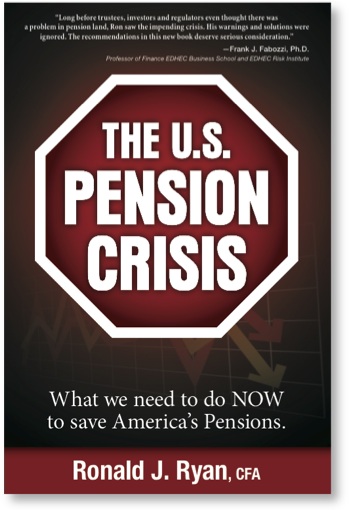
“The U.S. Pension Crisis”

Congratulations to Ron Ryan, CEO at Ryan ALM, on the publishing of his book titled, “The U.S. Pension Crisis”.  Ryan’s book articulates what needs to be done NOW to save America’s pensions. 

When testifying before the ERISA Committee in 2003, Ron highlighted the issues related to GASB and FASB accounting rules, and the distortions to contributions, funded ratios, earnings and balance sheets brought about by their failings.  This book is a must read for anyone who truly wants to understand why our defined benefit plans are in such a state right now.

Kamp Consulting Solutions (KCS) Fourth Quarter 2013 Review

Kamp Consulting Solutions (KCS) Fourth Quarter 2013 Review

We are pleased to share with you the KCS Fourth Quarter 2013 Review.  Please don’t hesitate to reach out to us if we can be of any assistance to you.